
WORKFORCE PATHWAY & SERVICE CONTINUITY WORKSHOP MODULE
Training-to-Employment Transitions
Give training a clearer connection to the next employment step. Bring preparation, reviewed evidence, applications, employer conversations, and continuing support into a route participants can understand and use beyond completion.
Does this sound familiar?
Training ends before the next step is clear
Participants complete a program without an agreed route into relevant applications, employer conversations, or further preparation.
Completion is easier to show than capability
A certificate confirms that someone finished training, but the participant struggles to explain the activities, contribution, and evidence relevant to a particular role.
Career preparation begins too late
Application materials, evidence review, and employer expectations receive attention only after the course has ended.
Employer introductions arrive without a shared purpose
Participants and employers enter a conversation with different expectations about whether it is exploratory, informational, an interview, or another step.
Support becomes uncertain after completion
Responsibility changes when training ends, leaving participants unsure who can help with applications, questions, or an emerging opportunity.
Application activity stands in for progress
The record counts submissions or interviews without showing what the participant is learning, which questions remain open, or what should change next.
What are training-to-employment transitions?
Training-to-employment transitions connects a participant’s learning and preparation to the actions, conversations, and decisions involved in pursuing work.
The route may include selecting relevant opportunities, reviewing evidence, preparing application materials, speaking with employers, and arranging support around the next step.
It begins before completion when appropriate. Participants may need time to understand role expectations, gather usable examples, or explore whether particular work fits their goals and circumstances.
It also continues beyond an initial introduction. A participant may need help interpreting feedback, reconsidering an application approach, or preparing for an agreed employment start.
This module examines one selected transition so your team can clarify what needs to connect, who supports each step, and what evidence can establish progress.
Completion creates a starting point for the next decision.
Finishing a program can be a meaningful achievement.
An employer may still need to understand what the participant has done, what evidence supports the account, and how that experience relates to the role being considered.
The participant may need to understand the opportunity just as clearly, including the work, expectations, and practical conditions.
A useful transition brings those questions into a sequence of preparation and conversation.
It distinguishes what training completion establishes from the judgments that remain with the participant, employer, or another responsible organization.
The workshop helps your team define that route without assuming that completion guarantees an interview, offer, or successful employment outcome.
What needs to connect?
Participant direction
Work the person wants to pursue
Immediate and longer-term priorities
Relevant prior experience
Practical conditions
Questions about fit
Preparation and evidence
Relevant training activities
Individual contribution
Reviewed work examples
Source and review context
Preparation still needed
Applications
Opportunity being considered
Requirements to clarify
Claims and supporting examples
Submission and follow-up
What the participant learns
Employer conversations
Purpose of the conversation
Questions to prepare
Evidence to discuss
Feedback and unresolved questions
Agreed next action
Continuing support
Who remains available
What support can continue
When responsibility changes
What requires another service
When the route is reviewed
The review keeps training completion, evidence of particular activities, employer judgments, and employment outcomes distinct.
Four moves toward a clearer transition
1. Select the employment step
Identify the participant’s direction and the application, conversation, or other transition the workshop will examine.
2. Prepare a relevant evidence account
Connect activities and individual contribution to appropriate examples, source context, and reviewed claims.
3. Clarify the employer interaction
Establish the purpose, expectations, preparation, and responsibilities around the selected application or conversation.
4. Maintain support and review
Define who helps with the next action, how feedback is interpreted, and when the route should be reconsidered.
Start with one transition beyond training.
The module begins with a selected example, such as preparing for a relevant application, entering an employer conversation, or carrying support from a training team to an employment advisor.
Your team brings the participant’s intended direction, relevant program activities, available evidence, and the instructions or arrangements used for that transition.
Together, we examine whether the participant and supporting staff can understand what the next step requires and who will help it happen.
Questions we examine together
Define the selected application, conversation, or transition. Identify its connection to the participant’s goals and the questions still open about fit.
Review training activities and other appropriate experience, including the person’s individual contribution and the conditions in which the work occurred.
Examine the examples, source context, and review behind the account. Identify claims that need clarification or further evidence.
Distinguish an exploratory conversation from a recruitment step. Clarify expectations, preparation, and any commitments that have actually been confirmed.
Identify continuing responsibilities, limits on service availability, and any handoff needed to maintain appropriate support.
Define how feedback, participant experience, and unresolved questions inform another action without treating activity counts as proof of an outcome.
Six dimensions of a useful employment transition
Participant direction
The selected step reflects the person’s goals, interests, and practical circumstances.
Relevant preparation
The participant understands what the next application or conversation requires.
Evidence clarity
Claims connect to activities, individual contribution, sources, and appropriate review.
Employer expectations
The purpose and conditions of the interaction are explicit.
Support continuity
Responsibilities remain understandable as the participant moves beyond training.
Feedback and adjustment
The route can change in response to what the participant and team learn.
When completion carries the whole promise
The transition may rely on assumptions that have not been examined.
- A completed course is treated as sufficient preparation for every related role.
- Application claims repeat broad skill labels without useful examples.
- Group work is presented without clarifying individual contribution.
- An employer introduction is assumed to be a hiring opportunity.
- Post-training support has no clear owner or boundary.
- Applications and interviews are counted without informing the next decision.
The participant may be active in the process while lacking a clear basis for explaining their experience or adjusting their approach.
When the next employment step is prepared
A clearer route connects the person’s direction to relevant evidence and accountable support.
- The selected opportunity is examined in relation to the participant’s goals.
- Claims are supported by appropriate activity examples.
- Individual contribution and review context are understandable.
- Employer interactions have a stated purpose and confirmed expectations.
- Support responsibilities remain visible after completion.
- Feedback informs a practical next action.
The team can then test whether the transition becomes more understandable and usable.
Example: A course certificate with an unclear application story
A participant completes a technical training program and wants to pursue an entry-level role.
Their application lists the certificate and several broad skills from the course description.
The participant has also completed a practical project, but the application does not explain what they personally did or how the work was reviewed.
An employer conversation is arranged, yet the participant is unsure which examples to discuss or whether the meeting is an interview.
In the workshop, the team selects that conversation as the transition to examine.
The review connects the participant’s project activities to the role’s relevant tasks, while keeping the limits of the training example visible.
The instructor clarifies the participant’s contribution and the basis of the project review. The participant selects an appropriate example they can explain.
The employment advisor confirms the purpose of the employer conversation and helps the participant prepare questions about the role and its expectations.
The team also identifies who will follow up after the conversation and how the participant can obtain help with an agreed next action.
The improvement is tested through the clarity of the evidence account, preparation, and follow-up. The workshop does not assume that the conversation will produce an offer or that the project establishes every capability the employer requires.
A certificate and an evidence account do different jobs.
A certificate may establish that a person completed a particular program or met its stated requirements.
It does not automatically explain the person’s individual work in a form that answers an employer’s questions.
An evidence account can add useful context about activities, contribution, conditions, and review.
The account should make clear whether an example came from a simulation, supervised practice, a group project, or another setting.
That context helps the participant explain the experience without overstating what it demonstrates.
The workshop identifies what is useful for the selected transition and which judgments remain with the employer or another authorized reviewer.
Continuing support needs explicit boundaries.
Training completion may change which team or program is responsible for supporting the participant.
The person should understand what help remains available, how long an arrangement applies, and whom to contact.
Support may involve applications, employer questions, preparation for an agreed start, or a connection to another service.
Those responsibilities should be confirmed rather than assumed from the existence of a broader partnership.
If support must transfer, the team needs an appropriate introduction and an understandable account of outstanding actions.
The workshop defines those arrangements for the selected example and identifies any limitations or partner decisions that remain unresolved.
WORKSHOP MODULE
Training-to-Employment Transitions
This module is a practical minicourse in connecting training and relevant experience to a prepared employment step.
Your team learns a repeatable method, applies it to one selected transition, and develops a focused improvement with an owner and a way to test it.
The work also identifies the evidence, application context, employer expectations, and continuing support arrangements that a subsequent Gobekli configuration would need to support.
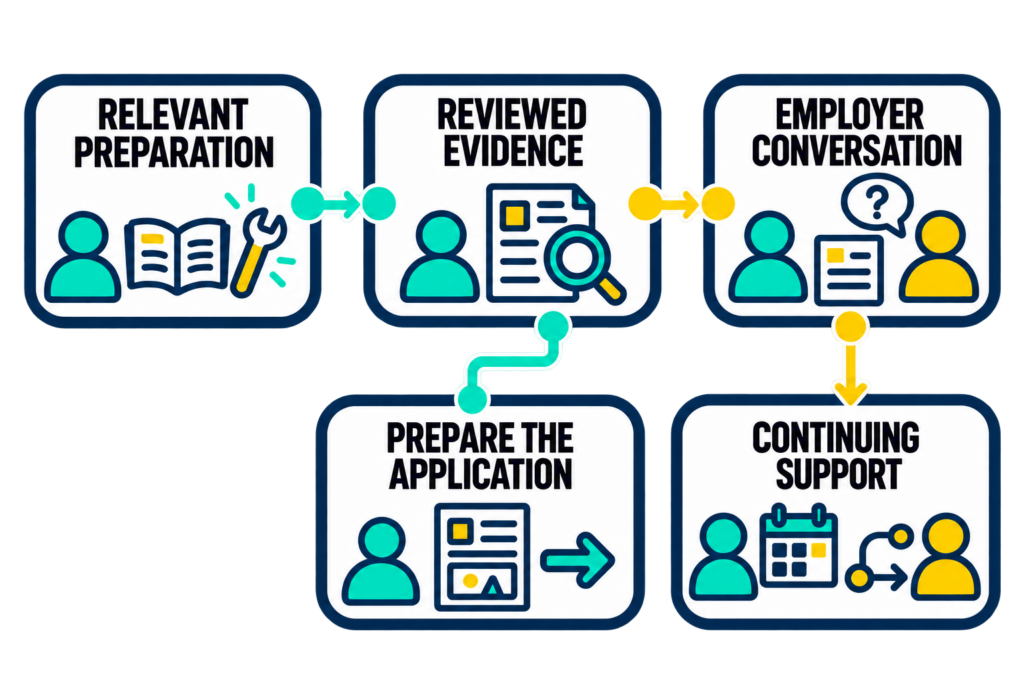
What can this module help clarify?
Scope is established through Workforce Pathway Direction and narrowed to a transition your team can meaningfully examine.
- The participant population and intended employment direction.
- The application or employer interaction under review.
- The relevant role expectations and questions about fit.
- Training activities and appropriate prior experience.
- Individual contribution within the selected examples.
- Available evidence, sources, and review context.
- Claims that need qualification or further support.
- Preparation needed before the next interaction.
- The purpose and expectations of employer conversations.
- Participant, training staff, advisor, and employer responsibilities.
- Continuing support and any required handoff.
- Feedback and triggers for revising the approach.
What kinds of responses might follow?
The selected example may point to changes in preparation, evidence, employer interactions, or support.
Earlier transition preparation
Introduce relevant planning, evidence review, or application preparation before training ends.
A clearer evidence account
Connect claims to specific activities, individual contribution, and appropriate source and review context.
A more focused application
Help the participant select relevant examples and identify questions about the opportunity.
A prepared employer conversation
Clarify its purpose, expectations, questions, and agreed next action.
Defined continuing support
Confirm what help remains available and who is responsible for providing or introducing it.
A feedback review
Use participant experience and available employer feedback to decide what should happen next.
The workshop may identify operating changes that should happen before any product configuration is introduced.
What will we review?
The participant’s direction
The work the person wants to pursue and the circumstances affecting the selected transition.
The preparation sequence
What happens before completion and what remains to be done afterward.
The evidence account
Activities, contribution, sources, and review supporting the participant’s claims.
The application or conversation
Its purpose, expectations, requirements, and outstanding questions.
The continuing support
Responsibilities, availability, boundaries, and handoffs beyond training.
The feedback and next action
What the participant and team can learn and how that informs the route forward.
The workshop exercise
Your team works through one selected training-to-employment transition using the materials and responsibilities available.
STEP 1
Select the employment step
Define the application, conversation, or handoff and its connection to the participant’s direction.
STEP 2
Identify relevant experience
Review the activities and individual contribution that could help explain the person’s preparation.
STEP 3
Review the evidence
Clarify what supports the account, who reviewed it, and which claims remain uncertain.
STEP 4
Prepare the interaction
Identify the purpose, expectations, questions, and materials needed for the next step.
STEP 5
Assign continuing support
Confirm who helps before and after the interaction, including any partner-dependent arrangements.
STEP 6
Define the review
Agree on how to examine participant understanding, evidence clarity, feedback, and the next responsible action.
A Training-to-Employment Transition Map, one assigned improvement, and a validation plan that can also inform an initial product configuration brief.
FROM WORKSHOP INSIGHT TO A POSSIBLE GOBEKLI SETUP
Connect the participant’s experience to the next opportunity.
The workshop establishes what the selected transition needs before deciding how technology should support it.
Depending on confirmed capabilities and implementation scope, a future setup could explore TalentPass for participant-held experience and evidence, Pythia-guided preparation, Passport Pages for appropriate presentation, and TalentSync for agreed organizational or employer workflows.
The configuration brief identifies the information needed to support the interaction while preserving source context, participant choice, and the employer’s decision authority.
- The selected participant population and transition.
- The participant’s intended direction and relevant preferences.
- The role or opportunity being considered.
- Relevant activities and individual contribution.
- Evidence sources and review context.
- Claims, limitations, and questions needing confirmation.
- The application or conversation’s purpose.
- The participant’s choices about presentation and sharing.
- Staff, partner, and employer responsibilities.
- Feedback, continuing support, and review triggers.
Any implementation would require confirmation of product availability, employer participation, integrations, permissions, and operating responsibilities.
A Gobekli setup would support preparation and communication. It would not guarantee that an employer reviews a profile, accepts a claim, offers work, or reaches a particular hiring decision.
SCOPE & RESPONSIBILITY
What this module does—and what it does not decide
This module helps your team improve a selected transition from training toward employment.
It connects preparation, evidence, applications, conversations, and support to an understandable next action.
Participants, employers, and responsible program staff retain their respective choices and decision authority.
- The workshop does not guarantee interviews, offers, placement, or retention.
- It does not treat training completion as proof of every requirement for a role.
- It does not independently validate all capability claims or credentials.
- It does not assign group achievements to an individual without supporting context.
- It does not commit employers to participate or hire.
- It does not authorize sharing of participant work or personal information.
- It does not replace employer selection, assessment, or onboarding processes.
- It does not redesign an entire curriculum or regional talent pipeline.
Questions requiring instructor review, employer confirmation, or another authorized decision are assigned to the appropriate owner.
The output distinguishes improvements the team can make directly from commitments and judgments that remain outside its control.
What should you bring?
Bring one selected transition and enough material to understand how the participant prepares and receives support.
A de-identified example can reveal gaps without requiring a complete application history or unrestricted access to participant work.
Useful inputs
- The selected participant population and employment direction.
- A description of the training program.
- The application, conversation, or handoff under review.
- Relevant role information available to the team.
- Examples of training activities.
- An appropriate account of individual contribution.
- Evidence or work examples suitable for review.
- Existing assessment or reviewer context.
- Application or preparation materials.
- Employer introduction instructions or expectations.
- Continuing support responsibilities.
- Available participant feedback and unresolved questions.
Use only materials appropriate to the selected exercise. Identify permission or source questions before relying on a work example for external presentation.
What can you leave with?
Training-to-Employment Transition Map
A shared account connecting the participant’s direction, preparation, evidence, selected interaction, and continuing support.
Assigned Transition Improvement
A focused change to preparation, evidence presentation, employer expectations, or support, with an owner and next action.
Validation Plan
A way to check whether the participant understands the step, the evidence account is appropriately supported, and follow-up leads to a clear next action.
Initial Configuration Brief
The activity records, evidence context, presentation choices, responsibilities, and review requirements a subsequent Gobekli implementation would need to support.
These outputs begin with the example reviewed during the module. Final scope depends on the modules selected, available inputs, and the decision established through Workforce Pathway Direction.
Where might the work lead next?
Prior Experience & Capability Recognition
When the evidence account needs to include relevant experience beyond the training program, examine how that experience can be understood with appropriate evidence and recognition boundaries.
Support Barriers & Coordinated Assistance
When practical, informational, or accessibility conditions make the application, employer conversation, or agreed start difficult, examine the assistance and coordination needed.
Participant Progress, Outcomes & Program Improvement
When the team needs to understand what employment transitions reveal across the service journey, connect available evidence to a focused improvement decision.
These modules can be combined within the Workforce Pathway & Service Continuity Workshop according to the selected journey and organizational decision.
Frequently asked questions
Questions organizations ask before beginning.
Workforce programs, training providers, public agencies, community organizations, and partnerships helping participants move from preparation toward work. Useful contributors understand the training, employment support, or selected employer interaction.
Yes. The foundation establishes the participant population, selected journey, organizational decision, evidence, responsibilities, and boundaries that guide this module.
No. The review can identify preparation that should begin earlier, including evidence gathering, opportunity exploration, and clarification of continuing support.
No. The workshop improves a selected transition. Hiring and employment outcomes depend on decisions and conditions beyond the workshop’s control.
Yes. A specific interaction provides a useful example for examining preparation, evidence, expectations, and follow-up.
Employer input can be useful, particularly when expectations need clarification. The team can begin without an employer, but it must identify assumptions and questions that require confirmation.
The selected step may be exploratory, such as understanding a role or preparing for a future opportunity. Its purpose should be explicit so participants do not mistake exploration for a hiring commitment.
The review can consider relevant training activities, projects, supervised practice, and other appropriate experience. The account should explain the setting and limits of what the evidence demonstrates.
Potentially. The account should distinguish the group result from the participant’s individual contribution and identify the basis for that distinction.
The gap should remain visible. The team can identify further preparation or another route rather than presenting completion as evidence that every requirement has been met.
No. This module examines the participant’s transition toward employment. Findings may identify questions for a separate review of curriculum, employer requirements, or program relevance.
That module examines how relevant experience is understood and appropriately recognized. This module connects that account and other preparation to a selected application, employer conversation, or employment transition.
The referral module examines introductions and receiving responsibilities across services. This module adds the preparation, evidence, employer expectations, and continuing support needed around an employment step.
The review should make that boundary clear and identify whether an appropriate handoff or alternative support route is available. It cannot assume continuing service eligibility or funding.
Potentially, subject to confirmed capabilities and permissions. Participants and responsible staff should review suggested language and ensure that claims remain grounded in the person’s actual experience and evidence.
The validation plan can examine participant understanding, evidence clarity, confirmed interaction expectations, and ownership of follow-up. Later employment outcomes require separate evidence and careful interpretation.
No. The transition map, assigned improvement, and validation plan should be useful independently. They can also establish a clearer starting point for a later Gobekli configuration.
CONNECT PREPARATION TO THE NEXT EMPLOYMENT STEP
Help participants carry their learning into the conversation.
A useful transition connects what the person has done to relevant evidence, a prepared interaction, and clear support for what comes next.
Use Training-to-Employment Transitions within the Workforce Pathway & Service Continuity Workshop to examine one route beyond training and define a practical improvement your team can take forward.
