
WORKFORCE PATHWAY & SERVICE CONTINUITY WORKSHOP MODULE
Prior Experience & Capability Recognition
Help people explain what they have already done and how it may matter to their next step. Connect relevant work, learning, military, caregiving, and community experience to specific activities, supporting evidence, and appropriate review.
Does this sound familiar?
The record shows titles but little of the work
A résumé or intake form lists positions and dates without explaining the activities, responsibilities, or judgment involved.
Useful experience sits outside formal employment
Caregiving, community work, informal projects, and other responsibilities remain difficult to describe because the intake process primarily asks about paid jobs and qualifications.
Familiar labels hide unfamiliar capability
Military roles, overseas experience, specialized occupations, or internal job titles are recorded without enough explanation for the receiving advisor or reviewer.
Skills are named without supporting examples
The record includes terms such as leadership, communication, or problem-solving, but does not show what the person actually did.
Missing documentation is treated as missing experience
People struggle to provide conventional records, and the process offers no clear way to explore other evidence or an appropriate demonstration.
Recognition means different things to different people
A participant hears that their experience “counts,” while staff may mean only that it is relevant to a conversation—not that it earns credit, meets a requirement, or establishes readiness.
What is prior experience and capability recognition?
Prior experience includes activities and responsibilities a person has undertaken through work, learning, military service, caregiving, community participation, and other contexts.
Capability recognition concerns how that experience is understood and considered for a defined purpose.
A useful account explains what the person did, their individual responsibility, the conditions involved, and the support available for the statement.
The level of recognition depends on the decision. Experience may inform advising, suggest a development route, or become the subject of a more formal assessment.
This module helps your team distinguish those uses and develop a clearer account without treating every experience as proof of current proficiency or formal equivalence.
Start with what the person did.
A job title, course name, or period outside paid employment rarely explains the full experience.
Someone may have coordinated schedules, maintained equipment, supported others, resolved problems, or learned to use unfamiliar tools.
Those activities become more understandable when the person can describe their role, the setting, and an example of what happened.
The team can then examine which capabilities the account may support and where more information is needed.
That order matters: the description should support the capability statement.
The result is a stronger starting point for guidance and review, with a clear distinction between relevant experience and a decision that an authorized reviewer still needs to make.
What needs to connect?
Experience context
Where the experience occurred
Relevant dates
Purpose of the activity
Conditions and constraints
Opportunities to practice
Activities and responsibility
What the person did
Individual contribution
Tools and methods
Level of independence
Frequency and scope
Supporting information
Participant account
Work examples
Source records
Appropriate confirmations
Reviewed demonstrations
Intended use
Advising conversation
Pathway exploration
Development planning
Assessment referral
Defined requirement review
Recognition boundary
What the account supports
What remains uncertain
Additional evidence needed
Authorized reviewer
Decision and limitations
The same experience may be useful for several purposes, but each use may require different evidence and a different level of review.
Four moves make experience more understandable.
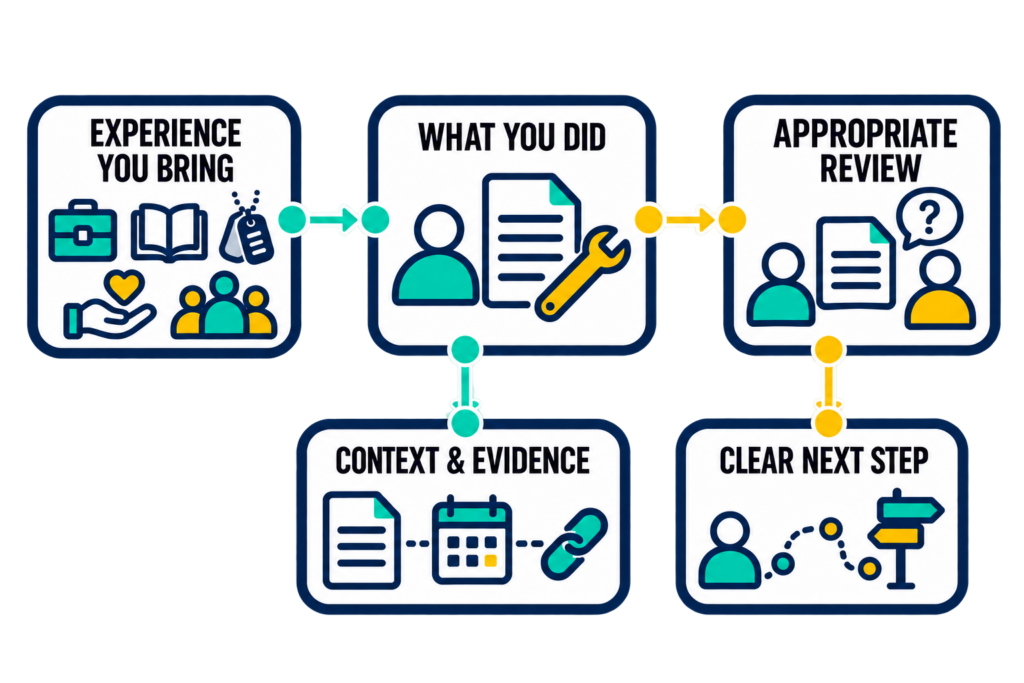
1. Surface the relevant experience
Identify activities that may matter to the participant’s goal, including those that do not appear clearly in conventional employment or education records.
2. Describe the actual contribution
Clarify what the person did, their responsibility, the conditions, and the extent of their involvement.
3. Connect statements to support
Identify available examples, records, confirmations, or demonstrations and distinguish what each can establish.
4. Define the recognition route
Specify how the account can inform the next step and what further review is needed before a stronger conclusion can be made.
Start with a real recognition question.
A participant returning to paid employment has spent several years coordinating care for a family member.
Their résumé presents that period as a gap, while a conversation reveals experience organizing appointments, maintaining schedules, communicating with providers, and resolving practical problems.
The review asks how to describe that experience accurately, which parts may be relevant to the person’s goal, and what should be assessed separately.
Questions that turn experience into a reviewable account
Move beyond the role label. Identify specific activities, decisions, tools, and responsibilities.
Distinguish the person’s work from the wider activity of a team, household, unit, or community group.
Consider the setting, complexity, frequency, independence, support, and relevant constraints.
Identify examples, records, appropriate confirmations, and other information. Keep participant statements distinguishable from independently reviewed findings.
Connect the experience to a defined goal or requirement without assuming that similar activities establish full readiness.
Identify whether the next use is guidance, further exploration, a demonstration, or formal review by an organization authorized to decide.
Six dimensions shape credible recognition.
Specificity
The account describes observable activities and responsibilities rather than relying only on broad skill labels.
Contribution
The person’s own role is clear within any shared work or group outcome.
Context
The conditions, tools, scope, and level of independence help a reviewer interpret the experience.
Support
Available evidence is connected to the statement it can reasonably support.
Relevance
The account relates to a defined pathway question, opportunity, or requirement.
Boundaries
The record explains what has been described, what has been reviewed, and what still needs a decision.
When experience remains difficult to interpret
The record may contain:
- Job titles without descriptions of actual work.
- Broad skill lists without examples.
- Unexplained periods outside formal employment.
- Team outcomes attributed to an individual.
- Documents with no explanation of what they establish.
- Recognition language that implies more than was reviewed.
The receiving person must fill in the gaps or overlook potentially relevant experience.
When the account provides useful context
The record can show:
- Specific activities and individual responsibilities.
- Relevant settings, dates, tools, and conditions.
- Experience from appropriate formal and informal contexts.
- Supporting information connected to particular statements.
- Uncertainty and additional evidence needs.
- A clear purpose and route for further review.
The next conversation can begin with a better understanding of what the person brings.
Example: Making caregiving experience understandable
A participant wants to explore administrative work after several years outside paid employment.
Their initial record lists earlier jobs but says little about the intervening period.
With the participant’s agreement, an advisor asks about relevant activities rather than requesting a detailed personal history.
The participant describes coordinating appointments, maintaining a shared schedule, communicating changes, and organizing practical arrangements for a family member.
The team helps distinguish those activities from responsibilities held by healthcare professionals and from work performed by other family members.
The account identifies the participant’s own contribution and the tools they used, without including private information about the person receiving care.
Where original materials are sensitive, the team considers whether a non-confidential example or a separate demonstration would help.
The resulting description gives the advisor a basis for exploring relevant administrative tasks and identifying unfamiliar requirements.
It does not label the participant as a qualified healthcare worker or establish that they meet every requirement of an administrative role.
A later Gobekli configuration could help the participant retain the account, connect appropriate evidence, and present selected experience for a defined next step.
Experience can be relevant without being equivalent.
Activities in different settings may share useful features.
Coordinating a volunteer event may involve scheduling and communication. Maintaining equipment in one environment may provide a starting point for exploring another technical role.
The receiving context can still involve different tools, standards, conditions, or levels of responsibility.
The workshop helps the team describe those similarities and differences explicitly.
Where formal credit, entry requirements, certification, or occupational readiness are involved, the relevant organization determines the assessment and acceptance process.
The module prepares a clearer account for that process without substituting its own authority.
Evidence should clarify experience without demanding unnecessary disclosure.
Not everyone has access to conventional records of their work.
A former employer may be unavailable. Community activities may have left few documents. Caregiving examples may contain another person’s private information.
The review identifies what is already available and what each source can support.
Where appropriate, the team can define a further conversation, permitted confirmation, work sample, or demonstration for consideration.
Those options should be proportionate to the intended use and reviewed by the responsible organization.
The goal is to make the experience understandable while keeping unnecessary personal or third-party information outside the account.
ABOUT THIS WORKSHOP MODULE
What happens in Prior Experience & Capability Recognition?
This module is a focused minicourse in turning relevant experience into a clearer, evidence-aware account.
Your team works through a selected example, examining activities, individual contribution, context, supporting information, intended use, and the boundaries of recognition.
The work produces an Experience & Recognition Map, an assigned improvement, and initial requirements for a subsequent Gobekli configuration.
What can this module help clarify?
The scope can include:
- Relevant experience missing from current records.
- Work and learning activities behind formal titles.
- Military experience requiring contextual explanation.
- Caregiving and community responsibilities the participant chooses to describe.
- Individual contribution within shared work.
- Tools, methods, frequency, and level of independence.
- Statements that available information can support.
- Differences between self-report, confirmation, and assessment.
- Missing evidence and possible review routes.
- Relevance to a selected goal or requirement.
- Boundaries around credit, equivalence, and current readiness.
- Participant review, appropriate sharing, and source responsibilities.
What kinds of responses might emerge?
The selected example may point to changes in questions, descriptions, evidence, review arrangements, or supporting technology.
Ask about activities
Replace an overly narrow focus on titles and qualifications with prompts that reveal relevant responsibilities and examples.
Clarify the individual contribution
Separate what the person did from the wider results of a team, unit, household, or group.
Strengthen the experience statement
Add the context, tools, scope, and conditions needed to make a description understandable.
Identify appropriate support
Connect available records or examples to specific statements and define where further evidence could help.
Establish a review route
Identify who can assess a relevant requirement, consider a demonstration, or determine whether formal recognition is available.
Make recognition boundaries explicit
Explain what the account establishes and which conclusions remain subject to further review.
An improved description can be useful even when formal recognition is not available. The appropriate response follows the participant’s goal and the selected decision.
What will we review together?
The participant’s intended next step
Why the experience matters and who needs to understand it.
The current account
What résumés, intake records, profiles, or conversations currently reveal and what remains unclear.
The activities and responsibilities
What the person did, how they contributed, and the conditions in which they worked.
The supporting information
Available examples, records, confirmations, and limitations affecting their use.
The recognition question
Whether the immediate purpose is guidance, exploration, development, or a defined assessment decision.
The review and ownership arrangements
Who can confirm sources, assess requirements, correct the account, and explain the outcome.
Applied exercise: Build an Experience & Recognition Map
Choose one experience relevant to a participant’s selected goal.
STEP 1
Define the intended use
Identify the next conversation or decision the account should support.
STEP 2
Describe the experience
Record the setting, dates, purpose, and relevant activities in understandable language.
STEP 3
Clarify the contribution
Specify the person’s responsibility, independence, tools, and role within any shared work.
STEP 4
Connect supporting information
Identify what supports each important statement and where uncertainty remains.
STEP 5
Define the recognition boundary
State what the account can inform now and what requires further assessment or acceptance.
STEP 6
Assign the next review
Name the responsible person and define how the account’s clarity, usefulness, or remaining evidence needs will be examined.
An Experience & Recognition Map connecting activities, individual contribution, context, supporting information, intended use, and the next authorized review.
CONNECTING THE WORK TO IMPLEMENTATION
How could this inform a Gobekli configuration?
The workshop can define requirements for representing experience in a form that participants and receiving organizations can understand.
Depending on scope and product fit, this could inform TalentPass experience records, Pythia-guided reflection, TalentSync review workflows, and selected presentation through Passport Pages.
Available capabilities, evidence handling, review processes, and implementation responsibilities would be confirmed during scoping.
Potential configuration inputs include:
- The selected participant population and intended use.
- Experience types included in the initial scope.
- Prompts for describing activities and responsibilities.
- Context such as dates, tools, frequency, and independence.
- Links between capability statements and supporting activities.
- Evidence references and source responsibilities.
- Distinctions between self-reported, confirmed, and assessed information.
- Participant review, correction, and sharing requirements.
- Reviewer roles and unresolved recognition questions.
- A practical test of whether the account supports the intended conversation.
A first configuration can focus on one experience type and a defined receiving use.
The workshop does not assume automatic skill verification, formal credit, or acceptance by every employer or institution.
SCOPE AND BOUNDARIES
What does this module not decide?
This module helps your team make selected experience understandable and identify an appropriate recognition route.
It separates a supported description from decisions that require a particular assessment process or authority.
The scope does not include:
- Verifying every statement in a participant’s history.
- Inferring proficiency solely from time spent in a role.
- Treating a shared outcome as proof of individual capability.
- Guaranteeing academic credit or credential equivalence.
- Granting a license, certification, or occupational authorization.
- Establishing job readiness without relevant review.
- Requiring disclosure of confidential or third-party information.
- Making an employment or program acceptance decision.
Questions requiring assessment, credential evaluation, program review, or another specialist process are assigned to the appropriate owner.
The practical result is a clearer account, an improvement to test, and a defined next step for recognition where relevant.
What should you bring?
Bring a selected example of experience that current records do not explain well.
Use materials appropriate for the session, with the participant’s perspective represented through an agreed process.
Useful inputs may include:
- The selected pathway direction brief.
- The participant’s intended goal or next step.
- An existing résumé, profile, or de-identified summary.
- A description of the relevant experience.
- Examples of activities and responsibilities.
- Relevant dates, tools, and working conditions.
- Available work samples or source records.
- Appropriate confirmations or references.
- The receiving organization’s questions.
- Any defined assessment or acceptance criteria.
- Known evidence gaps or disclosure constraints.
- Contacts responsible for further review.
Composite or de-identified examples can support the exercise. Sensitive details are not needed merely to demonstrate how the method works.
What do you leave with?
Experience & Recognition Map
A structured account of relevant activities, individual contribution, context, support, and the intended use.
Assigned Recognition Improvement
A proposed change to questions, experience wording, evidence collection, or a review route, with an accountable owner.
Validation Plan
A defined way to examine whether the account is understandable, appropriately supported, and useful for the selected next step.
Initial Configuration Brief
The experience records, prompts, evidence relationships, reviewer roles, and participant choices a later Gobekli implementation would need to address.
These outputs begin with the example reviewed during the module. Final scope follows the population, journey, and decision established through Workforce Pathway Direction.
Where might the work lead next?
Participant Goals & Pathway Planning
Use the clearer account of experience to explore a practical route toward the person’s goals, including development needs and useful milestones.
Training-to-Employment Transitions
If the account will support an employment transition, examine how reviewed experience and evidence connect to applications, employer conversations, and continuing support.
Repeated Intake & Participant Story Continuity
If the improved account needs to move between services, define what can be reused, confirmed, updated, and appropriately shared.
Workforce Pathway Direction establishes the shared scope. Explore the full Workforce Pathway & Service Continuity Workshop to select the modules relevant to your journey.
FREQUENTLY ASKED QUESTIONS
Questions organizations ask before beginning.
Relevant work, learning, military service, caregiving, community activity, and other experiences the participant chooses to discuss. The scope follows a defined goal and intended use.
A résumé may be one output format, but the module focuses on the underlying account: activities, responsibility, context, evidence, and recognition boundaries.
The module can help prepare information for a recognition process and identify the appropriate reviewer. It does not itself award academic credit or replace an institution’s assessment process.
Yes. The review can make activities and responsibilities more understandable to a receiving audience. It does not assume that a military title directly establishes equivalence to a civilian qualification or role.
They can contain relevant activities worth understanding. How the experience is considered depends on the intended use, available support, and the receiving organization’s requirements.
The team identifies what is available and what remains uncertain. It can consider appropriate further questions, permitted confirmations, examples, or demonstrations without presenting unsupported statements as verified.
Time provides context, but it does not by itself establish proficiency. The review also considers activities, conditions, responsibility, evidence, and any assessment required for the intended use.
Begin with specific activities and examples. Connect capability statements to supporting information and make the limits of any review explicit.
Clarify the participant’s own responsibility and contribution. A team’s result should not automatically be attributed to every individual.
Dates and subsequent practice help a reviewer interpret the account. Some uses may require a current demonstration or additional development.
Yes. The team can clarify the activities and context for the intended audience. Formal qualification equivalence or credential evaluation may require a separate process.
The team identifies what can appropriately be used. A permitted summary, non-confidential example, or separate demonstration may be considered where original materials cannot be shared.
This module clarifies the experience a person brings and its recognition boundaries. Pathway planning uses that context alongside goals, requirements, support, and milestones to examine a route forward.
Potentially. Guided prompts can help organize an account, but the participant should review the description and any capability suggestions. Generated wording does not itself verify the experience.
Useful contributors include advisors, people familiar with the selected experience, and representatives who understand the receiving use or assessment process. Participant perspectives should be included appropriately.
No. The experience map, improved account, and review plan are useful independently. They can also establish a clearer starting point for a later Gobekli configuration.
A worked example, an Experience & Recognition Map, an assigned improvement, and a validation plan. Formal assessments and broader implementation follow the agreed scope.
BUILD YOUR WORKFORCE PATHWAY & SERVICE CONTINUITY WORKSHOP
Make the experience people bring easier to understand.
Connect actual activities and responsibilities to appropriate evidence and a clear next review.
Use Prior Experience & Capability Recognition to help one participant journey begin with a fuller account of what the person has already done.
