
WORKFORCE SCALABILITY PROBLEM
Workforce Capacity Planning: Prepare for the Work Ahead
Organizations often know that demand is changing without knowing what the change will require from their workforce.
Growth plans, customer commitments, contracts, transformation initiatives, vacancies, seasonal variation, and new technology can all alter the amount, type, location, and timing of work.
A useful capacity plan translates those changes into the work, capabilities, operating conditions, and workforce capacity required to respond.
Workshop Module 2 — Workforce Demand & Capacity Planning
Does this sound familiar?
Growth targets do not translate into work
Leaders can describe the expected business result but cannot show which activities, workflows, or responsibilities must expand.
Headcount is used as a proxy for capacity
Workforce plans count positions without accounting for capability, availability, coordination, systems, or operating conditions.
Demand changes faster than the plan
Customer needs, contracts, volume, schedules, locations, and priorities shift after annual assumptions are approved.
Existing workload is underestimated
New demand is added without fully accounting for current responsibilities, backlogs, rework, meetings, or hidden effort.
Capability arrives too late
Hiring or development begins only after the work has become urgent and the organization is already constrained.
Leaders cannot compare response options
The organization cannot determine whether to hire, develop, redeploy, redesign, automate, partner, or change the commitment.
What is workforce demand and capacity planning?
Workforce demand and capacity planning connects anticipated organizational demand to the work, capabilities, people, time, systems, and operating conditions required to meet it.
Demand may be created by growth, customer commitments, contracts, seasonal variation, geographic expansion, new services, technology, transformation, vacancies, attrition, or changing quality requirements.
Capacity is not simply the number of employees assigned to a function. It reflects how much relevant work the organization can perform under real operating conditions.
The problem is not simply how many people you have. It is what the workforce can actually support.
A staffing total cannot show whether people have the required capabilities, time, tools, authority, information, coordination, and operating support to perform the work.
Leaders need to connect demand to outcomes, activities, volume, timing, capabilities, existing workload, systems, dependencies, quality expectations, uncertainty, and the consequences of being underprepared.
This turns workforce planning from a staffing estimate into an operating decision.
See the complete capacity system
not just the headcount forecast.
Demand and Outcomes
- Growth commitments
- Customer requirements
- Contracted work
- Operational demand
- Volume and variability
Required Work
- Core activities
- Decisions and approvals
- Coordination and handoffs
- Exceptions and rework
- New responsibilities
Capability Requirements
- Technical capabilities
- Human capabilities
- Credentials and licenses
- Organizational knowledge
- Leadership and judgment
Usable Capacity
- Employees and teams
- Available time
- Internal talent
- Contractors and partners
- Systems and automation
Constraints and Decisions
- Timing and location
- Coverage and concentration
- Process constraints
- Evidence gaps
- Response options
Capacity becomes decision-useful when future demand, required work, capabilities, available resources, operating constraints, and response options can be examined together.
How capacity gaps take hold
STAGE 1
The organization makes a commitment
Growth, funding, contracts, transformation, customer demand, or another priority creates an expectation of future delivery.
STAGE 2
The work is estimated too broadly
The commitment becomes a headcount or budget assumption without fully defining the activities and conditions involved.
STAGE 3
Capacity is assumed to be available
Employees, open positions, technology, contractors, or future hires are counted without testing whether they can support the work.
STAGE 4
The gap appears during delivery
Backlogs, overtime, quality problems, delayed hiring, capability shortages, and missed commitments reveal the constraint after action is urgent.
Why a headcount forecast does not tell the whole story
A headcount forecast can estimate how many positions may be added, maintained, or removed. It does not establish whether the workforce can perform the required work.
A useful capacity review must answer several additional questions.
Capacity planning connects staffing assumptions to the actual operating requirement.
What leaders need to see clearly
When demand will change
Understand when work will increase, decrease, move, vary, or require different operating conditions.
Which work drives the requirement
Identify the activities, workflows, decisions, and responsibilities creating the capacity need.
Where capacity is already constrained
Reveal backlogs, delays, vacancies, overload, capability gaps, fragile coverage, and system limitations.
Which capabilities require lead time
Identify skills, credentials, knowledge, relationships, or experience that cannot be acquired or developed quickly.
Which response options are realistic
Compare internal development, redeployment, hiring, contingent talent, automation, redesign, and partnerships.
Which assumptions require review
Establish triggers for revisiting the plan when demand, timing, resources, or conditions change.
Planned capacity
A simplified plan may emphasize budgeted positions, standard hours, expected hiring dates, contractor allocations, technology investments, staffing ratios, and annual demand estimates.
Usable capacity
A decision-useful view examines capabilities, existing workload, time, location, ramp-up, systems, coordination, knowledge dependencies, variability, and service requirements.
Capacity on paper can conceal constraints
Intended resources do not automatically become available, relevant, supported capacity.
Usable capacity should drive the plan
The goal is to understand what capacity will be usable when the work must be performed.
Prepare the workforce before demand becomes a constraint.
Connect future commitments to required work, capabilities, usable capacity, and realistic response options.
THE MATCHING WORKSHOP MODULE
Module 2: Workforce Demand & Capacity Planning
This module translates organizational demand into the work, capabilities, timing, locations, and usable capacity required to meet it.
The analysis begins with the outcome and bounded decision established through Workforce Direction. Participants examine expected demand, the work it creates, available capacity, emerging constraints, and responses that could be ready in time.
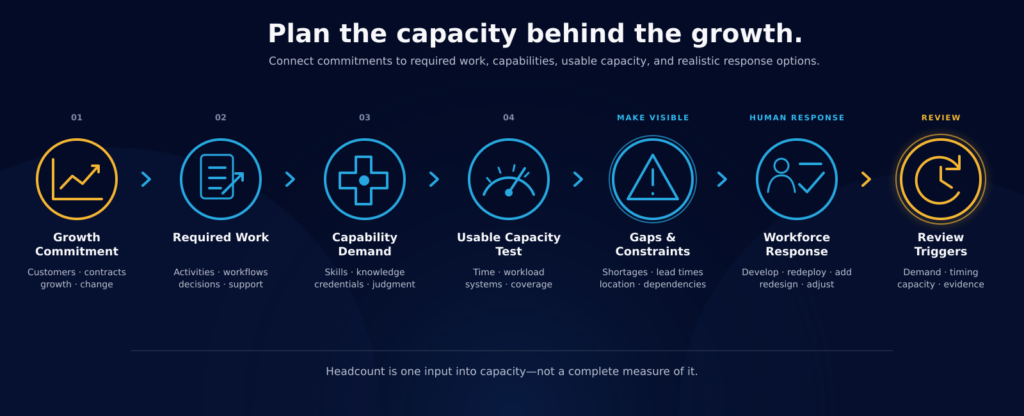
This module helps your team:
- Translate growth and commitments into workforce demand
- Connect demand to activities and workflows
- Estimate volume, timing, variability, and location
- Identify required capabilities
- Examine existing workload and usable capacity
- Reveal gaps and dependencies
- Test hiring and development lead times
- Compare workforce response options
- Build practical demand scenarios
- Establish review triggers
What should happen when demand and capacity do not align?
The response depends on the work, capability requirements, timing, available capacity, operating conditions, evidence, and consequences.
Absorb
Use verified available capacity
Redeploy
Move relevant internal capacity
Develop
Build capability before demand arrives
Add
Increase workforce capacity
Redesign or Adjust
Change the work, operating system, scope, or sequence
Investigate
Resolve uncertainty before committing
These categories organize evidence and response options. They do not automatically determine staffing levels, budgets, employment actions, workload assignments, or technology decisions.
What should a workforce capacity review examine?
The demand
What outcome creates the work? How much demand is expected, when, where, and with what variability?
The work
Which activities, workflows, decisions, exceptions, coordination, and support requirements must be performed?
The capability
Which skills, knowledge, credentials, experience, judgment, and relationships are required?
The available capacity
Which employees, teams, partners, systems, and sources of time can realistically contribute?
The constraints
What workload, vacancies, dependencies, conditions, or lead times reduce usable capacity?
The evidence
Which assumptions are supported, what remains unknown, and what indicators should trigger a revised plan?
Use TalentSync to connect workforce demand to the work and capability behind it.
TalentSync can help structure relationships between outcomes, work, roles, people, capabilities, systems, and evidence. The process begins with the bounded workforce question—not an automated headcount recommendation.
STEP 1
Define the demand
Clarify the outcome, expected work, timing, variability, location, and consequences.
STEP 2
Map the work
Identify activities, workflows, decisions, coordination, exceptions, and dependencies.
STEP 3
Connect capability requirements
Define the technical, human, credentialed, relational, and contextual capabilities required.
STEP 4
Examine available capacity
Understand which employees, teams, roles, contractors, partners, and systems may contribute.
STEP 5
Reveal gaps and constraints
Identify missing capability, workload pressure, weak coverage, system limitations, and evidence gaps.
STEP 6
Support a workforce response
Organize evidence to compare development, redeployment, hiring, contingent talent, redesign, automation, partnerships, or changes to demand.
TalentSync can make relationships between demand, work, capability, people, and evidence more visible. Leaders, managers, employees, and qualified specialists remain responsible for interpretation and final decisions.
- Demand and outcomes
- Activities and workflows
- Capability requirements
- People and roles
- Available capacity
- Constraints and dependencies
- Evidence gaps
- Response options
SCENARIO PLANNING
One forecast should not become the only version of the future.
A useful capacity plan examines expected demand, higher demand, lower or delayed demand, disrupted capacity, and changed work.
Scenarios do not eliminate uncertainty. They help the organization prepare to act as conditions become clearer.
FORECAST AND DECISION BOUNDARIES
Workforce evidence supports planning. It does not predict the future.
TalentSync, Pythia, and workshop outputs should not be presented as producing guaranteed forecasts, automatically determining exact staffing, measuring individual productivity, predicting performance, directing employment actions, or replacing financial, operational, or leadership judgment.
Forecasts depend on assumptions that may change. Employment, labor, privacy, accessibility, cybersecurity, procurement, financial, technical, and legal questions may require qualified specialists.
What to bring into the conversation
You do not need a perfect forecast, complete activity inventory, or advanced workforce-planning system. We begin with the demand signals and operational evidence already available.
Useful inputs may include:
- Strategic and operating priorities
- Growth or contraction assumptions
- Customer and service commitments
- Contracts, funding, or expansion plans
- Historical demand and volume
- Seasonal patterns
- Current workforce information
- Vacancies and attrition
- Workload, backlog, delay, and quality measures
- Role and capability information
- Scheduling and location requirements
- Hiring and development lead times
- Contractor and partner capacity
- Technology plans
- Financial constraints
- Employee and manager observations
Workforce Direction establishes the outcome, affected work, timeframe, and bounded decision this evidence should support.
What this module can help clarify
What demand the workforce must support
Translate commitments into expected work, timing, location, volume, and variability.
What capacity is genuinely available
Examine capability, time, workload, systems, coverage, and operating constraints.
Where gaps may emerge
Reveal capability, capacity, timing, location, knowledge, coordination, and evidence gaps.
Which response can be ready in time
Compare development, redeployment, hiring, contingent talent, redesign, automation, partnerships, and changes to demand.
Final outputs depend on the modules selected and the decision established through the required Workforce Direction foundation.
Where might the work lead next?
Demand and capacity planning frequently reveals connected problems involving capability visibility, role design, talent supply, critical knowledge, and sustainable workload.
Workforce Capability Visibility
Reveal which capabilities are active, latent, emerging, missing, or difficult to access.
Skills-Based Role Design
Define outcomes, activities, capabilities, responsibilities, and prerequisites around changing work.
Workforce Growth & Reskilling
Determine which capabilities can be developed internally before demand becomes constrained.
Flexible & Contingent Workforce Strategy
Identify where external capacity may be appropriate and how it should connect to the work.
Critical Knowledge & Role Coverage
Understand where delivery depends on concentrated knowledge, credentials, or relationships.
Workload, Retention & Sustainable Scale
Test whether commitments and proposed responses can be sustained without chronic overload.
Frequently asked questions
Questions leaders ask before booking.
PLAN THE CAPACITY BEHIND THE GROWTH
Prepare the workforce before demand becomes a constraint.
Connect future commitments to required work, capabilities, usable capacity, operating conditions, and realistic response options.
This module is part of Gobekli’s configurable Workforce Scalability Workshop.