
WORKFORCE PATHWAY & SERVICE CONTINUITY WORKSHOP MODULE
Workforce Pathway Direction
Define whose journey you are improving, what progress should look like, and which decision the workshop needs to support. Establish a practical starting point for clearer navigation, accountable handoffs, and support that follows the participant’s goals.
Does this sound familiar?
The challenge is larger than the decision
“Improve the workforce system” describes an ambition, but leaves the team unsure which participant experience, service transition, or operational decision to address first.
Different teams mean different people
Partners discuss “participants” while referring to different populations, eligibility groups, stages of service, and circumstances.
Program targets stand in for participant goals
Enrollment, completion, and placement measures are visible, but the team has not established how they relate to what people are trying to accomplish.
The journey crosses unclear responsibilities
Several organizations support the same person, yet no one has clearly defined who owns a transition, confirms the next step, or responds when progress stops.
Available information does not answer the question
Reports show activity within individual programs without explaining where people encounter difficulty or what happens between services.
The proposed solution arrives before the problem is clear
A portal, shared record, referral tool, or dashboard is already being discussed before the team agrees on the change it needs to make.
What is workforce pathway direction?
Workforce pathway direction establishes the purpose and boundaries of a focused effort to improve how people move through workforce services and support.
It identifies the participant population, the goal being pursued, and the portion of the journey the workshop will examine.
It also defines the organizational decision: what someone needs to decide, who has the authority to decide it, and what information would make that decision better informed.
The starting point may be a challenge within one agency or a transition involving training providers, employers, public programs, community organizations, and other partners.
The result is a shared brief that gives the remaining workshop modules a clear job to do.
A useful starting point connects the person’s goal to an actionable decision.
A participant may want stable employment, a career change, recognition of prior experience, or a workable return to learning.
A program may need to improve enrollment, reduce missed handoffs, or understand why people stop participating.
Those purposes can be related without being identical.
This module helps the team make that relationship explicit, including where participant goals are known and where they still need to be heard.
It then narrows the work to a decision the organization or participating partners can realistically make.
That focus creates a basis for selecting modules, gathering useful evidence, and identifying where a later product configuration could support the agreed response.
What needs to connect?
Participant population
Who is included
Relevant circumstances
Different support needs
Perspectives represented
Perspectives missing
Intended progress
Participant-defined goals
Useful near-term milestones
Program objectives
Known tensions
Questions to validate
Selected journey
Starting point
Services involved
Important transitions
End point
Work outside scope
Organizational decision
Decision to be made
Available options
Evidence needed
Decision authority
Review timing
Responsibilities and boundaries
Accountable sponsor
Operational owners
Partner dependencies
Information boundaries
Unresolved approvals
The workshop does not need to address an entire regional system. A defined population and one consequential part of the journey can provide a useful starting point.
Four moves establish the direction.
1. Choose the participant journey
Identify whose experience matters and select the portion of the pathway where a clearer understanding could support useful change.
2. Define the decision
State what the organization needs to decide, who can make that decision, and what is currently preventing a confident response.
3. Examine what is known
Review available evidence, participant perspectives, source limitations, and assumptions that need further validation.
4. Set the scope and responsibilities
Agree on the workshop focus, selected modules, necessary contributors, boundaries, and the next point at which the work will be reviewed.
Start with a real pathway question.
A workforce agency notices that some people referred to training never reach an initial advising appointment.
Staff describe the issue as low engagement. Participants may be encountering unfamiliar enrollment steps, conflicting instructions, scheduling constraints, or uncertainty about whether the training fits their goals.
Before choosing a response, the team needs to establish which people and transitions it will examine, what decision it can make, and whose perspective is missing.
Questions that turn a broad concern into a workable starting point
Define the population and circumstances relevant to the question. Avoid treating everyone served by the organization as one undifferentiated group.
Separate what participants have expressed from what staff assume they want. Identify where direct input is needed.
Choose observable boundaries, such as an initial referral through a first advising conversation. Name later stages that are outside the current scope.
Specify the choice the workshop should inform, such as changing referral instructions, assigning follow-up responsibility, or testing a different introduction process.
Consider relevant records, staff observations, participant accounts, and process documents. Note what each source can and cannot establish.
Identify the decision owner, people responsible for implementation, and partners whose participation or agreement is needed.
Six dimensions shape a useful direction.
Participant definition
A clear description of the people included, their relevant circumstances, and the differences that may affect their experience.
Goal clarity
An explicit relationship between participant goals, useful milestones, and the organization’s reason for undertaking the work.
Journey boundaries
An agreed starting point, end point, and set of services or transitions to examine.
Decision readiness
A specific decision, an accountable decision-maker, and a clear explanation of what remains uncertain.
Evidence context
An understanding of the available sources, missing perspectives, limitations, and questions requiring validation.
Responsibility and authority
A distinction between what the team can change directly, what requires partner agreement, and what sits outside the workshop’s authority.
When the direction remains broad
The team may begin with:
- A population described only as “our participants.”
- A general ambition to improve coordination.
- Program targets treated as the only definition of progress.
- A journey with no agreed beginning or end.
- Reports collected without a defined question.
- An expectation that attending partners can authorize every change.
Discussion can produce many ideas without establishing which decision they support.
When the direction becomes workable
The team can establish:
- A defined participant population and relevant circumstances.
- A specific service journey or transition.
- Participant goals and program objectives considered together.
- A decision the workshop should inform.
- Evidence sources and important unanswered questions.
- Named responsibilities and explicit partner dependencies.
The remaining modules can then examine the parts of the problem that matter to that decision.
Example: Defining a training referral challenge
A local workforce organization wants to understand why some adults referred to a partner training provider do not attend their first advising appointment.
The initial proposal is to purchase a shared referral platform.
During Workforce Pathway Direction, the team first defines the population: adults referred to one selected training program during an agreed recent period.
The selected journey begins when an advisor discusses the referral and ends when the participant attends an initial advising appointment, chooses another route, or cannot be reached through the agreed follow-up process.
The team identifies a participant question: does the person understand how the training relates to their goal and what the next step requires?
It also identifies an organizational decision: should the agencies change the introduction, appointment scheduling, or follow-up process?
Available sources include referral records, appointment information, existing instructions, staff accounts, and participant feedback. The team records that these sources do not yet explain every missed appointment.
The workforce agency can change its own referral preparation. Changes to appointment scheduling require the training provider’s agreement.
The resulting scope selects Referrals & Follow-Through and Support Barriers & Coordinated Assistance as follow-on modules, with participant input gathered through an agreed route.
A later configuration could support the revised process, but its requirements would follow the decisions about responsibilities, information, and participant support.
One organization can begin. Shared changes need the right partners.
An agency does not need every regional stakeholder in the room to examine its own service journey.
It can clarify its instructions, internal responsibilities, participant questions, and the information it uses to support decisions.
Some changes will depend on another organization’s process, capacity, or authority.
Those dependencies should be visible in the brief, rather than treated as commitments made by people who are not present.
A partner representative may contribute valuable context without having authority to approve a new operating arrangement.
The module distinguishes the workshop sponsor, convener, decision-maker, operational contributors, and partners needed for later agreement.
Participant goals need a place in the definition of progress.
Program activity provides useful information, but it does not fully explain whether a pathway is helping someone move toward a meaningful goal.
A completed referral may still leave the participant uncertain about what happens next.
An enrollment may not be workable if the schedule conflicts with employment or caregiving responsibilities.
The workshop identifies which participant perspectives are available and how they were obtained.
Where perspectives are missing, the team defines a proportionate way to seek them and keeps assumptions visible until they can be checked.
The direction brief should help the organization improve support while preserving room for people to make different choices.
ABOUT THIS WORKSHOP MODULE
What happens in Workforce Pathway Direction?
This required foundation is a focused minicourse in defining a workforce pathway improvement problem before selecting interventions or configuring tools.
Participants learn how to connect a person’s journey, an organizational decision, available evidence, and the responsibilities needed to act.
Your team applies that method to a selected example and produces a Workforce Pathway Direction Brief that guides the remaining workshop modules.
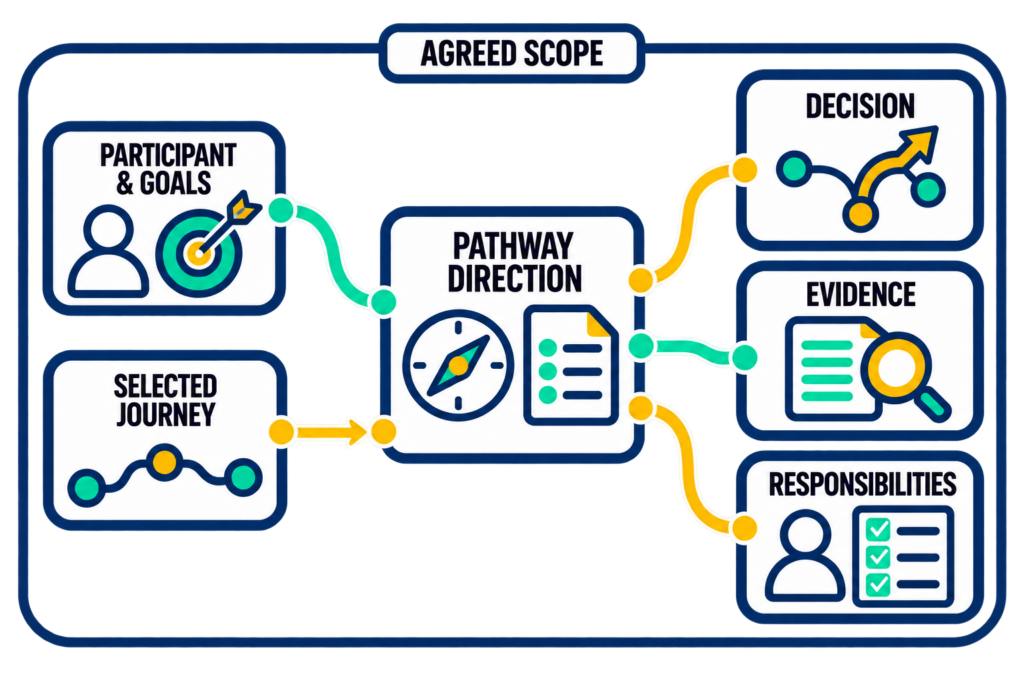
What can this module help clarify?
The scope can include:
- The participant population the workshop will address.
- Relevant circumstances and differences within that population.
- Participant goals that are known or need validation.
- The organization’s intended benefit from the work.
- The selected journey’s starting point and end point.
- Services and transitions included in the review.
- The decision the workshop should inform.
- Available evidence and its limitations.
- Missing perspectives and unanswered questions.
- Decision rights and operational responsibilities.
- Partner dependencies and information-use boundaries.
- The follow-on modules and review point needed to continue.
What kinds of responses might emerge?
The module helps distinguish different reasons a pathway challenge may need attention.
Narrow the starting point
Reduce a broad system concern to a population, transition, and decision that the team can examine meaningfully.
Gather a missing perspective
Identify participant or frontline input needed before interpreting existing records or choosing a response.
Clarify an internal responsibility
Assign ownership for a step the organization already controls but has not clearly allocated.
Convene a necessary partner
Define the specific question or decision that requires another organization’s participation.
Examine a priority transition
Select a follow-on module to investigate a consequential handoff, barrier, or continuity problem.
Define a configuration question
Identify where an agreed process may need supporting records, views, permissions, or follow-up functionality.
These are possible directions for further work. The foundation establishes which responses deserve investigation; it does not assume that every challenge requires a new system.
What will we review together?
The presenting concern
How the problem is currently described and why someone believes it needs attention.
The participant population
Who is affected, whose perspective is represented, and which differences may matter.
The current journey
The main steps, transitions, organizations, and points where progress becomes uncertain.
The evidence available
Records, documents, observations, and participant accounts relevant to the selected question.
The operating responsibilities
Who currently acts, who decides, and where responsibilities are unclear or shared.
The proposed workshop scope
What the team can usefully address now and what requires another process, partner, or decision.
Applied exercise: Build a Workforce Pathway Direction Brief
Choose one current pathway concern and turn it into a shared brief.
STEP 1
Describe the concern
State what appears to be happening without treating an untested explanation as an established cause.
STEP 2
Define the population and goals
Identify whose journey matters, what participants are trying to accomplish, and which assumptions need checking.
STEP 3
Bound the journey
Set a starting point, end point, and the services or transitions included in the review.
STEP 4
State the decision
Name the choice the work should inform and the person or group authorized to make it.
STEP 5
Map evidence and responsibilities
Identify useful sources, missing perspectives, operational owners, and partner-dependent actions.
STEP 6
Select the next work
Choose follow-on modules, immediate preparation, and a review point for confirming or revising the scope.
A Workforce Pathway Direction Brief linking the participant population, goals, selected journey, decision, evidence questions, responsibilities, and agreed next steps.
CONNECTING THE WORK TO IMPLEMENTATION
How could this inform a Gobekli configuration?
A useful configuration begins with a defined purpose: whose progress it supports, what decisions it helps people make, and which responsibilities it needs to respect.
This module identifies the initial requirements that later workshop modules can refine. Depending on scope and product fit, these may inform a TalentSync configuration and participant-facing uses of TalentPass, Pythia, or Passport Pages.
The workshop does not assume that every product is needed or that an integration is already available. A subsequent implementation would confirm functionality, source access, responsibilities, and operating requirements.
Potential configuration inputs include:
- The participant population and selected use case.
- The goals and milestones the configuration should help represent.
- Relevant service steps and transitions.
- Information needed for the agreed decision.
- Source records and their responsible owners.
- Staff and partner roles.
- Participant-facing information and support needs.
- Sharing choices and access boundaries.
- Follow-up responsibilities and review triggers.
- Criteria for testing whether the configuration helps.
The direction brief provides a starting point for implementation scoping, rather than a complete technical specification.
Process changes, participant validation, or partner agreements may need to happen before configuration work begins.
SCOPE AND BOUNDARIES
What does this module not decide?
The module establishes a focused starting point for improvement. It does not give the workshop authority over every program or organization involved in a participant’s journey.
Attending the session does not itself authorize information sharing, change eligibility rules, or commit a partner to a new operating arrangement.
The scope does not include:
- Determining an individual’s eligibility for a service.
- Making employment or benefit decisions about participants.
- Guaranteeing training completion or employment outcomes.
- Assuming staff accounts fully represent participant experience.
- Authorizing access to another organization’s records.
- Replacing partner agreements or applicable review processes.
- Selecting a technology before its purpose is established.
- Redesigning an entire regional workforce system in one module.
Work can begin with process documents and de-identified or composite examples.
Any need for identifiable information should be established separately, with the appropriate purpose, access, and handling arrangements.
What should you bring?
Bring a current challenge and enough context to examine a real portion of the participant journey.
You do not need a complete dataset or a fully documented process. Missing information is part of what the module helps identify.
Useful inputs may include:
- A brief description of the concern.
- The participant population you have in mind.
- Relevant participant goals or feedback.
- Program objectives connected to the concern.
- A simple description of the current service journey.
- Existing intake or referral instructions.
- Relevant activity or milestone summaries.
- Staff observations about where progress stalls.
- A list of involved organizations or teams.
- Current ownership and escalation arrangements.
- Known constraints or partner dependencies.
- Any proposed response the team is already considering.
Bring only information appropriate for the session. Summaries and de-identified examples are often sufficient for establishing direction.
What do you leave with?
Workforce Pathway Direction Brief
A shared definition of the population, goals, selected journey, organizational decision, and workshop boundaries.
Evidence and Validation Map
A record of what is known, which sources support it, what remains uncertain, and whose perspective is needed.
Responsibility and Dependency Map
A clear distinction between decision authority, operational ownership, and actions requiring partner involvement.
Scoped Workshop and Configuration Priorities
A recommended selection of follow-on modules and initial questions that a later Gobekli implementation would need to address.
These outputs establish direction for the selected example. Their detail depends on the available inputs, participating organizations, and decisions the workshop is authorized to support.
Where might the work lead next?
Service Discovery & Entry Navigation
If the selected challenge begins before people reach the right service, examine how they find relevant options, understand requirements, and identify a workable starting point.
Referrals & Follow-Through
If progress becomes uncertain between organizations or services, examine introductions, receiving responsibilities, acknowledgment, and the next supported step.
Participant Progress, Outcomes & Program Improvement
If the team needs a clearer basis for evaluating change, connect service activity, participant experience, meaningful milestones, and supported outcomes.
Your direction brief determines which modules fit. Explore the full Workforce Pathway & Service Continuity Workshop to build the appropriate combination.
FREQUENTLY ASKED QUESTIONS
Questions organizations ask before beginning.
The other modules need a shared population, journey, decision, and scope. Establishing these first helps the workshop produce connected outputs that someone can act on.
Yes. An agency can examine its own responsibilities and identify where progress depends on partners. Those dependencies remain explicit until the relevant organizations are involved.
No. Attendance should follow the selected question. Some partners may provide input beforehand, join a later module, or review a proposed change through their own process.
Usually the decision owner, someone familiar with frontline delivery, and someone who understands the relevant evidence or records. Partner and participant perspectives should be included in a way appropriate to the scope.
We distinguish sponsorship, convening, decision authority, and implementation responsibility. The brief identifies who needs to review or authorize the resulting recommendations.
Specific enough to make the selected journey and evidence meaningful. That may involve a particular service, transition, geographic area, or set of circumstances without assuming everyone in the group has identical needs.
The brief should reflect that variation. The team can select a narrower focus or identify how the pathway needs to accommodate different goals and choices.
Bring it. This module translates the relevant ambition into a bounded participant journey and operational decision, while retaining the connection to the larger plan.
You can begin with process documents, staff observations, and available participant input. The module distinguishes evidence from assumptions and identifies what needs further validation.
Not necessarily. Establishing direction can often use summaries, de-identified examples, or composite journeys. The workshop does not create permission to share identifiable records.
No. It defines a focused improvement effort. Broader regional capacity, industry alignment, or shared infrastructure questions may require a different workshop scope.
It establishes the purpose and requirements that should inform a later technology decision. A process change or clearer responsibility may be the appropriate first response.
We can examine the intended use case and the decisions it should support. That helps clarify requirements and identify assumptions before implementation.
Yes. New evidence may reveal a different priority or missing dependency. The brief includes a review point so changes can be deliberate and visible.
We select the modules most relevant to the defined decision and journey. A focused workshop may combine this foundation with two or three additional modules.
No. The brief and improvement priorities are useful independently. Any later product configuration is a separate decision based on scope, fit, and agreed requirements.
Confirm the brief with the appropriate decision owner, assign preparation or validation tasks, involve necessary partners, and continue with the selected modules.
BUILD YOUR WORKFORCE PATHWAY & SERVICE CONTINUITY WORKSHOP
Start with a journey your team can improve.
Define the people, purpose, decision, and responsibilities that will give the work direction.
Use that shared starting point to select the modules that address your pathway challenge and build a practical plan for what happens next.
