
MEMBER ENGAGEMENT WORKSHOP MODULE
Mentoring & Peer Support Participation
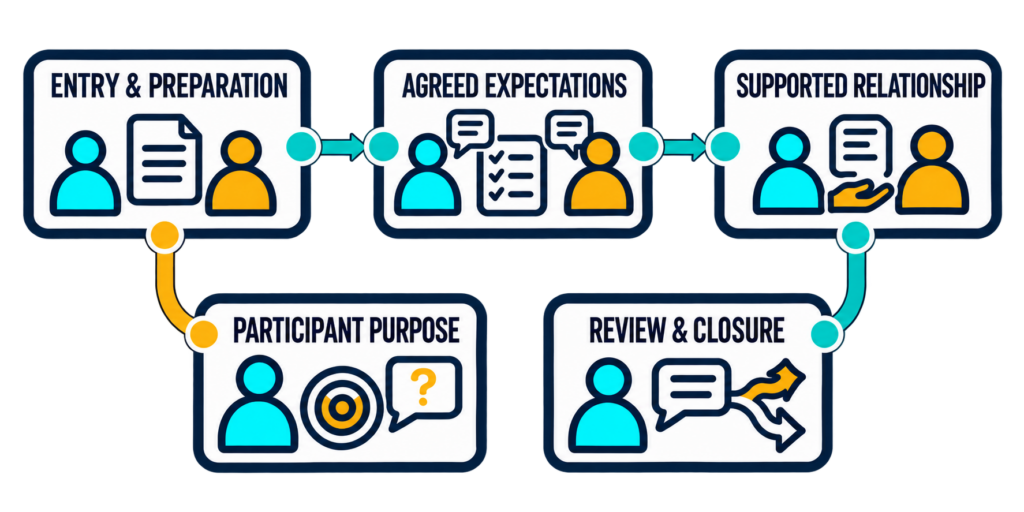
A mentoring introduction can leave participants unsure what comes next. Clarify how members enter an arrangement, agree on expectations, receive support, and choose when to continue, change, or conclude it.
Does this sound familiar?
Sign-up lacks direction
Members express interest without clarifying the question, goal, or support they want the arrangement to address.
Matching becomes the finish line
The organization introduces participants but provides little preparation for their first conversation or ongoing work.
Expectations differ
Participants have different assumptions about availability, responsibilities, confidentiality, or the help being offered.
Relationships lose momentum
Conversations become irregular or unfocused, and participants are unsure how to reset the arrangement.
Support routes are unclear
Members do not know whom to contact when the arrangement is unsuitable, difficult, or no longer workable.
Endings happen by silence
Relationships fade without reviewing what helped, acknowledging the contribution, or agreeing on an appropriate conclusion.
What are mentoring and peer-support participation?
Mentoring participation is the experience through which members enter and take part in an agreed relationship focused on learning, development, or navigating a particular situation.
Peer-support participation involves members helping one another through relevant experience, reflection, practical encouragement, or shared problem-solving.
These arrangements may involve a pair, a small group, a peer circle, or a time-limited series of conversations.
Their roles can differ. A mentor may offer experience that another participant wants to learn from. Peers may alternate between seeking and offering support.
This module examines how the arrangement begins, how participants understand their responsibilities, and how support, review, and closure work.
A relationship needs an agreement beyond the introduction.
Participants may welcome an introduction while holding different ideas about what the relationship will involve.
One person may want a focused conversation about a career decision. Another may expect a continuing development relationship. Someone offering support may have limited availability or experience relevant to only part of the request.
A useful beginning makes those expectations discussable.
The organization helps participants clarify the purpose, roles, commitments, boundaries, and support available before assuming the arrangement is underway.
See the complete support arrangement.
Purpose and Participants
Questions and goals
Relevant experience
Support being sought
Willingness and availability
Program eligibility
Entry and Preparation
Expression of interest
Participation information
Selection or matching
Introductions and orientation
First-conversation guidance
Working Agreement
Shared purpose
Roles and responsibilities
Contact and meeting rhythm
Information-sharing expectations
Boundaries and commitments
Support and Review
Coordinator contact
Conversation resources
Progress conversations
Questions and concerns
Changes in circumstances
Continuation and Closure
Review of usefulness
Revised goals or format
Pause or reassignment
Agreed conclusion
Appropriate next opportunities
The arrangement becomes easier to support when entry, expectations, participation, review, and closure are connected.
How mentoring arrangements lose direction
STAGE 1 — Members express interest
Participants sign up to receive or offer support, sometimes with only a broad description of their goals and availability.
STAGE 2 — The organization makes an introduction
The program connects people using available information about interests, experience, roles, or preferences.
STAGE 3 — Participants interpret the arrangement differently
They work out meeting frequency, purpose, preparation, and responsibilities without a shared starting agreement.
STAGE 4 — Difficulties remain unaddressed
When needs change or conversations stall, participants may continue an unhelpful pattern or stop responding because no review or conclusion route is clear.
A match does not establish a working relationship.
A program report can answer an important question:
How many members applied, were introduced, or attended an initial meeting?
A participation review also examines whether the participants understood the arrangement, began useful work, and could obtain help or change direction.
The review should clarify:
Identify the question, goal, or situation the participant wants to address. Clarify which parts fit the arrangement and which may need another route.
Review relevant experience, willingness, availability, preferences, and the limits of what is known about fit.
Examine the information, orientation, prompts, or coordinator support available before the first substantive conversation.
Clarify purpose, roles, commitments, contact, information-sharing expectations, and boundaries.
Trace how participants raise questions, seek help, reset expectations, or request a different arrangement.
Identify review points and choices to renew, revise, pause, reassign, or finish the relationship.
A workable arrangement needs six forms of clarity.
Purpose
Participants understand what they want to explore or work toward together.
Roles
Each person knows what they are offering, what they are responsible for, and what remains outside the arrangement.
Commitment
Availability, preparation, meeting rhythm, and expected duration are realistic and understood.
Boundaries
Participants understand contact limits, information-sharing expectations, and how concerns will be handled.
Support
People know where to seek guidance when the relationship needs help or the request exceeds its scope.
Review
Participants have a way to discuss usefulness, change expectations, and decide what happens next.
A supported relationship
An arrangement is easier to sustain when it provides:
- A purpose participants can explain.
- Willing participation on both sides.
- Relevant preparation for the first conversation.
- A manageable working agreement.
- Access to a coordinator or support route.
- A clear opportunity to review and conclude.
The structure helps participants use their time while allowing the relationship to respond to their needs.
An unsupported match
An introduction can leave participants with:
- Broad goals that never become discussable questions.
- Different assumptions about the mentor’s role.
- Unclear expectations for initiating contact.
- Meetings without preparation or direction.
- No comfortable route to request a change.
- An indefinite obligation with no agreed ending.
The review identifies where preparation, agreement, or support would make participation more workable.
A career question can become a focused mentoring arrangement.
A member moving into their first supervisory role asks for mentoring.
The association introduces them to an experienced manager, but neither participant knows whether the program expects occasional advice, regular meetings, or a defined development plan.
The team selects this arrangement for review.
Participants clarify the member’s immediate questions, the mentor’s relevant experience and availability, and what a useful initial period could involve.
They draft guidance for the first conversation, identify a realistic meeting rhythm, and establish a point for reviewing whether the arrangement is helping.
They also define whom to contact if the fit is poor or circumstances change.
The response is a clearer participation arrangement to test, with support and a review point built into the beginning.
Peer support may involve shared roles rather than a designated mentor.
Members with related challenges may benefit from a facilitated circle, reciprocal partnership, or small group.
Participants may alternate between asking questions, sharing experience, reflecting, and helping others identify a next step.
That flexibility still benefits from clear expectations.
The review examines how questions are brought forward, how time is shared, what preparation is useful, and how the group avoids placing responsibility on one informal helper.
It also clarifies the facilitator’s role and the support available when a question or concern exceeds what the group can reasonably address.
A useful conclusion is part of a well-supported relationship.
An arrangement may conclude because its purpose has been served, participants’ circumstances have changed, availability has shifted, or a different form of support would be more appropriate.
Closure gives participants a way to acknowledge what helped, identify unfinished questions, and agree on any next step.
A pause or reassignment should also have an understandable route.
The organization can support these choices without treating every ending as failure or every continuing relationship as evidence of success.
Any further contact should reflect what participants choose, rather than an assumed obligation created by the original introduction.
THE MATCHING WORKSHOP MODULE
Module 6: Mentoring & Peer Support Participation
This practical minicourse helps membership organizations clarify how members enter mentoring or peer-support arrangements, establish expectations, receive support, and continue or conclude the relationship.
Participants learn a repeatable review method, apply it to one selected arrangement, and identify whether the priority response concerns entry, fit, preparation, agreement, support, or review.
The exercise also defines the participant context, support goals, roles, commitments, coordinator responsibilities, and relationship stages that a subsequent Gobekli configuration would need to support.
This module helps your team:
- Define the purpose of one support arrangement.
- Clarify participant goals and relevant experience.
- Examine willingness, availability, and fit.
- Review sign-up, selection, and introductions.
- Identify preparation for the first conversation.
- Establish realistic roles and commitments.
- Clarify contact and information-sharing expectations.
- Define coordinator and support responsibilities.
- Identify review points and changing needs.
- Create routes to pause, change, or conclude.
- Develop a focused participation arrangement brief.
- Outline a connected mentoring configuration.
What should happen to each part of the arrangement?
The review leads to a deliberate response based on the support purpose, participant circumstances, and the conditions affecting the relationship.
Confirm
Retain an arrangement with a clear purpose, willing participants, and workable expectations.
Clarify
Explain goals, roles, commitments, boundaries, or support routes.
Prepare
Provide the orientation or conversation guidance needed to begin useful work.
Support
Help participants address questions, stalled progress, or difficulties within the arrangement.
Adjust
Revise the purpose, rhythm, format, or pairing when circumstances call for a change.
Conclude
Provide an appropriate route to pause or finish, acknowledge contributions, and identify any next step.
These responses guide participation design. They do not guarantee compatibility, development outcomes, or a relationship of any particular duration.
What should a mentoring and peer-support review examine?
The support purpose
What question, goal, transition, or development need is the arrangement intended to address?
The participants
What experience, willingness, availability, preferences, and eligibility are relevant to participation?
The entry
How do members express interest, understand the offering, receive preparation, and begin the relationship?
The agreement
What do participants understand about roles, commitments, contact, boundaries, and how they will work together?
The support
Who helps when questions arise, progress stalls, circumstances change, or another support route is needed?
The review and ending
How do participants assess usefulness and choose whether to continue, adjust, pause, or conclude?
Trace one arrangement from entry to review.
Your team applies the method to one mentoring or peer-support arrangement established through Member Engagement Direction.
STEP 1
Define the support purpose
Identify the participant population, question, goal, or transition within scope.
STEP 2
Examine entry and fit
Review interest, eligibility, relevant experience, willingness, availability, and the basis for an introduction or group placement.
STEP 3
Clarify the working agreement
Describe the purpose, roles, commitments, contact expectations, and boundaries participants need to discuss.
STEP 4
Trace preparation and support
Review orientation, first-conversation guidance, coordinator contact, and routes for questions or changes.
STEP 5
Choose a response
Confirm, clarify, prepare, support, adjust, or conclude the parts of the arrangement that need attention.
STEP 6
Assign and test the change
Identify the owner, proposed improvement, participant feedback needed, review points, and starting configuration requirements.
The result is a draft Mentoring & Peer Support Participation Map connecting purpose, entry, preparation, agreement, support, review, and closure.
FUTURE PRODUCT CONNECTION
Keep support relationships connected to their purpose and agreements.
A subsequent Gobekli configuration could help the organization connect participant-selected context to mentoring opportunities, peer-support arrangements, and coordinator responsibilities.
TalentSync could relate each arrangement to its purpose, participant roles, agreed commitments, preparation, support contacts, and review points.
TalentPass could help members express relevant goals, experience, availability, and sharing choices. Pythia could help clarify a support request, explain participation expectations, or prepare questions for a conversation using the information and permissions in scope. Passport Pages could support agreed source and sharing connections.
A connected participation view could potentially show:
- What support a participant is seeking.
- What relevant experience someone chooses to offer.
- Which preferences and availability affect the arrangement.
- What supports a proposed introduction or group placement.
- Which roles and commitments participants have agreed to.
- What preparation is available.
- Who coordinates the arrangement and handles questions.
- When participants plan to review usefulness.
- Whether the arrangement is active, changing, paused, or concluded.
- What next step participants have chosen to share.
The workshop produces a starting configuration brief: participant context, opportunity and arrangement profiles, working-agreement fields, coordinator roles, sharing boundaries, review points, and relationship stages.
Specific matching suggestions, messaging, scheduling, reminders, integrations, and workflows would be confirmed during solution planning.
PRODUCT AND DECISION BOUNDARIES
A supported arrangement preserves participant judgment and choice.
Relevant experience may support an introduction without establishing that someone is available, willing, or suitable for every request.
A later configuration should distinguish a suggested arrangement, agreement to participate, activity that occurred, and the usefulness participants report.
The workshop and product connection do not establish:
- Suitability based only on a profile or job title.
- Willingness to mentor based only on expertise.
- A professional qualification that has not been established.
- A guarantee of confidentiality without defined arrangements and limits.
- Development outcomes inferred from meeting counts.
- Permission for staff to view private conversation content.
- An obligation to continue when the arrangement is no longer appropriate.
Program responsibilities, information-sharing expectations, and existing concern or referral routes remain part of organizational review.
The workshop can clarify the arrangement and its responsibilities independently of future product adoption.
What to bring into the conversation
You do not need a complete mentoring program redesign or a new matching platform.
Begin with one mentoring or peer-support arrangement connected to the participation challenge established through Member Engagement Direction.
Useful inputs may include:
- The purpose of the selected arrangement.
- Current sign-up or expression-of-interest forms.
- Participant information and selection criteria.
- Introduction and orientation materials.
- First-conversation prompts or working agreements.
- Participant questions about expectations.
- Availability and commitment expectations.
- Coordinator and support responsibilities.
- Contact and information-sharing arrangements.
- Review, reassignment, pause, or closure processes.
- A program lead and participant perspective.
- The owner of a proposed improvement.
The aim is to examine one arrangement in sufficient detail to make a practical change. The foundation module establishes the population, purpose, evidence, and boundaries for that work.
What this module can help clarify
What the arrangement is for
Connect the support purpose to participant goals, relevant experience, and realistic expectations.
How participants begin
Clarify entry, fit, preparation, introductions, and the initial working agreement.
How the relationship is supported
Establish coordinator responsibilities, review points, and routes to address questions or changing circumstances.
What should change next
Develop an assigned improvement and test plan, supported by a starting configuration brief.
Final outputs depend on the modules selected and the participation challenge established through the workshop’s required Member Engagement Direction module.
Where might the work lead next?
Peer Connections & Community Belonging
Create broader routes into peer interaction when members need introductions or community participation without a structured support arrangement.
Learning Program Participation & Follow-Through
Connect mentoring or peer support to participation in a learning program and the application of what members learn.
Volunteer & Leadership Participation
Clarify preparation, responsibilities, capacity, and recognition when mentors or facilitators contribute through defined volunteer roles.
Explore the full Member Engagement Workshop to combine this module with the other parts of the participation experience that need attention.
Frequently asked questions
Questions organizations ask before beginning.
It includes how members enter an arrangement, understand its purpose, prepare, agree on expectations, receive support, and review or conclude the relationship.
The method also applies to reciprocal partnerships, peer circles, and small groups. It examines shared roles, participation expectations, facilitation, and support appropriate to the arrangement.
Matching or introductions may be part of the review. The module follows the arrangement further into preparation, agreements, support, review, and closure.
No. You can bring a proposed arrangement. The exercise helps make its participation requirements concrete before a small test.
Begin with the support purpose, relevant experience, willingness, availability, preferences, and applicable eligibility. The workshop identifies what is necessary for the selected arrangement and what can remain optional.
Seniority alone does not establish relevance. The arrangement should reflect the experience or perspective being sought, the roles involved, and the participants’ willingness to work together.
The selected purpose, roles, commitments, meeting or contact rhythm, preparation, boundaries, information-sharing expectations, support route, and a point for review.
Enough to help participants understand how to begin and where to seek help. The appropriate structure depends on the purpose, duration, format, and experience of those involved.
Provide an early opportunity to discuss expectations. They may agree on a narrower purpose, change the format, seek another arrangement, or choose not to continue.
Examine whether the difficulty concerns time, purpose, preparation, expectations, fit, or changing circumstances. A coordinator can help participants reset or conclude instead of relying on generic reminders.
Participants need a clear explanation of information-sharing expectations, organizational visibility, and any limits or concern routes. The workshop identifies what must be clarified through the organization’s program arrangements.
Clarify availability, commitment, role boundaries, preparation, and coordinator support. The review should make it possible to decline, pause, or conclude without an assumed open-ended obligation.
That module addresses introductions, general peer interaction, and community entry. This module focuses on an agreed support arrangement with clearer roles, commitments, preparation, and review over time.
This module examines the support relationship and participant experience. Volunteer & Leadership Participation examines how the organization defines, recruits, prepares, supports, and recognizes people contributing through formal roles.
Review whether participants understand the purpose, can use the arrangement, receive appropriate support, and report progress or useful learning relevant to their goals. Meeting counts alone do not establish those outcomes.
The outputs can inform a configuration connecting participant-selected context, support opportunities, working agreements, coordinator roles, review points, and relationship stages. Specific capabilities and implementation requirements would be confirmed during scoping.
Your team will review one bounded arrangement and develop a draft participation map, assigned improvement and test plan, and starting configuration brief. Wider rollout and ongoing operation are subsequent steps.
GIVE SUPPORT RELATIONSHIPS A WORKABLE STRUCTURE
Help members begin with clarity and continue with purpose.
Connect mentoring and peer support to agreed expectations, practical help, and clear choices to continue, change, or conclude.
This module is part of Gobekli’s configurable Member Engagement Workshop.