
MEMBER ENGAGEMENT WORKSHOP MODULE
Volunteer & Leadership Participation
The same members can become the default helpers while others struggle to see where they fit. Make contribution opportunities, expectations, entry routes, support, and progression clearer so more members can take part.
Does this sound familiar?
The same people get asked
Staff and leaders return to familiar contributors because other members’ interest, availability, or route into participation is unclear.
Roles sound bigger than they are
Broad requests to volunteer leave members unsure what they would do, how much time it takes, or where the commitment ends.
Interest goes unanswered
Members offer to help but encounter unclear applications, delayed responses, or no explanation of how opportunities are assigned.
Responsibility arrives without preparation
New contributors receive a title or task before they have the guidance, access, contacts, or authority needed to carry it out.
Reliable volunteers carry too much
Responsibilities accumulate around people who keep saying yes, while limits, shared ownership, and support remain difficult to discuss.
Leadership has no visible pathway
Members cannot see how to develop toward greater responsibility, and outgoing leaders have no clear route to prepare a successor or hand over.
What are volunteer and leadership participation?
Volunteer participation is the experience through which members choose to contribute time, knowledge, effort, or service through an organizational opportunity.
Leadership participation involves taking responsibility for guiding work, supporting others, representing a group, or making decisions within an established role.
Opportunities may range from a short review task or event assignment to ongoing mentoring, committee service, project coordination, or an elected position.
Members need to understand the contribution being requested, how they can express interest, how selection works, and what support accompanies the responsibility.
This module examines those connections for one selected contribution pathway, including preparation, participation, development, handover, and an appropriate conclusion.
A willingness to help needs a clear opportunity to act.
A member may want to contribute without knowing which opportunity fits their experience, interests, or available time.
The organization may need help without having translated that need into a manageable role.
“Join a committee” or “become a volunteer” can leave the practical questions unanswered.
What would I do? Who would I work with? What decisions could I make? What preparation would I receive? How long am I committing?
A practical review connects the organizational need to an understandable contribution and a supported route into the work.
See the complete contribution pathway.
Purpose and Opportunity
Work that needs doing
Who the contribution serves
Member interests and experience
Available time and capacity
Bounded tasks and ongoing roles
Entry and Selection
Opportunity descriptions
Expressions of interest
Eligibility and selection criteria
Application or nomination routes
Responses and alternative options
Preparation and Agreement
Responsibilities and limits
Time and term expectations
Orientation and resources
Access and decision authority
Support contacts
Contribution and Support
Tasks and working relationships
Feedback and guidance
Questions and concerns
Capacity and changing circumstances
Acknowledgment of contributions
Development and Handover
Further responsibility
Preparation for another role
Renewal or rotation
Knowledge and access transfer
Conclusion and future choices
Participation becomes easier to support when the opportunity, entry route, responsibilities, support, and ending are understandable together.
How contribution becomes concentrated among familiar members
STAGE 1 — A need for help emerges
A program, event, project, or leadership transition creates work that members could contribute to.
STAGE 2 — Recruitment follows existing relationships
Staff and leaders approach people they already know because their experience and reliability feel familiar.
STAGE 3 — Responsibility grows informally
Contributors take on additional work while expectations, limits, preparation, and support remain largely unwritten.
STAGE 4 — Entry and succession become harder
New members cannot see how to begin, and existing contributors struggle to step back without leaving work uncovered.
A filled role does not establish a workable contribution.
A volunteer report can answer an important question:
How many members expressed interest, accepted assignments, or occupied leadership positions?
A participation review also examines whether people understood the role, could carry out the work, received appropriate support, and had a clear route to continue or conclude.
The review should clarify:
Identify the work, the purpose it serves, and the responsibilities involved. Distinguish a specific need from a broad request for more volunteers.
Examine relevant experience, interests, availability, eligibility, and preparation. Identify which requirements are essential and which reflect familiar recruiting habits.
Trace discovery, questions, expressions of interest, applications, nominations, and responses. Clarify how decisions are made and communicated.
Review orientation, resources, access, introductions, responsibilities, and the authority needed for the selected role.
Examine guidance, feedback, capacity, practical assistance, and routes to raise a concern or request a change.
Identify opportunities to learn, take on another role, renew, rotate, hand over, or conclude without leaving expectations unresolved.
A workable contribution needs six forms of clarity.
Purpose
Members understand what the contribution serves and why the work matters.
Scope
The role explains its tasks, limits, time commitment, and expected duration.
Entry
Members can see how to express interest and how participation decisions are made.
Preparation
Contributors receive the guidance, resources, access, and introductions needed to begin.
Support
People know where to seek help, discuss capacity, and address difficulties.
Transition
Renewal, development, handover, and conclusion have understandable routes.
Supported contribution
An opportunity is easier to enter and sustain when it provides:
- A specific purpose and manageable scope.
- Visible ways to express interest.
- Understandable eligibility and selection.
- Preparation matched to the responsibility.
- Realistic support and capacity discussions.
- A clear term, handover, or conclusion.
The structure helps members contribute with confidence while allowing the organization to plan for continuity.
Dependence on familiar helpers
Participation becomes harder to widen when it relies on:
- Personal invitations as the only entry route.
- Vague roles that expand after acceptance.
- Unspoken expectations about availability.
- Titles without the authority or resources to act.
- The same contributors absorbing unfinished work.
- Indefinite commitments with no supported exit.
The review identifies where clearer opportunities and responsibilities would make participation more accessible and manageable.
A broad request for volunteers can become a manageable first contribution.
An association wants more members to help improve its practical resource library.
Staff usually ask a small group of experienced volunteers to review materials. Those contributors now struggle to keep up.
The team selects this contribution pathway for review.
Participants separate the work into a bounded review assignment and an ongoing coordination role.
The review assignment explains the topic, expected effort, review criteria, deadline, and support contact. Members can express interest without committing to a standing committee.
The coordinator receives a defined responsibility for assigning work, answering questions, and closing the feedback loop.
The team also clarifies how completed contributions are acknowledged and how interested members could prepare for a future coordination role.
The result is a clearer entry opportunity and support arrangement to test, with responsibility distributed through explicit roles.
A small contribution can be valuable without becoming a leadership commitment.
Members may want to review a document, host one discussion, share an example, or help with a specific activity.
Others may seek an ongoing service role or want to develop toward leadership.
Those are different participation choices.
The review examines whether the organization offers manageable ways to contribute and explains how members can explore further responsibility if they wish.
It does not treat every volunteer task as the first step in a required leadership ladder.
A member can make a useful contribution, receive appropriate acknowledgment, and finish the assignment without taking on more.
Leadership continuity begins before someone is ready to leave.
An outgoing leader may hold practical knowledge about relationships, recurring tasks, decisions, and unfinished work.
A role description alone may not make that knowledge available to the next person.
The review examines what preparation, shadowing, documentation, introductions, and access transfer are useful for the selected transition.
It also clarifies the outgoing person’s remaining responsibilities and when those responsibilities end.
Where roles are elected, appointed, or governed by established rules, preparation and handover should fit those arrangements. A participation pathway does not determine who is entitled to hold the position.
THE MATCHING WORKSHOP MODULE
Module 9: Volunteer & Leadership Participation
This practical minicourse helps membership organizations make contribution opportunities, expectations, entry routes, support, and progression clearer so participation can extend beyond familiar volunteers and leaders.
Participants learn a repeatable review method, apply it to one selected contribution pathway, and identify whether the priority response concerns opportunity scope, entry, selection, preparation, support, or transition.
The exercise also defines the member context, contribution roles, participation choices, support responsibilities, and handover relationships that a subsequent Gobekli configuration would need to support.
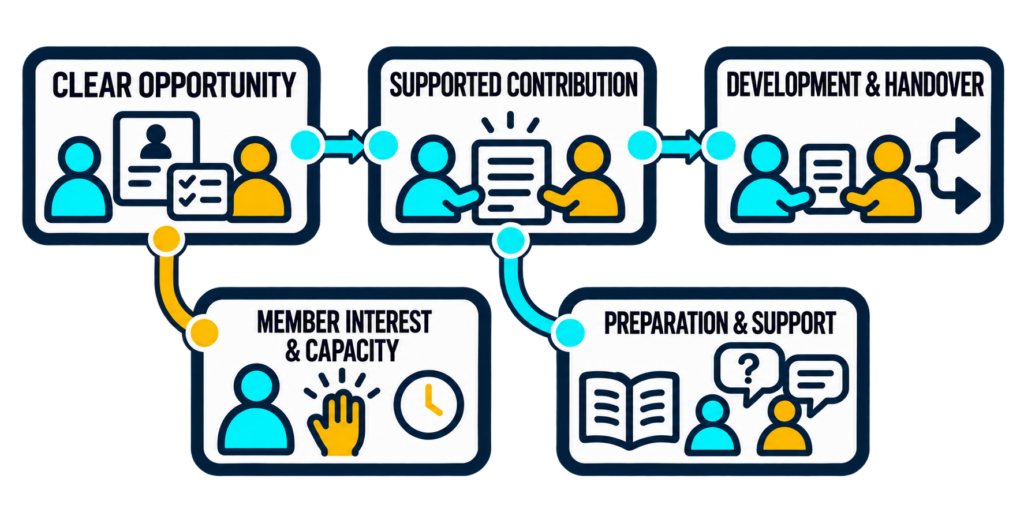
This module helps your team:
- Define the purpose of one contribution pathway.
- Translate a need into a manageable opportunity.
- Clarify responsibilities, limits, and commitments.
- Examine eligibility and selection expectations.
- Review expressions of interest and responses.
- Identify preparation needed to begin.
- Clarify resources, access, and decision authority.
- Examine support, feedback, and capacity.
- Create optional routes toward further responsibility.
- Establish handover and conclusion arrangements.
- Develop a focused contribution pathway brief.
- Outline a connected participation configuration.
What should happen to each part of the contribution pathway?
The review leads to a deliberate response based on the work needed, the member’s circumstances, and the responsibilities the organization can support.
Confirm
Retain an opportunity with a clear purpose, realistic commitments, and workable support.
Clarify
Explain the role, entry route, selection process, authority, or expected duration.
Prepare
Provide the orientation, resources, and introductions needed to begin responsibly.
Support
Address questions, capacity pressures, feedback needs, or difficulties carrying out the role.
Develop
Create an optional route to gain experience or prepare for further responsibility.
Transition
Arrange renewal, rotation, handover, or conclusion with clear ownership of remaining work.
These responses guide participation design. They do not guarantee selection, confer authority, or require members to accept greater responsibility.
What should a volunteer and leadership participation review examine?
The opportunity
What work needs doing, whom does it serve, and what contribution is being requested?
The commitment
What responsibilities, limits, time, duration, and authority should a member understand before agreeing?
The entry
How do members discover the opportunity, express interest, understand selection, and receive a response?
The preparation
What guidance, resources, access, introductions, or development are needed to begin?
The support
Who provides feedback, answers questions, addresses capacity, and helps resolve difficulties?
The transition
How can members develop, renew, rotate, transfer responsibilities, or conclude the role?
Trace one opportunity from interest to contribution and handover.
Your team applies the method to one contribution pathway established through Member Engagement Direction.
STEP 1
Define the contribution
Identify the work, the population it serves, and the purpose within scope.
STEP 2
Clarify the opportunity
Describe responsibilities, essential requirements, time, duration, authority, and available support.
STEP 3
Follow the entry route
Trace how a member discovers the role, asks questions, expresses interest, and receives a participation decision.
STEP 4
Examine preparation and support
Review the resources, access, relationships, feedback, and capacity discussions needed to carry out the work.
STEP 5
Choose a response
Confirm, clarify, prepare, support, develop, or transition the parts of the pathway that need attention.
STEP 6
Assign and test the change
Identify the owner, proposed improvement, contributor feedback needed, transition responsibilities, and starting configuration requirements.
The result is a draft Volunteer & Leadership Participation Map connecting opportunity, entry, agreement, preparation, contribution, support, and transition.
FUTURE PRODUCT CONNECTION
Keep contribution opportunities connected to people, responsibilities, and support.
A subsequent Gobekli configuration could help the organization relate contribution needs to member-selected interests, relevant experience, availability, and participation choices.
TalentSync could connect volunteer and leadership roles to their purposes, responsibilities, requirements, support contacts, terms, and handover needs.
TalentPass could help members express what they want to contribute, the experience they choose to share, their availability, and the responsibilities they agree to accept. Pythia could help clarify an opportunity, prepare questions, or explore a suitable contribution using the information and permissions in scope. Passport Pages could support agreed source and sharing connections.
A connected contribution view could potentially show:
- What work the organization needs help with.
- What purpose each opportunity serves.
- Which responsibilities and commitments apply.
- What members choose to express interest in.
- Which relevant experience or preparation they share.
- How entry and selection decisions are handled.
- What resources and authority accompany the role.
- Who provides coordination, guidance, and support.
- When review, renewal, or handover is expected.
- What contribution and next-step information members choose to carry forward.
The workshop produces a starting configuration brief: opportunity and role profiles, member-selected context, interest and participation states, selection responsibilities, support roles, term information, and transition relationships.
Specific opportunity suggestions, applications, assignments, reminders, recognition records, integrations, and workflows would be confirmed during solution planning.
PRODUCT AND DECISION BOUNDARIES
Relevant experience does not replace willingness or an authorized decision.
A member’s background may suggest a possible contribution without establishing current interest, availability, or suitability for a particular role.
An expression of interest does not establish appointment. A title does not explain the full contribution someone made.
A later configuration should distinguish suggested opportunities, member interest, selection decisions, accepted responsibilities, recorded contributions, and reviewed evidence.
The workshop and product connection do not establish:
- Willingness to volunteer based only on expertise.
- Availability inferred from previous participation.
- Selection or appointment through a profile match alone.
- Decision authority that has not been granted.
- Capability based only on a volunteer title.
- Consent to public recognition or profile sharing.
- An obligation to continue beyond an agreed commitment.
The organization retains responsibility for selection, appointments, elections, role authority, and any applicable governing arrangements.
The workshop can clarify the contribution pathway and its responsibilities independently of future product adoption.
What to bring into the conversation
You do not need a new volunteer platform or a complete leadership development program.
Begin with one contribution pathway connected to the participation challenge established through Member Engagement Direction.
Useful inputs may include:
- The purpose of the selected contribution.
- Current opportunity or role descriptions.
- Recruitment and expression-of-interest materials.
- Eligibility and selection arrangements.
- Time, term, and responsibility expectations.
- Questions from potential or current contributors.
- Orientation and preparation materials.
- Resource, access, and authority arrangements.
- Support and feedback responsibilities.
- Recognition, renewal, and handover practices.
- A role owner and contributor perspective.
- The owner of a proposed improvement.
The aim is to examine one pathway in sufficient detail to make a practical change. The foundation module establishes the population, purpose, evidence, and boundaries for that work.
What this module can help clarify
What members can contribute
Translate the selected need into an understandable opportunity with realistic responsibilities and commitments.
How members enter and begin
Clarify expressions of interest, selection, responses, preparation, and access to the work.
What supports continuity
Establish guidance, capacity discussions, optional development, and appropriate handover or conclusion.
What should change next
Develop an assigned improvement and test plan, supported by a starting configuration brief.
These outputs begin with the example reviewed during the module. Final scope depends on the modules selected, available inputs, and the participation challenge established through Member Engagement Direction.
Where might the work lead next?
Benefit & Opportunity Discovery
Make contribution opportunities easier for members to find, compare, and understand before expressing interest.
Chapter, Committee & Partner Participation
Clarify the wider participation arrangements when contribution roles operate across organizational groups or delivery partners.
Participation Barriers & Inclusive Access
Examine barriers that make opportunities difficult to enter or sustain, including time, costs, format, and participation requirements.
Your team can combine this module with other parts of the Member Engagement Workshop according to the participation challenge established through Member Engagement Direction.
Frequently asked questions
Questions organizations ask before beginning.
Short assignments, resource reviews, event support, mentoring roles, project coordination, committee service, and leadership positions. The exercise focuses on one bounded pathway.
Recruitment may be part of the response. The review also examines whether the opportunity is understandable, selection is clear, contributors can begin, and the organization can support the commitment.
Examine how opportunities become visible, who receives invitations, which requirements are essential, and how new people can begin. Also review whether existing responsibilities can be made more manageable or shared through clearer roles.
The amount of detail should fit the responsibility. Even a short task benefits from a clear purpose, expected effort, deadline or ending, and a contact for questions.
Provide an understandable expression-of-interest route and explain what happens next. Someone should own the response, including cases where no suitable opportunity is currently available.
The module helps make the organization’s criteria, responsibilities, and decision process understandable. It does not replace established appointment, election, or eligibility arrangements.
Yes. The review can examine information, preparation, participation expectations, support, and handover around the role. Eligibility, nominations, elections, and authority remain governed by the organization’s established arrangements.
The purpose, responsibilities, limits, time commitment, duration, relevant requirements, available resources, decision authority, and support contact.
Review what they have actually taken on, how responsibilities have grown, and what support or redistribution is possible. Clarify the ability to discuss capacity, decline additional work, and conclude an agreed commitment.
No. Some members want a bounded contribution; others want to prepare for greater responsibility. The review can create optional development routes without treating advancement as the expected outcome for everyone.
Begin with what the person actually contributed and how they prefer it to be acknowledged. Public recognition, records, references, or further opportunities should reflect appropriate agreement and supporting context.
Yes. The review can identify the knowledge, relationships, access, unfinished work, and preparation needed for one role transition, alongside responsibility for the handover.
That module helps the organization understand relevant experience and potential capability. This module examines how a member chooses to enter a contribution opportunity and receives the preparation and support needed to participate.
The mentoring module examines the support relationship between participants. This module examines the organizational role through which a mentor or facilitator contributes, including recruitment, commitments, preparation, support, and transition.
This module follows an individual contribution pathway. The chapter, committee, and partner module examines participation across groups, including coordination, shared responsibilities, and handoffs.
The outputs can inform a configuration connecting contribution opportunities, member-selected interests and experience, accepted responsibilities, support roles, terms, and transition needs. Specific capabilities and implementation requirements would be confirmed during scoping.
Your team will review one bounded contribution pathway and develop a draft participation map, assigned improvement and test plan, and starting configuration brief. Wider rollout and ongoing operation are subsequent steps.
MAKE CONTRIBUTION EASIER TO BEGIN AND SUSTAIN
Give more members a clear way to help.
Connect volunteer and leadership opportunities to realistic commitments, useful preparation, practical support, and an appropriate next step.
This module is part of Gobekli’s configurable Member Engagement Workshop.