
MEMBER ENGAGEMENT WORKSHOP MODULE
Chapter, Committee & Partner Participation
Members should not need to understand your organizational structure to find their next step. Clarify entry, movement, handoffs, and support across chapters, committees, local activities, and partner programs.
Does this sound familiar?
Members cannot see where they fit
Chapters, committees, groups, and partner programs appear as separate names without a clear explanation of their purpose or participation routes.
Entry rules vary without explanation
Members encounter different eligibility, applications, schedules, or commitments and struggle to understand which conditions apply.
Referrals end at another inbox
A team passes along a contact or link without confirming who will receive the request or what the member should expect next.
Members repeat their story
Each group asks for the same background while useful context from an earlier conversation fails to reach the next responsible person.
Support falls between teams
Central staff, local leaders, committee contacts, and partners each assume that someone else is helping the member.
Transitions depend on personal contacts
Moving between chapters, joining another group, or continuing through a partner program works best for members who already know whom to ask.
What is chapter, committee, and partner participation?
Chapter, committee, and partner participation concerns how members enter and take part in opportunities delivered through different groups connected to the organization.
A chapter may provide local activities and relationships. A committee may undertake defined work. A partner may deliver a program or service under its own arrangements.
These settings can have different purposes, participation requirements, responsibilities, and degrees of independence.
The member needs to understand where an opportunity fits, how to enter, and who can help when the journey crosses from one group to another.
This module examines those connections for one selected participation route, including referrals, transitions, receiving responsibilities, and support.
A referral needs a receiving responsibility.
The organization may describe a chapter, committee, or partner program as the appropriate next step.
For the member, that recommendation creates practical questions.
Am I eligible? Do I need to apply? Who should I contact? What information should I provide? Will someone respond? What happens if the opportunity is unavailable?
A useful handoff makes the next action and the receiving responsibility clear.
It also explains what context can travel with the request, what the receiving group will decide, and where the member can seek help if the connection does not work.
See the complete route across groups.
Member Purpose
Questions and interests
Location and affiliations
Participation goals
Relevant circumstances
Preferred ways to take part
Group and Opportunity
Chapter or group purpose
Committee responsibilities
Partner offering
Eligibility and commitments
Available participation routes
Entry and Handoff
Inquiry or expression of interest
Application or referral
Information shared by agreement
Receiving contact
Expected response and next action
Participation and Support
Welcome and orientation
Local or program expectations
Responsible support contacts
Questions and unresolved requests
Coordination across groups
Movement and Continuity
Another group or activity
Chapter changes
Further partner participation
Updated responsibilities
Return, pause, or conclusion
The route becomes easier to navigate when each group’s purpose, entry conditions, receiving responsibility, and support are understandable together.
How participation becomes fragmented across groups
STAGE 1 — Opportunities develop in different places
Chapters, committees, program teams, and partners create activities suited to their purposes and communities.
STAGE 2 — Each group establishes its own entry route
Local contacts, applications, registration processes, and participation expectations grow around the way each group works.
STAGE 3 — Members cross an unclear boundary
A member follows a referral or seeks another opportunity without knowing what changes, who receives the request, or which information is needed.
STAGE 4 — Responsibility becomes difficult to trace
Teams see their own part of the process while unanswered questions, repeated requests, and incomplete handoffs remain unresolved.
A referral count does not explain whether the member reached the opportunity.
A participation report can answer an important question:
How many members were referred, registered with a group, or directed to a partner program?
A participation review also examines whether the member understood the route, reached the receiving group, received a response, and could begin or make another choice.
The review should clarify:
Identify the connection between the member’s purpose and the opportunity. Clarify what the group offers and what remains outside its scope.
Review differences in eligibility, commitments, costs, schedules, information requirements, and participation arrangements.
Explain whether the next step involves an inquiry, registration, application, nomination, introduction, or another action.
Identify the person or role responsible for acknowledging the request and explaining what happens next.
Determine which information is useful, what the member agrees to share, and what the receiving group must establish independently.
Clarify support, alternative options, and how an unresolved request returns to someone who can help.
A workable route across groups needs six forms of clarity.
Purpose
Members understand how each group or program relates to what they want to do.
Conditions
Eligibility, commitments, costs, and local or partner requirements are explained before entry.
Action
The member knows the next step and what information or preparation it requires.
Receiver
A named role owns the incoming request and the response.
Context
Useful information moves by agreement, with its source and limits understood.
Continuity
Members know where to get help and how to continue, change direction, or conclude.
An accountable handoff
A transition is easier to navigate when it provides:
- A clear reason for the referral.
- An explanation of the receiving opportunity.
- Understandable entry conditions.
- A specific next action and receiving contact.
- Agreed information sharing.
- A support route if the connection stalls.
The sending and receiving groups understand their responsibilities, and the member can see what happens next.
A loose referral
A transition can leave the member unsupported when it relies on:
- A group name without an explanation of relevance.
- A link to another website with no entry guidance.
- Assumptions about eligibility or acceptance.
- A general inbox with no response owner.
- Repeated requests for information already provided.
- No route back when the referral fails.
The review identifies what needs to be clarified at the boundary between the groups.
A local inquiry can become a supported route into a partner program.
A member asks their chapter for help developing a practical project-management approach.
The chapter points them toward a program delivered by an association partner.
The member follows the link but cannot tell whether their membership provides access, whether they meet the starting requirements, or whom to ask.
The team selects this route for review.
Participants clarify what the chapter should explain, which questions the partner must answer, and who receives the inquiry.
They define a short referral summary containing the member’s stated purpose and only the information the member agrees to share.
The partner contact confirms the applicable entry route or explains an alternative. The chapter knows how to help if the member does not receive a response.
The result is a more accountable connection between two existing offerings, with clear responsibilities to test.
Different groups can keep different ways of working.
A local chapter, a specialist committee, and a delivery partner may have good reasons to organize participation differently.
They may serve different populations, work to different schedules, or carry different responsibilities.
The review does not assume that every group should use the same process.
It identifies the information and handoffs members need to understand those differences: purpose, entry conditions, next action, receiving contact, and support.
The aim is a navigable experience across the selected route, with local or partner decisions made by the people responsible for them.
Moving between groups should not erase useful context.
A member may move to another region, change interests, finish a committee term, or seek a different form of participation.
The next group may need some context about that transition without needing the member’s entire history.
The review examines what is relevant, what remains current, and what the member chooses to carry forward.
It also clarifies when the previous group’s responsibility ends and the next group’s begins.
A transition should not be treated as complete simply because a record was updated or a message was sent.
THE MATCHING WORKSHOP MODULE
Module 10: Chapter, Committee & Partner Participation
This practical minicourse helps membership organizations clarify how members enter and move among groups, local activities, committees, and partner programs, with accountable handoffs and support.
Participants learn a repeatable review method, apply it to one selected route across groups, and identify whether the priority response concerns purpose, entry conditions, referrals, receiving responsibilities, shared context, or continuity.
The exercise also defines the group relationships, participation routes, handoff states, information-sharing choices, and support responsibilities that a subsequent Gobekli configuration would need to support.
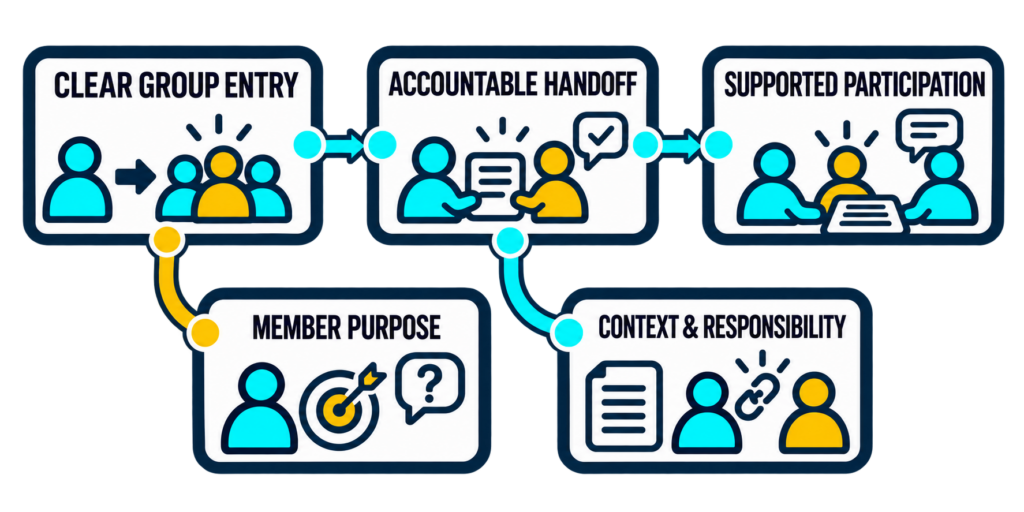
This module helps your team:
- Define the purpose of one route across groups.
- Clarify what each group or program offers.
- Examine eligibility and participation conditions.
- Trace inquiries, applications, and referrals.
- Identify the action expected from the member.
- Assign a receiving responsibility for each handoff.
- Clarify what context can move by agreement.
- Examine welcome, orientation, and support.
- Resolve gaps between sending and receiving teams.
- Establish routes to move, return, or conclude.
- Develop a focused participation handoff brief.
- Outline a connected group participation configuration.
What should happen at each boundary between groups?
The review leads to a deliberate response based on the member’s purpose, the receiving opportunity, and the responsibilities of the groups involved.
Confirm
Retain a route with a clear purpose, understandable conditions, and accountable support.
Clarify
Explain the opportunity, eligibility, next action, or division of responsibilities.
Connect
Establish the referral or introduction needed to reach the receiving group.
Coordinate
Align the information, timing, and responsibilities needed for the handoff.
Support
Provide a route for unanswered questions, stalled requests, or difficulties beginning participation.
Redirect
Offer an appropriate alternative, return route, or conclusion when the original opportunity does not fit.
These responses guide participation arrangements. They do not establish eligibility, guarantee acceptance, or transfer authority between independent groups.
What should a chapter, committee, and partner participation review examine?
The member purpose
What question, interest, activity, or transition brings the member across the selected group boundary?
The opportunity
What does the receiving group provide, and which participation conditions apply?
The entry
What inquiry, application, referral, or other action is required to begin?
The handoff
Who sends, who receives, what information moves, and how is the next step acknowledged?
The support
Who helps with questions, unresolved requests, or difficulties participating across the route?
The continuity
How does responsibility change when the member moves, returns, chooses another option, or concludes?
Trace one member journey across a group boundary.
Your team applies the method to one participation route established through Member Engagement Direction.
STEP 1
Define the member purpose
Identify the population, question, opportunity, or transition within scope.
STEP 2
Map the groups involved
Clarify what each group provides, the conditions it sets, and the responsibilities it controls.
STEP 3
Follow the entry and handoff
Trace the member’s actions, the sending contact, the receiving role, and the expected response.
STEP 4
Examine context and support
Review what information is needed, what can be shared by agreement, and who helps when the route stalls.
STEP 5
Choose a response
Confirm, clarify, connect, coordinate, support, or redirect the parts of the route that need attention.
STEP 6
Assign and test the change
Identify the owners, proposed improvement, member feedback needed, handoff expectations, and starting configuration requirements.
The result is a draft Cross-Group Participation Map connecting member purpose, group opportunities, entry conditions, handoffs, shared context, and support.
FUTURE PRODUCT CONNECTION
Keep participation connected across organizational boundaries.
A subsequent Gobekli configuration could help the organization relate chapters, committees, and partner offerings to member-selected purposes and understandable participation routes.
TalentSync could connect group and program profiles to their entry conditions, responsible contacts, referral arrangements, and support roles.
TalentPass could help members express relevant interests, affiliations, questions, and the context they choose to share when moving between opportunities. Pythia could help explain a route, prepare an inquiry, or clarify the next action using the information and permissions in scope. Passport Pages could support agreed source and sharing connections.
A connected participation view could potentially show:
- What purpose brings a member to the selected route.
- Which groups or programs are involved.
- What each opportunity offers.
- Which entry conditions and commitments apply.
- What action the member has chosen to take.
- Who sends and receives a referral.
- What context the member has agreed to share.
- Whether a request has been acknowledged or needs attention.
- Who provides support at each stage.
- What continuation, alternative, or conclusion has been agreed.
The workshop produces a starting configuration brief: group and program profiles, entry conditions, referral relationships, receiving roles, handoff states, sharing choices, and support responsibilities.
Specific cross-system connections, referrals, status exchanges, messaging, reminders, and partner workflows would be confirmed during solution planning.
PRODUCT AND DECISION BOUNDARIES
A connected route respects each group’s responsibilities.
Membership in the wider organization may provide context without establishing eligibility for every chapter activity, committee position, or partner program.
A referral can establish an intended connection without showing that the receiving group has accepted the member or that participation has begun.
A later configuration should distinguish affiliation, expressed interest, referral, application, acceptance, and actual participation.
The workshop and product connection do not establish:
- Eligibility based only on general membership.
- Acceptance inferred from a referral.
- Authority to appoint someone to a committee.
- Permission to share a member’s full record.
- An identical experience across different groups.
- Responsibility transferred without agreement.
- Access to a partner’s systems or information without an established arrangement.
Each group retains responsibility for its decisions and commitments within the applicable organizational or partner arrangements.
The workshop can clarify the selected route and its responsibilities independently of future product adoption.
What to bring into the conversation
You do not need to standardize every chapter or replace your partner systems.
Begin with one participation route connected to the challenge established through Member Engagement Direction.
Useful inputs may include:
- The purpose of the selected member journey.
- Descriptions of the groups or programs involved.
- Eligibility and participation conditions.
- Current inquiry, application, or referral instructions.
- Examples of member questions at the boundary.
- Available information about incomplete handoffs.
- Sending and receiving contact responsibilities.
- Information-sharing arrangements.
- Welcome, orientation, and support materials.
- Routes for unresolved requests or alternatives.
- Perspectives from both sides of the handoff.
- The owners of a proposed improvement.
The aim is to examine one route in sufficient detail to make a practical change. The foundation module establishes the population, purpose, evidence, and boundaries for that work.
What this module can help clarify
Where the member is trying to go
Connect the selected purpose to the appropriate group or program and its participation conditions.
How the handoff works
Clarify the member’s next action, sending and receiving responsibilities, and agreed information sharing.
Who supports continuity
Establish help for unresolved requests, movement between groups, and appropriate alternatives or conclusions.
What should change next
Develop an assigned improvement and test plan, supported by a starting configuration brief.
These outputs begin with the example reviewed during the module. Final scope depends on the modules selected, available inputs, and the participation challenge established through Member Engagement Direction.
Where might the work lead next?
Relevant Communication & Outreach
Coordinate invitations, contact, and follow-up when several groups communicate with the same members.
Volunteer & Leadership Participation
Clarify individual contribution roles when the route involves committee service, chapter leadership, or a defined volunteer responsibility.
Participation Barriers & Inclusive Access
Examine access difficulties when different group requirements, formats, schedules, or costs create barriers to participation.
Your team can combine this module with other parts of the Member Engagement Workshop according to the participation challenge established through Member Engagement Direction.
Frequently asked questions
Questions organizations ask before beginning.
Chapters, local branches, committees, specialist groups, program teams, and delivery partners. The exercise focuses on one member route involving a manageable set of groups.
No. A route between central staff and one chapter, or between a committee and a partner program, can provide a useful example.
The module examines how members enter, move among, and receive support across groups. It may reveal unclear responsibilities, while broader governance structures and agreements remain separate organizational work.
No. Different purposes may require different arrangements. The review clarifies the information, actions, and support that make those differences understandable to members.
A clear purpose, an understandable next action, a receiving responsibility, agreed information sharing, and a route for follow-up if the connection does not work.
Yes, when the destination clearly explains entry and the member can act without additional coordination. The review identifies when a personal introduction, referral, or supported handoff is needed.
Explain which conditions apply to the receiving opportunity and who determines eligibility. A general membership record should not be treated as proof that every local or partner requirement has been met.
Yes. The review can trace the transition, clarify what context is useful to share, and identify welcome, access, and support responsibilities in the receiving chapter.
Yes. Work within the information and responsibilities the parties have agreed to share. The module can identify questions to resolve without assuming access to the partner’s internal systems or decisions.
Only the context needed for the selected purpose and appropriate to the sharing arrangement. That may include the member’s question, the opportunity sought, and agreed contact details.
Identify what the receiving group actually needs, what has already been established, and what the member agrees to share. Some information may still need to be confirmed by the receiving group.
The route should explain who can check the status, help the member, or offer an alternative. The exercise identifies that responsibility and the response expectations the groups can reasonably support.
Identity and affiliation work clarifies whom records describe and how people relate to organizations and groups. This module examines the participation experience through which members enter or move among those groups.
That module follows an individual contribution role, including commitments, preparation, support, and transition. This module follows the member across group boundaries and examines coordination and handoffs.
Outreach examines invitations, timing, channels, and responses. This module examines the wider participation route across groups, including entry conditions, receiving responsibilities, and ongoing support.
The outputs can inform a configuration connecting groups, programs, member-selected context, entry conditions, referral states, responsible contacts, and support. Specific capabilities and implementation requirements would be confirmed during scoping.
Your team will review one bounded route across groups and develop a draft participation map, assigned improvement and test plan, and starting configuration brief. Wider rollout and ongoing operation are subsequent steps.
MAKE THE NEXT GROUP EASIER TO REACH
Help members move forward without getting lost between teams.
Connect chapters, committees, local activities, and partner programs through understandable entry routes, accountable handoffs, and practical support.
This module is part of Gobekli’s configurable Member Engagement Workshop.
