
REGIONAL WORKFORCE & INDUSTRY ALIGNMENT WORKSHOP MODULE
Employer Participation & Small-Business Access
Make employer involvement easier to understand and sustain by clarifying how businesses enter, what contributing requires, and which shared arrangements can help smaller organizations participate.
Does this sound familiar?
Participation depends on familiar employers
The initiative repeatedly hears from organizations already connected to its leaders, while other businesses have no clear route into the conversation.
The invitation leaves the commitment unclear
Employers are asked to “partner” without knowing what decisions, activities, staff time, information, or resources that involves.
Smaller businesses cannot absorb the process
Meetings, forms, separate contacts, and follow-up requests assume administrative capacity that an owner or small team does not have.
Different partners ask for the same things
Employers receive overlapping requests from training providers, agencies, and intermediaries without a coordinated explanation of who needs what.
Shared support has no dependable owner
Partners discuss pooled coordination or administrative assistance, but nobody has agreed to provide, resource, or maintain it.
Initial interest fades without a next step
A productive conversation ends with unclear responsibilities, delayed responses, or a participation request that no longer fits the employer’s circumstances.
What is employer participation and small-business access?
Employer participation is the practical arrangement through which a business contributes to a workforce initiative. It includes how the organization enters, chooses a role, authorizes a commitment, receives support, and stays involved.
Contributions can take different forms. An employer might review role requirements, explain work activities, advise on preparation, provide equipment access, support learning, or take part in hiring conversations.
Each form of involvement places different demands on the business. A short review conversation and an ongoing placement commitment require different people, preparation, and support.
Small-business access examines whether these arrangements are workable for organizations with limited administrative capacity, fewer specialists, variable schedules, or an owner handling several responsibilities.
The purpose is to define participation that employers and regional partners can understand, support, and revisit as circumstances change.
A useful partnership needs a workable way to participate.
A regional initiative can have a compelling purpose while making participation difficult.
An invitation may reach the right business but the wrong person. A relevant opportunity may arrive during a busy season. A modest contribution may require several meetings before anyone can begin.
Employers also need to understand what participation offers them, what they are being asked to provide, and which decisions remain theirs.
Regional partners need enough clarity to plan around a contribution without treating an exploratory conversation as an agreement.
Shared arrangements may help reduce repeated work. Their usefulness depends on clear responsibilities, appropriate information boundaries, and dependable delivery.
This module examines those conditions around a selected participation route.
Where employer participation can become difficult
Finding a way in
Invitations and introductions
Trusted local contacts
Eligibility to participate
Clear points of contact
An understandable first step
Understanding the contribution
Purpose and expected benefit
Available participation roles
Activities and deliverables
Time and resource demands
Decision authority
Making involvement workable
Staff availability
Business schedules
Administrative requirements
Preparation and assistance
Appropriate participation scale
Coordinating across partners
Repeated requests
Shared employer contacts
Responsibility for responses
Information-use boundaries
Dependable handoffs
Sustaining the arrangement
Confirmation of commitments
Follow-up and support
Changes in availability
Review and adjustment
Pause or withdrawal routes
The workshop selects the part of employer participation that matters to the regional decision. It does not assume that every business should participate in the same way.
How this module helps
Understand the participation challenge
Identify the employers, contribution, and organizational decision the selected route needs to support.
Examine what involvement requires
Trace the invitation, decisions, activities, staff time, information, and follow-up expected from employers.
Review support and shared arrangements
Determine which demands could be simplified, coordinated, or supported—and who would take responsibility.
Define a practical response
Outline a participation route with clear expectations, accountable contacts, and assumptions to test with employers.
Employer interest can be lost between invitation and involvement.
A business owner may welcome a regional workforce initiative and still struggle to take part.
The invitation might lead to a lengthy application, several introductory meetings, and requests from multiple organizations. The owner may be willing to review a role description but unable to join a standing committee.
Examining that route helps partners distinguish a lack of interest from a participation arrangement that needs to change.
Example: “We want smaller employers involved, but they rarely stay engaged.”
A regional partnership has strong relationships with several large employers. Smaller businesses attend launch events but seldom continue into working groups.
The partners initially consider sending more reminders. A review of the participation route reveals that every employer receives the same request: appoint a regular representative, attend monthly meetings, complete a detailed workforce questionnaire, and respond separately to interested providers.
The workshop examines which contributions actually require that level of involvement. Partners identify a shorter role-review option, a coordinated contact route, and a supported way to explore a larger commitment.
These changes become a proposal to test with smaller employers. The workshop does not assume that a simpler invitation will resolve every reason businesses decline.
Questions to review together
Which businesses are being invited, who would participate, and what operating conditions affect their availability?
What is the employer being asked to do, and how does that contribution support the initiative’s decision or next step?
What time, preparation, information, approvals, costs, and continuing responsibilities does the request involve?
How does the employer begin, who responds, and where do requests or handoffs become confusing?
Which tasks could partners coordinate or provide together, and what resources and authority would that require?
How will the arrangement be confirmed, reviewed, changed, paused, or concluded?
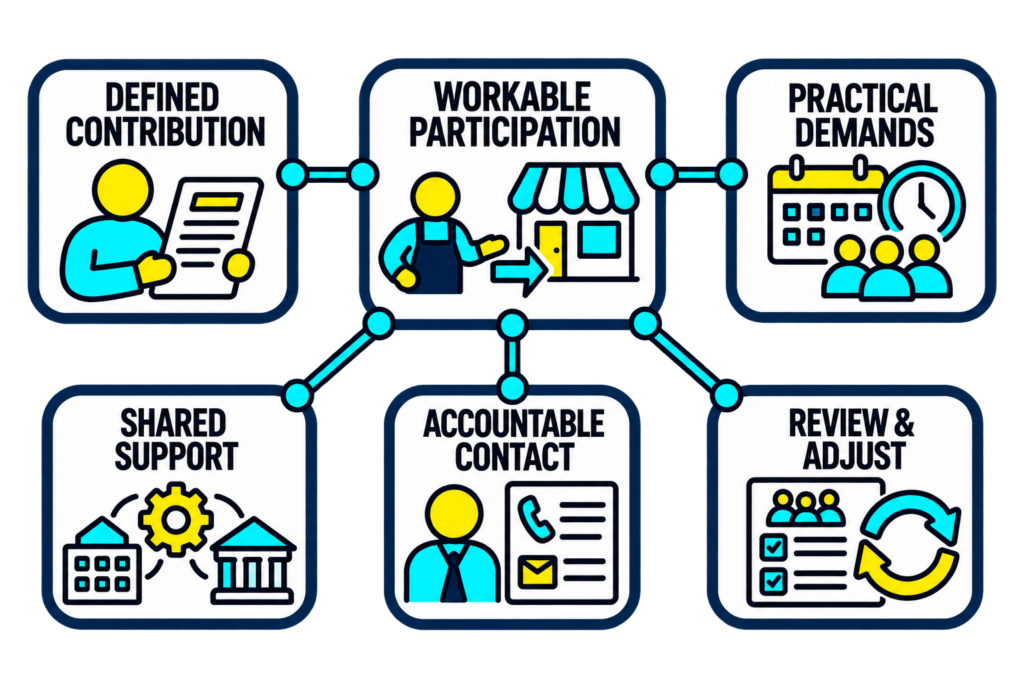
What needs to connect?
Employer purpose
The reason a business would consider involvement and the contribution relevant to its circumstances.
Participation role
The specific activity or responsibility the employer is considering.
Practical demands
The time, staffing, information, preparation, and resources needed to carry out that role.
Available support
The assistance that participating organizations have agreed and are able to provide.
Accountable coordination
The contacts and responsibilities that keep requests, decisions, and handoffs understandable.
Review and change
The conditions that trigger confirmation, adjustment, renewed discussion, or withdrawal.
When participation is difficult to interpret
Employers and partners may be working from different assumptions.
- “Partner” describes several different commitments.
- Attendance is treated as agreement to contribute.
- Every employer receives the same participation request.
- Repeated forms and meetings accumulate.
- Support is discussed without a delivery owner.
- Silence is interpreted without checking circumstances.
These conditions make it difficult to understand whether the participation route is workable.
When participation is clearer
The arrangement gives employers and partners a shared basis for deciding what happens next.
- Available roles have understandable expectations.
- Interest and confirmed commitments remain distinguishable.
- Demands reflect the contribution being requested.
- Contacts and requests are coordinated.
- Support has a named owner and defined scope.
- Employers can revisit their involvement.
This clarity supports more responsible planning and a better conversation about participation.
A practical example: making a role-review contribution workable
A regional manufacturing initiative wants input from small employers on preparation for a priority occupation.
Its existing participation route asks each company to nominate a committee member, attend monthly meetings, and complete a broad questionnaire.
Several owners express interest but do not complete the process.
The workshop begins by identifying the immediate decision: which work activities and entry expectations need employer review before providers revise preparation.
Partners examine what information is necessary for that decision and which requests belong to later stages.
They outline a focused conversation using a short role draft that an employer can review in advance.
A regional intermediary proposes handling scheduling and consolidating questions, subject to confirming staff capacity and employer agreement about how responses will be used.
Employers would receive a summary of their input for confirmation and a clear explanation of any further invitation.
The revised arrangement is tested with a small group, including businesses that did not continue through the original process.
The result is a more specific participation proposal with known responsibilities and open questions. A role-review contribution remains separate from any later decision to host learners or hire.
Shared arrangements need someone to deliver them.
Shared support can reduce demands on individual businesses when the arrangement fits the work.
Examples might include a coordinated employer contact, common preparation materials, consolidated scheduling, or assistance with repeated administrative steps.
Each arrangement still creates responsibilities somewhere in the partnership.
A single contact needs time and authority to respond. A shared request needs agreement about what information is necessary and who may use it.
Partners also need a route for issues that exceed the coordinator’s role.
The workshop makes these dependencies visible so proposed support can be evaluated as an operating arrangement.
Broader access needs more than a shorter form.
Simplifying administration may help some employers participate.
Other businesses may question the initiative’s relevance, lack available staff, face seasonal pressures, or have concerns about how their information will be used.
A familiar intermediary may help establish a conversation, but cannot assume authority to speak for every business.
Different contributions may offer useful entry points, provided their expectations remain clear and the initiative can support them.
Employer feedback is needed to understand whether a proposed change addresses the actual constraint.
The workshop therefore defines changes and validation questions together.
WORKSHOP MODULE 9
Make employer involvement practical enough to sustain.
This module is a focused minicourse and working session. Your team learns how to examine employer participation, applies the method to a selected contribution or entry route, and develops a practical response that can inform a subsequent Gobekli configuration.
What can this module address?
The scope follows the employer population, contribution, and regional decision established through Regional Workforce Direction.
- Employer invitations and introductions
- First contact and entry routes
- Participation roles and expectations
- Employer purpose and intended benefit
- Time and staffing demands
- Preparation and administrative requirements
- Participation arrangements for smaller businesses
- Repeated requests across partners
- Shared coordination and assistance
- Employer contacts and decision authority
- Follow-up and changes in availability
- Routes to pause, decline, or conclude involvement
What kinds of responses might emerge?
The workshop helps identify a response that fits the selected problem and the partners’ actual ability to act.
Clarify
Define the contribution, expectations, intended benefit, and decision the employer is being invited to support.
Simplify
Remove unnecessary steps or reduce requests that do not serve the selected participation role.
Differentiate
Offer understandable participation options with demands proportionate to the contribution.
Coordinate
Align contacts, scheduling, requests, and follow-up across participating organizations.
Support
Specify assistance, shared arrangements, resources, and accountable delivery responsibilities.
Test
Review the proposed route with employers and adjust it using their experience and feedback.
A proposed response becomes dependable only when the relevant organizations confirm responsibilities and employers can assess whether the arrangement works for them.
What will we review?
The selected employer population
Business characteristics, operating conditions, current relationships, and gaps in whose perspective is available.
The contribution and purpose
The activity being requested, why it matters, and what employers and partners expect from it.
The current participation route
Invitations, entry steps, approvals, meetings, information requests, and follow-up.
The demands on employers
Staff time, preparation, scheduling, costs, administrative work, and continuing responsibilities.
Coordination and support
Existing assistance, proposed shared tasks, delivery capacity, and unresolved ownership.
Evidence and validation questions
Available employer feedback, incomplete perspectives, and assumptions the proposed response needs to test.
The working exercise
Your team traces one employer participation route and develops a more workable arrangement around a defined contribution.
STEP 1
Choose the contribution
Identify the employer population, requested role, and decision the contribution should support.
STEP 2
Trace the current route
Follow the experience from invitation through entry, participation, support, and follow-up.
STEP 3
Identify the demands
Make the time, staffing, preparation, information, and decision requirements explicit.
STEP 4
Examine support options
Determine what could change, which tasks might be shared, and who would need to provide the support.
STEP 5
Define the proposed arrangement
Specify the entry route, expectations, contacts, responsibilities, and conditions for adjustment.
STEP 6
Plan employer validation
Identify whom to consult, what to test, and how feedback will inform the next decision.
A draft employer participation arrangement connecting a defined contribution to practical demands, accountable support, and questions for validation.
CONNECTING THE WORK TO A POSSIBLE GOBEKLI SETUP
Turn participation requirements into a configuration brief.
The workshop can establish the relationships, responsibilities, and information a subsequent TalentSync setup would need to support. Configuration scope and available capabilities would be confirmed separately.
A proposed setup might need to connect:
- Employer organizations and relevant contacts
- Participation roles and intended contributions
- Employer purpose and stated constraints
- Invitations and entry requirements
- Interest, proposed involvement, and confirmed commitments
- Responsible partner organizations
- Shared support arrangements and their owners
- Participation status and next steps
- Information-use boundaries and source context
- Review dates and changes in availability
Where an individual’s experience is relevant to a defined contribution, TalentPass or Passport Pages could form part of a separately scoped, voluntary sharing arrangement. This would require a clear purpose and appropriate individual control.
The workshop produces useful decisions and a configuration brief whether or not a subsequent product engagement proceeds.
KEEPING THE WORK FOCUSED
What this module does—and what needs separate work
This module examines how employers enter and contribute to the selected initiative.
It can clarify demands, support, coordination, and a proposal for testing participation arrangements.
Decisions about hiring demand, workplace learning capacity, investment, or formal agreements may require additional modules and the responsible organizations’ review.
The module does not:
- Guarantee employer participation
- Treat interest as a hiring commitment
- Establish work-based learning capacity by itself
- Assume an intermediary represents every employer
- Commit partners to unapproved services or expenditure
- Determine eligibility for public funding or procurement
- Replace legal, contractual, or program-specific review
- Create authority to share employer or individual information
Workshop outputs reflect the evidence and perspectives available during the session.
Employers and responsible partners must validate assumptions and confirm any proposed commitments.
What should you bring?
Bring enough material to examine one actual or proposed employer participation route.
Examples can be redacted or summarized where business-sensitive information is unnecessary.
Useful inputs may include:
- The regional initiative’s purpose and selected decision
- A description of the intended employer population
- Current invitations or partnership descriptions
- Participation roles or committee expectations
- Entry forms and requested documentation
- Meeting schedules and preparation materials
- Employer feedback or reasons for declining
- Partner contact and handoff arrangements
- Examples of repeated requests
- Existing support and coordinator responsibilities
- Known staffing or resource constraints
- Questions requiring employer or partner confirmation
Incomplete information is useful when its limits are visible. The workshop can identify what needs to be learned and who should be involved next.
What can you leave with?
Employer Participation Map
A view of the selected contribution, entry route, participation demands, contacts, and follow-up.
Access & Support Response
A proposed set of changes addressing identified constraints, with delivery responsibilities and dependencies.
Employer Validation Plan
Questions, participants, and review steps for testing whether the proposed arrangement is workable.
Configuration Requirements Brief
The employer, contact, contribution, support, and responsibility relationships a subsequent Gobekli setup would need.
These outputs begin with the example examined during the module. Final scope depends on the modules selected, available inputs, and the decision established through Regional Workforce Direction.
Where might the work lead next?
Employer Demand & Hiring Commitment
Examine the strength, timing, and meaning of employer demand when participation discussions lead to claims about future hiring.
Apprenticeship & Work-Based Learning Capacity
Review work activities, supervision, mentoring, and responsibilities when an employer is considering hosting learners.
Investment, Partner Commitments & Mobilization
Connect proposed shared support to resources, partner decisions, dependencies, and a practical mobilization sequence.
Select additional modules where the participation review reveals a distinct decision that needs deeper examination.
Frequently asked questions
Questions regional partners ask before beginning.
Economic-development organizations, workforce leaders, industry partnerships, chambers, training providers, and regional intermediaries that need a more workable way for employers to contribute.
Bring a specific participation decision, such as how smaller employers will review role requirements, join a working group, or explore a defined contribution. Regional Workforce Direction establishes the scope.
The focus is the participation arrangement that an invitation leads into. Messaging may need revision, but the exercise also examines expectations, demands, support, responsibilities, and follow-up.
The selected initiative may depend on arrangements that assume dedicated staff or administrative resources. This module examines those assumptions with the intended employers rather than treating business size as a complete explanation.
Direct employer involvement can strengthen the exercise. If employers are absent, their perspectives should be represented through available evidence, with proposed changes clearly marked for validation.
Yes. The workshop can examine the route and identify questions to investigate. Nonresponse alone does not explain whether the issue is relevance, timing, trust, capacity, or something else.
Yes, where different roles serve a useful purpose and the partnership can support them. Each option needs clear demands and expectations so employers can make an informed choice.
It can identify duplication and propose coordination. Partners still need to agree which requests can be combined, who manages them, and how the information may be used.
Examples include coordinated scheduling, common preparation materials, consolidated questions, or administrative assistance. The exercise examines whether those arrangements have a capable owner and sufficient resources.
Only where authority and responsibilities have been agreed. A coordinator may organize contact while specific providers or employers retain responsibility for their own decisions.
No. Reviewing a program, attending a meeting, or supporting an activity does not establish a hiring commitment. Employer Demand & Hiring Commitment examines that separate question.
This module can clarify entry and participation expectations. Apprenticeship & Work-Based Learning Capacity examines whether the proposed placement has suitable work, supervision, mentoring, and support.
Yes. The exercise can identify staff time, administrative work, and other resource demands. Funding decisions, eligibility, and detailed financial arrangements require the appropriate separate review.
Use only the information needed for the selected decision, clarify its source and intended use, and identify who may access it. Redacted or summarized examples may be sufficient.
The arrangement should make that route understandable, including whom to contact, what commitments need review, and how affected partners will respond.
It can define requirements for connecting employer contacts, participation roles, contributions, support, and follow-up in a proposed TalentSync configuration. Availability and implementation scope are confirmed separately.
Partners can validate the proposal with employers, confirm support responsibilities, test a selected route, or scope a subsequent implementation. The workshop outputs remain usable independently.
MAKE CONTRIBUTING WORKABLE
Build an employer participation route your partners can support.
Examine what involvement asks of employers and what needs to change for a useful contribution to become practical.
Include Employer Participation & Small-Business Access in a Regional Workforce & Industry Alignment Workshop built around your selected initiative.
