
LEARNING ALIGNMENT WORKSHOP MODULE
Credential Claims & Learning Requirements
What does your credential say a learner has achieved? Connect certificates, badges, degrees, licenses, and other recognitions to the learning, evidence, and requirements behind them—then identify where the claim needs clarification or stronger support.
Does this sound familiar?
The credential promises more than the requirements establish
The title or description suggests a capability that learners are not consistently required to practice or demonstrate.
Completion and demonstrated capability are blurred together
Attendance, participation, submitted work, and assessed performance contribute to recognition without a clear explanation of what each establishes.
Different routes lead to a credential with unclear shared meaning
Electives, transfer credit, prior learning, placements, or delivery variations affect the learning behind the same award.
People cannot see what a badge or certificate represents
A recipient can display the recognition, but learners, employers, or receiving institutions struggle to interpret its scope, criteria, or evidence.
Stacked credentials imply progression that has not been examined
Several badges or certificates combine into a larger recognition without a clear account of integration, additional requirements, or duplicated learning.
Program completion is confused with external authorization
Learners are unsure whether an award recognizes educational completion, prepares them for another assessment, or grants a status controlled by a separate authority.
What are credential claims and learning requirements?
A credential claim is the meaning communicated by a recognition: what someone is said to have completed, demonstrated, achieved, or become eligible to pursue.
Learning requirements describe the knowledge, activities, experiences, assessments, and performance expectations involved in earning that recognition.
Award requirements may also include conditions such as required credits, participation, approved substitutions, or other rules established by the issuing organization. These conditions should be distinguished from the specific learning they are intended to support.
Certificates, badges, degrees, licenses, and other recognitions serve different purposes. A participation badge, an assessed certificate, a degree, and a license should not be assumed to communicate the same kind of achievement.
A useful review identifies the precise claim, who makes it, which requirements support it, and what a reasonable reader can conclude from the recognition.
The credential’s meaning depends on the requirements behind it.
A credential title compresses a substantial learning experience into a few words. Its description, criteria, and supporting information help people interpret what those words mean.
That interpretation can become uncertain when marketing language, curriculum requirements, assessment practices, and award decisions develop separately.
To examine the connection, your team may need to bring together:
- The credential’s title and public description
- The achievement or status it claims to recognize
- The issuer and relevant decision authority
- The learners and audiences who rely on it
- The outcomes and capabilities associated with the claim
- Required courses, activities, and experiences
- Assessment and evidence expectations
- Completion and award rules
- Electives, substitutions, and alternative routes
- The relationship to other credentials or requirements
- Any additional steps needed for an external status
- The scope and limitations of the recognition
- The version of the requirements that applied
- Responsibility for reviewing the claim when learning changes
These connections help participants determine whether the recognition communicates its meaning accurately and whether its requirements support the intended interpretation.
Connect the public claim to the learning and award decision.
Credential Meaning
Title and description
Type of achievement
Intended audience
Scope of the claim
Important limitations
Learning Requirements
Outcomes and capabilities
Courses and activities
Required experiences
Practice and application
Pathway variations
Evidence and Review
Learner work
Observed performance
Assessment criteria
Reviewer responsibility
Evidence limitations
Award Conditions
Completion rules
Required thresholds
Approved alternatives
Issuing authority
Decision records
Interpretation and Use
Learner understanding
Employer interpretation
Further-study relevance
External requirements
Version and currency
A credential becomes easier to interpret when people can see what it recognizes, what earning it required, and which conclusions extend beyond its scope.
How a credential’s promise drifts from its requirements
STAGE 1 — A recognition is defined
The organization establishes a credential around a learning purpose, an audience, and a set of requirements.
STAGE 2 — The learning experience evolves
Courses, activities, assessments, delivery formats, alternatives, and learner pathways change over time.
STAGE 3 — Descriptions and award rules develop separately
Public language, curriculum documents, badge criteria, and completion processes are updated by different people or on different schedules.
STAGE 4 — The meaning becomes difficult to defend or explain
The organization can confirm that a credential was awarded but struggles to connect its current claims to the learning and evidence required of each recipient.
“The learner earned the credential” starts the interpretation.
The award confirms that an issuing organization recognized an achievement or status under its process.
Understanding that achievement requires a closer look at the claim, the requirements, the evidence, and the authority responsible for the decision.
The review should clarify:
Identify whether it recognizes participation, completion, assessed learning, demonstrated capability, a defined status, or a combination. Examine the title and supporting description together.
Separate shared requirements from optional experiences and pathway-specific learning. Identify which parts of the claim are supported across all recognized routes.
Locate the assessments, observations, artifacts, or reviewed records that support the claim. Distinguish an association with an outcome from evidence that recipients were required to demonstrate it.
Examine electives, substitutions, transfer credit, prior-learning recognition, and other approved variations. Determine what shared expectations are preserved and what differences need to remain visible.
Identify the issuer, authorized reviewers, applicable criteria, and the process used to confirm that requirements have been met. Clarify any separate authority involved in an external credential or status.
Consider how learners, employers, receiving institutions, or other audiences interpret the recognition. Look for ambiguity about capability, scope, level, currency, or additional requirements.
Make the meaning of the recognition explicit.
Achievement
State what the credential recognizes: participation, completion, assessed learning, demonstrated performance, or another defined achievement.
Scope
Clarify the subject, capabilities, activities, or responsibilities covered—and where the recognition’s meaning ends.
Level and Context
Explain the complexity, independence, conditions, or application setting reflected in the learning and assessment.
Requirements
Make the learning and award conditions understandable, including how approved variations relate to shared expectations.
Evidence and Authority
Identify what supports the award and who is responsible for reviewing the evidence and issuing the recognition.
Time and Version
Preserve which requirements applied when the credential was earned and any relevant conditions concerning currency or renewal.
Credentials that communicate a clear achievement
A well-supported recognition helps people:
- Understand what the award represents
- Distinguish completion from assessed performance
- Identify the scope and level of the learning
- See the requirements recipients must meet
- Understand relevant variation among pathways
- Locate criteria and appropriate supporting information
- Identify the issuer and award authority
- Recognize limitations and any additional steps
The credential gives its audience a usable account of the achievement.
Claims that deserve closer examination
A recognition needs review when it:
- Uses broad capability language without corresponding requirements
- Implies demonstrated performance from attendance alone
- Treats optional learning as common to all recipients
- Relies on an overall result that hides an essential requirement
- Combines smaller awards without examining their relationship
- Leaves external eligibility or authorization ambiguous
- Applies current descriptions to older awards without context
- Provides too little information to interpret its meaning
These signals identify a need for clarification or investigation. They do not automatically establish that the credential lacks value.
What does a “Data-Informed Decision-Making” certificate require?
Imagine a certificate described as recognizing the ability to evaluate data and make justified recommendations.
Learners complete several short courses. Most assessments test terminology and routine calculations. A final project asks for a recommendation, but learners can pass overall even when their justification is weak.
The review asks which parts of the public claim are supported by the shared requirements. It examines where learners practice evaluation, what the final project reveals, and whether the award rules preserve the importance of justified reasoning.
Possible responses include strengthening the learning, revising an essential assessment criterion, reviewing the award threshold, or narrowing the public description to match what the program currently establishes.
Participants then identify who owns each proposed change and how the relationship between the claim and the requirements will be maintained.
Educational completion, professional certification, and licensure need clear distinctions.
A learning organization may issue its own certificate or degree while preparing learners for a recognition or authorization controlled by another body.
The review should identify what the organization itself awards, what it prepares learners to pursue, and which additional decisions or requirements belong to an external authority.
Where a license or other externally governed status is in scope, participants should work from the relevant authority’s requirements and identify questions that need confirmation from that authority.
The same care applies to stackable credentials. Combining badges or certificates may provide useful recognition, but the larger claim should reflect the actual coverage, progression, integration, and additional requirements involved.
An accurate description helps learners understand the value of the award and the next steps that may remain.
The same credential should have an understandable meaning across its recognized routes.
Learners may complete different electives, placements, concentrations, transfer routes, or prior-learning processes.
Examine which achievement is genuinely shared, which learning varies, and what supporting information should make those differences visible.
The goal is a clear common claim that preserves meaningful detail about the learning behind each recipient’s recognition.
THE MATCHING WORKSHOP MODULE
Module 7: Credential Claims & Learning Requirements
This practical minicourse helps program leaders, faculty, assessment teams, credentialing colleagues, and communications teams examine whether a recognition accurately reflects the learning required to earn it.
Participants learn a repeatable review method and apply it to one selected credential or one consequential claim within a broader award. They connect public language to learning requirements, evidence, pathway variations, and the award decision.
The exercise also identifies the credential, outcome, activity, evidence, and requirement relationships that a subsequent Gobekli configuration would need to maintain.
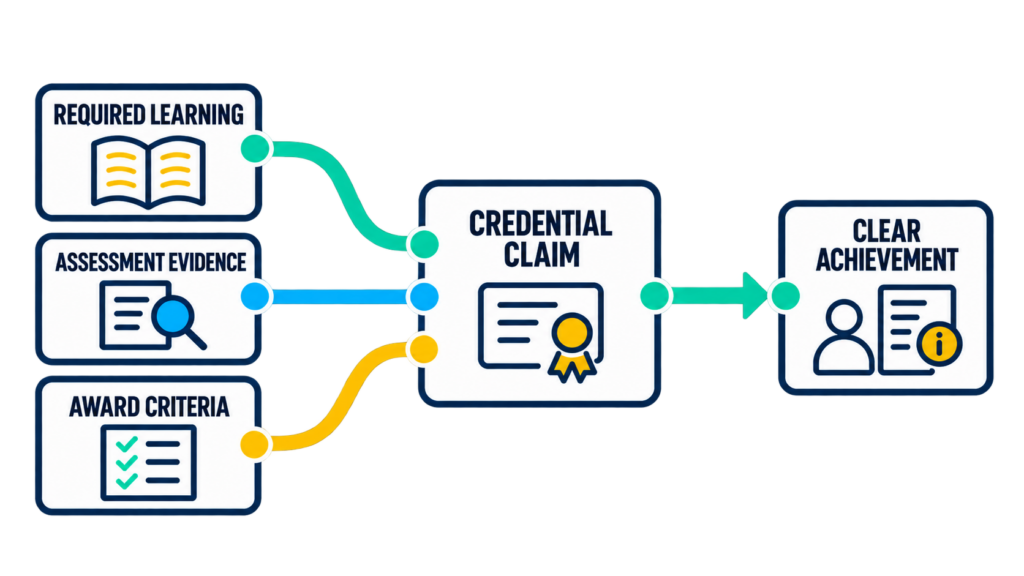
This module helps your team:
- Define the achievement a credential claims to recognize
- Distinguish participation, completion, and demonstrated learning
- Connect important claims to required outcomes and activities
- Examine the evidence supporting those claims
- Review the relationship between assessment and award rules
- Identify requirements shared across recognized pathways
- Examine electives, substitutions, and alternative routes
- Clarify relationships among stacked credentials
- Distinguish institutional awards from external statuses
- Identify unclear or overstated public language
- Develop a focused credential improvement brief
- Outline a connected credential and requirements configuration
What should change when the claim and the requirements do not line up?
Participants identify the specific mismatch before proposing a response. The issue may concern wording, missing learning, insufficient evidence, award conditions, or differences among recognized pathways.
Confirm
Retain the claim where its meaning, requirements, evidence, and award process are sufficiently connected.
Clarify the Claim
Make the achievement, scope, level, limitations, or relationship to an external status easier to understand.
Strengthen the Learning
Address a gap in the required activities, practice, experience, or progression supporting the claim.
Strengthen the Evidence
Improve the assessment or review needed to support an important part of the recognition.
Review Award Rules
Examine thresholds, substitutions, pathway variations, or stacking arrangements that affect the credential’s meaning.
Investigate
Gather additional information where the claim, evidence, authority, or effect of a proposed change remains uncertain.
Several responses may apply to the same credential. Changes to public descriptions, learning requirements, assessment, or award rules should follow the organization’s established review and approval processes.
What should a credential claim and requirements review examine?
The claim
What does the recognition say or imply about the recipient’s achievement, capability, or status?
The learning
Which required outcomes, activities, experiences, and developmental expectations support that meaning?
The evidence
What must recipients demonstrate, and what information supports the judgment?
The award conditions
How are completion, thresholds, substitutions, and other requirements combined in the award decision?
The interpretation
What can learners and other audiences reasonably conclude, and which limitations or additional steps need explanation?
The ownership and review
Who maintains the claim, requirements, supporting information, and decision process as the credential evolves?
Learn the method. Trace one credential claim to its requirements.
Bring one certificate, badge, degree, or other recognition. For a broad award, select one consequential claim that can be examined meaningfully within the session.
STEP 1
Capture the public claim
Read the title, description, criteria, and relevant promotional language. State what the audience is being asked to understand about the recipient.
STEP 2
Define the recognized achievement
Clarify the achievement type, scope, level, context, issuer, and any relationship to an external status.
STEP 3
Trace the learning requirements
Identify the required outcomes, activities, experiences, and pathway conditions supporting the selected claim.
STEP 4
Examine evidence and award rules
Review what recipients must demonstrate and how thresholds, alternatives, and completion conditions affect the award decision.
STEP 5
Test the interpretation
Consider the claim from the perspective of learners and intended audiences. Identify ambiguity, unsupported assumptions, or missing context.
STEP 6
Plan the improvement and configuration
Select a response and record the responsible people, approval needs, review point, and relationships a future implementation would need to maintain.
Participants leave with a reviewed claim, a proposed improvement, and a starting configuration brief. Where the evidence is incomplete, the brief records what needs further review before the claim or requirements change.
- Begin with a specific recognition or claim
- Connect public meaning to shared requirements
- Distinguish completion from demonstrated learning
- Examine pathway variation and award conditions
- Keep issuer and external authority clear
- Assign responsibility for maintaining the connection
FUTURE PRODUCT CONNECTION
Keep the credential connected to the learning it represents.
The workshop identifies the information and relationships needed to maintain a clear connection between credential claims, learning requirements, evidence, and award decisions.
A potential TalentSync EDU configuration could organize those relationships around shared credential, outcome, course, and activity profiles. Appropriate TalentPass connections could help learners carry the recognition alongside relevant context about their own learning.
The proposed configuration could connect:
- Credential profiles: the title, issuer, achievement type, description, scope, and relevant version
- Claim relationships: which outcomes or capabilities the recognition represents
- Learning requirements: the courses, activities, experiences, and progression supporting each claim
- Evidence expectations: what recipients must demonstrate and what reviewers need to examine
- Award conditions: completion rules, thresholds, approved alternatives, and responsible decision roles
- Pathway variations: how electives, concentrations, transfer, and prior learning relate to shared expectations
- Stacking relationships: what smaller recognitions contribute to a broader award and what additional learning is required
- External dependencies: separate assessments, recognition processes, or authority-controlled requirements relevant to interpretation
- Source records: where authoritative descriptions, criteria, and requirements are maintained
- Review history: which changes have been approved and when important relationships were last confirmed
- Learner connections: awarded credentials and relevant experiences or evidence the learner chooses to share
For example, the workshop might identify that a certificate’s public description claims independent problem-solving while its award rules permit completion without a successful independent demonstration. An implementation brief could specify the claim, required capability, learning activity, assessment expectation, award condition, responsible reviewers, and version affected by an approved change.
With the learner’s participation, TalentPass could help organize the credential alongside relevant learning experiences, capabilities, artifacts, and stories. Different profile views could present appropriate detail for further study, employment, or another learner-selected purpose.
The next step is a scoped implementation conversation: select the initial credential, confirm available capabilities, identify integration or development needs, and agree on responsibilities and success criteria.
PRODUCT AND DECISION BOUNDARIES
Preserve the meaning, evidence, and authority behind the award.
A connected configuration should make credential relationships easier to understand and maintain.
Its design should preserve the distinction between:
- A credential being issued and its learning claims being adequately supported
- A technically verifiable record and an educational judgment about its meaning
- Completing requirements and demonstrating every capability associated with a program
- Recognizing prior learning and assuming all experiences are equivalent
- Combining credentials and establishing a broader or more advanced achievement
- Preparing for an external status and receiving that status
- A learner sharing a credential and granting access to all underlying evidence
Authorized issuers and reviewers remain responsible for award decisions. External authorities retain responsibility for the statuses and requirements they control.
The product connection described here includes capabilities envisioned for TalentSync EDU and potential TalentPass connections. Availability, configuration needs, integrations, and required development would be confirmed during scoping.
The workshop produces a useful credential review and improvement brief independently of product adoption.
What to bring into the conversation
Start with one recognition whose meaning matters to learners or another audience. For a degree or broad qualification, choose a specific claim or requirement relationship to examine.
A useful starting question is: “What would someone reasonably believe this learner can do—and what was required to support that belief?”
Useful inputs may include:
- The credential title and public description
- Badge or certificate criteria
- Relevant promotional and advising language
- Program and course outcomes
- Required courses and learning activities
- Experiential or practical requirements
- Assessment tasks and rubrics
- Examples of expected performance
- Appropriately shared evidence of learner work
- Completion and award rules
- Required thresholds and essential criteria
- Elective and concentration arrangements
- Transfer and substitution practices
- Prior-learning recognition processes
- Relationships to smaller or larger credentials
- Relevant external authority requirements
- Learner and audience questions
- Issuer and reviewer responsibilities
- Previous versions or recent changes
- The decision the review should support
The required Learning Alignment Direction module establishes the scope and decision this work should support. Related modules can help clarify uncertain outcomes, missing curriculum coverage, or assessment relationships affecting the selected claim.
The depth of the exercise depends on the available evidence and the time allocated within the selected workshop.
What this module can help your team produce
A reviewed credential claim
A clear statement of the achievement, scope, context, and limitations communicated by the selected recognition.
A claim-to-requirements map
A documented connection among the claim, required learning, evidence expectations, pathway variations, and award conditions.
A practical improvement brief
A proposed response, responsible people, approval needs, and a review point for evaluating the change.
A starting configuration brief
An outline of the credential profiles, learning relationships, evidence expectations, award rules, source records, and review responsibilities a subsequent Gobekli implementation would need.
These outputs begin with the credential or claim reviewed during the module. Final scope depends on the modules selected, available inputs, and the alignment decision established through Learning Alignment Direction.
Where might the work lead next?
A credential review may reveal an outcome that needs clearer meaning, learning that is not consistently required, or an assessment that does not support the intended claim.
Outcome & Capability Clarity
Define the knowledge, actions, context, and level behind the achievement your credential describes.
Curriculum Coverage & Progression
Examine where the required learning develops and whether recognized pathways provide coherent preparation.
Learning Activities & Assessment Alignment
Review whether the required activities and assessments develop and reveal the capabilities the credential claims.
Questions institutions ask before beginning.
A credential claim is what a recognition communicates about its recipient’s achievement or status. It may concern participation, completion, assessed learning, demonstrated capability, or another defined result. The title and supporting information shape how that claim is interpreted.
Learning requirements are the outcomes, activities, experiences, assessments, and performance expectations involved in earning a recognition. They should be examined alongside any additional conditions used in the award decision.
Not necessarily. A completion certificate may recognize that specified requirements were finished. A claim about demonstrated capability needs appropriate performance expectations and evidence. The meaning depends on the actual criteria, not the label alone.
Yes. Participation can be worth recognizing when it is described accurately. The problem arises when the wording leads an audience to infer assessed performance or capability that participation alone does not establish.
The badge’s format does not, by itself, establish the quality of its educational claim. Its usefulness depends on the issuer, criteria, required learning, assessment, and supporting information.
That module examines whether a particular activity and assessment develop and reveal the intended capability. This module examines the broader recognition: which claims the credential makes and whether the combined learning and award requirements support them.
Yes, using an appropriately bounded question. A session might examine one important graduate claim, a concentration, a capstone requirement, or the shared meaning of an award across selected pathways.
Identify what every recipient must achieve and what varies by choice. The credential’s common claim should reflect shared expectations, while appropriate supporting information can describe additional learning.
Examine how recognized alternatives address the relevant requirements through the institution’s established processes. Record what supports the decision and where the learner’s route differs from the standard sequence.
No. A stacking arrangement should explain coverage, overlap, progression, integration, and any additional requirements. The broader recognition needs a clear basis for the achievement it claims.
Clarify who controls the status and which requirements apply. Distinguish the organization’s educational award from any separate assessment, application, or authorization. Questions about external requirements should be confirmed with the relevant authority.
Preserve the version and requirements applicable to the award. Review whether current descriptions could misrepresent earlier achievements and identify what contextual information should remain available.
Sometimes clearer wording is the appropriate response. In other cases, the organization may need to strengthen learning, evidence, or award conditions to support an intended claim. The review identifies which connection needs attention.
Include people who understand the credential’s purpose, design the required learning, assess performance, confirm completion, issue the award, and maintain public descriptions. External-authority questions may require additional qualified input.
The reviewed example identifies the credential profiles, claims, learning requirements, evidence expectations, award conditions, source records, and review responsibilities that need to remain connected. These become the starting point for scoping a potential TalentSync EDU configuration and appropriate TalentPass connections.
No. The review method and improvement brief are useful independently. A subsequent implementation can be considered if your organization wants help maintaining credential relationships or connecting recognition to appropriate learner-controlled context. Product availability and implementation requirements are confirmed during scoping.
MAKE THE ACHIEVEMENT BEHIND THE AWARD CLEAR
Connect what the credential says to what earning it requires.
Examine the claim, trace the learning and evidence, and identify where the recognition needs clearer meaning or stronger support. Leave with a focused improvement and a starting configuration brief.
This module is part of Gobekli’s configurable Learning Alignment Workshop. Begin with Learning Alignment Direction, then select the modules that address your organization’s particular challenges.
