
LEARNING ALIGNMENT WORKSHOP MODULE
Framework & Requirement Crosswalks
What does the mapping actually establish? Relate institutional outcomes to external frameworks and requirements, then clarify the interpretation, evidence, gaps, and responsibilities behind each important connection.
Does this sound familiar?
The crosswalk is complete, but the rationale is missing
Rows and checkmarks connect outcomes to requirements without explaining the relationship or why the mapping is appropriate.
Similar wording is treated as a sufficient match
Two statements share keywords, but differences in scope, level, context, or expected performance remain unexamined.
A learning outcome is used to answer a different kind of requirement
A requirement about a process, resource, responsibility, or institutional practice is mapped to an outcome that cannot establish whether it is met.
Evidence is listed without showing what it supports
Documents are attached to a requirement, but reviewers cannot readily locate the relevant information or understand its limitations.
Each external framework creates another disconnected spreadsheet
Teams repeat mapping work across reference points without a clear way to maintain the shared institutional outcomes and supporting sources.
A revised requirement leaves the old mapping in place
The external reference or institutional curriculum changes, but the organization cannot readily identify which relationships need review.
What are framework and requirement crosswalks?
A crosswalk documents relationships between two sets of statements, expectations, or reference points.
In learning organizations, it may relate institutional outcomes to accreditation expectations, professional standards, licensure requirements, transfer frameworks, or other external references.
The relationship may involve comparable learning, partial coverage, a contribution to a broader expectation, or a connection that still requires interpretation.
External references also contain different kinds of statements. Some concern learner knowledge or performance. Others concern processes, resources, responsibilities, documentation, or organizational conditions.
A useful crosswalk identifies what kind of relationship is being proposed and what information supports it.
The mapping helps people organize and explain their review. Any formal determination depends on the applicable requirements, evidence, and authorized decision process.
A line between two statements needs an explanation.
Institutional outcomes and external expectations often organize ideas at different levels of detail.
One external statement may draw on several institutional outcomes. One institutional outcome may contribute to several reference points without fully addressing any of them on its own.
To make an important mapping understandable, your team may need to connect:
- The purpose of the crosswalk
- The external source and applicable version
- The scope in which the expectation applies
- The type of requirement or reference statement
- The institutional outcome or response being mapped
- The meaning of key terms
- Differences in scope, level, and context
- The proposed relationship between the statements
- Relevant courses, activities, or organizational practices
- The evidence needed for the particular expectation
- The supporting information currently available
- Gaps, limitations, and unresolved questions
- Reviewers and decision responsibilities
- Changes that should trigger reconsideration
These connections help participants explain what a mapping supports and what still needs examination.
Connect the external expectation to an appropriate institutional response.
External Reference
Source and authority
Applicable version
Requirement identifier
Scope and conditions
Meaning of the expectation
Institutional Response
Outcomes and capabilities
Courses and activities
Processes and practices
Resources and responsibilities
Relevant source records
Mapping Relationship
Direct correspondence
Partial contribution
Combined coverage
Meaningful differences
Unresolved interpretation
Evidence and Review
Required information
Supporting sources
Relevant passages or examples
Reviewer judgment
Evidence limitations
Ownership and Maintenance
Mapping responsibility
Decision authority
Recorded rationale
Change dependencies
Review triggers
A useful crosswalk makes the relationship, its support, and its limits visible enough for someone else to understand and review.
How a crosswalk loses its meaning
STAGE 1 — A reference is selected
The organization identifies an external framework or requirement set relevant to a particular review or decision.
STAGE 2 — Connections are recorded
Teams map institutional outcomes, courses, documents, or practices to the external statements.
STAGE 3 — The explanation remains incomplete
The mapping records the connection but leaves its meaning, supporting evidence, assumptions, or review status unclear.
STAGE 4 — The crosswalk is reused beyond what it supports
An earlier relationship is treated as current, complete, or conclusive even though its scope or supporting information has changed.
“Mapped” should have an understandable meaning.
A mapping can be a useful starting point for a review.
Its value depends on what the relationship means, what supports it, and whether the people using it understand its status.
The review should clarify:
Define the decision or question the work should support. A curriculum comparison, internal gap review, preparation for an external review, and transfer discussion may require different information.
Identify the source, version, scope, and relevant conditions. Record any uncertainty about applicability and who needs to resolve it.
Determine whether the statement concerns learning, performance, a process, a resource, an organizational condition, or a combination. Select an institutional response appropriate to that expectation.
Explain whether the institutional response addresses the expectation directly, contributes partially, works in combination with other responses, or requires further interpretation.
Identify the relevant information and explain how it supports the mapping. Distinguish an intended outcome, a designed learning opportunity, evidence of implementation, and evidence of learner performance.
Clarify who interprets the expectation, reviews the supporting information, records the decision, and responds when either side changes.
Examine each important mapping across six dimensions.
Applicability
Confirm the reference, version, scope, and conditions relevant to the selected question.
Meaning
Interpret what the external statement asks for and what the institutional statement actually describes.
Relationship
Explain the nature and extent of the connection, including partial or combined contributions.
Support
Identify the learning, practice, process, resource, or other institutional response relevant to the expectation.
Evidence
Locate the information needed to examine the relationship and distinguish what is available from what is still missing.
Judgment and Ownership
Record the rationale, review status, responsible people, and circumstances requiring another look.
Differences that may still support a useful relationship
A mapping may remain appropriate despite differences in:
- Terminology used by the institution and external source
- The order in which ideas are presented
- The grouping of capabilities into outcomes
- The distribution of learning across several courses
- Examples or application settings
- The format of the supporting documentation
- The location of evidence across several sources
- Additional institutional learning beyond the external expectation
The review explains how those differences affect the meaning and extent of the relationship.
Mappings that deserve closer examination
Attention is needed when:
- Shared keywords conceal different performance expectations
- A broad outcome is assumed to address every part of a detailed requirement
- A partial contribution is presented as complete coverage
- A course description is treated as evidence of learner achievement
- A learning statement is used to answer a process or resource requirement
- The supporting document does not address the relevant expectation
- Several mappings repeat the same unsupported assumption
- The source version or applicability is unclear
These signals identify where the mapping needs clarification, better support, or a different institutional response.
“Communicates effectively” may support only part of an external expectation.
Imagine an external learning expectation asking graduates to communicate technical recommendations to different audiences and explain the limitations of their conclusions.
The institution maps its outcome, “Communicates effectively,” to that statement.
The wording suggests a relationship, but the review needs to examine what the institutional outcome means in practice.
Participants identify relevant assignments, audiences, criteria, and examples. They ask where learners explain limitations and whether that expectation is required or merely possible within the activity.
The resulting crosswalk may document a supported contribution, identify another outcome or assessment needed to complete the relationship, or record a gap requiring attention.
The useful result is an explanation that another reviewer can follow.
Some requirements need a different institutional response.
An external reference may ask for evidence of learner performance in one statement and an organizational process or resource in another.
Mapping both statements to a program outcome can obscure the difference.
Participants should identify the appropriate response for each expectation. That response might involve an outcome and assessment, a documented review process, a resource arrangement, a defined responsibility, or several connected elements.
The evidence should fit the question. A policy may describe an intended process; understanding its implementation may require additional records. An assessment design may show what learners are asked to demonstrate; examining achievement may require reviewed learner evidence.
A useful crosswalk helps teams route the expectation to the right information and the right people.
Preserve the institution’s purpose while making external relationships clear.
An institution may pursue outcomes that extend beyond a selected external framework.
It may also express its educational purpose in language that is meaningful to its learners, faculty, and community.
The crosswalk should make relevant connections understandable while preserving that purpose and recording where the external reference has a narrower, broader, or different scope.
THE MATCHING WORKSHOP MODULE
Module 11: Framework & Requirement Crosswalks
This practical minicourse helps academic leaders, faculty, assessment teams, and colleagues responsible for external requirements build clearer and more reviewable crosswalks.
Participants learn a repeatable method and apply it to one selected external expectation or a small, related group. They examine applicability, interpret the requirement, identify the institutional response, and document the relationship and supporting evidence.
The exercise also identifies the external reference profiles, institutional outcomes, response relationships, source records, and review responsibilities that a subsequent Gobekli configuration would need to maintain.
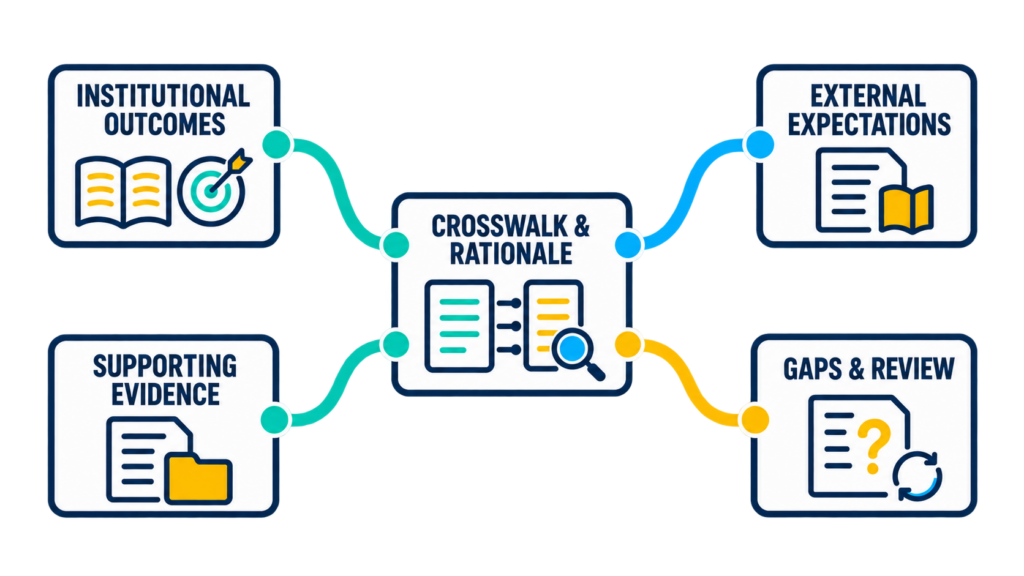
This module helps your team:
- Define the purpose and scope of a crosswalk
- Identify the relevant source and version
- Distinguish different kinds of external expectations
- Interpret scope, level, and contextual differences
- Clarify direct, partial, and combined relationships
- Connect expectations to appropriate institutional responses
- Distinguish intended learning from evidence of achievement
- Locate supporting information and explain its relevance
- Record gaps, assumptions, and unresolved questions
- Clarify reviewer and decision responsibilities
- Develop a focused crosswalk improvement brief
- Outline a connected framework and requirements configuration
What should happen when the mapping is unclear or incomplete?
Participants identify which part of the relationship needs attention before proposing a response. The issue may concern interpretation, coverage, evidence, applicability, or ownership.
Confirm the Relationship
Document the meaning, scope, and support for a mapping that withstands review.
Clarify the Interpretation
Resolve ambiguity about the external expectation, institutional response, or relationship between them.
Identify Additional Contributions
Locate other outcomes, activities, processes, or resources needed to address the expectation.
Strengthen the Evidence
Find or develop the information needed to examine the proposed relationship meaningfully.
Address a Gap
Define a response where the relevant institutional learning or practice does not yet address an applicable expectation.
Refer for Determination
Bring unresolved applicability or interpretation questions to the people or authority responsible for deciding them.
A proposed mapping or improvement should retain its review status. Formal decisions about external requirements remain within the relevant authorized processes.
What should a framework and requirement crosswalk review examine?
The review purpose
What decision or question is the crosswalk intended to support?
The external expectation
Which source, version, requirement type, scope, and conditions apply?
The institutional response
Which outcomes, learning experiences, processes, resources, or responsibilities are relevant?
The relationship
What does the mapping mean, how much does it address, and what differences matter?
The supporting information
What evidence supports the relationship, where is it located, and what remains uncertain?
The ownership and maintenance
Who interprets, reviews, records, and updates the mapping when the source or institutional response changes?
Learn the method. Build one crosswalk relationship that others can review.
Bring one external expectation and the institutional outcome or response currently associated with it. Where the statement contains several connected parts, select a scope that participants can examine meaningfully.
STEP 1
Establish the source and purpose
Record the reference, version, applicability, and decision the crosswalk should support.
STEP 2
Interpret the expectation
Identify what is being asked for, including its type, scope, level, conditions, and any questions requiring clarification.
STEP 3
Identify the institutional response
Locate the relevant outcomes, activities, assessments, processes, resources, or responsibilities.
STEP 4
Describe the relationship and evidence
Explain the direct, partial, or combined contribution. Identify supporting sources and what each one establishes.
STEP 5
Review gaps and uncertainty
Examine missing coverage, insufficient evidence, differences in meaning, and unresolved interpretation. Record a proposed response and review status.
STEP 6
Plan ownership and configuration
Assign follow-up responsibilities, identify change triggers, and outline the profiles and relationships a future implementation would need to maintain.
Participants leave with a documented mapping, a proposed next action, and a starting configuration brief. The record distinguishes supported findings from questions requiring further evidence or authorized interpretation.
- Begin with a defined source, version, and purpose
- Match the institutional response to the expectation
- Explain the nature and extent of the relationship
- Connect evidence to the claim it supports
- Preserve uncertainty, review status, and authority
- Identify who responds when either side changes
FUTURE PRODUCT CONNECTION
Keep external requirements connected to institutional learning and evidence.
The workshop identifies the information and relationships needed to explain and maintain an important crosswalk.
A potential TalentSync EDU configuration could connect external reference statements to institutional outcomes, learning experiences, organizational responses, supporting sources, and review responsibilities.
The proposed configuration could connect:
- External reference profiles: the framework or requirement set, source, version, identifiers, and applicable scope
- Requirement types: whether each statement concerns learning, performance, processes, resources, responsibilities, or other conditions
- Institutional profiles: the outcomes, capabilities, courses, activities, or organizational responses being mapped
- Mapping relationships: the nature, extent, rationale, and conditions of each connection
- Combined contributions: how several institutional responses work together to address a broader expectation
- Supporting sources: relevant documents, criteria, records, examples, and the locations of important information
- Evidence status: what has been examined, what it supports, and what remains missing or uncertain
- Review responsibilities: the people contributing interpretation, evidence, academic judgment, or authorized decisions
- Gap and action records: proposed responses, ownership, dependencies, and follow-up dates
- Version and change relationships: which mappings may need review when the external source or institutional response changes
- Learner connections: relevant learning experiences, credentials, and appropriately shared evidence where individual context is useful
For example, the workshop might identify that an external expectation is only partially addressed by a mapped program outcome. An implementation brief could specify the expectation, the existing contribution, an additional learning activity, relevant assessment evidence, an unresolved interpretation, and the responsible reviewer.
Where an individual learning record is relevant, TalentPass could help a learner organize and selectively share experiences, credentials, and supporting context. An individual record would contribute only what it establishes; institutional processes and external determinations require their own appropriate evidence and authority.
The next step is a scoped implementation conversation: select the initial reference and institutional scope, confirm available capabilities, identify integration or development needs, and agree on responsibilities and success criteria.
PRODUCT AND DECISION BOUNDARIES
Keep the mapping, evidence, and determination distinct.
A connected configuration should help people understand the relationship and the basis for reviewing it.
Its design should preserve the distinction between:
- Similar wording and an adequately supported relationship
- Partial contribution and complete coverage
- An intended outcome and evidence of learner achievement
- A documented process and evidence of its implementation
- An internal interpretation and an external determination
- A proposed mapping and a reviewed mapping
- An earlier requirement version and the currently applicable reference
- An individual learning record and evidence of an institutional condition
Institutional reviewers retain responsibility for their judgments and records. External authorities retain responsibility for the determinations within their scope.
The product connection described here includes capabilities envisioned for TalentSync EDU and potential TalentPass connections. Availability, configuration needs, integrations, and required development would be confirmed during scoping.
The workshop produces a useful crosswalk review and improvement brief independently of product adoption.
What to bring into the conversation
Start with one mapping that matters to an upcoming decision, is difficult to explain, or may need revision.
A useful starting question is: “What does this expectation require, how does our institutional response relate to it, and what supports that relationship?”
Useful inputs may include:
- The selected external framework or requirement
- Its source and applicable version
- Relevant identifiers and definitions
- Applicability guidance or scope conditions
- The purpose of the crosswalk
- Existing mapping documents
- Institutional learning outcomes
- Relevant course and program descriptions
- Learning activities and assessments
- Assessment criteria or performance expectations
- Relevant institutional processes or practices
- Resource and responsibility records
- Supporting documents and evidence locations
- Appropriate examples of reviewed learner work
- Previous interpretations or review comments
- Known gaps or incomplete mappings
- Recent source or curriculum changes
- Questions requiring external clarification
- Reviewer and decision responsibilities
- The decision the review should support
The required Learning Alignment Direction module establishes the scope and decision this work should support. Related modules can help clarify institutional outcomes, curriculum coverage, or the evidence expected from assessment.
The depth of the exercise depends on the selected requirement, available sources, relevant reviewer participation, and time allocated within the workshop.
What this module can help your team produce
An interpreted requirement brief
A clear account of the selected expectation, source, version, applicability, and questions requiring clarification.
A documented crosswalk relationship
An explanation of the institutional response, the nature and extent of its contribution, supporting evidence, and review status.
A practical gap and review plan
A proposed next action with responsible people, missing information, decision dependencies, and a review point.
A starting configuration brief
An outline of the external references, institutional profiles, mapping relationships, evidence sources, reviewer roles, and change dependencies a subsequent Gobekli implementation would need.
These outputs begin with the expectation and relationship reviewed during the module. Final scope depends on the modules selected, available inputs, and the alignment decision established through Learning Alignment Direction.
Where might the work lead next?
A crosswalk review may reveal an institutional outcome that needs clearer meaning, learning that is not sufficiently covered, or an assessment that does not establish the relevant expectation.
Outcome & Capability Clarity
Define the knowledge, actions, context, and level behind the institutional outcomes being mapped.
Curriculum Coverage & Progression
Examine where the relevant learning develops and whether required pathways provide sufficient opportunities to build it.
Learning Activities & Assessment Alignment
Review whether activities and assessments develop and reveal the learning needed to support an important relationship.
Questions institutions ask before beginning.
A crosswalk documents relationships between two sets of statements or expectations. In this module, it connects an external reference to institutional learning or another relevant institutional response.
The method can support work involving accreditation expectations, professional standards, licensure requirements, transfer frameworks, and other reference points. Participants bring the applicable source and define the question the review should support.
No. A completed mapping shows that a relationship has been recorded. Its meaning depends on the interpretation, institutional response, supporting evidence, and relevant review or determination process.
They can suggest a possible connection, but the review should examine meaning, scope, level, context, and the type of expectation. Similar language can conceal important differences.
Yes. A broader expectation may draw on several outcomes, experiences, or other responses. The crosswalk should explain their combined contribution and identify anything still unaddressed.
Yes. The same outcome may contribute to several reference points. Each relationship still needs an appropriate interpretation, scope, and supporting rationale.
State which part is addressed, what supports that conclusion, and what remains outside the relationship. Avoid using a single checkmark in a way that hides those limits.
Identify the institutional response appropriate to that expectation. A learning outcome alone may not answer a question about an organizational process, responsibility, or resource.
That depends on the expectation. Relevant sources may include assessment information, reviewed learner work, implementation records, process documentation, or other appropriate material. The crosswalk should explain what each source supports.
Curriculum mapping examines relationships within the learning design, such as where outcomes develop across courses. This module examines the relationship between institutional learning or practice and an external reference point.
That module compares learning across institutions or programs to support a defined recognition decision. This module focuses on interpreting and relating external framework statements or requirements to institutional responses.
Preserve the version used in the earlier mapping and identify which relationships depend on the changed statement. Review the impact before treating an earlier mapping as applicable to the new version.
Software may help organize statements and suggest candidate relationships. Those suggestions require appropriate interpretation and review, particularly where scope, applicability, evidence, or formal determinations matter.
Include people who understand the external reference, the institutional outcomes or practices, and the relevant evidence. Depending on the example, this may include faculty, assessment colleagues, program leaders, and staff responsible for external requirements.
The reviewed example identifies external reference profiles, institutional responses, mapping relationships, supporting sources, reviewer roles, and change dependencies that need to remain connected. These become the starting point for scoping a potential TalentSync EDU configuration and appropriate TalentPass connections.
No. The review method and improvement brief are useful independently. A subsequent implementation can be considered if your organization wants help maintaining crosswalk relationships and supporting context. Product availability and implementation requirements are confirmed during scoping.
MAKE EACH IMPORTANT MAPPING EXPLAINABLE
Show the relationship—and what supports it.
Interpret the expectation, connect the appropriate institutional response, and make the evidence and remaining questions visible. Leave with a reviewed crosswalk relationship and a starting configuration brief.
This module is part of Gobekli’s configurable Learning Alignment Workshop. Begin with Learning Alignment Direction, then select the modules that address your organization’s particular challenges.
