Aaliyah enters a state-supported advanced-manufacturing apprenticeship at 22.
She will spend the next several years moving between classroom instruction, supervised work, technical assessments, safety training, mentoring, and progressively more difficult assignments. She will earn wages while she learns and finish with a recognized credential and experience in a high-demand industry.
The pathway is designed to connect learning and work.
The records describing that pathway are not.
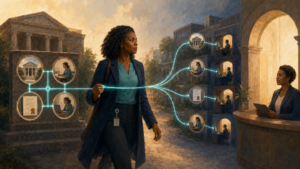
Her training provider records attendance, coursework, and assessments. Her employer tracks assignments and performance. Credential issuers verify safety and technical certifications. The apprenticeship agency records participation and completion.
Each organization sees part of Aaliyah’s development.
Aaliyah is the only person who experiences it as a whole.
Completion does not tell the full story of an apprenticeship
A traditional record can confirm that Aaliyah completed the program and earned its credential. That matters, but it does not show how her capability developed along the way.
It cannot fully explain:
What she first learned in the classroom
Where she applied it on the job
Which assignments she gradually became trusted to perform
How supervisor feedback changed her work
What problems she learned to solve independently
How her technical and human capabilities developed together
What evidence demonstrates her readiness
Where she may be able to progress next
The employer may understand these details because it watched Aaliyah develop. Another employer, education provider, or licensing agency sees only the final credential and whatever Aaliyah can reconstruct on a resume.
That limits the portability of the apprenticeship’s value.
The credential verifies completion. Aaliyah also needs a trusted account of what the experience taught her to do.
Aaliyah begins building the record while she learns
At the beginning of the apprenticeship, Aaliyah connects with the state program through its Passport Page and creates her TalentPass.
TalentPass gives her a private, portable place to bring together the records and experiences produced across the apprenticeship. It does not replace the employer’s systems, the training provider’s student records, or the state’s official program administration.
It connects their contributions around the apprentice.
Pythia helps Aaliyah understand the pathway ahead:
Related classroom instruction
Required hours and workplace experiences
Technical competencies
Safety and industry credentials
Progressive responsibilities
Supervisor feedback
Evidence she can collect
The credential earned at completion
Instead of seeing the apprenticeship as one distant finish line, Aaliyah can see how learning, work, and increasing responsibility connect.
Classroom learning gains meaning on the job
During the first part of her apprenticeship, Aaliyah studies technical drawings, measurement, materials, equipment safety, and the fundamentals of the production process.
A classroom assessment confirms that she understands the concepts. Her first workplace assignment gives them meaning.
Working with an experienced mentor, Aaliyah prepares a production setup using a technical drawing. She measures materials, checks tolerances, follows the safety procedure, and verifies the setup before work begins.
Afterward, Pythia helps her reflect on the connection.
Pythia: “You studied tolerances in class and applied them during today’s setup. What did you have to notice in the workplace that was not obvious from the classroom example?”
Aaliyah describes the condition of the material, the limitations of the equipment, and the decision to stop and confirm one measurement before proceeding.
The training provider verifies the related instruction. The employer or mentor validates that she performed the workplace activity. Aaliyah adds context about what she noticed, decided, and learned.
The classroom record and workplace experience no longer sit in separate systems without reference to one another.
They become one development story.
Progress becomes visible before completion
As Aaliyah advances, she is trusted with more difficult assignments.
At first, she observes and assists. Later, she completes portions of the work under close supervision. Eventually, she plans and performs an assignment independently before asking a mentor to verify the result.
Her TalentPass can show this progression without reducing it to a generic proficiency score.
A profile may connect:
The task she was asked to perform
The level of responsibility she held
The technical knowledge required
The safety procedures followed
Evidence of the completed work
Supervisor or mentor validation
The outcome
What she is ready to attempt next
This helps Aaliyah understand that development is more than accumulating hours. She can see how experience changes the shape and depth of her capabilities over time.
It also makes mentor feedback more useful. Instead of receiving disconnected comments, she and her mentor can discuss them in relation to previous work and future responsibility.
The apprentice becomes an active participant in her development
Apprenticeship programs can become administratively complex. Hours, competencies, assessments, credentials, wages, and employer requirements all have to be tracked.
That structure is necessary, but the apprentice should not experience the program only as a set of requirements being tracked about her.
Pythia gives Aaliyah an active role.
Before a new assignment, it can help her:
Review the related learning
Understand what success requires
Identify questions for her mentor
Recall relevant prior experience
Prepare to collect appropriate evidence
After the assignment, it can help her:
Reflect on what happened
Document her contribution
Connect the work to competencies
Request supervisor validation
Identify what she still needs to practice
Update a profile showing her progress
Aaliyah is not being passively measured by several institutions. She is building intelligence she can use to guide her own development.
Employers gain a clearer view of the apprenticeship experience
The employer knows whether Aaliyah reports to work and completes assigned tasks. But supervisors may struggle to see how workplace assignments connect to classroom learning, program requirements, and the apprentice’s broader progression.
Through an employer Passport Page, appropriate information can move between the participating organizations with Aaliyah’s knowledge and consent.
A supervisor can understand:
What related instruction Aaliyah recently completed
Which competencies she is prepared to practice
What experience she has already documented
What evidence or validation the program requires
Where she needs a new opportunity to demonstrate growth
This makes it easier to give Aaliyah meaningful work rather than keeping her on the same limited tasks because those tasks are convenient.
It also helps the employer communicate emerging needs back to the training provider and state program.
If several employers find that apprentices understand a technical concept but struggle to apply it in a particular environment, that becomes useful program intelligence—not merely an individual performance issue.
Completion becomes a beginning rather than an ending
When Aaliyah finishes the apprenticeship, she receives the recognized credential confirming completion.
Her TalentPass adds the context surrounding it.
She can create a professional profile that shows:
The credential and its issuing source
Related technical and safety credentials
The work processes she understands
Examples of increasingly complex assignments
Evidence of completed work
Mentor and supervisor validation
The technical and human capabilities she developed
The level of responsibility she earned
Areas in which she wants to continue growing
A future employer does not have to guess what the apprenticeship involved. An education provider can better understand the learning and experience she brings. A licensing or certification body can identify relevant verified components. Aaliyah can continue adding to the same record as her career develops.
The apprenticeship becomes part of a portable professional identity rather than a credential left behind in a program database.
The state learns where pathways are working
The state apprenticeship agency needs to understand more than enrollment and completion.
It needs to know whether programs are giving apprentices meaningful workplace experience, whether instruction aligns with current practice, whether employers are providing progressive responsibility, and whether participants are moving into sustainable careers.
With appropriate governance, consent, and aggregation, TalentSync can help program leaders understand:
Which competencies lack sufficient opportunities for practice
How mentor engagement affects persistence
Which credentials support advancement
Where employer needs are changing
Which programs produce strong employment and wage progression
Where access and completion differ across populations or regions
This intelligence can help states improve program quality without turning the apprentice’s private TalentPass into a government surveillance record.
Aaliyah controls her personal record. Participating organizations remain authoritative for the records they issue. The state receives the program-level intelligence it is authorized to use.
Better feedback can improve the pathway for everyone
Aaliyah’s employer begins using a new production technology midway through her apprenticeship. The related instruction does not yet address it, and mentors are teaching apprentices informally as they encounter the equipment.
Because employers and apprentices can contribute structured feedback, the training provider sees the gap sooner.
The state convenes participating employers, instructors, and apprentices. They update the relevant learning module, identify appropriate workplace activities, and establish a clear way to document the new capability.
The pathway adapts before an entire cohort completes outdated instruction.
That creates a continuous improvement loop:
The training provider introduces knowledge.
Aaliyah applies it through real work.
Her employer observes how well the learning transfers.
Aaliyah documents what she experienced and learned.
The program identifies gaps between instruction and practice.
Employers, educators, apprentices, and the state improve the pathway.
The next apprentice receives a stronger experience.
The system learns because the people participating in it can contribute intelligence while the work is happening.
An apprenticeship should produce more than a final credential
Aaliyah’s credential is important. It provides trusted recognition that she completed a rigorous pathway.
But the full public value of the apprenticeship includes much more:
The capabilities she developed
The wages she earned while learning
The mentoring relationship
The work she contributed
The responsibility she grew into
The evidence she created
The professional identity she began building
The clearer talent pathway available to future apprentices
TalentPass allows Aaliyah to carry that value forward. Passport Pages connect the organizations contributing to it. Pythia helps her understand and actively participate in her own growth. TalentSync helps employers, providers, and the state improve the pathway together.
Aaliyah does not leave the apprenticeship with only proof that she finished.
She leaves with a trusted account of what she can now do—and a foundation that continues growing with her career.
Denise’s official job classification captures only part of the judgment and institutional knowledge she has built through 17 years of public service. Better human intelligence helps the state connect that ...
Sofia’s return to work depends on training, childcare, transportation, and healthcare transitions. TalentPass helps her coordinate the pathway without giving every program access to her complete life.
Casey’s military records document 11 years of service, but civilian employers cannot easily see the work and judgment inside them. TalentPass helps her carry that value into a new career ...
Andre completed education, credentials, work, and reentry planning before release. A resident-owned TalentPass helps ensure that progress does not disappear when he returns home.
Mara’s state can count jobs, programs, credentials, and workers—but still cannot see clearly how they fit together. A resident-owned human intelligence layer reveals the transitions and targeted investments the workforce ...
Nia has an active license, years of experience, and verified credentials—but moving to another state forces her to reconstruct the entire record. A portable, trusted licensing profile can preserve both ...