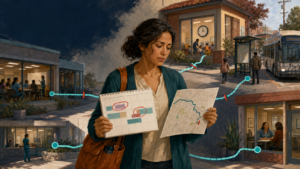
Mara directs workforce strategy for a state investing heavily in advanced manufacturing, healthcare, clean energy, infrastructure, and AI-enabled industries.
Employers across the state say they cannot find enough qualified people. Education and training providers are expanding programs. Workforce agencies are helping residents enter new pathways. Economic-development leaders are recruiting companies that promise thousands of jobs.
The state has data about all of it.
Mara can see projected job openings, unemployment claims, program enrollments, credential completions, occupational licenses, wage records, and employer surveys.
Yet when state leaders have to make decisions, some of the most important questions remain unanswered:
Which capabilities already exist among the state’s residents?
Where is experienced talent being underused?
Which workers could move into priority industries with limited additional training?
What are employers actually asking people to do?
Which credentials represent capabilities being applied in the workplace?
Where do residents encounter barriers along otherwise viable pathways?
Which regions and populations are being left behind?
What should the state invest in next?
The state can count jobs, programs, credentials, and workers.
It cannot yet see clearly enough how they fit together.
Workforce data describes the system in pieces
Each public system holds an important part of the picture.
Education agencies know which programs people enter and complete. Workforce agencies know which services participants receive. Licensing boards know who is authorized to practice regulated occupations. Unemployment systems record claims and reemployment. Wage records help the state measure employment outcomes. Employers describe demand through job postings, surveys, and direct engagement.
These records are valuable, but they were created for different purposes. They use different definitions, measure different moments, and often describe people through transactions rather than capability.
A credential-completion record can show that someone finished a program. It does not necessarily show what that person can now do.
A job posting describes what an employer says it needs. It may not accurately reflect the work people perform after hiring.
A wage record can show that someone is employed. It does not explain which capabilities enabled the transition or whether public training contributed to it.
An unemployment claim can show that someone lost a job. It does not reveal how much of that person’s experience could transfer into another industry.
The state possesses a large amount of workforce data without possessing a complete understanding of its workforce.
The missing intelligence often belongs to the people themselves
Residents know things about their own development that no single institution can see.
They know:
What they actually did in a job
Which responsibilities they gradually earned
What they learned outside formal programs
Where they applied a credential
Which barriers interrupted a pathway
What kind of work they want next
What capabilities they have not had an opportunity to use
Which public or community resources helped them move forward
This information is often collected informally during counseling, interviews, surveys, performance reviews, or applications. It is then reduced to notes, stored in separate systems, or lost when the person moves to another organization.
The state cannot solve this by constructing a more comprehensive centralized profile about every resident.
People need a source of truth that serves them first.
TalentPass gives residents a private, portable place to connect work, learning, credentials, evidence, goals, and reflection. Pythia helps them build and use that intelligence for their own decisions and opportunities.
The information remains valuable even when the resident changes jobs, schools, programs, agencies, or regions.
Passport Pages connect the ecosystem without forcing it into one system
A statewide workforce ecosystem includes many legitimate systems of record. Those systems do not all need to be replaced or collapsed into a single database.
Passport Pages create trusted connections between residents and the organizations participating in their development.
A community college can provide education and credential records. A workforce agency can provide program participation and career resources. A licensing board can verify professional status. An employer can validate selected work or contribution. A training provider can issue a credential. A regional workforce board can connect residents to local pathways.
Each organization remains authoritative for its own records.
The resident decides which organizations to connect with and what information to share for a particular purpose. An employer does not need access to benefit information. A training provider does not need a resident’s complete work history. A workforce agency does not automatically receive everything stored in TalentPass.
The architecture can be connected without making the person transparent to every institution in it.
Mara sees a workforce transition that occupational data obscured
A large distribution employer announces that it will close two facilities in the western part of the state. More than 1,100 people will be displaced.
At the same time, several advanced-manufacturing employers in the region report difficulty filling operations, maintenance, quality, and production-coordination positions.
Traditional occupational analysis makes the two workforces appear significantly different. The job titles, industry codes, and technical environments do not match.
Aggregated, permission-based TalentPass intelligence reveals more overlap.
Many displaced workers have experience coordinating complex workflows, responding to equipment disruptions, enforcing safety procedures, training new employees, using inventory and planning systems, troubleshooting quality problems, and communicating across shifts and departments.
They are not immediately qualified for every manufacturing role. But many are much closer than their job titles suggest.
TalentSync helps state and regional leaders see:
Which capabilities are common across the displaced workforce
Which manufacturing roles require similar human and operational capabilities
Which technical gaps recur most often
Which gaps can be addressed through short bridge programs
Which workers face transportation, scheduling, childcare, or other barriers
Which employers are willing to validate and refine the pathway
Where existing training already meets the need
Where a new regional response is necessary
Mara: “We thought we were looking at an unemployed distribution workforce and an unrelated manufacturing shortage. We are actually looking at a transition the state can help complete.”
The state builds a bridge around the talent it already has
Mara convenes the regional workforce board, affected workers, participating employers, a community college, labor representatives, and community organizations.
They do not begin by designing a broad new training program.
They begin with the transition itself.
Employers clarify what the target roles actually require. Workers describe the operational responsibilities contained within their prior jobs. The college maps the technical gaps. Community organizations identify barriers that could prevent otherwise qualified residents from completing the pathway.
Together, they develop several targeted bridges:
Manufacturing orientation for workers entering the industry
Short training in production-planning systems
Equipment-specific instruction
Recognized safety or quality credentials
Work-based assessments
Transportation support
Employer interviews connected to pathway completion
Residents do not have to repeat learning they already possess. Employers do not have to lower standards. Public investment focuses on the difference between existing capability and new opportunity.
The state can see where the pathway breaks
Even a well-designed pathway does not work equally for everyone.
Enrollment numbers may initially look strong, but TalentSync reveals that participants from two rural counties are completing the classroom instruction and then dropping out before employer interviews.
The technical program is working. The regional pathway is not.
Further feedback shows that the manufacturing facilities operate on schedules poorly aligned with available transportation. Several residents also need more clarity about shift requirements before committing to the program.
The state and regional partners respond by:
Providing schedule information earlier
Coordinating transportation support
Adding employer conversations before enrollment
Creating an alternative cohort aligned with a different shift
Engaging an employer closer to the affected counties
The state does not wait until an annual report shows lower placement rates. It can learn where the pathway is failing while there is still time to improve it.
Employers contribute more useful demand intelligence
Job postings are an imperfect expression of workforce demand. They often combine reused language, inflated requirements, broad skill lists, and preferences that may not reflect the work’s real priorities.
Through employer Passport Pages and TalentSync, participating employers can contribute structured role and capability information grounded in the work itself.
The state can better distinguish between:
Requirements that are legally or operationally essential
Capabilities that can be developed after hiring
Credentials employers genuinely use
Experiences that transfer across industries
Technical gaps requiring formal training
Human capabilities employers repeatedly struggle to find
Regional differences in work and demand
Employers also gain something in return: clearer pathways, better-prepared candidates, and a public workforce system that can respond more precisely to actual needs.
This makes demand signaling a reciprocal process rather than another survey employers complete for the state.
Education and training providers see what happens after completion
Providers frequently receive delayed or incomplete information about how graduates fare in the workplace.
Employment and wage outcomes matter, but they do not tell instructors which parts of a program transferred successfully, where graduates struggled, or how employer needs have changed.
Permission-based feedback can help providers understand:
Which learning graduates apply most frequently
What workplace experiences reinforce the curriculum
Which capabilities need more practice
Where credentials lack sufficient context
Which employers provide strong advancement pathways
What new technologies are changing the work
Whether shorter or stackable bridges would serve residents better
Providers can improve programs using information from the people applying the learning—not only broad labor-market projections.
Public leaders gain a better basis for investment
Mara still uses traditional workforce and economic data. A human intelligence layer does not replace unemployment statistics, wage records, job projections, credential registries, program reporting, or employer research.
It helps connect and interpret them.
State leaders can ask more useful questions:
What talent already exists in a region targeted for economic development?
Which declining and growing industries share transferable capabilities?
What limited bridges could unlock mobility?
Which programs produce applied capability, not only completion?
Where do public-service and support gaps interrupt pathways?
Which populations are not benefiting from investment?
What do residents and employers say is changing in the work?
Which interventions deserve expansion?
Public funding can become more precise because the state understands more of the distance between people and opportunity.
Statewide intelligence must remain governed and trustworthy
A living map of state talent could easily become intrusive if designed around institutional access rather than resident agency.
Gobekli’s model depends on clear boundaries:
Residents own and control their TalentPass.
Organizations remain authoritative for the records they issue.
Passport Page requests have defined purposes.
Residents know what they are sharing and what they receive.
Sensitive information remains separated from unrelated uses.
Aggregated insight should not expose individual records.
Public decisions continue to follow applicable law, policy, and human oversight.
Talent intelligence should expand opportunity, not automate exclusion.
The objective is not to score every resident or create a government dossier.
It is to give people continuity while helping authorized public leaders understand patterns the fragmented system currently misses.
Trust is not an additional feature. It is the condition that makes better intelligence possible.
A state can become more self-aware without becoming centralized
Mara’s state does not need one enormous platform that owns every education, employment, licensing, and workforce record.
It needs a shared layer through which trusted information can move and become more useful.
Residents build portable talent intelligence that serves their own goals.
Schools, agencies, credential issuers, and employers contribute trusted records.
Partners use those patterns to improve pathways and investments.
Residents experience better support and create new intelligence through what happens next.
The state’s existing systems continue performing their official functions. Gobekli helps them participate in a more coherent relationship around the resident.
A state’s greatest workforce asset is the talent its people already possess
Economic-development strategies often begin with projected demand: the employers a state hopes to attract, the occupations expected to grow, and the credentials it wants more residents to earn.
Those are important signals.
But a state should also begin with what its people have already learned, built, solved, and contributed.
Some of that talent is active and visible. Some is buried inside job titles. Some was developed in another industry. Some has not been used recently. Some is disconnected from formal credentials. Some is ready to move with only limited additional support.
A statewide human intelligence layer helps the state see more of it.
Mara can make better decisions because residents, employers, educators, and public agencies are no longer contributing disconnected fragments to separate conversations.
Together, they can understand the state’s talent as a living system—and help more people move toward where the economy is going next.
Denise’s official job classification captures only part of the judgment and institutional knowledge she has built through 17 years of public service. Better human intelligence helps the state connect that ...
Sofia’s return to work depends on training, childcare, transportation, and healthcare transitions. TalentPass helps her coordinate the pathway without giving every program access to her complete life.
Casey’s military records document 11 years of service, but civilian employers cannot easily see the work and judgment inside them. TalentPass helps her carry that value into a new career ...
Andre completed education, credentials, work, and reentry planning before release. A resident-owned TalentPass helps ensure that progress does not disappear when he returns home.
Aaliyah’s apprenticeship connects classroom learning with real work, but the records remain scattered across different organizations. A portable TalentPass helps her carry the whole experience forward.
Nia has an active license, years of experience, and verified credentials—but moving to another state forces her to reconstruct the entire record. A portable, trusted licensing profile can preserve both ...