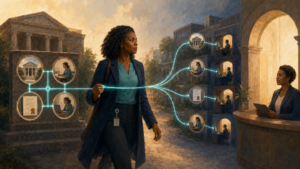
She began in a regional benefits office and gradually became one of the people colleagues rely upon when a case is unusually complicated. She understands policy, recognizes patterns across programs, helps newer employees learn the work, and can explain difficult processes to residents who are frustrated or confused.
Her official position description captures only part of that value.
Now the agency is introducing AI-assisted tools that will automate portions of document review, data entry, and routine case processing. Leaders expect the technology to reduce administrative work and allow employees to focus on more complex service.
But that outcome will not happen automatically.
The agency knows which tasks the new system can perform. It does not yet have a clear picture of how thousands of employees’ roles should change, which capabilities they already possess, what support they need, or where experienced people like Denise could contribute more.
The technology roadmap is becoming clear.
The human transition is not.
Government knows where employees sit, but not always what they can do
States maintain extensive information about their workforce:
Job classifications
Position descriptions
Agency and department assignments
Compensation and tenure
Required licenses and credentials
Training completions
Performance processes
Retirement eligibility
Open positions
These records are essential for administering a large public workforce.
They do not necessarily show the complete intelligence contained within it.
A job classification may not reveal that Denise:
Informally mentors new employees
Recognizes recurring problems across cases
Translates policy into language residents understand
Coordinates effectively with other programs
Identifies when a process is creating unnecessary harm
Helps supervisors understand frontline conditions
Has become highly skilled at de-escalating difficult interactions
Wants to contribute to service and process redesign
These capabilities may never appear in the systems used for workforce planning.
When leaders redesign work around AI, they risk planning from formal positions and transaction data while overlooking the people who understand how the work actually happens.
AI changes tasks before it changes job titles
The agency’s new AI tools can help organize documents, identify missing information, summarize case histories, and support routine correspondence.
That does not mean Denise’s job simply disappears.
Some tasks will take less time. Others will become more important:
Reviewing unusual cases
Exercising policy judgment
Identifying errors or inappropriate recommendations
Communicating with residents
Coordinating across programs
Escalating systemic problems
Improving the workflows surrounding the technology
Teaching colleagues how to use the tools responsibly
Contributing frontline feedback to system design
The agency needs to understand the changing combination of human and technical work.
If it focuses only on automation, it may eliminate tasks without redesigning roles. Employees experience uncertainty, managers improvise expectations, and the organization fails to capture the value the technology was supposed to create.
The real transformation is not the introduction of the tool.
It is the reorganization of work around people and machines.
Denise builds a clearer picture of her contribution
The state invites employees to use TalentPass as a private place to organize their professional experience, credentials, learning, interests, and goals.
Denise remains in control of her individual TalentPass. It is not automatically converted into a management surveillance profile.
Pythia helps her reflect on the work she performs beyond the formal position description.
Pythia: “Which parts of your job require the most judgment?”
Denise describes a case in which information from two programs appeared to conflict. The automated process would have produced an incomplete answer. Denise recognized the issue, contacted a colleague in another agency, clarified the resident’s circumstances, and helped resolve the case correctly.
Pythia helps her document:
The situation
The policies and systems involved
The judgment she exercised
The people she coordinated
The resident outcome
What the experience demonstrates
What could be improved in the process
The story makes several capabilities visible: systems thinking, policy interpretation, cross-agency coordination, human communication, and responsible review of automated processes.
These capabilities are valuable not only in Denise’s current role, but across the state.
The agency creates a profile of the changing work
The agency uses TalentSync to build a structured profile of what the benefits role is becoming.
Leaders, managers, frontline employees, labor representatives, technology teams, and service-design professionals contribute to the process.
They identify:
Tasks the AI system can assist
Decisions that require human authority
Risks requiring review
Resident interactions needing empathy and explanation
New responsibilities created by the technology
Capabilities employees need to develop
Evidence that would demonstrate readiness
Feedback the agency needs from frontline use
The resulting profile is not simply a rewritten job description produced by the technology vendor.
It is a living view of the relationship between the role, the people performing it, the public outcomes it serves, and the systems now supporting it.
Denise can compare her selected TalentPass profile with this changing work and see that she already possesses many of the capabilities becoming more important.
Employees help design the transition
The state creates a Passport Page for the role-transformation initiative.
Employees receive clear information about:
What is changing
Why the technology is being introduced
Which decisions remain human
What the agency needs to learn
What training and development will be available
How employees can contribute feedback
What information will and will not be used in employment decisions
Denise chooses to contribute selected experience and participate in a guided Pythia conversation about the new workflow.
She explains that one AI-generated summary regularly obscures the distinction between two program categories. Other employees report a similar issue.
The technology team can correct the system. The policy team can clarify guidance. The training team can add an example. Managers can adjust the review process.
Employees are not merely being trained to accept a new tool.
They are contributing the human intelligence required to make it work.
A changing role creates a new internal opportunity
As the implementation progresses, the agency realizes it needs a small team of service-quality specialists who can review difficult cases, identify patterns, improve workflows, and help employees use the new system responsibly.
The role requires:
Deep knowledge of public programs
Cross-agency coordination
Process analysis
Resident-centered communication
Training and facilitation
Responsible AI review
The ability to translate frontline experience into system improvement
Denise has never held a formal service-design or quality-assurance title.
Her TalentPass shows that she has been performing many related activities for years.
Pythia helps her create an internal-opportunity profile connecting her experience to the new role. She includes selected work stories, training, peer validation, and evidence of process improvement.
Denise: “I thought moving into this kind of work would require leaving the agency or starting over.”
Pythia: “Your current title does not describe all the work you have already been doing. Let’s show the relevant experience and identify the gaps that remain.”
Denise needs additional training in process mapping, data interpretation, and responsible AI governance. The state offers a focused development pathway rather than requiring her to complete a broad program unrelated to her actual gaps.
When public employees cannot see pathways beyond their current classifications, many leave government to grow.
The state loses experience that is difficult to replace:
Knowledge of policy and implementation
Understanding of residents and communities
Relationships across agencies
Awareness of recurring system failures
Credibility with colleagues
Practical judgment built over years of service
Internal mobility allows that intelligence to move into new areas of need.
TalentSync can help authorized leaders identify employees whose selected profiles align with:
Emerging roles
Cross-agency projects
Temporary assignments
Leadership development
Mentoring
New technology implementation
Service redesign
Hard-to-fill positions
Succession needs
This should not become a hidden system for ranking employees or assigning people to roles they did not choose.
Employees need visibility into opportunities, a way to express interest, and a fair process for demonstrating readiness. Civil-service rules, collective-bargaining agreements, classification systems, accessibility requirements, and human review continue to govern employment decisions.
Talent intelligence makes more relevant information available within those processes. It does not replace them.
Retirement risk becomes a knowledge-transfer opportunity
Denise’s agency also has a significant number of employees approaching retirement.
Traditional workforce planning can identify the positions likely to become vacant. It has more difficulty identifying the practical knowledge that may leave with each person.
TalentSync can help teams build succession and knowledge-transfer profiles around critical work:
Which decisions depend on accumulated judgment
Which relationships are essential
Which processes are poorly documented
Which employees possess overlapping experience
Which newer workers need exposure before a retirement occurs
What mentoring, documentation, or temporary assignments could reduce the gap
Experienced employees can use Pythia to help articulate what they know without being asked to write an exhaustive manual from scratch.
Newer employees gain guided opportunities to apply that knowledge in context.
The state does not merely fill the position after someone leaves. It intentionally carries more of the intelligence forward.
Public leaders gain a living view of workforce capacity
A state may have tens of thousands of employees spread across agencies, regions, classifications, and professions.
TalentSync can help authorized leaders understand aggregate patterns such as:
Capabilities concentrated in one agency but needed in another
Emerging gaps created by AI and policy change
Employees interested in internal mobility
Roles facing retirement risk
Training that produces applied capability
Underused talent within existing classifications
Regions with persistent hiring difficulty
Human capabilities becoming more important as routine tasks automate
Opportunities for cross-agency teams and shared services
This creates a more dynamic view than a traditional organization chart.
But the individual and organizational views must remain distinct. The state should not gain unrestricted access to everything employees place in TalentPass. Passport Pages define what information is requested for a particular employment relationship or opportunity. Employees choose what to contribute where choice is appropriate and understand when official employment records govern.
Organizational self-awareness should not come at the cost of individual agency.
Better workforce intelligence can improve service to the public
The purpose of public-sector talent transformation is not simply to make government more efficient.
It is to improve how government serves people.
When Denise moves into the service-quality role, she helps the agency:
Identify recurring sources of resident confusion
Improve AI-assisted case summaries
Design clearer escalation rules
Strengthen employee training
Connect policy teams with frontline experience
Reduce unnecessary handoffs
Preserve human judgment in consequential decisions
Measure whether changes improve resident outcomes
Her value was present before the new role existed.
The state simply lacked a reliable way to see it, develop it, and connect it to the work that needed it.
AI transformation becomes a continuous human feedback loop
The state’s AI tools will continue changing. So will policy, resident needs, staffing, and the nature of public work.
A one-time training program will not be enough.
The state needs a continuous loop:
Agencies define the outcomes and responsibilities of changing work.
Employees contribute frontline experience and identify risks.
TalentSync helps leaders see capability, gaps, and emerging roles.
TalentPass and Pythia help employees understand their own development and options.
Passport Pages provide governed exchanges of resources, feedback, opportunities, and selected talent information.
Employees receive targeted learning and move into new responsibilities.
Their experience improves the technology, workflow, and public service.
The organization learns and adapts again.
This is how AI can increase the capacity of public employees rather than simply reduce the number of tasks assigned to them.
Government should be able to grow its own talent
Denise did not suddenly become capable of service design, responsible AI review, and cross-agency improvement when the new position was created.
Those capabilities had been developing through years of public service.
Her title could not express them. The organization chart could not locate them. The learning system could not connect them to the agency’s emerging need.
Gobekli helps make that intelligence usable.
TalentPass gives Denise a private, portable source of truth about her work and development. Pythia helps her understand and articulate what she has learned. Passport Pages connect her with state opportunities, resources, and guided feedback. TalentSync helps public leaders understand how the workforce is changing and where existing people can grow into new work.
The state does not have to choose between adopting new technology and protecting its workforce.
It can use better human intelligence to redesign work, develop people, and improve public service at the same time.
Sofia’s return to work depends on training, childcare, transportation, and healthcare transitions. TalentPass helps her coordinate the pathway without giving every program access to her complete life.
Casey’s military records document 11 years of service, but civilian employers cannot easily see the work and judgment inside them. TalentPass helps her carry that value into a new career ...
Andre completed education, credentials, work, and reentry planning before release. A resident-owned TalentPass helps ensure that progress does not disappear when he returns home.
Mara’s state can count jobs, programs, credentials, and workers—but still cannot see clearly how they fit together. A resident-owned human intelligence layer reveals the transitions and targeted investments the workforce ...
Aaliyah’s apprenticeship connects classroom learning with real work, but the records remain scattered across different organizations. A portable TalentPass helps her carry the whole experience forward.
Nia has an active license, years of experience, and verified credentials—but moving to another state forces her to reconstruct the entire record. A portable, trusted licensing profile can preserve both ...