
MEMBER ENGAGEMENT WORKSHOP MODULE
Lapsed Participation & Re-Engagement
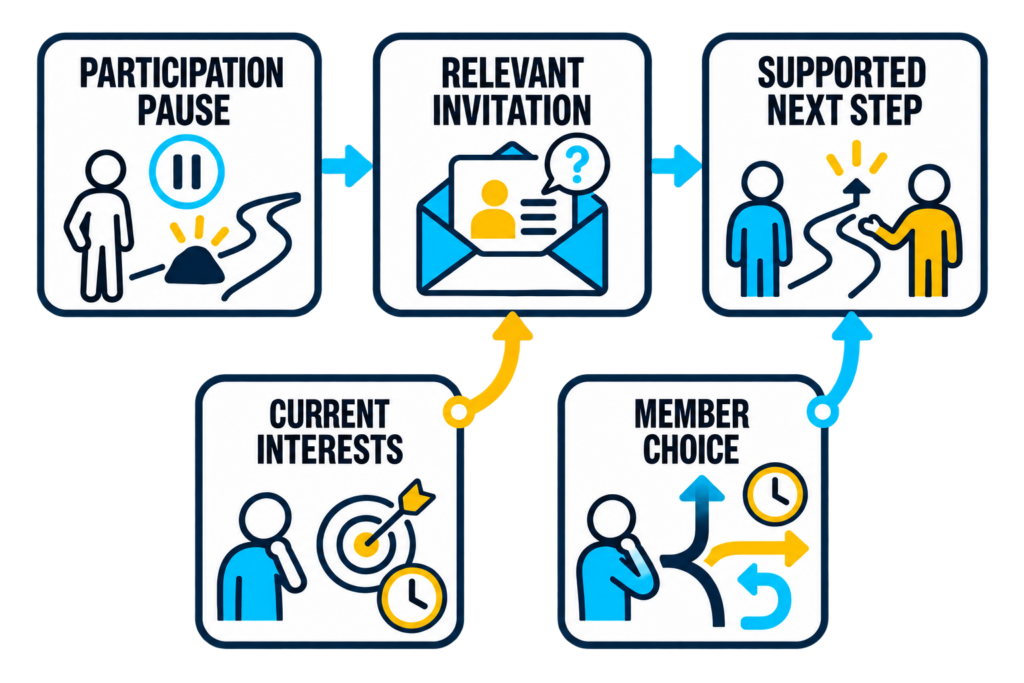
Participation can pause while a member’s interests, circumstances, or availability change. Examine interrupted participation and define a respectful route back, with a relevant next step and room to choose another direction.
Does this sound familiar?
Silence becomes a conclusion
A gap in attendance or activity is treated as lost interest, even when the organization has little information about what changed.
The same invitation keeps returning
Members receive reminders for an experience that may no longer fit their goals, schedule, or preferred way to participate.
Returning means starting over
A member must repeat orientation, explain earlier involvement, or navigate an unfamiliar process without help understanding what has changed.
Earlier difficulties remain unresolved
An invitation to return arrives before the organization has addressed the confusing entry, unsupported experience, or practical barrier that interrupted participation.
Several teams pursue the same member
Program staff, chapters, and community teams contact independently, without a shared understanding of preferences or follow-up responsibilities.
Success stops at the response
The organization counts replies or registrations but does not examine whether the member reached a useful experience or received needed support.
What are lapsed participation and re-engagement?
Lapsed participation describes an interruption in a particular activity or participation pattern, within a defined period and source context.
It does not, by itself, explain why the interruption occurred.
A member may have completed what they needed, changed roles, encountered a difficulty, become unavailable, or continued participating somewhere the organization cannot see.
Re-engagement concerns whether and how to offer a relevant route into participation again.
This module examines one interrupted participation route and helps your team define an appropriate invitation, supported return, alternative, or pause.
A route back begins with what fits now.
A member’s previous participation can provide useful context.
It cannot establish what they want today.
Someone who regularly attended a discussion group may now need a practical resource. A former volunteer may welcome a smaller contribution. A member who stopped a learning program may need a different format or more time.
The organization needs a way to acknowledge previous involvement while making current choices understandable.
A practical review connects what is known about the interruption to an invitation the member can evaluate and a next step the organization can support.
See the complete route from interruption to a new choice.
Participation Context
Previous activity
Expected participation pattern
Time period and source
Known completion or pause
Gaps in available information
Current Relevance
Member-selected interests
Changed goals or circumstances
Available opportunities
Appropriate commitments
Options requiring validation
Contact and Choice
Contact preferences
Reason for the invitation
Clear next action
Another option or later timing
An understandable way to decline
Return and Support
What has changed
Entry or readiness requirements
Useful previous context
Responsible support contact
An achievable first step
Follow-Through
Whether the route was usable
Member feedback
Unresolved difficulties
Updated participation choices
Appropriate pause or conclusion
The route becomes more useful when the organization can explain why it is reaching out, what returning involves, and how the member can choose what happens next.
How a participation pause becomes a repeated outreach cycle
STAGE 1 — Participation changes
A member stops attending, contributing, or continuing within a particular activity.
STAGE 2 — The record becomes a label
An activity gap is described as disengagement without enough context to explain the change.
STAGE 3 — Familiar invitations are repeated
Teams send reminders based on the previous activity, with limited consideration of current relevance or earlier difficulties.
STAGE 4 — The response reveals little
A click, silence, or one-time return is recorded without clarifying whether the member found a workable next step.
An activity gap does not explain the member’s decision.
A participation report can answer an important question:
Who has not taken part in this activity during the selected period?
A re-engagement review also examines whether participation was expected to continue, what the organization knows about the interruption, and whether contact would serve a useful purpose for the member.
The review should clarify:
Identify the specific activity, expected pattern, time period, and source. Avoid treating a gap in one program as absence from the whole organization.
Distinguish interrupted participation from a completed experience, seasonal activity, finished responsibility, or agreed pause.
Separate member-provided context, observed difficulties, and organizational assumptions. Record what remains unknown without filling the gaps with a presumed explanation.
Review the member’s expressed preferences, recent contact, the purpose of the invitation, and any known reason to pause outreach.
Identify a useful return experience or alternative. Explain its purpose, requirements, commitment, and any changes that address an earlier difficulty.
Assign responsibility for replies, entry questions, assistance, and follow-through. Define how a decline, later preference, or lack of response will be handled.
A respectful route back needs six forms of clarity.
Context
The team knows which participation pattern changed and what the available records can establish.
Relevance
The invitation offers a next step that may serve a current member purpose.
Choice
Members can return, explore another option, defer, decline, or update their preferences.
Readiness
The organization explains what returning requires and what has changed.
Support
A responsible contact helps the member act on the invitation and resolve difficulties.
Closure
Follow-up has a defined boundary, including when to pause or conclude contact.
A supported return
A route back becomes easier to evaluate when it provides:
- A clear reason for the invitation.
- An understandable account of the opportunity.
- Relevant changes since earlier participation.
- Visible requirements and commitments.
- A responsible person or team for help.
- Practical choices about what happens next.
The member can decide whether the experience fits and receive support acting on that decision.
A repeated reminder
Outreach can become unhelpful when it relies on:
- An assumption that silence means lost interest.
- The same invitation regardless of circumstances.
- A vague request to “get involved again.”
- Unresolved difficulties from the earlier experience.
- Separate follow-up from several teams.
- Continued contact without a clear stopping point.
The review identifies what needs to change before another invitation becomes useful.
A former volunteer may need a different way to contribute.
An association notices that several members have stopped participating in a recurring volunteer group.
The team selects one route back for review.
Some earlier volunteers completed an agreed term. Others described difficulty with the meeting schedule. For several people, the reason for the interruption is unknown.
The team separates these situations before deciding whom to contact and for what purpose.
For members who previously expressed a scheduling difficulty and remain open to contact, the organization considers a smaller contribution that can be completed without attending the recurring meeting.
The invitation explains the task, expected time, available support, and how it differs from the earlier role.
Members can express interest, ask a question, choose a later time, or decline.
A receiving contact owns the replies and helps interested members begin.
The result is a specific return option to test, supported by clear responsibilities and no assumption that every former volunteer wants to resume.
A completed experience does not need to be reopened.
Some participation is intended to end.
A member may finish a course, complete a project, serve a term, or receive the help they sought.
The review asks whether there is an unfinished participation need before treating the absence as a problem.
A further opportunity may still be useful, but its relevance should be explained on its own terms.
The organization can acknowledge a completed contribution without implying that the member owes continued activity.
This distinction helps teams focus re-engagement work on appropriate situations.
A member can remain connected while choosing less activity.
Participation changes as work, family responsibilities, interests, and availability change.
A member may prefer occasional resources, a different group, a smaller contribution, or a period without invitations.
Those choices can inform a more appropriate relationship with the organization.
The review considers how members can express them without repeatedly explaining personal circumstances.
It also defines what the organization can realistically honor and how preferences reach the teams responsible for contact.
A useful outcome may be a return, a different form of participation, or an understood pause.
THE MATCHING WORKSHOP MODULE
Module 12: Lapsed Participation & Re-Engagement
This practical minicourse helps membership organizations examine interrupted participation and define respectful routes back that account for changing interests, circumstances, preferences, and availability.
Participants learn a repeatable review method, apply it to one selected participation route, and identify whether the priority response concerns context, relevance, contact, return requirements, support, or a pause.
The exercise also defines the participation context, member choices, opportunity information, receiving responsibilities, and follow-up boundaries that a subsequent Gobekli configuration would need to support.
This module helps your team:
- Define one interrupted participation pattern.
- Distinguish interruption from completion or seasonality.
- Examine available context and information gaps.
- Review contact preferences and earlier outreach.
- Identify a relevant return experience or alternative.
- Clarify what has changed since prior participation.
- Make requirements and commitments understandable.
- Provide choices to return, defer, or decline.
- Assign receiving and support responsibilities.
- Establish follow-up and stopping boundaries.
- Create a focused re-engagement response brief.
- Outline a connected return-support configuration.
What should happen after participation is interrupted?
The review leads to a deliberate response based on the participation context, the member’s expressed choices, and the usefulness of the proposed next step.
Clarify
Resolve uncertainty about the activity pattern, completion, pause, or available source information.
Invite
Offer a specific and relevant return opportunity through an appropriate contact route.
Adapt
Change the commitment, format, timing, or entry arrangements where a different approach could help.
Redirect
Offer another opportunity that may better fit the member’s current purpose.
Support
Provide help understanding changes, meeting entry requirements, or beginning again.
Pause
Defer or conclude outreach when the member’s choice, circumstances, or lack of an appropriate next step calls for it.
These responses guide a respectful participation route. A lack of response does not establish the member’s motivation or authorize repeated contact.
What should a re-engagement review examine?
The participation pattern
Which activity changed, over what period, and against what reasonable expectation of continuation?
The available context
What do member statements, activity records, completed responsibilities, or earlier support conversations establish?
The contact decision
Why would an invitation be useful, which preferences apply, and who else has already contacted the member?
The proposed experience
What can the member return to or explore, and what requirements, changes, and commitments should be explained?
The receiving support
Who handles replies, entry questions, assistance, and unresolved difficulties?
The follow-through
How will the team examine whether the route worked and honor a request to defer, decline, or stop?
Trace one interruption to a respectful next step.
Your team applies the method to one participation route established through Member Engagement Direction.
STEP 1
Define the participation pattern
Identify the population, activity, time period, and expected continuation within scope.
STEP 2
Examine the interruption
Distinguish a possible lapse from completion, seasonality, an agreed pause, or missing information.
STEP 3
Review context and contact
Identify known member preferences, earlier difficulties, recent outreach, and assumptions requiring validation.
STEP 4
Choose an appropriate response
Clarify, invite, adapt, redirect, support, or pause according to the selected situation.
STEP 5
Design the route
Explain the opportunity, requirements, member choices, receiving contact, and assistance needed to begin.
STEP 6
Assign and test the follow-through
Identify the owners, member feedback, review criteria, contact boundaries, and starting configuration requirements.
The result is a draft Re-Engagement Route & Response Map connecting participation context, contact suitability, the proposed experience, member choices, responsible support, and follow-up boundaries.
FUTURE PRODUCT CONNECTION
Keep return opportunities connected to current choices and support.
A subsequent Gobekli configuration could help the organization relate interrupted participation to appropriate opportunities, member-selected preferences, and accountable follow-through.
TalentSync could connect program and activity information to participation context, return requirements, receiving contacts, and assigned support.
TalentPass could help members express current interests, availability, and the participation choices they wish to share. Pythia could help explain a return option, prepare a question, or identify an available support route using the information and permissions in scope. Passport Pages could support agreed source and sharing connections.
A connected re-engagement support view could potentially show:
- Which participation pattern changed.
- What source and time period support that observation.
- Whether completion, seasonality, or a pause is known.
- Which current interests or preferences the member has shared.
- What contact has already occurred within the agreed scope.
- Why a proposed opportunity may be relevant.
- What has changed and what returning requires.
- Who receives replies and provides assistance.
- Which return, alternative, later, or decline choice has been expressed.
- When follow-up should proceed, pause, or conclude.
The workshop produces a starting configuration brief: participation definitions, source context, member sharing choices, opportunity information, contact responsibilities, return states, support routes, and review boundaries.
Specific integrations, reminders, preference handling, contact coordination, and workflows would be confirmed during solution planning.
PRODUCT AND DECISION BOUNDARIES
An interruption describes activity, not the whole member.
A gap in one participation record does not establish a person’s interests, commitment, satisfaction, or relationship with the organization.
Previous involvement provides context without creating an obligation to return.
A later configuration should distinguish an observed activity gap, a completed experience, a member-stated pause, an invitation, an expressed preference, and an actual return.
The workshop and product connection do not establish:
- A reason for nonparticipation inferred from silence alone.
- Loss of membership value based on activity frequency.
- Permission to contact through every available channel.
- Permission to share private explanations across teams.
- Readiness or eligibility to resume a role without review.
- A successful return based only on a click or registration.
- An obligation to participate or respond.
- Automatic renewal, retention, or satisfaction outcomes.
The organization remains responsible for its contact practices, participation requirements, and commitments to members.
The workshop can clarify a respectful route back independently of future product adoption.
What to bring into the conversation
You do not need an organization-wide disengagement model before beginning.
Start with one participation route connected to the challenge established through Member Engagement Direction.
Useful inputs may include:
- The selected activity and its participation purpose.
- A reasonable description of expected continuation.
- Relevant activity records and their limitations.
- Known completion, seasonal, or pause arrangements.
- Previous invitations and follow-up examples.
- Member-provided reasons or feedback, where appropriate.
- Current contact and participation preferences.
- Available return opportunities or alternatives.
- Changes to requirements, formats, or support.
- Responsibilities for receiving and responding.
- Existing follow-up and stopping practices.
- A program owner and relevant member perspective.
The aim is to examine one route in sufficient detail to define a practical response. The foundation module establishes the population, purpose, evidence, and boundaries for that work.
What this module can help clarify
What the interruption means
Distinguish the observed participation change from completion, seasonality, a stated pause, and unresolved information gaps.
Whether a next step is useful
Identify an appropriate return, alternative, or pause based on available context and member choice.
How the return will work
Clarify requirements, relevant changes, receiving responsibilities, assistance, and follow-up boundaries.
What should happen next
Develop an assigned improvement and review plan, supported by a starting configuration brief.
These outputs begin with the example reviewed during the module. Final scope depends on the modules selected, available inputs, and the participation challenge established through Member Engagement Direction.
Where might the work lead next?
Relevant Communication & Outreach
Clarify the invitation, timing, channel, and follow-up when the return route requires more appropriate contact.
Participation Barriers & Inclusive Access
Examine and address conditions that made the earlier experience difficult before inviting members to return.
Benefit & Opportunity Discovery
Help members find and evaluate another opportunity when their earlier activity no longer fits.
Your team can combine this module with other parts of the Member Engagement Workshop according to the participation challenge established through Member Engagement Direction.
Frequently asked questions
Questions organizations ask before beginning.
An interruption in a defined activity or expected participation pattern over a relevant period. The team should establish that definition for the selected experience rather than applying one inactivity threshold across the organization.
The focus is returning to participation. A person may remain a member while pausing an activity. Membership renewal, pricing, and the overall value proposition require their own review.
No. The person may have completed what they needed, participated elsewhere, changed availability, or chosen a pause. Activity records alone do not establish the reason.
Review the intended participation pattern, agreed commitments, known end points, and member-provided context. A finished course or completed volunteer term should not automatically be treated as interrupted participation.
Events, learning programs, volunteering, mentoring, community groups, chapter activities, and other participation routes. The exercise focuses on one bounded experience.
No. Mark unknown context clearly. The team can design an appropriate choice without requiring a personal explanation or assuming a reason.
Make it possible to express a current interest or explore another opportunity. The return route does not need to lead back to the same activity.
Review that difficulty before presenting the experience as ready for return. The appropriate response may be a change, support arrangement, alternative, or pause in outreach.
No. Consider whether continuation was expected, whether the opportunity is relevant, which preferences apply, and whether contact serves a useful member purpose.
The module helps your team define a bounded approach for the selected route, including ownership, timing, and stopping conditions. It does not prescribe one contact schedule for every population or activity.
Treat the absence of a reply as an unknown response. Follow the agreed contact boundaries and avoid assigning a motive or continuing outreach indefinitely.
Yes, where the organization can support that arrangement. Clarify what a later preference means, whether further contact is requested, and who is responsible for honoring it.
Explain the current opportunity, relevant changes, entry requirements, expected commitment, available support, and next action. Previous participation does not guarantee that every current requirement has been met.
That module examines how messages and invitations connect to member circumstances and a next step. This module examines the interruption itself and the complete route into a return, alternative, or pause.
Review whether contact was appropriate, the choice was understandable, preferences were honored, and interested members could reach the experience. A reply or registration alone does not establish a useful return.
The outputs can inform a configuration connecting participation context, member-selected preferences, return opportunities, contact responsibilities, support, and follow-up boundaries. Specific capabilities and implementation requirements would be confirmed during scoping.
Your team will review one bounded participation route and develop a draft re-engagement route and response map, assigned improvement and review plan, and starting configuration brief. Wider implementation and ongoing evaluation are subsequent steps.
MAKE THE NEXT STEP WORTH RETURNING FOR
Offer a useful way back, with room for a different choice.
Connect interrupted participation to relevant opportunities, understandable expectations, member preferences, and accountable support.
This module is part of Gobekli’s configurable Member Engagement Workshop.
