
MEMBER INTELLIGENCE WORKSHOP MODULE
Member Consent, Sharing & Trust
Members share information for a reason. Does its use stay connected to that choice?
Clarify what members choose to share, for which purposes, with whom, and how the arrangement can remain understandable and trustworthy.
Module 11 · Member Intelligence Workshop
Does this sound familiar?
One choice is treated as permission for everything.
Information shared for a particular program becomes available for other uses without a clear review of the original arrangement.
Members cannot tell who will see what.
Staff, chapter leaders, peers, employers, and partners appear under broad sharing language that leaves important differences unexplained.
Useful sharing requires too much disclosure.
A member wants to share relevant experience or receive support, but the available process exposes more information than the purpose requires.
Preferences do not follow the information.
A choice is recorded in one place while exports, profiles, connected systems, or program teams operate with a different understanding.
Changing a choice becomes difficult to explain.
Members cannot easily understand how to update access, where a change applies, or what happens to information already shared.
Trust depends on individual staff judgment.
Teams interpret requests and exceptions differently because responsibilities, explanations, and review processes are unclear.
What are member consent, sharing, and trust?
Member consent and sharing concern the choices and arrangements that govern how information is made available and used.
A useful arrangement explains what information is involved, why it is needed, who will receive it, and what the member can expect afterward.
Trust develops when those explanations remain connected to actual practice.
Important distinctions include:
- Providing information to receive a particular service.
- Choosing to make information visible to other members.
- Sharing a selected profile with an external audience.
- Allowing information to be used for a defined organizational purpose.
- Receiving a request to expand an existing use.
- Changing a preference or ending future access.
- Asking for clarification or correction.
This module examines one sharing arrangement so the organization can make its purpose, choices, responsibilities, and limits easier to understand.
Information can be useful without being visible to everyone.
A member may want staff to understand a career goal without making it visible to their employer.
They may want peers to see selected expertise without seeing private feedback. They may share a professional profile with a partner while keeping unrelated experience outside that view.
These are different information relationships.
The organization needs to distinguish them clearly enough that members can make meaningful choices and staff can apply those choices consistently.
This module helps your team connect the purpose of sharing to the information, audience, explanation, and practical controls involved.
Where sharing arrangements take shape
Membership & Administration
Members provide information to establish and maintain their relationship with the organization. Administrative requirements and optional sharing choices need clear explanations.
Programs & Member Support
Learning, mentoring, advising, volunteer, and other programs may need information for particular activities. The relevant audience may be limited to a program team or designated participants.
Directories & Peer Visibility
Members may choose to make selected contact details, interests, experience, or expertise visible within a community.
Employers, Partners & External Audiences
Members may share information with organizations outside the immediate membership team for a defined opportunity, relationship, or service.
Connected Profiles & Systems
Information may appear in profiles, exports, connected applications, or other views. The sharing arrangement needs to account for where information becomes available and how changes are handled.
The workshop examines one relevant sharing situation. It does not require a complete review of every information practice in the organization.
How a sharing arrangement becomes difficult to trust
1. Information is shared for a particular reason.
A member provides information, selects a preference, or responds to a request within a specific setting.
2. The information travels beyond that setting.
Another team, profile, export, or connected system receives it.
3. The original arrangement becomes unclear.
The purpose, audience, explanation, or member choice is no longer visible to the people using the information.
4. Expectations and practice diverge.
Members encounter unexpected visibility, staff cannot explain the use confidently, or a request to change the arrangement becomes difficult to carry through.
“I shared that with the program team.” Who else should see it?
A member joins a mentoring program and describes a career change they are considering.
They want the program coordinator to use that context when discussing possible mentors. They do not intend to publish it in the member directory or share it with their employer.
The information may be useful to the program, but its usefulness does not resolve every sharing question.
The team needs to clarify the relevant purpose, audience, member explanation, and handling of any later request to expand access.
Questions that change the interpretation:
Examine the information requested, the explanation provided, and the choice or arrangement presented at the time.
Distinguish the coordinator, potential mentor, broader staff, other members, and external organizations. Each audience may need different information.
A coordinator may need detailed context while a potential mentor needs only a limited introduction. A broader profile may not need the information at all.
Identify how the new purpose would be reviewed and whether a new explanation, choice, or other appropriate step is needed before proceeding.
Clarify the available process, where the change applies, who handles it, and any practical limits that should be explained.
The team should be able to explain the information involved, its source, the intended use, the audience, and the responsibilities for follow-up.
Six dimensions of an understandable sharing arrangement
Information & Scope
What information is involved? Distinguish a complete record, selected details, a profile, a summary, and the underlying source material.
Purpose & Benefit
Why is the information being requested or shared, and what is it intended to help the member or organization accomplish?
Audience & Access
Who may receive or view it? Distinguish individuals, teams, communities, employers, partners, and connected services.
Choice & Explanation
What can the member decide, and how is that choice presented? Explain required and optional information without combining unrelated purposes.
Duration & Change
How long does the arrangement apply, what can be updated, and what happens when the purpose or member preference changes?
Responsibility & Follow-Through
Who maintains the arrangement, handles questions, reviews exceptions, and carries changes into the relevant systems and practices?
From broad permission to understandable sharing
A limited sharing view
- One broad choice covering unrelated purposes.
- Audiences described only as “partners” or “the community.”
- Complete records shared when selected details would suffice.
- Preferences recorded separately from the views they affect.
- No clear explanation of how to change a choice.
- Staff making exceptions without a defined review route.
- Claims of control that do not explain practical limits.
This view makes it difficult for members and staff to understand the arrangement in the same way.
A contextual sharing view
- Specific information and a defined purpose.
- Clearly described audiences.
- Selected details suited to the intended use.
- Choices connected to the relevant access arrangements.
- An understandable update or withdrawal process.
- Assigned review and follow-up responsibilities.
- Clear explanations of what changes can and cannot do.
This view provides a more practical foundation for consistent information handling and member trust.
Worked example: sharing expertise without exposing unrelated context
An association wants to help members make their expertise visible to potential collaborators.
Its existing member record includes contact details, professional experience, program participation, staff notes, and information supplied for support conversations.
A proposed directory would draw from that record.
During the module, the team examines:
- What collaborators need to understand.
- Which information members may choose to make visible.
- Which information was provided for a different purpose.
- Whether members can preview the proposed view.
- How contact information should be handled.
- What visibility options the arrangement needs.
- How corrections and preference changes would be applied.
- What happens when information has already been exported or received elsewhere.
The team defines a bounded expertise-sharing arrangement and identifies the explanations, member choices, and technical requirements it would need.
The output provides a starting point for a useful profile without assuming that every part of the member record belongs in it.
A sharing choice needs a clear relationship to the service involved.
Some information may be needed to administer a membership or deliver a requested program. Other information may support optional visibility, introductions, or additional uses.
Members should be able to understand those distinctions.
The workshop helps your team examine:
- What the service actually requires.
- What is optional.
- Why each item is requested.
- What happens if optional sharing is declined.
- Whether unrelated choices have been combined.
- How the explanation can remain understandable.
The goal is to make the arrangement clear enough for members to understand the practical consequences of their choices.
Changing access requires an honest explanation of what happens next.
Updating a sharing preference may change future access to a profile or information source.
It may not remove information that a recipient has already downloaded, copied, or incorporated into another record. Different systems may also apply changes through different processes or schedules.
A trustworthy arrangement explains these distinctions before they become a surprise.
This module helps the team identify what can be changed directly, what requires a request or review, and what limits need to be communicated.
It also clarifies who is responsible for carrying the change through the relevant organizational processes.
THE MATCHING WORKSHOP MODULE
Member Consent, Sharing & Trust
This practical minicourse helps your team examine one real sharing arrangement, clarify the member’s choices and expectations, and define how the arrangement can be explained and maintained.
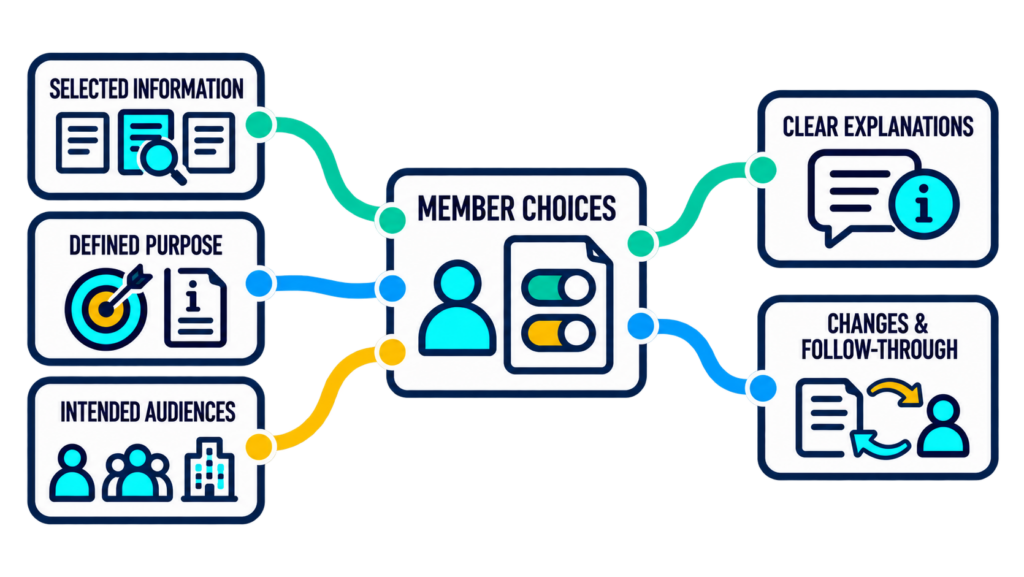
This module helps your team:
- The organizational purpose and member benefit.
- The information involved and its original context.
- Required and optional information.
- Relevant audiences and access needs.
- Existing explanations and member choices.
- Selected profiles, summaries, or other shared views.
- Duration and changes in purpose.
- Preference updates and requests to end access.
- Exports and downstream information handling.
- Staff responsibilities and exception processes.
- Questions or concerns members may raise.
- A bounded starting configuration.
What might an appropriate response involve?
The response depends on whether the difficulty concerns explanation, choice, access, technical handling, or organizational follow-through.
Clarify the Meaning
Seek further explanation where a comment, request, or summary is ambiguous.
Preserve the Context
Keep the relevant question, source, experience, and timing attached to the input.
Examine the Pattern
Compare related feedback while retaining meaningful differences and contradictory accounts.
Seek Further Evidence
Identify which missing perspectives or unanswered questions could change the interpretation.
Assign the Response
Route individual issues and broader findings to the people responsible for reviewing and acting.
Communicate the Outcome
Explain what was heard, what happens next, and what remains under consideration.
A useful response may begin with clearer language or a better process. A later product configuration can support the arrangement established through that work.
What we review together
Purpose & Member Experience
What the sharing is intended to accomplish and how the arrangement appears from the member’s perspective.
Information & Source Context
What is involved, where it came from, and the circumstances under which it was provided.
Audiences & Views
Who needs access and what each audience should be able to see.
Choices & Explanations
The options presented to members and whether the language describes the practical arrangement clearly.
Changes & Exceptions
How updates, new uses, withdrawals, and unusual requests are handled.
Ownership & Follow-Through
Who maintains the arrangement and ensures that questions and changes reach the relevant people and systems.
The minicourse: make one sharing arrangement understandable
Your team applies the concepts to a bounded example, such as a member directory, mentoring intake, expertise profile, partner introduction, or program-specific information request.
STEP 1
Step 1 — Define the purpose and sharing situation.
Choose the organizational use and describe what the member is trying to accomplish.
STEP 2
Step 2 — Identify the information and its context.
Examine what is requested or shared, where it originated, and which details are necessary for the purpose.
STEP 3
Step 3 — Distinguish audiences and views.
Identify who needs access and what each audience should see.
STEP 4
Step 4 — Review the member’s choices and explanation.
Examine how required information, optional sharing, duration, and consequences are presented.
STEP 5
Step 5 — Trace changes and follow-through.
Clarify how preferences, corrections, new purposes, and requests to end access would affect the relevant views and processes.
STEP 6
Step 6 — Define the response and starting configuration.
Choose practical improvements and outline the sharing arrangements, controls, explanations, and responsibilities a subsequent implementation would need.
Exercise output
A draft Member Sharing Arrangement Map, with defined purposes, audiences, choices, change processes, and an assigned next step.
- A defined purpose and sharing situation.
- Clear information boundaries.
- Distinct audiences and views.
- Understandable member choices.
- A practical change process.
- Assigned follow-through responsibilities.
FUTURE PRODUCT CONNECTION
How this work can connect to Gobekli
The workshop establishes what members should be able to understand and choose, and what the organization needs to do in response. That work can inform a scoped Gobekli configuration.
TalentPass could support member-held information and selective sharing through relevant profiles. Passport Pages could support the connection and sharing arrangements included in scope.
A TalentSync configuration could provide organizational views and responsibilities suited to the agreed purpose. Pythia could help explain requests and guide clarification within the information and access available to the person or organization involved.
The starting configuration should make the sharing arrangement visible in both the member experience and the organization’s handling of information.
Potential configuration mapping
- A request combines several unrelated purposes. Separate sharing arrangements linked to clearly defined uses.
- Complete records expose unnecessary information. Selected profiles or views containing the details relevant to each audience.
- Members cannot tell who will see the information. Clearly described recipients, audiences, and access arrangements.
- Optional sharing is difficult to distinguish from required information. Separate choices and explanations appropriate to the service involved.
- Preferences are disconnected from actual visibility. Connections between the member’s choice and the relevant profile or access settings.
- Members need to preview or clarify what they share. Review and correction steps before information is made available.
- New uses appear without a clear review process. Purpose-change review and any additional member-facing steps required by the arrangement.
- Requests to change access are difficult to carry through. Defined update processes and responsibilities across affected views and systems.
- Staff cannot explain how the arrangement was established. Records of the relevant explanation, choice, scope, and subsequent changes.
- Trust depends on informal staff knowledge. Assigned owners, member inquiry routes, and periodic review of the arrangement.
Specific controls, connected-system behavior, and implementation scope would be confirmed during solution planning.
PRODUCT AND DECISION BOUNDARIES
What this module does—and its boundaries
The module helps your team:
- Examine one real information-sharing situation.
- Clarify purpose, information, and audience.
- Distinguish required information from optional sharing.
- Improve explanations and member choices.
- Plan for changes, questions, and exceptions.
- Prepare a starting configuration brief.
The module does not complete:
- A legal determination about every information use.
- A privacy or security compliance assessment.
- Organization-wide policy development.
- Technical enforcement across every external recipient.
- Removal of every copy of previously shared information.
- A guarantee of trust based on a consent record alone.
The exercise provides a practical starting point. Questions requiring legal, policy, security, or detailed technical review can be identified for the appropriate follow-up.
What to bring into the conversation
Begin with one question that member input could help answer, or one collection of feedback that has been difficult to turn into a clear next step.
A useful starting question is: “What are members telling us about this experience, what does that evidence support, and who should do what next?”
Useful inputs may include:
- One sharing situation the organization wants to improve.
- The information requested or made visible.
- Current forms, explanations, or preference options.
- The audiences and systems involved.
- Examples of member questions or staff uncertainty.
- Existing processes for changes, corrections, or exceptions.
- The person responsible for the sharing arrangement.
- A membership or program lead.
- Someone familiar with the member experience.
- A system or profile administrator.
- Someone responsible for information practices.
- A person who could own the next step.
Use anonymized examples or representative forms where possible. The exercise focuses on understanding the arrangement and does not require disclosure of private member information.
What this module can help your team produce
A Member Consent & Sharing Brief
A clear account of the purpose, information, audiences, choices, and limits of the arrangement examined.
A Member Sharing Arrangement Map
A structured view connecting the member’s explanation and choices to the relevant information, recipients, profiles, and processes.
An Explanation & Follow-Through Plan
Assigned next steps for improving language, clarifying access, handling changes, and resolving questions or exceptions.
A Starting Configuration Brief
An outline of the selected views, sharing controls, member review steps, and organizational responsibilities a subsequent Gobekli implementation would need.
These outputs begin with the example examined during the module. Final scope depends on available inputs, selected modules, and the decision established through Member Intelligence Direction.
Where might the work lead next?
A sharing review may reveal source connections that need clarification, ongoing responsibilities that need ownership, or relationship information requiring a more specific interpretation.
Fragmented Member Data & System Connections
Trace where the information travels and identify which source connections, views, and update processes need to reflect the sharing arrangement.
Member Intelligence Governance & Currency
Establish ongoing ownership, review responsibilities, and processes for keeping explanations and practices aligned.
Member Relationships & Network Visibility
Clarify what relationship information describes and how its visibility should be interpreted for the purpose involved.
The resulting arrangements can also support other Member Intelligence modules when members share goals, experience, feedback, or contribution information.
Frequently asked questions
Questions membership organizations ask before beginning.
It examines the choices and arrangements through which member information becomes available for particular purposes and audiences. The focus is on making those arrangements understandable and practical to maintain.
No. The module clarifies the operational arrangement and identifies questions needing further review. It does not determine the legal basis for every information use or replace specialist advice.
The module does not assume that they do. It distinguishes the purposes, service requirements, choices, and review questions involved in the selected situation.
A notice is one part of the explanation. This module also examines the actual information, audiences, choices, system behavior, change process, and responsibilities behind it.
Yes. A directory setting, program intake form, expertise profile, or partner-sharing request can provide a useful bounded example.
Begin with the purpose and identify the details needed to support it. Separate unrelated information and examine whether a selected view can meet the need.
Explain what is required, why it is needed, and what happens if it is unavailable. Keep optional sharing choices distinguishable from those requirements.
That may be an appropriate requirement for the arrangement. The workshop identifies the views and choices needed; specific technical support would be confirmed during implementation planning.
The proposed use should enter a defined review process. The team needs to determine what new explanation, choice, or other appropriate step is needed before proceeding.
The arrangement should explain the available process and its effect. The module identifies which views or systems would change, who handles the request, and what practical limits need to be communicated.
Not necessarily. Previously downloaded or copied information may require separate handling. The workshop helps identify and explain the distinction between changing future access and addressing existing copies.
Examine whose information is involved, the source context, and the appropriate visibility. One member’s willingness to share an account does not resolve every question about other people mentioned in it.
AI may assist with explanations or clarification, but those explanations need to match the actual arrangement. It should not promise controls or consequences that the implementation cannot provide.
Members and staff need a shared understanding of the purpose, information, audience, choices, and follow-through. Trust also depends on whether actual practice remains consistent with those explanations.
No. Representative forms, anonymized examples, current explanations, and knowledgeable participants can support the exercise.
The outputs can inform a scoped configuration involving selected profiles, sharing arrangements, appropriate organizational views, and member clarification. Specific controls and connected-system behavior would be confirmed during solution planning.
Your team will examine one bounded example and create a draft brief, sharing arrangement map, explanation and follow-through plan, and starting configuration brief. Broader policy work and implementation are subsequent steps.
Make member sharing easier to understand and trust.
Start with one sharing situation, clarify the purpose and choices, and connect the explanation to what your organization actually does.
Choose Member Consent, Sharing & Trust as part of your Member Intelligence Workshop.
