
MEMBER INTELLIGENCE WORKSHOP MODULE
Member Intelligence Governance & Currency
You have a clearer member picture. Who keeps it useful as things change?
Establish ownership, source context, correction routes, update responsibilities, review triggers, and appropriate boundaries for using member information.
Module 12 · Member Intelligence Workshop
Does this sound familiar?
Everyone uses the information. No one maintains the whole arrangement.
Teams rely on member views without a clear owner for the definitions, sources, interpretations, and processes behind them.
Old information still looks current.
Past roles, interests, relationships, or support needs remain visible without showing when they were last reviewed or what period they describe.
Corrections stop where they are received.
A member updates one record, but related profiles, reports, or program decisions continue to reflect the earlier information.
Source changes go unnoticed.
A field definition, collection process, partner feed, or system connection changes while dependent views continue to operate as before.
New uses inherit old assumptions.
Information gathered for one decision is reused elsewhere without reviewing whether its context, quality, and sharing arrangements fit the new purpose.
Governance depends on a few familiar people.
Knowledge about who can resolve an issue or explain a record disappears when staff, volunteers, or partners change.
What are member intelligence governance and currency?
Member intelligence governance establishes the responsibilities and practices that keep member information understandable and appropriate to use.
Currency concerns whether that information remains relevant to the question being asked. It includes when something was recorded, what period it describes, what has changed, and whether its interpretation needs review.
Together, they help the organization answer:
- Who is responsible for this information or view?
- Where did it come from?
- What does it establish?
- When was it relevant or last reviewed?
- How can an error or disagreement be raised?
- What should trigger another review?
- For which purposes is it appropriate to use?
The aim is to make maintenance part of the way the organization works, with responsibilities proportionate to the information and decision involved.
A useful member view is an ongoing responsibility.
The earlier modules help an organization clarify identities, goals, expertise, participation, relationships, feedback, emerging needs, source connections, and sharing arrangements.
Each produces information that may need to be maintained.
Members change roles. Programs end. Sources are corrected. Definitions evolve. A finding that supported one decision may not support another.
This module helps your team establish how those changes will be recognized and handled.
It turns a useful starting view into a maintained practice with clear owners, correction routes, review triggers, and boundaries.
What needs ongoing attention
Member Circumstances
Roles, affiliations, goals, interests, availability, and support needs may change. Different information requires different update approaches.
Sources & Definitions
Systems, forms, partner reports, field meanings, and collection practices can change the interpretation of the information they provide.
Accounts & Interpretations
Expertise descriptions, feedback findings, relationship accounts, and emerging-needs hypotheses may need clarification as new information becomes available.
Views & Uses
Profiles, reports, searches, program decisions, and other uses need an owner who understands their purpose and limitations.
Responsibilities & Arrangements
Staff roles, chapter leadership, partner responsibilities, access arrangements, and sharing explanations need continuity as people and processes change.
The workshop begins with one member-information use or view. It does not require a complete governance redesign.
How member intelligence loses its usefulness
1. A useful view is created.
The organization brings relevant information together to support a defined question or activity.
2. Circumstances and sources change.
Members, programs, records, definitions, or organizational priorities evolve.
3. Maintenance responsibilities remain unclear.
No one consistently reviews the implications, resolves corrections, or updates dependent views.
4. Decisions rely on an outdated understanding.
Staff continue using information whose relevance, meaning, or permitted use may have changed.
“We updated the member record.” What else needs to change?
A member tells the organization that they have changed employers and are no longer available for mentoring.
The membership team updates the main record. A mentoring list still shows the earlier availability, and a committee report continues to describe the previous employer affiliation.
The correction was received, but the organization has not yet completed the work needed to reflect it in the places that depend on it.
A maintained information practice makes those dependencies and responsibilities visible.
Questions that change the interpretation:
Separate the employer relationship, mentoring availability, and any other affected details. One update may have several distinct implications.
Identify who maintains the source record, who reviews the member’s account, and who owns the views that use it.
Consider profiles, lists, reports, program processes, and pending decisions that may require an update or review.
Some information remains useful as history. A former affiliation should be distinguishable from a current one rather than automatically erased from every account.
Define what completion means and who checks that the relevant changes or reviews occurred.
Identify how uncertainty is recorded, who receives the issue, and whether particular uses should wait for clarification.
Six dimensions of maintained member intelligence
Purpose & Accountable Owner
What use does the information support, and who is responsible for keeping that use understandable and appropriate?
Source & Meaning
Where did the information originate, what does it describe, and which definitions or limitations need to remain attached?
Timing & Review Status
What period does the information concern, when was it recorded or reviewed, and what is known about its current relevance?
Correction & Resolution
How can members and staff raise problems, who reviews them, and how are disagreements or unresolved cases handled?
Change & Dependencies
What changes could affect the information or its use, and which sources, views, or decisions depend on it?
Boundaries & Oversight
Who may use the information, for which purposes, and when does a proposed use require additional review?
From a one-time cleanup to a maintained practice
A limited maintenance view
- Information updated only when someone notices a problem.
- System administrators assumed to own every interpretation.
- A recent import treated as proof that information is current.
- Corrections applied only to the most visible record.
- Historical information overwritten without context.
- New uses introduced without a review owner.
- Staff knowledge serving as the only escalation route.
This approach leaves the organization dependent on informal attention and individual memory.
A maintained intelligence view
- Defined owners for sources, interpretations, and uses.
- Dates and review status suited to the information.
- Clear routes for questions and corrections.
- Dependencies identified for important updates.
- Historical and current context distinguished.
- Review triggers for meaningful changes.
- Documented boundaries and handover responsibilities.
This approach gives teams a practical way to keep information useful after the initial work is complete.
Worked example: keeping a member expertise directory useful
An association has created a directory that helps staff understand members’ professional experience and possible areas of contribution.
The directory draws on member-provided descriptions, program records, and reviewed contribution accounts.
Over time, members change roles, some source records are corrected, and staff begin using the directory for additional purposes.
During the module, the team examines:
- Who owns the directory’s purpose and definitions.
- Who maintains each underlying source.
- Which details members should be able to clarify.
- What information is historical and what is presented as current.
- Which changes should trigger a review.
- How corrections reach the directory.
- What happens when a description is disputed.
- Whether a proposed new use fits the existing arrangement.
- How responsibilities transfer when staff change.
The output is a maintenance and review plan for the directory, with assigned responsibilities and a bounded set of next steps.
The plan does not assume that every detail needs the same review schedule or level of scrutiny.
Recently updated does not always mean currently relevant.
A record may have been imported yesterday while describing a role that ended several years ago.
A historical contribution can remain accurate and useful even when it is no longer recent. A current availability statement may become outdated quickly.
Currency therefore depends on the information and the use.
The workshop helps your team distinguish:
- When the underlying activity or circumstance occurred.
- When the information was recorded.
- When a source last supplied it.
- When someone last reviewed its meaning.
- Whether its present relevance has been confirmed.
- What would make another review necessary.
These distinctions help users understand what “current” means in the view they are using.
Different responsibilities need a clear handoff.
The person who maintains a source system may not be responsible for deciding what a finding means or whether it supports a particular use.
A program owner may understand the activity. A member may clarify their own circumstances. A reviewer may assess an interpretation. A system administrator may implement a correction.
The arrangement works when those responsibilities connect.
This module helps the team define:
- Who receives an issue.
- Who can clarify the source.
- Who decides how the issue affects a view or interpretation.
- Who makes the relevant changes.
- Who confirms follow-through.
- Who handles unresolved questions.
The goal is a practical route from a question or change to an accountable response.
THE MATCHING WORKSHOP MODULE
Member Intelligence Governance & Currency
This practical minicourse helps your team examine one member-information use and establish the ownership, correction routes, review triggers, and boundaries needed to keep it useful.
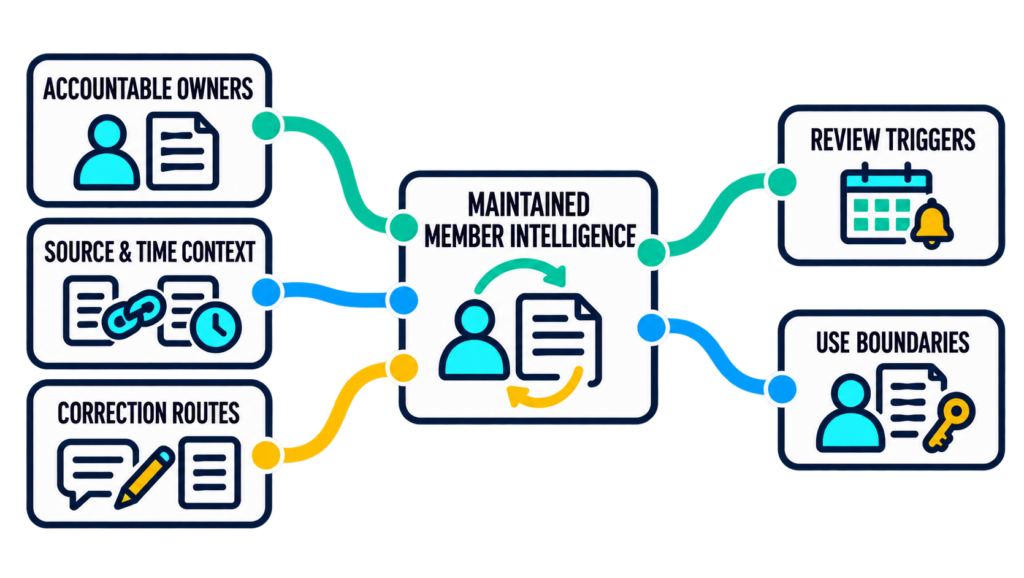
This module helps your team:
- The purpose and accountable owner of the selected use.
- Relevant sources and their responsibilities.
- Definitions and interpretation limits.
- Historical and current information.
- Existing update and review practices.
- Member and staff correction routes.
- Dependencies among records, views, and decisions.
- Changes that should trigger review.
- Unresolved or disputed information.
- Appropriate access and use boundaries.
- Staff and partner handover needs.
- A bounded maintenance configuration.
What might an appropriate response involve?
The response depends on which responsibilities or maintenance practices are missing.
Clarify the Meaning
Seek further explanation where a comment, request, or summary is ambiguous.
Preserve the Context
Keep the relevant question, source, experience, and timing attached to the input.
Examine the Pattern
Compare related feedback while retaining meaningful differences and contradictory accounts.
Seek Further Evidence
Identify which missing perspectives or unanswered questions could change the interpretation.
Assign the Response
Route individual issues and broader findings to the people responsible for reviewing and acting.
Communicate the Outcome
Explain what was heard, what happens next, and what remains under consideration.
A useful response may begin with a small ownership and review plan. A later configuration can support that plan through records, assignments, and appropriate visibility.
What we review together
Purpose & Responsibility
What the selected information supports and who is accountable for maintaining that use.
Sources & Definitions
Where the information comes from and what needs to remain clear about its meaning.
Timing & Currency
How historical context, current circumstances, and review status are represented.
Corrections & Disputes
How questions are received, reviewed, resolved, or kept visibly open.
Triggers & Dependencies
Which changes require attention and where their effects may travel.
Boundaries & Handover
How appropriate use, escalation, and continuity are maintained across teams and transitions.
The minicourse: establish how one member view stays useful
Your team applies the concepts to a bounded example, such as an expertise directory, participation report, member-needs view, relationship map, or feedback summary.
STEP 1
Step 1 — Define the use and accountable owner.
Choose the view or decision in scope and identify who is responsible for its purpose and continued usefulness.
STEP 2
Step 2 — Clarify sources and maintenance roles.
Identify where the information originates and who maintains, interprets, and uses it.
STEP 3
Step 3 — Examine timing and review needs.
Distinguish historical facts, current circumstances, source updates, and interpretation reviews.
STEP 4
Step 4 — Build the correction and resolution route.
Define how an issue is raised, reviewed, acted on, and communicated to the relevant people.
STEP 5
Step 5 — Identify triggers, dependencies, and boundaries.
Examine which changes should prompt review, which uses depend on the information, and where additional decisions are required.
STEP 6
Step 6 — Define the maintenance plan and starting configuration.
Assign practical next steps and outline the records, responsibilities, review processes, and views a subsequent implementation would need.
Exercise output
A draft Member Intelligence Maintenance Map, with accountable owners, correction routes, review triggers, dependencies, and an assigned next step.
- A defined use and accountable owner.
- Clear source and maintenance roles.
- Meaningful timing and review distinctions.
- A practical correction route.
- Defined triggers and use boundaries.
- An assigned maintenance plan.
FUTURE PRODUCT CONNECTION
How this work can connect to Gobekli
The workshop establishes how a useful member view should be maintained and who is responsible when information changes. That work can inform a scoped Gobekli configuration.
A TalentSync configuration could connect source context, review status, ownership, and the organizational views that depend on them. TalentPass could support member clarification and selective sharing where appropriate.
Passport Pages could support the source and sharing relationships included in scope. Pythia could help people understand what needs attention and guide clarification within their permitted information and responsibilities.
The configuration should make maintenance work visible enough to assign, review, and carry through.
- A member view has no accountable owner. Defined ownership linked to the view’s purpose and intended use.
- Source responsibilities are unclear. Source records with named maintenance roles and relevant definitions.
- Old information appears current. Distinct activity dates, source-update dates, and review status.
- Interpretations lose their supporting context. Connections to source material, review history, and stated limitations.
- Members and staff do not know how to raise corrections. A clear intake and routing process for clarification or correction requests.
- Disputed information is treated as settled. Visible unresolved status and an assigned review route.
- Corrections do not reach dependent views. Relationships identifying affected profiles, reports, and uses.
- Significant changes do not trigger review. Defined review conditions and responsibilities appropriate to the information.
- New uses extend beyond the original arrangement. Purpose and access review before a view is used in a materially different way.
- Knowledge is lost when owners change. Handover records, role assignments, and maintenance instructions.
Specific review workflows, update behavior, and implementation scope would be confirmed during solution planning.
PRODUCT AND DECISION BOUNDARIES
What this module does—and its boundaries
The module helps your team:
- Examine one member-information use.
- Assign source, interpretation, and use responsibilities.
- Clarify timing and review expectations.
- Define correction and escalation routes.
- Identify meaningful review triggers and dependencies.
- Prepare a starting configuration brief.
The module does not complete:
- An organization-wide governance transformation.
- A full audit of every member record.
- A legal or security compliance assessment.
- Automatic resolution of every disputed account.
- Continuous verification of all member information.
- A guarantee that information remains accurate without ongoing work.
The exercise provides a practical starting point. Broader policy development, source remediation, technical implementation, and ongoing operation may require additional work.
What to bring into the conversation
Begin with one question that member input could help answer, or one collection of feedback that has been difficult to turn into a clear next step.
A useful starting question is: “What are members telling us about this experience, what does that evidence support, and who should do what next?”
Useful inputs may include:
- One member view, report, or decision to examine.
- The sources and definitions it depends on.
- Existing ownership or maintenance arrangements.
- Examples of outdated, corrected, or disputed information.
- Current review schedules or change processes.
- Any relevant outputs from earlier workshop modules.
- The owner of the selected use or decision.
- A membership or operations lead.
- Someone familiar with the source records.
- A program or interpretation owner.
- A system or information administrator.
- A person who could own the maintenance plan.
Use anonymized examples or representative records where possible. The exercise can begin with incomplete arrangements; identifying missing responsibilities is part of the work.
What this module can help your team produce
A Member Intelligence Governance Brief
A clear account of the selected use, responsible roles, source context, review needs, and boundaries.
A Member Intelligence Maintenance Map
A structured view connecting sources, owners, interpretations, dependent uses, and correction responsibilities.
A Correction & Review Plan
Assigned routes for questions and disputes, meaningful review triggers, and practical expectations for carrying changes through.
A Starting Configuration Brief
An outline of the ownership records, review status, dependencies, member clarification, and maintenance processes a subsequent Gobekli implementation would need.
These outputs begin with the example examined during the module. Final scope depends on available inputs, selected modules, and the decision established through Member Intelligence Direction.
Where might the work lead next?
A governance review may reveal source connections that need attention, sharing arrangements that need clarification, or a purpose that should be revisited.
Fragmented Member Data & System Connections
Trace the sources and dependent views involved so updates and corrections can reach the places that use the information.
Member Consent, Sharing & Trust
Clarify the purposes, audiences, member choices, and explanations that should guide ongoing use.
Member Intelligence Direction
Revisit the organizational decision, population, responsibilities, and boundaries when the purpose of the work has changed.
This module can also bring outputs from the other Member Intelligence modules into a shared maintenance approach, with responsibilities proportionate to each use.
Frequently asked questions
Questions membership organizations ask before beginning.
It establishes who is responsible for member information, how it is interpreted and maintained, and what boundaries guide its use. The focus is on practical ownership and follow-through.
Currency concerns whether information remains relevant to the question being asked. It includes timing, changed circumstances, source updates, and the need to review an interpretation.
No. A cleanup addresses particular records. This module establishes how questions, changes, and corrections will be handled after the initial work is complete.
No. The exercise can examine an existing member view or use. Outputs from other modules are useful inputs when available.
Responsibility may be distributed. A source owner, program owner, interpretation reviewer, and system administrator may have different duties. The module clarifies how those duties connect.
Not necessarily. Technical administration does not automatically establish responsibility for interpreting member experience or deciding whether information supports a particular use.
The appropriate approach depends on the information and its use. The module identifies meaningful schedules or change triggers rather than assuming one review interval fits everything.
No. A recent transfer may contain historical information. Source-update timing should remain distinguishable from the period described and the last interpretation review.
Some information remains useful as history, while other records may no longer be appropriate to retain or use. The module identifies the relevant distinctions and questions for the responsible review process.
They need an understandable route that identifies who will receive the issue and what happens next. The workshop helps define that route for the selected use.
Preserve the source context, identify the point of disagreement, and assign an appropriate review. The arrangement should distinguish an unresolved account from a settled conclusion.
Identify which views depend on the information and who is responsible for updating or reviewing them. The module makes those dependencies part of the maintenance plan.
Examples include a member update, changed source definition, failed connection, disputed interpretation, new audience, or materially different use. The relevant triggers depend on the arrangement in scope.
AI may help identify questions or organize review work, but it does not establish that information is accurate simply by processing it. Responsibilities for clarification and interpretation remain part of the arrangement.
Begin with one important use and assign responsibilities proportionate to its needs. Reuse existing review points and processes where they can provide adequate follow-through.
The outputs can inform a scoped configuration connecting ownership, source context, review status, correction routes, and dependent views. Specific workflows and update behavior would be confirmed during solution planning.
Your team will examine one bounded example and create a draft governance brief, maintenance map, correction and review plan, and starting configuration brief. Wider rollout and ongoing operation are subsequent steps.
Keep your understanding of members useful as things change.
Start with one important member view, establish who maintains it, and define how questions, corrections, and changes receive a responsible response.
Choose Member Intelligence Governance & Currency as part of your Member Intelligence Workshop.
