
MEMBER ENGAGEMENT WORKSHOP MODULE
Member Engagement Direction
What should participation help your members accomplish—and where does the experience need attention?
Define the participation challenge, member population, member purpose, desired experience, available evidence, responsibilities, and boundaries that will guide your workshop.
Required Foundation · Module 1
Does this sound familiar?
“Improve engagement” means something different to everyone
Leadership wants stronger relationships. Events teams want attendance. Program owners want follow-through. The group has not agreed on the experience it needs to improve.
The target describes activity without explaining its purpose
More registrations, logins, or responses become the goal before anyone defines what useful participation would accomplish for members.
The proposed solution arrives before the problem is understood
A new campaign, community platform, welcome sequence, or matching tool is selected while the reasons for interrupted participation remain uncertain.
The experience crosses teams without a clear owner
Communications, registration, delivery, chapter support, and follow-up belong to different people. Nobody is responsible for examining how those steps work together.
The members most affected are missing from the conversation
Frequent participants can explain their experiences, but the people who never begin, stop early, or choose another route are less visible.
The project grows beyond a workable starting point
A concern about one program becomes a plan to redesign every benefit, message, event, and member interaction at once.
What is member engagement direction?
Member engagement direction establishes which participation experience an organization needs to improve, whom it affects, and what a useful change should accomplish.
It connects an organizational concern to a defined member population, a member purpose, an experience that can be examined, and a decision someone can act on.
The starting concern might involve:
- New members who do not take a first step.
- Opportunities that relevant members rarely discover.
- Invitations that attract interest without participation.
- Introductions that do not develop into useful relationships.
- Volunteers who encounter unclear expectations.
- Participants who receive little support after joining.
- Members who stop participating without an understood reason.
Each concern may require a different response.
Member Engagement Direction is the required starting module of Gobekli’s Member Engagement Workshop. It gives the selected modules a shared purpose and establishes the boundaries of the work.
A participation target needs a member purpose behind it.
An organization may want more members to attend, enroll, volunteer, or connect.
Members approach those opportunities with purposes of their own. They may want help with a work challenge, a useful professional relationship, a chance to contribute, or a manageable way to learn.
A clear direction connects those perspectives.
Before proposing improvements, the team needs to establish:
- What prompted the concern.
- Which participation experience is involved.
- What the organization wants to improve.
- What members may be trying to accomplish.
- Which parts of that member purpose have been confirmed.
- Where participation appears to become difficult.
- What existing evidence establishes.
- Whose experience remains unclear.
- Who can authorize and operate a change.
- What would make the first result useful.
A focused direction gives the workshop a practical question to answer and a reason for answering it.
Connect the participation challenge to the experience members need.
Challenge & Decision
Organizational concern.
Experience needing attention.
Choice the team must make.
Reason to act now.
Decision timing.
Members & Purpose
Population within scope.
Relevant circumstances.
Expressed goals and interests.
Intended member benefit.
Missing perspectives.
Experience & Friction
Discovery and invitation.
Entry requirements.
First experience.
Support and handoffs.
Follow-through.
Evidence & Boundaries
Participation records.
Member accounts.
Staff observations.
Assumptions and gaps.
Appropriate information use.
Responsibilities & Next Steps
Decision owner.
Experience and program owners.
Member input.
Selected workshop modules.
First useful result.
These connections establish the scope of the review. Detailed redesign of the selected experience happens through the relevant problem modules.
How engagement work loses direction
Stage 1 — A broad concern appears
Participation is lower than expected, familiar members carry most activities, or a program struggles to sustain involvement.
Stage 2 — Teams define success differently
Different responsibilities produce different targets, explanations, and preferred solutions.
Stage 3 — Activity begins before the experience is understood
Campaigns, technology changes, and new programs move forward while the member purpose and point of difficulty remain unclear.
Stage 4 — More effort produces an uncertain result
The organization still cannot explain which members benefited, what changed in their experience, or what should happen next.
“We need more engagement” needs a more specific question.
A useful direction names the member population, the experience, the uncertainty, and the decision ahead.
“We need new members to engage” can become:
“Which changes should we test to help newly joined independent professionals find and enter a relevant peer activity during their first three months?”
That question identifies a population, a participation experience, and a manageable decision.
It also leaves room to discover that the original assumption needs revision. Members may need a clearer invitation, a different format, practical support, or an opportunity that better fits their purpose.
The direction-setting conversation should clarify:
Name the opportunity, program, relationship, or journey involved. Distinguish an organization-wide concern from the example the workshop will address.
Identify expressed purposes and separate them from staff assumptions. Record where member input is needed before the team can confidently describe relevance.
Define the population clearly enough to examine its experience. Relevant distinctions might include membership stage, role, geography, affiliation, availability, or program eligibility.
Locate the suspected point of friction without treating it as a confirmed cause. Discovery, entry, participation, support, and continuation require different questions.
Name the choice the findings should support, such as revising an invitation, testing an entry route, adjusting support, or investigating an unresolved barrier.
Define the working output, responsible owner, member feedback needed, and review conditions. Distinguish the workshop result from changes that require later testing.
Establish direction across six dimensions.
Challenge
Define the participation concern and the organizational decision it creates.
Population
Identify the members, circumstances, and period the review will address.
Member Purpose
Describe what members want from the experience and where that understanding needs validation.
Experience & Evidence
Locate the relevant journey, observed difficulties, supporting sources, and unanswered questions.
Responsibility
Clarify who contributes, reviews, decides, operates a change, and follows through.
Boundaries
Set practical limits for scope, information use, member requests, commitments, and conclusions.
A useful scope is focused enough to act on.
A manageable starting boundary
The workshop might begin with:
- One new-member entry experience.
- One mentoring or peer-support program.
- One event-to-follow-up transition.
- One volunteer opportunity.
- One chapter participation route.
- One interrupted experience affecting a defined member group.
The boundary should retain the relationships and handoffs that could materially affect the experience.
Signs that the scope needs refinement
The work may need to be narrowed when:
- Teams are pursuing unrelated participation goals.
- Every member and program appears equally necessary.
- Nobody can explain what members should gain.
- The proposed solution is treated as the only possible response.
- No one can authorize or operate the resulting change.
- Success depends on information or resources unavailable within scope.
A broad engagement ambition can be developed through a sequence of focused improvements.
New members join. Few enter a peer activity.
An association wants more newly joined independent professionals to participate in its peer groups.
Staff propose an additional welcome email. Existing records show that members receive the current messages, visit some program pages, and occasionally register for an introductory session.
Those observations do not yet explain the experience.
During the Direction module, the team asks:
- What do these members want from peer participation?
- Which interests have members actually expressed?
- Can they distinguish the available groups?
- Do descriptions explain who each group is for?
- Is the expected commitment clear?
- What happens after someone expresses interest?
- Who makes an introduction?
- What do members who did not begin say about the process?
- Who could authorize and support a small test?
The team develops a direction statement:
“Determine which discovery and entry changes to test for newly joined independent professionals seeking peer support, using a review of the current journey and targeted member input.”
The team selects Benefit & Opportunity Discovery and New Member Onboarding & First Value.
If the review shows that members reach the group but struggle to establish connections, Peer Connections & Community Belonging may become an appropriate additional module.
The Direction module establishes this route. It does not assume that another email is the answer.
Participation should remain a meaningful choice.
Members have different reasons for belonging and different capacities to participate.
Some may want a sustained role. Others may need occasional support, a single learning experience, or access to resources when a particular question arises.
The Direction module helps the team describe the participation it hopes to support while recognizing those differences.
It asks:
- What makes this experience relevant?
- What commitment does it require?
- What options does the member have?
- Can someone decline or pause without being misrepresented?
- What information is necessary to support the experience?
- What should the organization ask members to clarify?
A useful direction makes the intended invitation and member benefit understandable.
Name what the evidence shows—and who can act on it.
An unopened message, an incomplete registration, and a missed session describe different events. None establishes a complete explanation on its own.
The workshop separates:
- Recorded activity.
- Member statements.
- Staff observations.
- Interpretations.
- Suspected causes.
- Questions requiring further review.
It also names the people needed to move the work forward:
- The sponsor responsible for the purpose.
- The person authorized to choose a response.
- The owners of the relevant experience.
- The people familiar with its sources and systems.
- The members or representatives contributing perspective.
- The person coordinating follow-through.
These initial assignments make the workshop actionable. Wider questions about information ownership, currency, or sharing can be carried into the relevant Member Intelligence modules when needed.
THE REQUIRED STARTING MODULE
Module 1: Member Engagement Direction
This practical minicourse helps membership leaders and their teams learn a repeatable method for turning a broad participation concern into a focused improvement decision.
Participants apply the method to one real organizational example. They define the member population and purpose, examine the available evidence, locate important uncertainties, establish responsibilities and boundaries, and select the additional modules needed.
Every Member Engagement Workshop begins with this foundation.
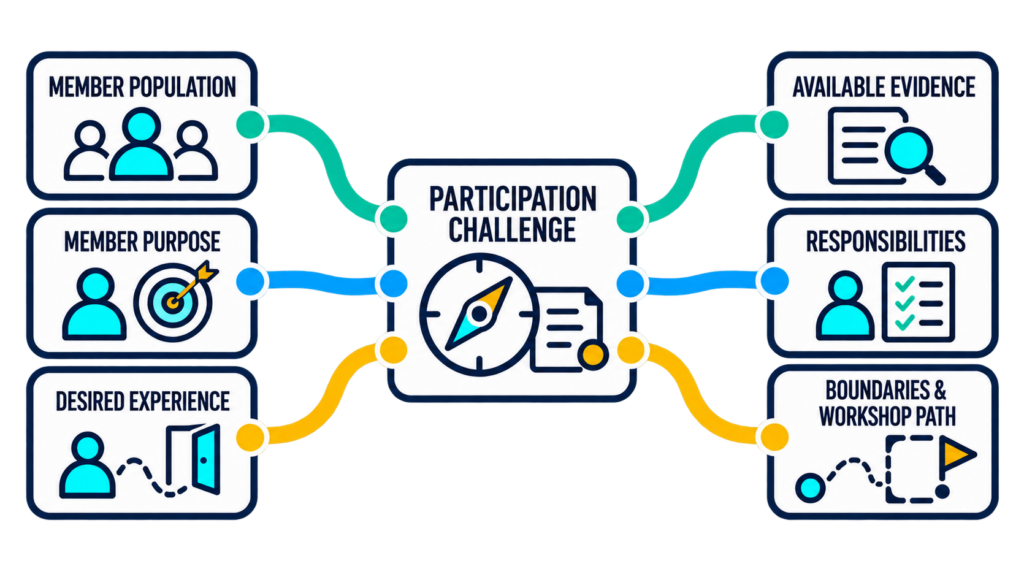
This module helps your team:
- Explain why the participation challenge needs attention now.
- Name the decision the workshop should support.
- Define the member population and circumstances.
- Describe the intended member purpose and benefit.
- Identify the experience within scope.
- Locate suspected points of friction.
- Separate evidence from interpretation.
- Recognize missing member perspectives.
- Establish practical information and participation boundaries.
- Clarify ownership and operating responsibilities.
- Select modules that address the actual uncertainty.
- Define a first useful result and starting configuration brief.
What should happen when the direction becomes clearer?
The aim is a practical next step with a named owner and an understood purpose.
Clarify the Meaning
Seek further explanation where a comment, request, or summary is ambiguous.
Preserve the Context
Keep the relevant question, source, experience, and timing attached to the input.
Examine the Pattern
Compare related feedback while retaining meaningful differences and contradictory accounts.
Seek Further Evidence
Identify which missing perspectives or unanswered questions could change the interpretation.
Assign the Response
Route individual issues and broader findings to the people responsible for reviewing and acting.
Communicate the Outcome
Explain what was heard, what happens next, and what remains under consideration.
Several responses may be appropriate. The Direction module establishes their purpose and sequence without prematurely choosing the final solution.
What should a member engagement direction review examine?
The Organizational Choice
What is the team preparing to change, prioritize, investigate, or test—and who can decide?
The Member Purpose
What would make participation useful to members, and how well is that purpose understood?
The Population & Perspectives
Which members belong in scope, and whose experience is missing from the available picture?
The Experience & Its Evidence
Where does participation appear to become difficult, and what supports that interpretation?
The Responsibilities & Boundaries
Who contributes, reviews, decides, and operates the response? What limits shape the work?
The First Useful Result
What should the workshop produce, which modules are needed, and how will the team carry the result forward?
Learn the method. Define one participation experience worth improving.
Bring one organizational concern about how members discover, enter, experience, or continue participating.
STEP 1
Step 1 — Name the concern and decision
Describe what prompted the work, why it matters, and what the organization needs to decide.
STEP 2
Step 2 — Define the members and their purpose
Identify the population and relevant circumstances. Distinguish expressed member purposes from assumptions requiring clarification.
STEP 3
Step 3 — Bound the experience
Name the opportunity or journey in scope. Identify its beginning, relevant handoffs, and the point at which the review ends.
STEP 4
Step 4 — Review evidence and uncertainty
Examine suitable records, member accounts, and staff observations. Note suspected friction, missing perspectives, and questions that could change the response.
STEP 5
Step 5 — Establish responsibilities and boundaries
Identify who can decide, who operates the experience, who contributes member context, and what practical limits apply.
STEP 6
Step 6 — Select modules and define the first result
Choose the additional modules that address the uncertainty. Define the working outputs, immediate next step, and configuration requirements worth exploring.
Exercise output
A draft Member Engagement Direction Map connecting the participation challenge, member population, member purpose, experience, evidence, responsibilities, and selected workshop path.
- A defined participation challenge.
- A clear member population and purpose.
- A bounded experience to examine.
- Evidence and uncertainty distinguished.
- Named responsibilities and limits.
- A selected workshop path and first useful result.
FUTURE PRODUCT CONNECTION
How this work can connect to Gobekli
The workshop establishes which participation experience should be supported and what information, relationships, and responsibilities it requires.
That direction can inform a scoped Gobekli configuration.
TalentSync could connect the organizational opportunity, intended experience, responsible roles, and participation relationships. TalentPass could support members in expressing relevant goals, interests, experience, and sharing choices.
Passport Pages could support the source and sharing connections included in scope. Pythia could help clarify an opportunity or guide a next step within the information and permissions available.
The Direction module defines the starting requirements. The selected problem modules refine how the experience should work.
- The participation purpose is unclear. A defined opportunity or initiative profile connecting organizational intent and member benefit.
- The relevant population is poorly defined. Appropriate member and affiliation relationships for the experience in scope.
- Member interests are assumed. Member clarification of relevant goals, interests, and preferences.
- Opportunity descriptions leave important questions unanswered. Structured information about purpose, eligibility, commitment, support, and entry.
- Entry and follow-through are disconnected. Relationships among opportunities, participation stages, responsible people, and next steps.
- Different teams hold different parts of the experience. Connected organizational views with defined coordination responsibilities.
- Participation records lack context. Connections among recorded activity, member input, source context, and the purpose being reviewed.
- Staff interpretations appear settled before review. Visible questions, assumptions, and assigned clarification responsibilities.
- Member information is requested without clear boundaries. Purpose-specific profiles, selected sharing, and appropriate access arrangements.
- Improvements have no owner or review point. Assigned actions, feedback responsibilities, and review conditions.
Specific workflow behavior, messaging, recommendations, integrations, and available capabilities would be confirmed during solution planning.
PRODUCT AND DECISION BOUNDARIES
What this module does—and its boundaries
The module helps your team:
- Define one participation challenge.
- Establish the relevant population and member purpose.
- Bound the experience to be examined.
- Review initial evidence and uncertainty.
- Assign responsibilities and practical limits.
- Select the appropriate problem modules.
The module does not complete:
- A redesign of every member interaction.
- A full investigation of every participation barrier.
- Detailed operation of a mentoring, event, or volunteer program.
- An organization-wide communications strategy.
- A complete member research study.
- A guarantee of increased participation or renewal.
The exercise creates the foundation for focused work. The selected modules develop the response, and subsequent testing determines how proposed changes perform with members.
What to bring into the conversation
Begin with one question that member input could help answer, or one collection of feedback that has been difficult to turn into a clear next step.
A useful starting question is: “What are members telling us about this experience, what does that evidence support, and who should do what next?”
Useful inputs may include:
- One participation concern the organization wants to address.
- A description of the relevant member population.
- The opportunity or experience involved.
- Representative invitations, descriptions, or entry steps.
- Available participation records and member feedback.
- Known constraints, responsibilities, and upcoming decisions.
- A sponsor or decision owner.
- A membership or member-experience lead.
- The owner of the program or opportunity.
- Someone familiar with communications or entry processes.
- Relevant member or chapter perspectives.
- A person who could coordinate follow-through.
Use representative materials or anonymized examples where possible. Complete records are not required. Identifying what is missing is part of the exercise.
What your team can leave with
A Member Engagement Direction Brief
A shared account of the participation challenge, organizational decision, member population, intended purpose, experience, and boundaries.
A Member Engagement Direction Map
A structured view connecting the members, opportunity, relevant journey, available evidence, uncertainties, and responsible roles.
A Selected Module & Validation Plan
A rationale for the follow-on modules, the member perspectives or evidence still needed, and the next steps required to make the work useful.
A Starting Configuration Brief
An outline of the opportunity profiles, member context, participation relationships, source connections, responsibilities, and sharing arrangements a subsequent Gobekli implementation would need.
These outputs begin with the example examined during the foundation module. The selected problem modules refine them and contribute to the wider 30–90 Day Member Engagement Path.
Where might the work lead next?
The foundation identifies which parts of the experience deserve closer examination. Common starting points include:
New Member Onboarding & First Value
Examine the route from joining to a relevant first experience when the challenge concerns how members begin.
Benefit & Opportunity Discovery
Examine how members find, understand, and enter relevant opportunities when useful options remain difficult to navigate.
Participation Barriers & Inclusive Access
Examine the practical, informational, social, or accessibility obstacles that make intended participation difficult.
The appropriate next modules depend on the direction established. Other paths may focus on communication, relationships, mentoring, events, learning, contribution, chapters, or re-engagement.
Frequently asked questions
Questions membership organizations ask before beginning.
It is the required foundation of the Member Engagement Workshop. It helps the team define the participation challenge, member population, intended purpose, experience, evidence, responsibilities, and boundaries before selecting additional modules.
Different teams may use “engagement” to describe different goals. The foundation gives the selected modules a shared purpose and a practical decision to support.
No. Bring the concern and what prompted it. The module distinguishes observations from suspected explanations and identifies what needs closer examination.
The module helps specify whose participation, in which experience, and for what purpose. That makes it easier to choose an appropriate response and interpret the result.
Yes. The target is a starting point. The team also examines what useful participation should accomplish and what the available measure can establish.
Not necessarily. Activity records may omit relevant experiences, and members differ in how they use the organization. The review identifies what requires clarification before drawing conclusions.
Begin with relevant member statements and feedback. Where the purpose is assumed or poorly understood, identify the input needed to clarify it.
Yes. A bounded program, opportunity, transition, or population is often a useful starting point. The scope should include the handoffs that materially affect that experience.
The module makes those differences explicit. The team can agree on a shared decision or divide the work into separate, sequenced questions.
That proposal can be considered within the review. The workshop examines which participation problem it is expected to address and what evidence would support proceeding.
Suitable inputs may include opportunity descriptions, communications, entry steps, activity records, member feedback, and staff observations. The module records their limitations and identifies important gaps.
Direct participation can be useful, but other approaches may include interviews, feedback, or experience walkthroughs. The intake identifies which perspectives are needed and how to involve them.
A named sponsor or decision owner should be able to authorize the next step. The people who operate the relevant experience also need clear responsibilities for follow-through.
Choose according to the part of the experience requiring closer examination. The foundation identifies whether the priority concerns discovery, communication, entry, connection, program participation, contribution, access, or return.
Member Intelligence Direction defines what the organization needs to understand about members to support a decision. Member Engagement Direction defines a participation experience to improve. Missing member understanding can become a focused input or follow-up.
The outputs can inform a configuration connecting member context, opportunities, participation relationships, responsibilities, and appropriate sharing. Specific capabilities and implementation requirements would be confirmed during scoping.
Your team will develop a draft direction brief, direction map, selected module and validation plan, and starting configuration brief for one bounded example. Detailed improvements and subsequent testing follow through the selected modules and action plan.
Give your engagement work a direction members can benefit from.
Start with one participation challenge, clarify the experience your members need, and establish who can carry the work forward.
Begin your Member Engagement Workshop with Member Engagement Direction, then select the modules that address the questions that remain.
