
MEMBER INTELLIGENCE WORKSHOP MODULE
Member Intelligence Direction
What does your organization need to understand about its members—and what decision will that understanding improve?
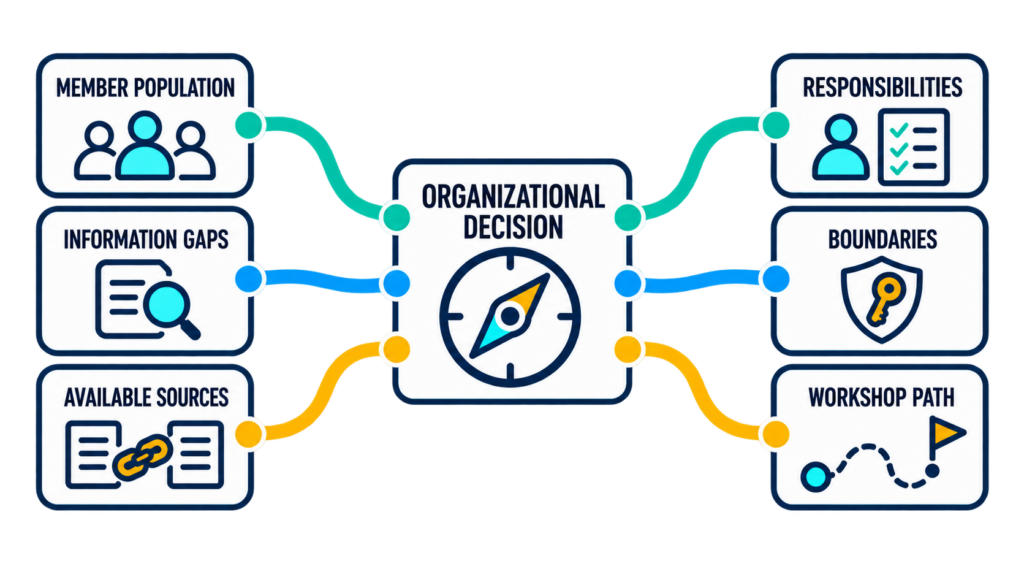
Define the decision, member population, information gaps, available sources, responsibilities, and boundaries that will guide your workshop.
Required Foundation · Module 1
Does this sound familiar?
“We need to know our members better” means something different to everyone
Leadership wants strategic insight. Program teams want clearer needs. Chapters want stronger relationships. Nobody has agreed on the decision that should organize the work.
You have records, but the important question remains unanswered
Membership status, event attendance, and survey results exist, yet your team cannot confidently explain what a particular member population needs or could contribute.
The project expands before the purpose becomes clear
A focused concern turns into a proposal to update every profile, connect every system, survey everyone, and build a new dashboard.
The most visible members shape the picture
Active volunteers, frequent attendees, and familiar voices are easier to understand than members who participate differently or rarely respond.
Information is collected without a clear next step
Members answer questions, but the organization has not established how their responses will inform a decision or who will follow through.
Responsibility is spread across teams and systems
Different people hold parts of the picture. It is unclear who can interpret the information, authorize its use, or act on what it reveals.
What is member intelligence direction?
Member intelligence direction establishes what an organization needs to understand about its members, why that understanding matters, and which decision it should support.
It connects a broad concern to a defined population, a manageable set of questions, relevant information sources, appropriate boundaries, and responsible people.
The starting question might concern:
- The needs of members entering a new career stage.
- Expertise that existing records do not reveal.
- Differences between the wider membership and the people responding to surveys.
- Relationships across chapters, employers, committees, or professional communities.
- Emerging work changes that may affect members.
- Information gaps preventing a program or service decision.
Each concern calls for a different view of the membership. The Direction module establishes which view is needed and what would make it useful.
Member Intelligence Direction is the required starting module of Gobekli’s Member Intelligence Workshop. It gives the selected modules a shared purpose and a clear decision to support.
Better member understanding begins with a decision people can name.
Membership organizations often hold substantial information across membership systems, event platforms, learning programs, surveys, chapter records, staff conversations, and member relationships.
These sources were created for different purposes. They may describe who paid, who attended, who completed a program, or who volunteered without explaining the question now facing the organization.
Before collecting more information, participants need to clarify:
- What prompted the concern.
- What the organization is preparing to decide.
- Which members and circumstances are relevant.
- What is already known.
- Which information gaps could change the decision.
- Whose perspective is missing.
- Who can authorize the decision and its follow-through.
- What information use members would reasonably understand.
- What falls outside the current scope.
- What a useful first result would look like.
A clear direction helps the organization ask better questions and make better use of the information it already has.
Connect the organizational decision to the member understanding it requires.
Decision and Purpose
Organizational concern
Decision to be supported
Intended member benefit
Available choices
Decision timing
Member Population
Members within scope
Career stages and circumstances
Chapters and affiliations
Participation differences
Missing perspectives
Questions and Gaps
What needs to be understood
What is already known
Assumptions and interpretations
Missing or outdated information
Gaps that could affect the decision
Sources and Boundaries
Existing records and systems
Member-provided information
Staff and partner observations
Appropriate access and use
Information outside scope
Responsibilities and Next Steps
Decision owner
Source owners and contributors
Member input and review
Selected workshop modules
First useful result
The workshop becomes easier to configure when the decision, population, questions, sources, and responsibilities can be understood together.
How member intelligence work loses direction
STAGE 1 — A broad concern appears
The organization wants to understand changing needs, discover expertise, improve representation, or make a better program decision.
STAGE 2 — Each team interprets the concern differently
Different responsibilities lead to different questions, preferred sources, and assumptions about what members need.
STAGE 3 — Collection and technology work expand
Surveys, profile updates, integrations, and reports move forward before the organization agrees on the decision they should support.
STAGE 4 — The organization has more information and unresolved choices
The team still needs to determine what the information means, whose experience it represents, and what should happen next.
“Know our members better” needs a more specific question.
A useful question names the population, the uncertainty, and the decision the organization is preparing to make.
“We need better member profiles” can become:
“Before choosing next year’s professional development priorities, what do we need to understand about the goals, experience, and unmet needs of members moving into their first management role?”
That question creates a practical boundary. It identifies a population, a decision, and the kinds of information that may matter.
The direction-setting conversation should clarify:
Name what the organization is preparing to choose, prioritize, revise, investigate, or test. Identify the person or group responsible for that decision.
Define the population clearly enough to examine its experience. Consider career stage, membership type, geography, affiliation, or another distinction relevant to the question.
Identify the information that could meaningfully affect the available choices. Separate useful context from information that would not change the next step.
Record what each source can support, when it was collected, and whose experience it describes. Attendance, payment, expressed interest, and demonstrated capability answer different questions.
Identify members who are less visible in existing records or conversations. Decide whether further listening or representation work is needed before drawing conclusions.
Define the output, its intended audience, the review needed, and the action it should enable. Record any uncertainty that would remain.
Establish direction across six dimensions.
Purpose
Connect the work to a specific organizational decision and the member benefit it is intended to support.
Population
Define which members, affiliations, circumstances, and time period the review will address.
Questions
Identify the uncertainties that matter and distinguish them from general curiosity.
Evidence
Locate relevant sources and record their limits, currency, coverage, and interpretation needs.
Responsibility
Clarify who contributes, reviews, decides, and follows through.
Boundaries
Set the limits for collection, access, use, scope, and conclusions.
A useful scope is focused enough to act on.
A manageable starting boundary
The workshop might begin with:
- One decision about a program or service.
- One career transition affecting a defined member group.
- One chapter or affiliation question.
- One suspected gap in expertise visibility.
- One set of missing perspectives.
- One information problem affecting a near-term choice.
The boundary should retain the relationships that could materially affect the decision.
Signs that the scope needs refinement
The work may need to be narrowed when:
- Different participants are pursuing unrelated decisions.
- Every member and system appears equally necessary.
- The group cannot explain how the information will be used.
- Several populations require substantially different questions.
- Nobody owns the decision or its follow-through.
- The proposed result depends on information that cannot reasonably be obtained.
A broad concern can be divided into a sequence of focused decisions.
A program decision can reveal the need for a different member picture.
Imagine an association considering a new professional development program for members entering management.
Event records show strong attendance at leadership sessions. Staff hear requests for more support. A recent survey favors additional training.
Those signals provide a starting point, but several questions remain:
- Did the respondents belong to the intended population?
- Are members seeking management roles or already responsible for teams?
- Do they need foundational instruction, peer advice, mentoring, or opportunities to practice?
- What relevant experience do they already have?
- Which members did not attend or respond?
- Who will decide whether to develop, adapt, or partner on a program?
The Direction module turns the broad idea into a decision statement:
“Determine which development needs we should prioritize for members entering their first management role, using existing program evidence and targeted member input before selecting a pilot.”
The team can then select modules on member goals, listening, or representation according to the gaps that remain.
Member input needs a visible purpose.
Members should be able to understand why the organization is asking for information and how it may be used.
The Direction module establishes an initial purpose for collection and review. It identifies where members should contribute, correct information, or help interpret findings.
It also distinguishes an organization’s existing records from information a member may choose to share for a particular purpose.
Questions requiring deeper work on permissions, sharing expectations, or access boundaries can be carried into Member Consent, Sharing & Trust.
Establish the initial responsibilities, then identify what needs deeper governance.
This module names the people needed to move the selected decision forward:
- The sponsor responsible for the purpose.
- The person or group authorized to decide.
- The people responsible for relevant sources.
- The participants contributing member and operational perspectives.
- The person coordinating unresolved questions and next steps.
It also records where authority or responsibility remains unclear.
Designing ongoing ownership, maintenance, review cycles, and changes across the wider member intelligence environment belongs in Member Intelligence Governance & Currency when that deeper work is needed.
THE REQUIRED STARTING MODULE
Module 1: Member Intelligence Direction
This practical minicourse helps membership leaders and their teams learn a repeatable method for turning a broad information concern into a focused decision.
Participants apply the method to one real organizational question. They define the population, examine the available sources, identify important gaps, establish responsibilities and boundaries, and select the additional workshop modules needed.
Every Member Intelligence Workshop begins with this foundation.
This module helps your team:
- Explain why better member understanding is needed now.
- Name the organizational decision the workshop should support.
- Define the member population and circumstances within scope.
- Connect the decision to an intended member benefit.
- Separate observations, interpretations, and assumptions.
- Identify the information gaps that could change the decision.
- Locate useful sources and record their limitations.
- Recognize missing member perspectives.
- Establish initial access and use boundaries.
- Clarify decision ownership and follow-through.
- Select the additional modules that address the actual gaps.
- Define a first useful result and a starting configuration brief.
What should happen when the direction becomes clearer?
The aim is a clear next step with a named owner and an understood purpose.
Clarify the Decision
Resolve competing interpretations of what the organization is preparing to decide.
Narrow the Population
Focus on the members and circumstances relevant to the question while recording important exclusions.
Use Existing Evidence
Identify where current records and observations can already support a responsible next step.
Seek Missing Perspectives
Plan targeted listening or review when important experiences are absent from the available picture.
Resolve Responsibilities and Boundaries
Identify who must clarify authority, access, information use, or follow-through before work proceeds.
Configure the Workshop
Select the additional modules needed to address the questions that remain.
Several responses may be appropriate. The aim is a clear next step with a named owner and an understood purpose.
What should a member intelligence direction review examine?
The Organizational Choice
What decision is approaching, what options are available, and who is responsible for choosing?
The Member Benefit
How could better understanding improve the relevance, accessibility, or usefulness of what the organization does?
The Population and Coverage
Which members belong in scope, and how well do existing sources reflect their circumstances?
The Information and Its Limits
What is known, how was it established, and which gaps could affect the decision?
The Responsibilities and Boundaries
Who contributes, interprets, reviews, decides, and acts—and what information use is appropriate?
The First Useful Result
What should the workshop produce, which modules are needed, and what happens after the findings are reviewed?
Learn the method. Define one decision worth improving.
Bring one organizational question that depends on a better understanding of members.
STEP 1
Name the concern and the decision
Describe what prompted the work. State the choice the organization is preparing to make, why it matters, and when the decision is needed.
STEP 2
Define the member population
Identify the members and circumstances within scope. Record important differences, exclusions, and perspectives that may be missing.
STEP 3
Separate what is known from what is assumed
List the observations supporting the concern. Identify interpretations, uncertainties, and the questions most likely to affect the decision.
STEP 4
Locate sources and establish boundaries
Map the relevant records, systems, conversations, and potential member input. Record source owners, limitations, and the proposed collection, access, and use boundaries.
STEP 5
Assign responsibilities and define a useful result
Clarify who reviews evidence, contributes member perspective, authorizes decisions, and follows through. Describe the result the group needs before taking its next step.
STEP 6
Select modules and outline the configuration
Choose the additional modules needed to answer the priority questions. Identify the profiles, relationships, source connections, permissions, and review needs a future implementation would have to support.
Participants leave with a Member Intelligence Decision Foundation: a documented decision, population, priority questions, source map, initial boundaries, responsibilities, and configured workshop path.
- Define the organizational decision.
- Identify the member population.
- Separate evidence from assumptions.
- Establish sources and boundaries.
- Assign responsibilities and a useful result.
- Select modules and configuration needs.
FUTURE PRODUCT CONNECTION
Give a future member intelligence configuration a clear purpose.
The workshop establishes what a useful Gobekli configuration would need to help the organization understand and do.
A potential TalentSync configuration could connect the relevant member population, affiliations, goals, experience, participation, and source context into views designed for the agreed decision.
Where appropriate, TalentPass could give participating members a way to develop their own information and choose what to share into that organizational context.
The starting configuration brief could identify:
- Organizational context: the membership groups, chapters, programs, committees, employers, or partner relationships relevant to the decision.
- Purpose-specific profiles: the member information needed for this use, with its context and limits.
- Guided discovery: questions Pythia could help participating members explore about relevant goals, experience, or contributions.
- Source connections: existing systems and records that may contribute useful information.
- Relationships: how people, affiliations, experiences, programs, and contributions need to connect.
- Sharing and access: what members choose to provide and what each organizational role needs to see.
- Human review: where information needs confirmation, correction, interpretation, or follow-up.
- A first pilot: the initial population, useful output, responsible team, and evidence that would indicate whether the configuration is helping.
The brief gives a subsequent implementation a concrete starting point for scoping.
PRODUCT AND DECISION BOUNDARIES
Keep the purpose, member choices, and organizational judgment visible.
The configuration should preserve the distinctions between:
- A record of participation and an explanation of member need.
- A member’s stated interest and evidence of capability.
- Information about respondents and conclusions about the wider population.
- An organizational record and information shared from a member’s personal profile.
- A useful signal and a decision that still requires human review.
- A proposed configuration and capabilities available for implementation.
Product availability, integrations, configuration requirements, and any additional development would be confirmed during scoping.
The workshop produces a decision foundation and action path that the organization can use independently of adopting Gobekli products.
What to bring into the conversation
Begin with one concern that people can describe but do not yet share a clear plan for investigating.
A useful starting question is: “What do we need to understand about which members before we can make this decision responsibly?”
Useful inputs may include:
- The organizational priority or upcoming decision.
- Relevant strategy or program planning documents.
- Membership categories, chapter structures, or affiliation definitions.
- Examples of current member profile fields.
- Existing surveys and response summaries.
- Event, learning, volunteering, or program participation summaries.
- Staff observations and recurring member questions.
- Available information about member goals or career transitions.
- A list of relevant systems and source owners.
- Existing information-sharing practices and access arrangements.
- Known gaps, conflicting interpretations, or missing perspectives.
- The people responsible for deciding and following through.
Use summaries, sample structures, or de-identified examples where individual information is unnecessary for the exercise.
A complete dataset or integrated platform is not required to establish the direction.
What this module can help your team produce
A Member Intelligence Decision Foundation
A clear statement of the organizational decision, intended member benefit, population, scope, timing, and first useful result.
A Priority Question and Source Map
A structured account of what is known, what remains uncertain, which sources may help, and where coverage or interpretation needs further attention.
A Responsibility and Workshop Plan
Named decision and follow-through roles, initial information boundaries, unresolved questions, and the additional modules selected for deeper work.
A Starting Configuration Brief
An outline of the member profiles, organizational relationships, source connections, sharing choices, and review needs a subsequent Gobekli implementation would need to support.
These outputs begin with the decision examined during the module. The wider workshop develops them through the additional modules selected and the evidence available.
Where might the work lead next?
The Direction module identifies which information gaps deserve deeper examination. Three common next steps are:
Member Goals, Needs & Career Transitions
Understand what members are working toward, how their circumstances are changing, and which needs matter to the selected decision.
Member Expertise & Hidden Capability
Examine the experience, knowledge, and capabilities that current member records may overlook.
Fragmented Member Data & System Connections
Determine where relevant information resides and which connections would make it more useful for the agreed purpose.
Other decisions may call for deeper work on identity, representation, listening, participation, relationships, emerging needs, sharing, or governance. The foundation determines which combination belongs in your workshop.
Frequently asked questions
Questions membership organizations ask before beginning.
Member Intelligence Direction is the required foundation of Gobekli’s Member Intelligence Workshop. It defines the organizational decision, member population, priority questions, available sources, responsibilities, and boundaries that guide the selected modules.
The other modules investigate specific information problems. Direction gives them a shared purpose so participants examine the same decision and member population. It also helps avoid unnecessary collection or analysis.
It combines a repeatable method with a practical exercise. Participants learn how to define a useful member intelligence question and apply that method to one real organizational decision.
Examples include deciding which member needs to investigate, which professional development priorities to explore, where expertise discovery is needed, or whether existing evidence adequately represents a particular population. The decision should depend on something the organization needs to understand about members.
Member Intelligence focuses on the understanding needed to make decisions. Member Engagement focuses on how members discover, enter, and continue participating in relevant opportunities. An intelligence finding may identify an engagement problem that deserves its own workshop.
Membership Value examines what membership enables, how benefits meet needs, and how that value can be demonstrated. Member Intelligence establishes the underlying understanding of members that can inform those choices.
No. The workshop can begin with a defined population, chapter, career stage, program question, or affiliation. The boundary should be broad enough to preserve important context and focused enough to support a useful decision.
That is a valid starting point. Participants record what the available sources can support and which gaps could affect the decision. Deeper source, listening, or currency work can then be selected deliberately.
No. Direction can help determine whether new member input is needed, what it should address, and which population should be included. Existing evidence may already answer some questions.
Include the decision owner and people who understand the relevant member relationships, sources, and operational context. Depending on the question, this may involve membership leaders, program teams, chapter representatives, research staff, systems owners, and members themselves.
The exercise makes the different interpretations visible. Participants identify the decisions, observations, and assumptions behind each view. The group may establish one shared question or separate the concern into several decisions requiring different work.
No. It identifies the sources, responsibilities, and boundaries needed to begin. Detailed system connections, sharing arrangements, and ongoing governance belong in the corresponding modules when the decision requires them.
No. The module establishes a defined purpose and the information needed to support it. It also records what should remain outside scope and where member choice, appropriate access, or further review is necessary.
It identifies the population, profiles, relationships, source connections, member input, and review needs a useful configuration would have to support. Those requirements become the starting point for assessing available capabilities and implementation scope.
No. The decision foundation, source map, responsibilities, and workshop plan can be used with your existing tools and processes. A Gobekli implementation is a possible continuation when it fits the agreed needs.
No. Every workshop begins with Direction. The remaining modules are selected according to the questions and gaps that matter to the decision. A focused workshop can combine this foundation with two or three relevant modules.
The selected modules examine the priority gaps in greater depth. Their findings contribute to a practical Member Intelligence Path for the next 30–90 days, with responsibilities, unresolved questions, and a possible implementation scope.
START WITH A DECISION WORTH IMPROVING
Give your member intelligence work a clear direction.
Define what you need to understand, whose experience matters, and which decision comes next. Then build a workshop around the questions that will help you move forward.
Member Intelligence Direction is the required foundation of Gobekli’s configurable Member Intelligence Workshop.