
LEARNING ALIGNMENT WORKSHOP MODULE
Prerequisites & Course Sequencing
Does the next course require what the previous one actually develops? Examine prerequisites, course order, and progression rules against learner readiness—then identify gaps, bottlenecks, and transitions that need attention.
Does this sound familiar?
Learners pass the prerequisite but struggle with the next step
Completion satisfies the entry rule, yet learners arrive without the knowledge, methods, or independence the next experience assumes.
One required course delays an entire pathway
A course offered infrequently—or with limited capacity—holds up several later experiences, placements, or completion requirements.
No one can explain why a prerequisite still exists
A requirement remains in the catalog even though its purpose, supporting evidence, or relationship to the next course is unclear.
Prepared learners must repeat familiar material
Transfer students, returning learners, and people with relevant experience encounter requirements that do not clearly account for what they already know and can do.
The real prerequisites are never stated
A course assumes particular tools, terminology, study practices, or technical skills that learners were not told they would need.
Exceptions depend on who answers the question
Different instructors, advisors, or departments interpret entry requirements differently, leaving learners uncertain about their options.
What are prerequisites and course sequencing?
A prerequisite establishes a condition that must be met before a learner enters a course, activity, placement, or other learning experience.
That condition may involve prior coursework, demonstrated knowledge, practical capability, required training, or another defined form of readiness.
Course sequencing describes the order in which learning experiences occur. A useful sequence gives learners access to the foundations, practice, integration, and support they need for later work.
Co-requisites establish experiences or support that must occur alongside one another. Progression rules govern movement between stages, such as entry to an advanced course, continuation in a program, or eligibility for a placement or capstone.
These arrangements serve different purposes. Some protect essential readiness. Others reflect scheduling, capacity, administrative practice, or external requirements.
A meaningful review makes the purpose of each important rule explicit and examines whether the pathway gives learners a credible way to meet it.
The course code is only the beginning of the readiness question.
A catalog may state that Course A must be completed before Course B. That relationship does not necessarily explain what Course B depends on.
The next experience may require a particular method, vocabulary, practical skill, way of reasoning, level of independence, or combination of capabilities. Those expectations may occupy only part of Course A—or may not be developed there consistently.
To understand the dependency, your team may need to connect:
- The next learning experience
- The tasks learners will be expected to perform
- The knowledge and capabilities those tasks require
- The level expected at entry
- Where the necessary preparation occurs
- What evidence indicates that preparation
- How recently the capability was developed or used
- Which requirements are essential before entry
- Which capabilities can develop alongside the next experience
- What support is available at the transition
- Which alternative preparation routes are recognized
- How scheduling and capacity affect access
- Who can interpret, approve, or revise the rule
- What happens when the readiness assumption proves inaccurate
Making those relationships visible helps participants examine whether a requirement supports learning and whether the available pathway prepares learners to meet it.
Connect each entry rule to the readiness it is meant to support.
Next-Step Demands
Required tasks
Knowledge and methods
Practical performance
Expected independence
Consequences of difficulty
Preparation
Prior coursework
Practice and feedback
Relevant experience
Foundational capabilities
Preparation opportunities
Readiness Evidence
Learner work
Observed performance
Relevant assessments
Reviewed prior learning
Evidence limitations
Pathway Conditions
Course availability
Capacity and scheduling
Co-requisites
Transition support
Alternative routes
Rules and Ownership
Entry requirements
Progression conditions
Exception processes
Decision authority
Review responsibility
A prerequisite becomes easier to evaluate when the organization can explain what it protects, how learners prepare, and what supports the decision to let them move forward.
How course order becomes disconnected from learner readiness
STAGE 1 — A sequence is established
Courses and entry requirements are arranged around intended progression, disciplinary expectations, available resources, and program requirements.
STAGE 2 — Learning experiences change
Assignments, tools, teaching approaches, delivery formats, and expectations evolve within individual courses.
STAGE 3 — Entry rules remain in place
Course codes and progression requirements continue to govern access without a corresponding review of the capabilities connecting one experience to the next.
STAGE 4 — The transition becomes unreliable
Some learners advance without essential preparation. Others encounter avoidable repetition, delayed access, or requirements whose purpose is difficult to explain.
“They passed the prerequisite” leaves important questions unanswered.
Course completion provides useful information about a learner’s prior participation and assessed work.
The next experience may depend on specific capabilities that a course title or overall grade does not fully describe.
The review should clarify:
Start with the work learners will perform. Identify the knowledge, methods, decisions, tools, practical skills, and level of independence needed to participate meaningfully.
Distinguish essential entry readiness from capabilities the next experience is designed to develop. Examine the consequences if a learner begins without each proposed prerequisite.
Locate the activities, assessments, courses, or experiences that develop the required foundation. Check whether preparation is consistent across instructors, delivery formats, and recognized pathways.
Examine relevant learner work, assessments, observations, and transition experience. Consider what course completion establishes and which important aspects remain uncertain.
Consider whether reviewed prior learning, another course, a bridging activity, or a co-requisite arrangement could address the specific dependency. Any alternative needs an appropriate evidence basis and authorized review.
Identify who owns the entry expectation, who coordinates preparation, who interprets exceptions, and who reviews the rule when the learning experience changes.
Readiness depends on more than having taken the previous course.
Knowledge
Learners understand the concepts, terminology, principles, or background information the next experience relies upon.
Performance
Learners can carry out the methods, procedures, techniques, or practical actions needed to begin the next stage.
Independence
Learners can work with the degree of guidance, supervision, and self-direction the next experience assumes.
Integration
Learners can bring relevant foundations together when a task draws on several areas of prior learning.
Context and Currency
Preparation remains relevant to the tools, setting, expectations, and conditions learners will encounter.
Support Conditions
The transition accounts for the guidance, resources, practice, and assistance available while learners move into the next experience.
Prerequisites that protect meaningful readiness
A well-supported prerequisite helps the organization:
- Identify a specific foundation needed for later work
- Explain why that foundation matters before entry
- Connect the requirement to actual preparation
- Use appropriate evidence to interpret readiness
- Make expectations visible to learners and advisors
- Recognize relevant variation in preparation
- Provide a defined response when a gap is identified
- Review the relationship when either experience changes
The requirement has a clear learning purpose and a maintained connection to the next step.
Requirements that deserve closer examination
A rule needs review when it:
- Relies on a course title without a clear dependency
- Requires a broad course for one narrow capability
- Assumes preparation that the earlier course rarely develops
- Treats all passing grades as equivalent readiness
- Blocks learners whose relevant preparation could be reviewed
- Depends on a course learners cannot reliably access
- Uses inconsistent or undocumented exceptions
- Continues after the next experience’s demands have changed
These signals identify questions to investigate. They do not, by themselves, establish that a requirement should be removed.
What does the advanced course need from the introductory one?
Imagine an advanced research course that requires completion of introductory statistics.
The advanced course expects learners to select an appropriate analytical method, interpret uncertainty, and explain limitations. The introductory course’s overall grade combines attendance, routine calculations, quizzes, and a final project.
A passing grade may indicate useful preparation while leaving uncertainty about the particular decisions required next.
Participants could examine where those decisions are taught and assessed, review relevant examples of learner work, and ask instructors where difficulties appear during the transition.
The response might be to strengthen a preparatory assignment, clarify the entry expectations, provide a short refresher, or review an alternative preparation route.
The review produces a specific improvement to the connection between the courses. Any change to the formal prerequisite remains with the institution’s authorized decision-makers.
Learners can arrive at the same transition through different experiences.
Transfer students, returning learners, part-time students, and people with relevant work or prior learning may bring different combinations of preparation.
A prerequisite review should distinguish the capability needed from the particular route traditionally used to develop it.
That does not make every experience equivalent. It creates a clearer question: what evidence would allow an authorized reviewer to determine whether this learner’s preparation addresses the relevant dependency?
A learner may need the complete prerequisite course. Another may need targeted preparation for a particular gap. Another may have relevant evidence that warrants review through an existing recognition or exception process.
Recording the expected capability, available evidence, decision rationale, and any required support can make these conversations more consistent and easier to explain.
A sound learning sequence also needs a workable route through it.
Course frequency, limited seats, timetable conflicts, placement availability, and required co-enrollment can prevent learners from reaching an essential next step.
Examine whether the barrier concerns readiness, access, capacity, or a combination of these. Each may require a different response.
A scheduling problem should be visible as a scheduling problem, with a responsible owner and a practical plan for addressing its effect on progression.
THE MATCHING WORKSHOP MODULE
Module 5: Prerequisites & Course Sequencing
This practical minicourse helps faculty, program leaders, curriculum teams, advisors, and learning-support colleagues examine whether prerequisites, course order, transition points, and progression rules reflect the readiness learners actually need.
Participants learn a repeatable method, apply it to one selected transition, and identify whether the priority response concerns preparation, evidence, sequencing, support, access, or further review.
The exercise also defines the course relationships, capability expectations, evidence requirements, decision roles, and support connections that a subsequent Gobekli configuration would need to maintain.
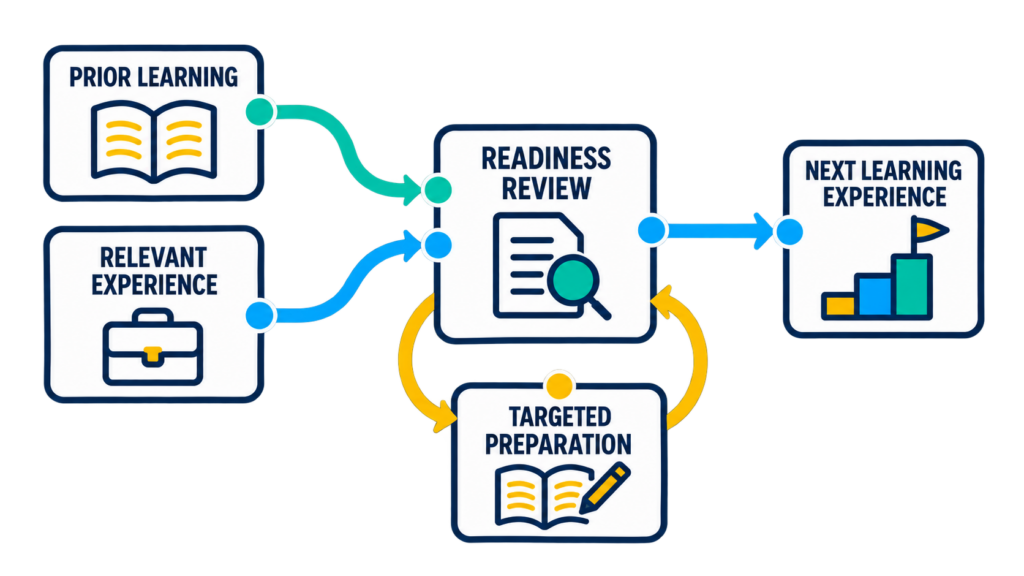
This module helps your team:
- Identify the actual demands of a selected next step
- Translate a prerequisite into specific readiness expectations
- Distinguish entry requirements from learning developed later
- Examine where essential preparation occurs
- Review what course completion and other evidence establish
- Identify unstated or inconsistently developed prerequisites
- Examine bottlenecks caused by scheduling and capacity
- Consider relevant alternative preparation routes
- Identify opportunities for bridging or co-requisite support
- Clarify responsibility for rules and exceptions
- Develop a focused transition improvement brief
- Outline a connected readiness and sequencing configuration
What should happen when a progression rule and learner readiness do not line up?
Participants identify the connection that needs attention before proposing a change. A transition may require stronger preparation, a clearer rule, more accessible provision, or a better way to review relevant evidence.
Confirm
Retain the relationship where its purpose, preparation, evidence, and consequences are sufficiently clear.
Clarify Readiness
Make the required knowledge, performance, context, and entry level explicit.
Strengthen Preparation
Improve the earlier learning, refresher work, bridging activity, or transition support.
Adjust the Sequence
Review course order, co-requisites, availability, or timing where the current arrangement creates a weak transition.
Review Alternatives
Examine evidence for another preparation route or a proposed revision to the requirement.
Investigate
Gather further evidence where the dependency, barrier, or consequences of change remain uncertain.
These options structure the review. Changes to entry rules, progression conditions, credit recognition, or required sequences remain subject to the organization’s established decision processes.
What should a prerequisite and sequencing review examine?
The next experience
What will learners need to do, and which demands arise immediately upon entry?
The dependency
Which foundations must be in place beforehand, and why are they necessary at that point?
The preparation
Where and how are those foundations developed, practiced, and assessed?
The evidence
What supports the readiness judgment, and which important assumptions remain untested?
The pathway conditions
How do timing, capacity, alternative routes, support, and learner circumstances affect access to the next step?
The decision and ownership
Who can interpret the evidence, authorize a response, maintain the rule, and evaluate whether a change helped?
Learn the method. Review one consequential transition.
Bring one prerequisite relationship or progression rule and the learning experience it governs. Participants trace the readiness assumptions and produce a focused improvement brief.
STEP 1
Define the next-step demands
Identify the tasks, knowledge, methods, and level of independence learners need when entering the selected experience.
STEP 2
Translate the rule into readiness
Explain what each requirement is intended to establish. Separate essential preparation from administrative or capacity conditions.
STEP 3
Trace preparation and evidence
Locate where the required foundations develop and what evidence shows that learners have had a meaningful opportunity to build them.
STEP 4
Examine the transition in practice
Review where learners struggle, repeat learning, wait for access, or depend on exceptions. Include relevant variation across recognized pathways.
STEP 5
Compare possible responses
Consider stronger preparation, clearer expectations, transition support, sequence changes, alternative routes, or further investigation.
STEP 6
Plan the improvement and configuration
Record the proposed response, responsible people, decision process, review point, and relationships a future implementation would need to maintain.
Participants leave with a reviewed transition, a proposed response, and a starting configuration brief. Unresolved questions remain visible alongside the evidence needed to address them.
- Begin with one consequential transition
- Explain the capability behind the course requirement
- Connect entry expectations to preparation and evidence
- Distinguish readiness gaps from access bottlenecks
- Keep alternative routes subject to appropriate review
- Assign responsibility for the next decision and follow-up
FUTURE PRODUCT CONNECTION
Keep readiness expectations connected as courses and pathways change.
The workshop identifies the relationships your organization needs to maintain between learning experiences, entry expectations, preparation, evidence, and progression decisions.
A potential TalentSync EDU configuration could organize those relationships around shared course, activity, and capability profiles. The reviewed transition would provide a concrete starting point for scoping the implementation.
The proposed configuration could connect:
- Learning experience profiles: the course, placement, capstone, or other next step and the work it requires
- Readiness expectations: the knowledge, capabilities, context, and level needed at entry
- Preparation relationships: which earlier courses, activities, or experiences develop each foundation
- Dependency types: what must precede the next step, what may occur alongside it, and what is recommended
- Evidence expectations: what information supports an authorized readiness review
- Alternative preparation routes: which options may be considered and how their evidence is reviewed
- Transition support: refreshers, bridging activities, co-requisites, and other relevant assistance
- Access conditions: known availability, capacity, scheduling, or placement constraints
- Decision roles: who owns the requirement, reviews evidence, handles exceptions, and authorizes changes
- Source and review records: where the governing information lives and when the relationship was last confirmed
- Learner connections: relevant experiences and evidence a learner may choose to share through TalentPass
For example, the workshop might identify that an advanced course depends on a particular analytical method, but the current prerequisite does not consistently assess it. An implementation brief could specify the dependency, preparatory activity, evidence expectation, transition support, responsible reviewers, and review date.
With the learner’s participation, TalentPass could help organize relevant learning, experience, capabilities, and evidence for a readiness conversation. An authorized institutional process would determine how that information affects access, recognition, or progression.
The next step is a scoped implementation conversation: select the initial transitions, confirm available capabilities, identify integration or development needs, and agree on responsibilities and success criteria.
PRODUCT AND DECISION BOUNDARIES
Make the basis for progression decisions visible.
A connected configuration should help people understand the expectations, evidence, and responsibilities behind a prerequisite or progression rule.
Its design should preserve the distinction between:
- Completing a course and demonstrating a particular entry capability
- Recording a dependency and establishing that it is educationally necessary
- Having relevant prior experience and receiving formal recognition for it
- Recommending support and determining eligibility to proceed
- Identifying a bottleneck and authorizing a change to the sequence
- Showing a possible route and guaranteeing its availability
- Sharing learner evidence and granting permission for broader use
Faculty, advisors, curriculum bodies, registrars, placement leads, and other authorized decision-makers retain the responsibilities assigned to them by the institution.
The product connection described here includes capabilities envisioned for TalentSync EDU and potential TalentPass connections. Availability, configuration needs, integrations, and required development would be confirmed during scoping.
The workshop produces a useful transition review and improvement brief independently of product adoption.
What to bring into the conversation
Start with one transition that matters: a prerequisite, a required course sequence, entry to a placement, or a progression rule associated with learner difficulty or delay.
A useful starting question is: “What does a learner actually need to be ready for this next step?”
Useful inputs may include:
- The selected prerequisite or progression rule
- The next course or learning experience’s outcomes
- Tasks learners encounter early in that experience
- Course descriptions and syllabi
- Relevant capability definitions
- Prerequisite course outcomes and activities
- Assessments addressing the required foundations
- Examples of learner work relevant to readiness
- Existing placement or entry review practices
- Required training or preparation information
- Instructor observations about transition difficulties
- Learner and advisor feedback
- Relevant progression, repeat, or delay information
- Course frequency and scheduling information
- Capacity or placement constraints
- Co-requisite and bridging arrangements
- Transfer and prior-learning review practices
- Exception criteria and decision records
- Ownership and approval responsibilities
- Known questions the review should resolve
The required Learning Alignment Direction module establishes the scope and decision this work should support. Outcome & Capability Clarity can help define unclear entry expectations, while Curriculum Coverage & Progression can provide the wider pathway context.
The depth of the exercise depends on the available evidence and the time allocated within the selected workshop.
What this module can help your team produce
A reviewed readiness relationship
A documented connection between the next experience, its entry demands, the required preparation, and the evidence supporting the prerequisite.
A transition issue map
A focused account of readiness gaps, unstated assumptions, access bottlenecks, alternative-route questions, and ownership needs affecting the selected transition.
A practical improvement brief
A proposed response, the person responsible, the decision process, and the evidence needed to evaluate the change.
A starting configuration brief
An outline of the profiles, dependencies, evidence expectations, support connections, source records, and decision roles a subsequent Gobekli implementation would need.
These outputs begin with the transition reviewed during the module. Final scope depends on the modules selected, available inputs, and the alignment decision established through Learning Alignment Direction.
Where might the work lead next?
A prerequisite review may reveal unclear entry expectations, missing preparation across the curriculum, or assessments that do not show the readiness the next experience assumes.
Outcome & Capability Clarity
Define the knowledge, actions, context, and level learners need before entering the next experience.
Curriculum Coverage & Progression
Examine where essential foundations develop and how the selected transition fits into the complete learning pathway.
Learning Activities & Assessment Alignment
Review whether preparatory activities and assessments develop and reveal the capabilities the next step requires.
Questions institutions ask before beginning.
A prerequisite is a condition that must be met before entering a course or other learning experience. It may involve prior coursework, demonstrated capability, required preparation, or another defined condition. This module examines the purpose of the requirement and how it connects to the next experience.
Course sequencing is the order in which learning experiences occur. A useful sequence connects earlier preparation to later demands while accounting for access, support, and relevant program requirements.
Curriculum Coverage & Progression examines where learning develops across the broader pathway. This module focuses on the transition between experiences: what learners need at entry, how readiness is established, and whether the rules governing access reflect that need.
It provides relevant information, but the answer depends on what the earlier course developed and assessed. An overall grade may combine several dimensions of performance. The review examines whether it supports the specific readiness assumption being made.
Course codes may remain useful for administration and advising. Connecting them to explicit capability expectations helps people understand the underlying dependency and review whether the requirement continues to serve its purpose.
Hidden prerequisites are foundations a learning experience assumes without making them explicit. They may involve terminology, technical methods, tool use, study practices, or other capabilities learners need to participate successfully.
A prerequisite must be satisfied before entry. A co-requisite is required alongside the learning experience. The appropriate arrangement depends on which foundations must already be present and which can develop concurrently with suitable support.
That is a question for the institution’s authorized review. A bridging activity may address a defined gap, but its suitability depends on the scope of the required preparation, the evidence available, and any other purposes the course requirement serves.
Identify the readiness needed for the next experience, then examine relevant evidence through the institution’s established processes. Similar course names or experience descriptions alone may not establish equivalence.
Consider whether the relevant knowledge, methods, or tools remain current and whether the learner has continued to use them. A refresher, a focused review, or another response may be appropriate depending on the dependency.
Examine whether learners depend on a course or experience they cannot reliably access because of timing, capacity, scheduling conflicts, or placement availability. Keep those conditions distinct from questions about academic readiness.
It may identify a requirement that deserves revision or further review. Removal is one possible institutional decision, not a predetermined outcome. The exercise examines purpose, evidence, consequences, and alternative responses.
The module helps clarify the evidence, criteria, responsible reviewer, rationale, and any support conditions needed for a consistent process. It does not authorize exceptions or replace existing institutional responsibilities.
Include people who understand the next experience, develop the prerequisite learning, advise learners through the transition, and can support or authorize improvements. Depending on the issue, this may include faculty, program leaders, curriculum teams, advisors, registrars, scheduling colleagues, and placement leads.
The reviewed transition identifies the course and capability profiles, preparation relationships, evidence expectations, support connections, and decision roles that need to remain connected. Those requirements become the starting point for scoping a potential TalentSync EDU configuration and appropriate TalentPass connections.
No. The review method and improvement brief are useful independently. A subsequent implementation can be considered if your organization wants help maintaining dependencies, extending the approach, or supporting appropriate learner evidence sharing. Product availability and implementation requirements are confirmed during scoping.
MAKE THE NEXT STEP MAKE SENSE
Connect course order to the readiness learners need.
Examine the foundations behind your prerequisites, identify weak transitions and access bottlenecks, and leave with a focused improvement and a starting configuration brief.
This module is part of Gobekli’s configurable Learning Alignment Workshop. Begin with Learning Alignment Direction, then select the modules that address your organization’s particular challenges.
