
LEARNING ALIGNMENT WORKSHOP MODULE
Transfer & Articulation Alignment
What learning carries forward—and what still needs to be developed? Compare outcomes, activities, evidence, and expectations across institutions or programs to support clearer transfer and articulation decisions.
Does this sound familiar?
Course titles look similar, but the learning differs
Catalog descriptions suggest a match while activities, assessment demands, scope, or expected independence reveal important differences.
Credit transfers without advancing the learner’s program
Accepted credit appears on the record, but learners are unclear about which requirements it satisfies and what remains.
Learners repeat learning they may already have developed
Relevant preparation is difficult to interpret because the comparison lacks sufficient detail about activities, expectations, and evidence.
A transfer decision leaves a hidden readiness gap
A requirement is satisfied, yet the next experience assumes a capability that the comparison did not examine.
An agreement no longer reflects the current programs
Courses, assessments, requirements, or delivery arrangements change without a corresponding review of the articulation relationship.
The rationale lives with one person
Reviewers reach decisions, but the supporting comparison, conditions, and unresolved questions are difficult for others to find or reuse.
What are transfer and articulation alignment?
Transfer alignment examines how learning completed in one institution or program relates to the requirements and expectations of another.
Articulation describes an agreed relationship that helps define how specified learning or credentials may be recognized within a receiving program.
A useful comparison looks beyond course titles and credit totals. It examines outcomes, learner activities, scope, level, assessment, evidence, and the role the learning plays in the receiving pathway.
The decision may concern a course, a sequence, a block of learning, a credential, or a particular program requirement.
Several questions may need separate answers: whether credit is accepted, where it applies, whether it satisfies a prerequisite, and what preparation the learner needs for subsequent work.
This module helps participants organize the educational comparison supporting those questions. Authorized institutional processes determine the resulting recognition and its conditions.
A useful comparison explains the learning behind the proposed match.
Two courses can share a title while asking learners to perform different kinds of work. Different courses can also develop relevant learning through distinct activities, contexts, or sequences.
A responsible review needs enough detail to understand the relationship without assuming that similarity means equivalence or that difference means incompatibility.
The comparison may need to connect:
- The receiving requirement under consideration
- The purpose that requirement serves
- The source course, sequence, or credential
- Intended outcomes on both sides
- The activities learners actually perform
- The scope and depth of the learning
- Expected complexity and independence
- Assessment tasks and criteria
- Available evidence and its limitations
- The context in which learning is applied
- Credit acceptance and program applicability
- Preparation needed for later experiences
- The versions and conditions being compared
- Decision authority, rationale, and review responsibility
Together, these connections help participants identify what aligns, which differences matter, and what further evidence or preparation may be needed.
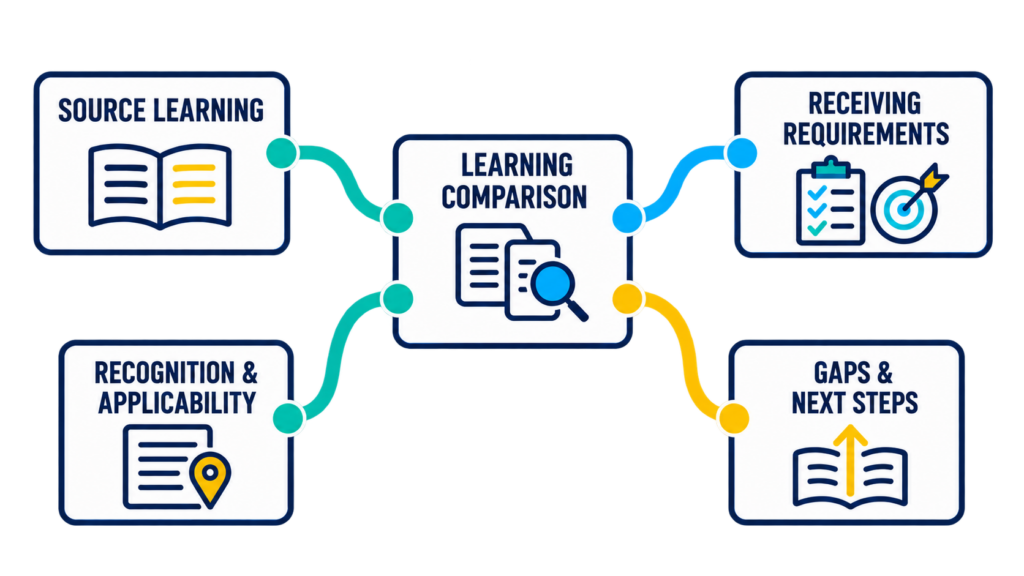
Connect the source learning to its role in the receiving program.
Source Learning
Courses and experiences
Outcomes and scope
Learner activities
Assessment expectations
Applicable version
Receiving Requirements
Program purpose
Required outcomes
Expected level
Prerequisite role
Later learning demands
Comparison Evidence
Syllabi and assignments
Assessment criteria
Relevant learner work
Faculty interpretation
Unresolved questions
Recognition and Conditions
Credit acceptance
Requirement applicability
Course or block recognition
Additional preparation
Decision conditions
Ownership and Maintenance
Institutional authority
Partner coordination
Recorded rationale
Learner communication
Review triggers
A transfer relationship becomes more useful when the organization can explain what is recognized, where it applies, why the decision is supported, and what the learner needs next.
How an articulation relationship becomes difficult to interpret
STAGE 1 — A relationship is established
Institutions or programs identify a potential match using the information, requirements, and learning expectations available at the time.
STAGE 2 — Learning changes on either side
Outcomes, assignments, assessments, prerequisites, technologies, or program requirements evolve.
STAGE 3 — The recorded relationship stays the same
An equivalency entry or agreement continues to guide decisions without preserving enough detail about the original comparison or subsequent changes.
STAGE 4 — Learners encounter the consequences
Credit may apply unexpectedly, preparation gaps may appear, or learners may repeat work because the relationship is no longer clear enough to interpret confidently.
“These courses are equivalent” needs an explanation of purpose and scope.
A recorded equivalency can simplify advising and administration.
Its usefulness depends on what was compared, which receiving requirement it addresses, and what conditions limit the decision.
The review should clarify:
Identify whether the review concerns credit acceptance, satisfaction of a specific requirement, prerequisite recognition, a block agreement, or another defined decision. Avoid treating these as interchangeable.
Clarify the outcomes, level, context, and preparation expected. Examine why the requirement exists and what later learning depends on it.
Review outcomes alongside activities, assignments, practice, and assessment. Identify what all learners encounter and what depends on electives, delivery conditions, or individual choices.
Compare scope, depth, methods, context, independence, and evidence. Distinguish variation that preserves the relevant learning from a gap that affects the receiving requirement.
Identify the sources used, the versions they describe, and the limits of the comparison. Record where additional documents, faculty discussion, or appropriately shared learner evidence are needed.
Clarify how the result affects the learner’s program, which conditions apply, who communicates them, and what changes should trigger a review of the relationship.
Compare the learning at the level the decision requires.
Outcomes
Examine what learners are expected to know, explain, apply, perform, create, or decide on each side.
Scope and Depth
Compare the breadth of material and the depth of engagement relevant to the receiving requirement.
Activities
Look at the work learners actually perform, including practice, investigation, application, collaboration, and creation.
Level and Context
Compare complexity, independence, tools, conditions, responsibility, and the settings in which learning is applied.
Assessment and Evidence
Examine what learners must demonstrate, how the work is judged, and what the available information establishes.
Role in the Pathway
Determine how the learning contributes to program requirements and prepares learners for subsequent experiences.
Differences that may preserve relevant alignment
Learning may remain relevant despite differences in:
- Course titles or numbering
- The order in which topics are introduced
- Examples and application settings
- Teaching methods and delivery formats
- Assignment formats
- The distribution of learning across several courses
- Optional material beyond the receiving requirement
- The terminology used to describe comparable expectations
The review examines whether the differences preserve the learning needed for the particular decision.
Differences that may require a response
Closer review is needed when the source learning:
- Omits an essential receiving outcome
- Requires substantially less depth or independence
- Provides limited practice in a necessary method
- Does not assess a consequential capability
- Makes essential learning optional
- Uses tools or contexts that leave a relevant preparation gap
- Depends on assumptions not supported by the available evidence
- Does not prepare learners for the next required experience
These differences call for a documented judgment. They do not automatically determine whether credit should be accepted or rejected.
Credit can be accepted while its program role still needs clarification.
Imagine a learner transferring an introductory research methods course.
The source course develops question formation, literature review, and research design. The receiving program’s methods requirement also includes an analytical technique needed in a later course.
A title-level comparison might miss that difference. A fuller review examines where the technique is taught, what learners must demonstrate, and whether the source learning includes it elsewhere.
The authorized decision might recognize the course toward a particular requirement, apply it as elective credit, consider it with another source course, or require targeted preparation before later work.
The learner needs a clear explanation of the actual decision: what counts, where it counts, which conditions apply, and how it affects the remaining pathway.
The workshop helps participants build the comparison and identify the questions that must be resolved.
The relevant learning may be distributed differently across programs.
A receiving institution may organize learning in one course that the source institution develops across two courses or a broader sequence.
A course-by-course review can miss that relationship if each item is considered in isolation.
Participants should select the unit of comparison that fits the decision: an individual course, a sequence, a defined block, or a completed credential.
For broader arrangements, the review should make shared outcomes, required components, pathway variations, and any remaining learning explicit. It should also identify whether the agreement applies to the complete package or to its individual components.
A clear comparison preserves the educational relationship without assuming that every program must organize learning in the same way.
Learners need to know where the credit applies.
Credit acceptance, satisfaction of a program requirement, prerequisite recognition, and readiness for later work answer different questions.
Make the relevant decisions explicit and explain their practical consequences for the learner’s remaining requirements and next steps.
A clear transfer pathway connects the recognition decision to the program the learner is actually trying to complete.
THE MATCHING WORKSHOP MODULE
Module 8: Transfer & Articulation Alignment
This practical minicourse helps faculty, program leaders, transfer teams, registrars, and advising colleagues compare learning across institutions or programs in support of responsible transfer and articulation decisions.
Participants learn a repeatable method and apply it to one selected course relationship, sequence, or bounded part of an agreement. They compare outcomes, activities, evidence, and expectations, then identify which similarities and differences matter to the receiving requirement.
The exercise also defines the source and receiving profiles, comparison relationships, decision conditions, and review responsibilities that a subsequent Gobekli configuration would need to maintain.
This module helps your team:
- Define the specific transfer or articulation decision
- Clarify the purpose of the receiving requirement
- Compare outcomes, scope, activities, and expected level
- Examine assessment and evidence expectations
- Distinguish meaningful differences from acceptable variation
- Identify where the available information is insufficient
- Consider course, sequence, and block relationships
- Separate credit acceptance from program applicability
- Identify readiness gaps and possible preparation needs
- Record rationale, conditions, and decision ownership
- Develop a focused comparison and improvement brief
- Outline a connected transfer and articulation configuration
What should happen when the comparison reveals a difference?
Participants identify how a difference affects the particular receiving requirement before proposing a response. The appropriate next step may involve clearer documentation, additional evidence, a different recognition relationship, or preparation for later learning.
Confirm Alignment
Document where the comparison supports the proposed relationship and its stated scope.
Clarify Applicability
Explain where recognized learning contributes to the receiving program and which requirements remain.
Request Evidence
Identify the additional documents, examples, or qualified interpretation needed to resolve uncertainty.
Address a Gap
Consider targeted preparation or another appropriate response to a relevant learning difference.
Revise the Relationship
Review the course, sequence, block, or agreement structure where the existing arrangement does not accurately describe the learning.
Refer for Decision
Bring unresolved or consequential questions to the people authorized to determine recognition and its conditions.
These options organize the educational review. They do not independently award credit, establish equivalency, amend an agreement, or determine admission or progression.
What should a transfer and articulation alignment review examine?
The receiving purpose
Which requirement or decision is being addressed, and what learning must it establish?
The source experience
What do learners encounter, practice, and demonstrate in the source course, sequence, or credential?
The comparison
Where do outcomes, scope, activities, level, and evidence align or differ?
The significance
Which differences affect applicability, readiness, or the meaning of the recognition?
The decision conditions
What is recognized, where does it apply, and what further evidence, preparation, or approval is needed?
The maintenance
Who owns the relationship, how is its rationale recorded, and what changes should trigger a review?
Learn the method. Compare one consequential transfer relationship.
Bring one source learning experience and one receiving requirement. For a broader agreement, select a bounded relationship that participants can examine meaningfully with the available information.
STEP 1
Define the receiving decision
State whether the review concerns credit acceptance, requirement satisfaction, a prerequisite, a block arrangement, or another specific purpose.
STEP 2
Describe the learning on both sides
Identify outcomes, scope, learner activities, level, assessment, and the role of each experience in its program.
STEP 3
Compare the relevant expectations
Document where the learning aligns, how it differs, and whether the unit of comparison should include additional courses or experiences.
STEP 4
Examine gaps and uncertainty
Identify differences that matter to the receiving requirement and the evidence needed to interpret them.
STEP 5
Frame the decision and conditions
Record the proposed recognition relationship, applicability, unresolved questions, potential preparation needs, and authorized decision roles.
STEP 6
Plan communication and configuration
Clarify what learners need to be told, who maintains the relationship, and which profiles, source records, conditions, and review triggers a future implementation would need.
Participants leave with a documented comparison, a proposed next action, and a starting configuration brief. The record distinguishes supported findings from questions requiring additional evidence or authorized determination.
- Begin with a defined receiving requirement
- Compare actual learning and assessment expectations
- Explain which differences matter and why
- Separate acceptance, applicability, and readiness
- Preserve rationale, conditions, and authority
- Connect the result to learner communication and ongoing review
FUTURE PRODUCT CONNECTION
Maintain the learning comparison behind the transfer relationship.
The workshop identifies the information and relationships needed to explain and maintain a transfer or articulation decision.
A potential TalentSync EDU configuration could organize source and receiving course, program, outcome, and activity profiles alongside comparison evidence, decision conditions, and review responsibilities.
The proposed configuration could connect:
- Source learning profiles: the courses, sequences, experiences, or credentials being considered
- Receiving requirement profiles: the purpose, outcomes, and expectations the recognition must address
- Comparison relationships: where scope, activities, level, context, and assessment align or differ
- Supporting sources: syllabi, assignments, criteria, qualified interpretations, and other relevant information
- Evidence status: what has been reviewed, what remains uncertain, and what additional information is needed
- Recognition relationships: the proposed or approved course, sequence, block, or credential arrangement
- Applicability conditions: where credit counts and which program requirements remain
- Preparation needs: relevant gaps, bridging options, or later learning dependencies requiring review
- Decision records: rationale, responsible authorities, conditions, and applicable dates
- Version and review relationships: which source and receiving requirements were compared and what changes trigger reconsideration
- Learner connections: relevant records and experiences a learner may choose to share through TalentPass
For example, the workshop might identify that a source sequence supports a receiving requirement only when both courses are completed. An implementation brief could specify the two source profiles, the receiving requirement, shared outcomes, supporting evidence, combination condition, authorized decision, and review trigger.
With the learner’s participation, TalentPass could help organize relevant credentials, learning experiences, capabilities, and evidence for a transfer conversation. The receiving institution would determine which information is acceptable and how it affects recognition through its established processes.
The next step is a scoped implementation conversation: select the initial relationship, confirm available capabilities, identify integration or development needs, and agree on responsibilities and success criteria.
PRODUCT AND DECISION BOUNDARIES
Keep the comparison, decision, and conditions distinct.
A connected configuration should help people understand the learning and rationale behind recognition decisions.
Its design should preserve the distinction between:
- Similar wording and comparable learning
- A mapped relationship and an approved equivalency
- Credit acceptance and application to a particular program
- Satisfaction of a requirement and readiness for all later work
- An institutional agreement and its applicability to a particular learner
- A technically verifiable record and an educational recognition decision
- Sharing relevant evidence and granting access to all learner information
Authorized institutional reviewers retain responsibility for credit, equivalency, applicability, and agreement decisions. Partner institutions retain their respective responsibilities.
The product connection described here includes capabilities envisioned for TalentSync EDU and potential TalentPass connections. Availability, configuration needs, integrations, and required development would be confirmed during scoping.
The workshop produces a useful learning comparison and improvement brief independently of product adoption.
What to bring into the conversation
Start with one transfer relationship that is important, uncertain, frequently reviewed, or associated with learner confusion.
A useful starting question is: “What learning are we recognizing, where should it apply, and what supports that decision?”
Useful inputs may include:
- The selected source course, sequence, or credential
- The receiving requirement under consideration
- Current course and program descriptions
- Learning outcomes on both sides
- Relevant syllabi and learning activities
- Assignment and assessment examples
- Rubrics or performance criteria
- Required practical or experiential components
- Prerequisite and progression relationships
- Relevant versions and effective dates
- Existing equivalency records
- Articulation agreements or pathway documents
- Credit acceptance and applicability rules
- Relevant transfer or recognition guidance
- Appropriately shared examples of learner work
- Faculty and evaluator observations
- Learner and advisor questions
- Known gaps or repeated review issues
- Decision and partner-contact responsibilities
- The decision the comparison should support
The required Learning Alignment Direction module establishes the scope and decision this work should support. Related modules can help clarify uncertain capability definitions, assessment expectations, or readiness dependencies.
The depth of the exercise depends on the available evidence, partner participation, and time allocated within the selected workshop.
What this module can help your team produce
A documented learning comparison
A structured account of outcomes, activities, scope, level, evidence, and relevant differences across the selected source and receiving experiences.
A recognition and conditions brief
A clear statement of the decision being supported, proposed applicability, unresolved questions, and conditions requiring authorized review.
A practical improvement plan
A proposed next action, responsible people, learner communication needs, and a review point for the relationship.
A starting configuration brief
An outline of the profiles, comparison relationships, source records, recognition conditions, decision roles, and review triggers a subsequent Gobekli implementation would need.
These outputs begin with the relationship reviewed during the module. Final scope depends on the modules selected, available inputs, and the alignment decision established through Learning Alignment Direction.
Where might the work lead next?
A transfer comparison may reveal unclear expectations, uncertainty about assessment evidence, or a readiness gap affecting the receiving pathway.
Outcome & Capability Clarity
Define the knowledge, actions, context, and level needed to compare learning meaningfully across programs.
Learning Activities & Assessment Alignment
Examine whether the activities and assessments on each side develop and reveal the learning relevant to the decision.
Prerequisites & Course Sequencing
Review whether recognized learning provides the preparation needed for the learner’s next required experience.
Questions institutions ask before beginning.
Transfer alignment examines how learning completed in one institution or program relates to the requirements and expectations of another. The comparison supports a defined recognition decision.
An articulation agreement describes an agreed relationship governing how specified learning or credentials may be recognized between institutions or programs. Its scope, conditions, and application depend on the agreement itself.
No. Titles provide a starting point, but the review may need to examine outcomes, scope, activities, expected level, assessment, and the purpose of the receiving requirement.
Potentially. Different titles or organizational structures may describe learning relevant to the same requirement. The comparison should examine the actual expectations and evidence rather than relying on naming alone.
Acceptance concerns whether the institution recognizes the credit. Applicability concerns where that credit counts within a particular program or requirement. Learners need to understand both where they are relevant to the decision.
It should not be assumed without understanding the relationship. A later experience may depend on specific capabilities that need attention within the comparison or through an appropriate preparation review.
No. Relevant learning may be distributed across a sequence or a defined block. The unit of comparison should fit the receiving requirement and the decision under consideration.
Examine what learners are required to demonstrate and how the work is judged. Assessment tasks, criteria, and appropriately shared examples can help explain the learning behind a course description.
No. Different assignments can provide relevant evidence of comparable expectations. The review examines the learning and performance required, including differences that affect the receiving purpose.
Document the remaining difference and its significance. Authorized reviewers can then consider appropriate recognition, conditions, additional evidence, or preparation. The workshop does not predetermine that decision.
Both involve examining relevant learning and evidence. This module focuses on relationships across institutions or programs. Where prior-learning recognition affects an arrangement, its applicable process and conditions should remain explicit.
Review whether the change affects the outcomes, scope, assessment, or conditions supporting the recorded relationship. Preserve the versions originally compared and identify who is responsible for reconsideration.
Software may help organize source information and highlight relationships or differences for review. A proposed match still needs the evidence, interpretation, and authority appropriate to the institutional decision.
Include people who understand the source and receiving learning, evaluate transfer, determine program applicability, and communicate the result to learners. This may include faculty, program leaders, registrars, transfer specialists, advisors, and partner representatives.
The reviewed example identifies the source and receiving profiles, comparison dimensions, evidence, recognition conditions, decision roles, and review triggers that need to remain connected. These requirements become the starting point for scoping a potential TalentSync EDU configuration and appropriate TalentPass connections.
No. The comparison method and improvement brief are useful independently. A subsequent implementation can be considered if your organization wants help maintaining articulation relationships or organizing appropriate learner context. Product availability and implementation requirements are confirmed during scoping.
MAKE THE LEARNING BEHIND TRANSFER VISIBLE
Explain what carries forward—and what comes next.
Compare the learning, clarify where recognition applies, and identify the evidence or preparation still needed. Leave with a focused comparison and a starting configuration brief.
This module is part of Gobekli’s configurable Learning Alignment Workshop. Begin with Learning Alignment Direction, then select the modules that address your organization’s particular challenges.
