
A WORKFORCE SCALABILITY WORKSHOP MODULE
Workforce Reskilling:
Develop Talent Before the Capability Gap Becomes Urgent
Organizations invest in courses, platforms, credentials, and development programs without always knowing whether those activities are building the capabilities future work will require.
Employees may complete training without gaining opportunities to practice. Managers may identify capability gaps without knowing who could realistically close them.
Workforce growth and reskilling connects development to defined work, real people, credible evidence, and the timeframe in which capability must become available.
Does this sound familiar?
Training is disconnected from future work
Employees complete learning programs that are not clearly connected to changing activities, roles, projects, or organizational priorities.
Skills gaps remain too broad to act on
Leaders know the organization needs digital, AI, leadership, or technical skills but cannot define the capabilities the work requires.
Completion substitutes for readiness
Course attendance, certificates, and learning hours are treated as evidence that someone can perform the work.
Employees have no opportunity to practice
People learn concepts but cannot apply them through projects, assignments, simulations, mentoring, or supported work.
Development begins after urgency
Reskilling starts only after capability shortages are already affecting delivery, growth, quality, or customer outcomes.
Learning investments produce unclear value
The organization can report participation and completion but cannot explain which workforce needs are becoming easier to meet.
What is workforce reskilling?
Workforce reskilling is the deliberate development of capabilities that enable people to perform substantially changed work or move into different work.
It may combine formal education, workplace learning, projects, stretch assignments, rotations, apprenticeships, mentoring, coaching, simulation, credentials, supervised application, and evidence development.
Reskilling prepares a person for work requiring meaningfully different activities, knowledge, tools, responsibilities, or operating conditions. Upskilling generally deepens capability within a current area of work. A development path may include both.
What matters is whether development connects to a defined workforce need, a realistic learner, meaningful practice, credible evidence, and a decision about readiness.
The problem is not a shortage of training. It is the missing path from learning to work.
A learning catalog can show employees what courses are available. It cannot explain which capabilities the organization needs, who could realistically develop them, or how learning will become demonstrated performance.
Leaders must connect future work, required capability, existing foundations, employee interest, the realistic gap, development experiences, organizational support, evidence, time, and the consequences of delayed readiness.
Without those connections, employees may complete courses while remaining unprepared for the work—and relevant experience may remain invisible because it was gained outside the current role.
See the complete development path
not just the course catalog.
Future Work
- Changing activities
- Emerging roles
- Growth commitments
- Critical projects
- Anticipated gaps
Capability Requirements
- Technical capabilities
- Human capabilities
- Domain knowledge
- Required credentials
- Operating conditions
People and Potential
- Existing capability
- Transferable experience
- Employee interests
- Learning readiness
- Practical circumstances
Development Experiences
- Courses and credentials
- Projects and assignments
- Mentoring and coaching
- Practice and simulation
- Supervised application
Evidence and Decisions
- Demonstrated progress
- Readiness evidence
- Remaining gaps
- Support requirements
- Appropriate next step
Development becomes useful when the organization can trace a line from changing work to required capability, relevant people, meaningful experiences, credible evidence, and a workforce decision.
How workforce development becomes disconnected
STAGE 1
Future capability needs remain vague
Leaders describe broad workforce trends without translating them into specific work, capabilities, and timeframes.
STAGE 2
Learning programs are selected
Courses, platforms, credentials, and initiatives are chosen before the development need is fully defined.
STAGE 3
Employees complete activities
Participation, learning hours, and completion rates become the easiest available measures of progress.
STAGE 4
Readiness remains uncertain
The organization still cannot determine who can perform the work, what evidence supports that conclusion, or which gaps remain.
A course can contribute to development. It cannot complete the path by itself.
Learning can introduce knowledge, methods, tools, vocabulary, and conceptual understanding. Workforce readiness may require several additional conditions.
A complete development path may combine formal learning with observation, simulation, guided practice, project contribution, mentoring, supervised application, and increasingly independent work.
The person needs opportunities to use the capability rather than merely recognize or describe it.
Capability must be applied within the systems, relationships, constraints, standards, and conditions of the actual work.
A learner needs timely information about performance, misunderstanding, quality, and further development.
The person may need progressively greater ownership of decisions, outputs, risks, and consequences.
The organization needs a responsible basis for determining what has been demonstrated and what remains uncertain.
Managers, mentors, peers, tools, time, access, and psychological safety may determine whether development can occur.
People can be relevant before they are fully ready.
Demonstrated capability
The person has relevant evidence from real work but may still need onboarding or contextual support.
Transferable experience
The person has performed related activities in another role, industry, project, or setting.
Knowledge without practice
The person understands the concepts but has not yet applied them under realistic conditions.
Manageable readiness gap
Strong foundations exist and the remaining development appears realistic within the available time.
Evidence without interest
The person may be capable but does not necessarily want the opportunity or development path.
Relevance requiring investigation
Potential exists, but evidence, prerequisites, support, or development time remains uncertain.
Development time
How long will it take to:
- Build foundational knowledge
- Practice relevant activities
- Receive useful feedback
- Complete required credentials
- Demonstrate acceptable quality
- Develop judgment and independence
Workforce time
When will the organization need:
- Additional capacity
- Independent performance
- Required coverage
- Customer delivery
- Contract fulfillment
- Succession readiness
Not every gap should become a course.
Knowledge, practice, context, evidence, prerequisite, and support gaps require different responses. Sometimes the environment must change before the person can develop.
A development path must fit the time the organization actually has.
If development time and workforce time do not align, the organization may need internal development, temporary support, external sourcing, work redesign, or phased responsibility.
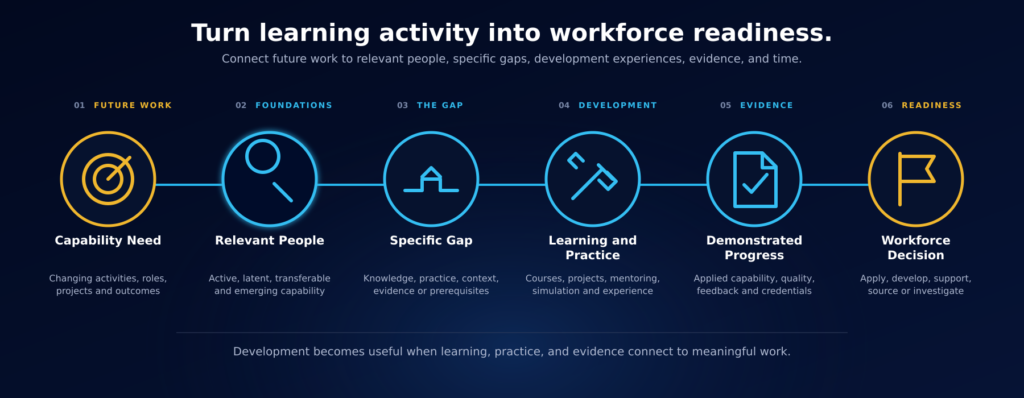
Turn learning activity into workforce readiness.
Connect future work to capability gaps, practice, evidence, support, and time.
THE MATCHING WORKSHOP MODULE
Module 7: Workforce Growth & Reskilling
This module helps participants determine which workforce capabilities can realistically be developed, who may be relevant, what development experiences are required, and whether readiness can be achieved within the available timeframe.
Participants connect changing work to capability requirements, employee interests, existing evidence, learning opportunities, workplace practice, support conditions, and readiness decisions.
The purpose is not to prescribe training or treat course completion as proof of capability. It is to develop an evidence-backed workforce response.
This module helps your team:
- Connect development to a defined workforce need
- Translate future work into capability requirements
- Identify people with relevant foundations
- Distinguish knowledge, practice, context, evidence, and prerequisite gaps
- Incorporate employee interests and participation
- Evaluate learning and development options
- Create opportunities for practice
- Clarify manager, mentor, time, and resource needs
- Compare development time with workforce demand
- Define evidence of progress and readiness
What should happen next for each capability need?
Not every capability gap should produce the same development response. Consider the work, current evidence, employee interest, size of the gap, available support, development time, and consequences of being unprepared.
Apply
Use capability already demonstrated through relevant work, with appropriate onboarding or contextual support.
Practice
Create applied experience through projects, simulation, repetition, feedback, or supervised responsibility.
Develop
Build a realistic capability gap through learning, practice, support, and evidence.
Credential
Complete a required license, certification, authorization, assessment, or supervised experience.
Support
Provide manager release, mentorship, accessibility, tools, time, coverage, or other enabling conditions.
Source or Redesign
Use external talent, contracting, automation, partnership, phased responsibility, or work redesign when development cannot meet the need in time.
Investigate
Resolve uncertainty about the work, capability, person, development path, support requirements, or timeframe.
These categories structure planning and human decision-making. They do not automatically determine who should receive development, enter a role, earn a credential, or be excluded from an opportunity.
What should a workforce development review examine?
The need
What work is changing, which capability is required, when is it needed, and what happens if it remains unavailable?
The person
What experience, interests, circumstances, and capabilities may provide a realistic foundation?
The gap
What specifically separates current evidence from the requirements of the work?
The experience
Which learning, practice, feedback, mentoring, credential, or applied-work experiences could close the gap?
The support and timeframe
What resources must be available, and can capability become ready before delay creates unacceptable consequences?
The evidence and decision
What demonstrates progress and readiness, who evaluates it, and what workforce response should follow?
Use TalentSync and TalentPass to connect learning with work and evidence.
TalentSync can help organizations connect capability gaps to the work that creates them, while TalentPass can help individuals develop a reusable view of experiences and evidence they choose to record.
The process begins with a defined workforce need—not a generic course recommendation.
STEP 1
Define the future work
Clarify outcomes, activities, responsibilities, tools, prerequisites, and operating conditions.
STEP 2
Identify relevant foundations
Examine active, latent, transferable, and emerging capabilities that may provide a realistic starting point.
STEP 3
Clarify the gap
Distinguish missing knowledge, practice, context, evidence, credentials, support, and experience.
STEP 4
Connect development experiences
Identify learning, projects, mentoring, simulations, rotations, credentials, and applied opportunities.
STEP 5
Develop evidence through experience
Capture activities, skills, credentials, accomplishments, feedback, and relevant evidence with the individual’s participation.
STEP 6
Review readiness and next steps
Examine evidence, remaining gaps, interest, support conditions, and timeframe before deciding what happens next.
TalentSync and TalentPass can make the relationship between work, capability, development, and evidence more visible. Employees, managers, educators, workforce partners, HR, and authorized leaders remain responsible for participation, interpretation, support, and decisions.
- Connect future work to defined capability needs
- See active, latent, transferable, and emerging foundations
- Identify specific readiness and evidence gaps
- Connect development to learning and applied experience
- Let evidence grow through meaningful work
- Support transparent human review
WHY TALENTPASS MATTERS TO DEVELOPMENT
Let development evidence grow with the person.
Learning records are often fragmented across platforms, credential systems, personnel records, managers, education providers, and the employee’s own files.
TalentPass is designed to help an individual develop a reusable view of work history, activities, skills, credentials, projects, accomplishments, and applied learning evidence.
The individual controls their TalentPass information and chooses when it is shared.
A reusable profile can help development build on prior experience rather than treating every course, credential, application, and opportunity as an isolated event.
PRODUCT AND DECISION BOUNDARIES
Development evidence supports workforce judgment. It does not predict human potential.
TalentSync, TalentPass, Pythia, and workshop outputs should not be presented as:
- Determining who is capable of learning
- Predicting who will succeed
- Automatically assigning development
- Inferring interest without participation
- Determining the “best” employee
- Treating course completion as proof of readiness
- Making promotion, transfer, compensation, or employment decisions
- Guaranteeing a development outcome
The workflow helps clarify requirements, organize relevant evidence, identify gaps, and support transparent human review.
Employment, labor, privacy, accessibility, compensation, credentialing, education, collective-bargaining, cybersecurity, and other questions may require qualified specialist review.
What to bring into the conversation
You do not need a complete skills inventory, perfect workforce forecast, or fully integrated learning ecosystem.
We begin with the workforce needs, employee information, learning resources, and development practices the organization already has.
Useful inputs may include:
- Workforce plans and anticipated demand
- Roles, activities, or capabilities expected to change
- Current and future role definitions
- Known capability shortages
- Skills or competency frameworks
- Existing learning programs and platforms
- Credential and certification requirements
- Tuition, apprenticeship, mentoring, or coaching programs
- Project, rotation, and stretch-assignment opportunities
- Employee profiles and development plans
- Career interests and mobility information
- Learning participation and completion records
- Work samples or performance evidence
- Manager feedback and readiness assessments
- Development budgets and capacity
- Known time, access, coverage, or manager constraints
The Workforce Direction module establishes the consequential outcome and bounded workforce decision this module should support.
What this module can help clarify
Which capabilities can be developed
Distinguish realistic development gaps from needs requiring another workforce response.
Who may have a relevant foundation
Identify active, latent, transferable, and emerging capabilities that may support development.
What development must include
Clarify learning, practice, experience, feedback, credentials, evidence, and support.
Whether readiness can be achieved in time
Compare development time with workforce demand and determine which response should follow.
Final outputs depend on the modules selected and the workforce decision established through the workshop’s required Workforce Direction foundation.
Where might the work lead next?
Workforce development frequently reveals connected problems in capability visibility, role design, internal mobility, workforce planning, external sourcing, and sustainable deployment.
Workforce Capability Visibility
Determine whether required capability is absent, hidden, emerging, or insufficiently documented.
Skills-Based Role Design
Clarify the work and operating conditions development must prepare someone to address.
Internal Talent Sourcing & Mobility
Identify employees with relevant foundations and determine what would support contribution or movement.
Workforce Demand & Capacity Planning
Establish when capability will be needed and whether development can occur before capacity is constrained.
External Talent Pipeline Development
Build external relationships when capability cannot be developed internally in time.
Team Formation, Onboarding & Mobilization
Support developed capability as it moves into real teams, responsibilities, and operating conditions.
Questions leaders ask before booking.
Workforce reskilling develops capabilities that enable people to perform substantially changed work or move into different work. It may combine education, workplace learning, projects, practice, mentoring, credentials, simulation, and supervised application.
Upskilling generally deepens capability within a current area of work. Reskilling prepares someone for work involving meaningfully different activities, tools, responsibilities, or conditions. A development path may include both.
Training is one possible activity. Workforce development connects learning and experience to a defined need, a specific gap, meaningful practice, available support, evidence, readiness, and time.
Not necessarily. Course completion may demonstrate participation or knowledge. Work readiness may also require practice, contextual understanding, judgment, feedback, acceptable quality, and required credentials.
Examine potentially relevant experience, transferable capability, employee interest, current responsibilities, readiness for development, practical circumstances, available support, and the size of the gap through a fair human process.
A workforce need does not erase employee agency. Organizations should communicate clearly about changing work, available options, expectations, support, consequences, and employee choices. Employment questions may require specialist review.
Consider applied capability, quality, independence, time to readiness, employee experience, deployment, mobility, retention, workforce coverage, and the organizational outcome—not participation alone.
The path may be missing practice, access, feedback, manager support, suitable work, or a route into an opportunity. Additional courses may not resolve an opportunity or support gap.
Internal development may fit when relevant foundations exist, employees are interested, support is available, and readiness can be achieved in time. Many needs require a blended response.
TalentSync can clarify work requirements, evidence, and gaps. It should not be described as automatically deciding what someone must learn, which program is appropriate, or who will succeed.
TalentPass can help an individual maintain a reusable view of experience, activities, skills, credentials, projects, accomplishments, and evidence they choose to record and share.
Every engagement begins with Workforce Direction. Workforce Growth & Reskilling can then be selected when the organization needs to determine what can be developed, who may have relevant foundations, what development requires, and whether readiness can be achieved in time.
BUILD CAPABILITY BEFORE THE GAP BECOMES URGENT
Turn learning activity into workforce readiness.
Connect future work to people, capability gaps, development experiences, evidence, support, and time—then decide what the organization should build and what requires another response.
This module is part of Gobekli’s configurable Workforce Scalability Workshop. Explore the complete 12-module structure and identify the right starting point for your organization.
