
MEMBER INTELLIGENCE WORKSHOP MODULE
Member Relationships & Network Visibility
You know who belongs. Can you see how your community connects?
Examine existing connections among members, groups, and organizations to reveal useful relationships, isolated communities, and gaps in what is known.
Module 8 · Member Intelligence Workshop
Does this sound familiar?
Useful connections depend on staff memory.
Knowing who has worked together, which groups collaborate, or who can provide relevant context depends on a few people remembering the relationship.
A shared membership becomes an assumed connection.
Two people appear in the same chapter, company, or event record, but the organization cannot tell whether they have actually interacted.
Local networks remain difficult to see.
Chapters, committees, and specialist communities know their own relationships while connections across the wider organization remain unclear.
The same people become every bridge.
Coordination repeatedly passes through familiar leaders or staff members, with little understanding of other existing connections or continuity needs.
Some communities appear disconnected.
A group has few visible links to other parts of the organization, but it is unclear whether the gap reflects limited relationships or incomplete information.
Old relationships look current.
Past collaborations, former appointments, and introductions remain on record without showing whether the connection is still relevant.
What is member relationship and network visibility?
Member relationship and network visibility connects people, groups, and organizations through clearly described relationships.
It asks more than whether two names appear in the same database. It examines what connects them, how that connection is known, when it was relevant, and what the organization can appropriately conclude from it.
Useful distinctions include:
- A member’s affiliation with a group.
- A formal role connecting someone to an organization.
- Participation in a shared activity.
- Collaboration on a particular piece of work.
- A mentoring or other support relationship.
- A relationship reported by a participant.
- A possible connection that still needs clarification.
The aim is to create a useful, bounded view of the community’s relationships while keeping uncertainty and appropriate sharing visible.
A directory identifies the participants. Relationships explain how they connect.
A membership directory may show individuals, employers, chapters, committees, and partner organizations.
Those records provide a starting point. Understanding the network requires examining the relationships between them.
A person may belong to a chapter, serve on a committee, collaborate with another member, and represent an employer in a partner initiative. Each connection has a different meaning and may come from a different source.
The distinction matters when the organization wants to understand existing collaboration, coordinate across groups, preserve continuity, or identify where more information is needed.
This module helps your team examine those relationships around one organizational question and develop a practical approach to keeping them understandable.
Where member relationships take shape
Members & Peers
People collaborate, exchange knowledge, support one another, and develop professional relationships. Some connections are formal; others are known only to the participants.
Chapters & Communities
Local, regional, specialist, and interest-based groups create shared settings for participation. Group membership provides context without establishing a direct relationship between every participant.
Committees & Working Groups
Appointments, responsibilities, and shared projects connect people around organizational work. The nature and timing of those connections can change.
Employers & Member Organizations
Individuals may represent, work for, or participate through organizations. These relationships need enough context to distinguish employment, representation, and membership arrangements.
Partners & Cross-Organization Initiatives
Shared programs, joint projects, coalitions, and service arrangements connect the membership organization to a wider ecosystem.
The workshop examines the relationships relevant to your decision. It does not require mapping every personal or professional connection in the community.
How a network becomes difficult to understand
1. Connections develop through real activity.
Members meet, collaborate, serve, and coordinate through programs, groups, and shared work.
2. Records capture only parts of the relationship.
A roster, event record, project document, or staff note preserves one aspect of the connection while other context remains elsewhere.
3. Relationships are flattened or assumed.
Different connections become the same generic link, or shared affiliation is treated as evidence that people know or work with one another.
4. Decisions rely on a partial picture.
The organization overlooks useful relationships, depends repeatedly on familiar intermediaries, or mistakes missing information for an isolated community.
Two members share a chapter. What does that actually tell you?
Two members belong to the same regional chapter. One also serves on a national committee, and the other has contributed to a partner project.
These records establish several organizational connections. They do not establish that the two members know one another, have collaborated, or would welcome an introduction.
A useful network view preserves the relationships that are known and identifies the questions that remain.
Questions that change the interpretation:
It connects both people to the chapter. It does not necessarily establish a direct personal or working relationship between them.
A shared project record, a participant’s account, or other relevant information may describe work undertaken together. The activity and source should remain connected to that account.
It may establish a formal connection through the person’s roles. Whether that person coordinates information or work between the groups requires additional context.
The relationship may suggest a route to explore. Willingness, relevance, and permission to make the introduction still need to be considered.
The organization may have limited information about that member’s relationships. A sparse record does not, by itself, establish that the person is socially or professionally isolated.
A past appointment or collaboration can remain useful historical context. Its current relevance should be distinguished from the fact that it once occurred.
Six dimensions of an understandable relationship
Participants & Entities
Who or what is connected? Distinguish individuals, chapters, committees, employers, member companies, and partner organizations.
Relationship Type
What does the connection mean? Separate affiliation, representation, shared participation, collaboration, mentoring, and other relevant relationships.
Activity & Context
What setting, purpose, role, or shared work explains the connection? Preserve the circumstances that make it meaningful.
Source & Confidence
How is the relationship known? Distinguish documented arrangements, participant accounts, observations, and proposed connections needing clarification.
Timing & Currency
When did the relationship apply? Identify current roles, historical collaborations, ended arrangements, and information awaiting an update.
Visibility & Appropriate Use
Who may see the information, and for what purpose? A relationship being known to one person does not make it appropriate for every audience.
From a list of links to a useful network view
A limited network view
- Everyone connected by the same generic line.
- Shared membership treated as a personal relationship.
- Past and current connections mixed together.
- Staff assumptions presented as established facts.
- Missing links interpreted as social isolation.
- Highly connected people assumed to be influential.
- Little explanation of where the information came from.
This view can look comprehensive while leaving the meaning of its connections unclear.
A contextual network view
- Clearly identified people, groups, and organizations.
- Relationships distinguished by type.
- Relevant activities and roles attached.
- Sources and uncertainty visible.
- Historical and current connections separated.
- Coverage gaps identified.
- Appropriate access and use defined.
This view helps the organization explore a particular question without claiming to represent every relationship in the community.
Worked example: understanding connections between specialist chapters
An association wants to understand how three specialist chapters already collaborate before planning a shared professional resource.
Its records include chapter rosters, working-group appointments, previous project materials, and staff accounts.
A first review shows that one member belongs to two chapters and another helped with a past joint project. Staff initially describe both as established links between the communities.
During the module, the team distinguishes:
- Membership in more than one chapter.
- Participation in a particular joint activity.
- Collaboration documented in project materials.
- Current coordination responsibilities.
- Historical relationships whose relevance needs review.
- Staff assumptions requiring clarification.
- Connections that may exist outside the available records.
The resulting map identifies existing collaboration, possible routes for further inquiry, and the people who can clarify uncertain relationships.
The team can then decide whom to consult about the shared resource. The map itself does not establish anyone’s willingness to coordinate the work.
A visible connection is not a promise of access, influence, or support.
A relationship can be relevant without implying that someone will make an introduction, share information, endorse a proposal, or take on additional work.
Likewise, a member with many recorded connections may be highly visible because of their formal role or the systems the organization uses. That does not automatically make them the most trusted, influential, or appropriate person for a particular request.
This module helps your team distinguish the relationship being described from assumptions about what it enables.
Where a decision depends on willingness, trust, influence, or availability, those questions need their own appropriate inquiry.
An apparently isolated community may reveal an information gap.
A group may appear disconnected because its activities happen locally, its records use different names, or its relationships are not captured in the sources being examined.
It may also have few cross-group relationships because there has been little reason or opportunity to develop them.
These are different situations with different implications.
The workshop helps participants distinguish:
- Few relationships visible in the selected sources.
- Limited information about a particular community.
- Uncertainty about whether existing connections remain active.
- Reported difficulty connecting with other groups.
- A confirmed coordination need that current relationships do not meet.
This creates a better basis for deciding whether to improve the information, consult the community, or explore a subsequent engagement response.
THE MATCHING WORKSHOP MODULE
Member Relationships & Network Visibility
This practical minicourse helps your team examine one part of the member network, clarify what its visible relationships mean, and identify useful connections and gaps in what is known.
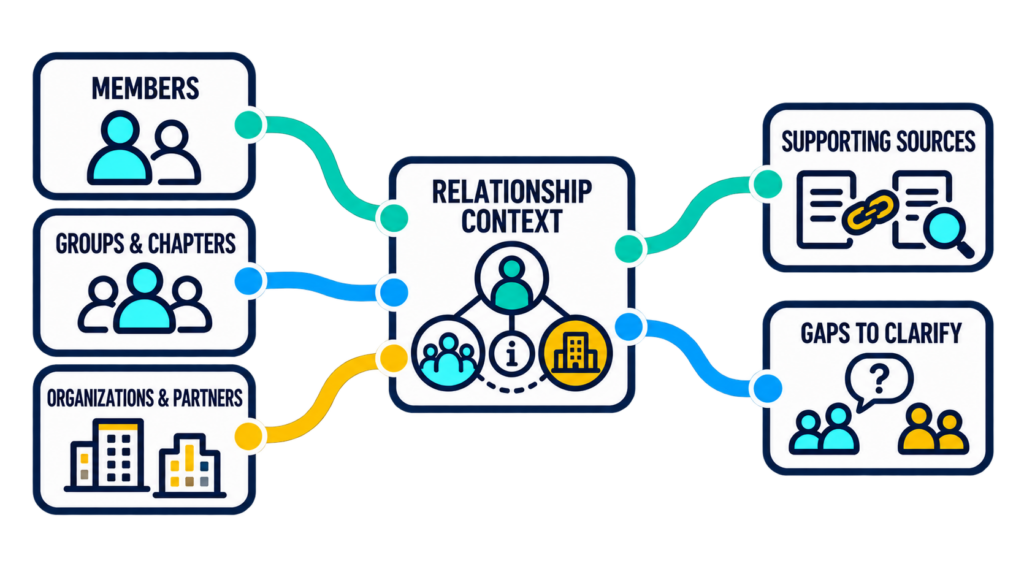
This module helps your team:
- The organizational decision the network view should support.
- The people, groups, and organizations in scope.
- Relevant relationship types and definitions.
- Formal affiliations and representative roles.
- Shared activities and documented collaborations.
- Existing sources of relationship information.
- Reported relationships needing clarification.
- Current and historical connections.
- Communities with limited visible coverage.
- Reliance on particular intermediaries.
- Appropriate visibility, sharing, and use.
- Ownership and ongoing review responsibilities.
What might an appropriate response involve?
The response depends on whether the difficulty concerns relationship definitions, missing context, incomplete coverage, or an actual coordination need.
Clarify the Meaning
Seek further explanation where a comment, request, or summary is ambiguous.
Preserve the Context
Keep the relevant question, source, experience, and timing attached to the input.
Examine the Pattern
Compare related feedback while retaining meaningful differences and contradictory accounts.
Seek Further Evidence
Identify which missing perspectives or unanswered questions could change the interpretation.
Assign the Response
Route individual issues and broader findings to the people responsible for reviewing and acting.
Communicate the Outcome
Explain what was heard, what happens next, and what remains under consideration.
Some findings may lead to a better information structure. Others may lead to member conversations, clearer coordination arrangements, or a separate engagement initiative.
What we review together
Question & Network Boundary
The decision in scope and which part of the community needs to be understood.
People, Groups & Organizations
The entities involved and how their identities and affiliations are represented.
Relationship Meaning
The distinctions among formal roles, shared settings, collaboration, support, and other relevant connections.
Sources & Interpretation
What records and participant accounts establish, and where assumptions exceed the available information.
Coverage & Continuity
Which communities are poorly represented and where coordination depends on relationships that may change.
Access & Maintenance
Who can view, clarify, update, and use the relationship information.
The minicourse: make one part of the network understandable
Your team applies the concepts to a bounded example, such as connections between chapters, a committee and its partners, or the groups involved in a shared initiative.
STEP 1
Step 1 — Define the question and network boundary.
Choose the organizational decision and the people, groups, or organizations relevant to answering it.
STEP 2
Step 2 — Distinguish the relationship types.
Agree which connections matter and what each means. Separate shared affiliation from direct interaction or collaboration.
STEP 3
Step 3 — Examine the available sources.
Review a small set of rosters, role records, project materials, and appropriate participant accounts. Identify what each source supports.
STEP 4
Step 4 — Build a contextual relationship map.
Connect the relevant entities using clearly described relationships, retaining activity context, timing, sources, and uncertainty.
STEP 5
Step 5 — Review gaps and appropriate use.
Examine apparent isolation, incomplete coverage, reliance on intermediaries, and the visibility appropriate for each audience.
STEP 6
Step 6 — Define the response and starting configuration.
Choose practical next steps and outline the records, relationship types, views, and review responsibilities a subsequent implementation would need.
Exercise output
A draft Member Relationship Map for the selected question, with source context, information gaps, clarification needs, and an assigned next step.
- A defined question and network boundary.
- Clear relationship types.
- Connected sources and context.
- A draft relationship map.
- Coverage and sharing boundaries.
- An assigned next step.
FUTURE PRODUCT CONNECTION
How this work can connect to Gobekli
The workshop establishes which relationships matter, what they mean, and how the organization should interpret and maintain them. That work can inform a scoped Gobekli configuration.
A TalentSync configuration could connect members, groups, organizations, activities, and relevant relationship context. TalentPass could support member-provided context and selective sharing where appropriate. Pythia could guide clarification and exploration within the information and access included in scope.
The configuration should make known relationships easier to understand while keeping uncertainty and the limits of the view visible.
Potential configuration mapping
- People, groups, and organizations are difficult to distinguish. Separate entity records with relevant identity and affiliation connections.
- Every relationship appears as the same generic link. Defined relationship types reflecting the distinctions established in the workshop.
- Shared membership is mistaken for direct collaboration. Separate affiliation and activity relationships from documented collaboration.
- Relationships lack explanatory context. Connections to relevant roles, activities, projects, and purposes.
- Staff knowledge is difficult to preserve. Structured relationship accounts with identified sources and review needs.
- Uncertain connections appear established. Clear distinctions among documented, reported, and unresolved relationships.
- Old relationships look current. Dates, status, and review responsibilities for relationship currency.
- Some communities have little visible coverage. Scoped views that identify missing information and questions for follow-up.
- Different audiences need different levels of detail. Purpose-based access and member sharing arrangements.
- Network information becomes outdated after the initial work. Assigned ownership, correction processes, and periodic review.
Specific capabilities, integrations, and implementation scope would be confirmed during solution planning.
PRODUCT AND DECISION BOUNDARIES
What this module does—and its boundaries
The module helps your team:
- Examine relationships around a defined organizational question.
- Distinguish different kinds of connection.
- Preserve source context and uncertainty.
- Identify useful existing relationships.
- Review apparent isolation and information gaps.
- Prepare a starting configuration brief.
The module does not establish:
- A complete map of members’ personal networks.
- Proof of friendship or trust from shared affiliation.
- A ranking of members by influence or network value.
- Permission to contact someone through a third party.
- Automatic introductions or relationship matching.
- A complete community-building or engagement strategy.
The exercise provides a practical starting point. Broader network research, engagement design, partnership development, or implementation may require additional work.
What to bring into the conversation
Begin with one question that member input could help answer, or one collection of feedback that has been difficult to turn into a clear next step.
A useful starting question is: “What are members telling us about this experience, what does that evidence support, and who should do what next?”
Useful inputs may include:
- A decision involving relationships or coordination.
- One bounded community, initiative, or set of groups.
- Relevant member, chapter, or committee rosters.
- Role and representative arrangements.
- Examples of shared projects or collaborations.
- Existing relationship records or appropriate staff accounts.
- The person responsible for the decision.
- A chapter, committee, community, or partnership lead.
- Someone familiar with the source records.
- A member perspective from the communities in scope.
- Someone responsible for access or information practices.
- A person who could own the next step.
Bring what is available and appropriate to share. Anonymized or representative examples can support the exercise when identifiable relationship information is unnecessary.
What this module can help your team produce
A Member Relationship & Network Brief
A clear account of the question, network boundary, relevant relationship types, sources, and limitations.
A Contextual Relationship Map
A structured view connecting selected members, groups, organizations, and activities through clearly described relationships.
A Coverage & Clarification Plan
Assigned next steps for reviewing uncertain connections, consulting underrepresented communities, and addressing information gaps.
A Starting Configuration Brief
An outline of the entity records, relationship types, source context, access arrangements, and maintenance responsibilities a subsequent Gobekli implementation would need.
These outputs begin with the example examined during the module. Final scope depends on available inputs, selected modules, and the decision established through Member Intelligence Direction.
Where might the work lead next?
A relationship review may reveal ambiguous affiliations, missing context about shared work, or questions about how relationship information should be used.
Member Identity & Affiliation Clarity
Clarify which individuals, companies, employers, chapters, and representative roles the relationship records describe.
Participation & Contribution Visibility
Understand the activities, responsibilities, and contributions behind recorded collaboration or shared involvement.
Member Consent, Sharing & Trust
Clarify appropriate purposes, access, sharing expectations, and member choices for relationship information.
Findings may also inform the Member Engagement Workshop when the priority is creating opportunities for connection, or Member Intelligence Governance & Currency when relationship information needs ongoing ownership and review.
Frequently asked questions
Questions membership organizations ask before beginning.
It connects members, groups, and organizations through relationships whose meaning, context, sources, and timing can be understood. The aim is to support a defined organizational question with an appropriately bounded view.
A directory identifies people and organizations. A relationship view also explains how they connect through affiliations, roles, activities, collaboration, or other relevant arrangements.
No. It establishes a shared affiliation. Direct interaction, collaboration, or a personal relationship requires additional information.
This module focuses on understanding existing relationships and gaps in what is known. Designing introductions, peer connections, or mentoring participation belongs in the relevant engagement work.
No. The exercise begins with one question and a bounded part of the community. A smaller map is often enough to establish useful definitions and identify practical next steps.
Relevant sources may include chapter and committee rosters, representative roles, shared project records, partnership arrangements, and appropriate participant accounts. The module examines what each source actually supports.
Yes, where appropriate for the purpose. The account should preserve who provided it, what relationship is being described, and what visibility or review is suitable for its intended use.
Record the relevant account with its source and context, then identify whether clarification is needed. Staff knowledge can be useful without being treated as complete or automatically confirmed.
Start by examining source coverage. The group may have relationships that are not recorded, use different systems, or have limited cross-group activity. The map alone may not distinguish those explanations.
No. Recorded connections can reflect formal roles, source coverage, or activity history. Influence, trust, and suitability for a particular request require their own context.
It can help examine where known coordination relationships pass through particular people or roles. Whether that creates a continuity problem depends on the work involved, alternative arrangements, and information available.
Preserve useful historical context while distinguishing it from current arrangements. Dates, ended roles, and review status help prevent past relationships from being interpreted as active.
Yes. The relevant entities can include people, chapters, committees, employers, member companies, and partners. Their relationships should remain clearly distinguished.
Not automatically. Relevance, willingness, and appropriate permission still matter. A relationship map can identify a question to explore without committing anyone to act.
The workshop does not assume replacement. It identifies the relationship information and context needed, then helps clarify what a subsequent implementation would require from existing sources.
The outputs can inform a scoped configuration connecting entities, relationship types, activities, and source context. Appropriate views, member input, and review processes would be considered according to the agreed purpose and available capabilities.
Your team will examine one bounded example and create a draft brief, contextual relationship map, coverage and clarification plan, and starting configuration brief. Wider rollout and implementation are subsequent steps.
Make the connections within your community easier to understand.
Start with one organizational question, clarify the relationships that matter, and identify where better context or further conversation is needed.
Choose Member Relationships & Network Visibility as part of your Member Intelligence Workshop.