
REGIONAL WORKFORCE & INDUSTRY ALIGNMENT WORKSHOP MODULE
Regional Workforce Direction
Define the regional opportunity, the decision partners need to make, and the evidence and responsibilities that should guide the work—so your workshop begins with a shared purpose and a manageable scope.
Does this sound familiar?
Everyone supports the ambition, but the next decision is unclear.
Partners agree that the region needs a stronger workforce. They have different ideas about what to investigate, fund, build, or change first.
The geography changes depending on who is speaking.
An employer’s recruitment area, a college’s service area, and a public agency’s jurisdiction describe different populations and operating conditions.
The initiative includes more than the partnership can address.
A broad industry strategy becomes a request to solve recruitment, training, transportation, investment, and infrastructure at once.
The opportunity is described more confidently than the evidence supports.
An announcement, forecast, employer conversation, and confirmed hiring requirement are treated as though they establish the same need.
People at the table cannot commit everything the plan requires.
Participants can share information or convene others, but some decisions belong to employers, institutions, funders, or agencies that are absent.
The work produces another report without a clear route into action.
Research accumulates while the decision owner, unresolved questions, and conditions for moving forward remain uncertain.
What is regional workforce direction?
Regional workforce direction establishes the purpose and boundaries of a selected regional or industry initiative.
It clarifies the opportunity partners want to pursue, the decision that needs to be made, the people and places affected, and the evidence needed to support a responsible response.
The starting point may be an employer expansion, an emerging industry, a manufacturing initiative, a changing occupation, or a concern that existing preparation routes are not supporting regional opportunities.
Each situation requires a different combination of evidence, participants, and action. A useful foundation makes those differences explicit before the workshop moves into detailed demand, talent, capacity, or investment questions.
This module produces a shared direction brief that guides the remaining workshop modules and identifies what partners need to confirm before acting.
A shared ambition becomes useful when it leads to a decision.
“Build a stronger manufacturing workforce” expresses an ambition. It does not yet establish what the partnership needs to decide.
A more actionable question might be: “What must we validate before committing to an initial preparation route for maintenance roles serving three employers in the selected area?”
That question establishes a starting point. It can be refined as evidence and partner perspectives are reviewed.
It also makes uncertainty visible. Employer requirements may be incomplete. Training capacity may be constrained. Potential participants may face conditions the partnership has not examined.
The workshop helps partners determine which of these questions matter first and who can help answer them.
Direction creates a basis for focused work while leaving room to revise assumptions.
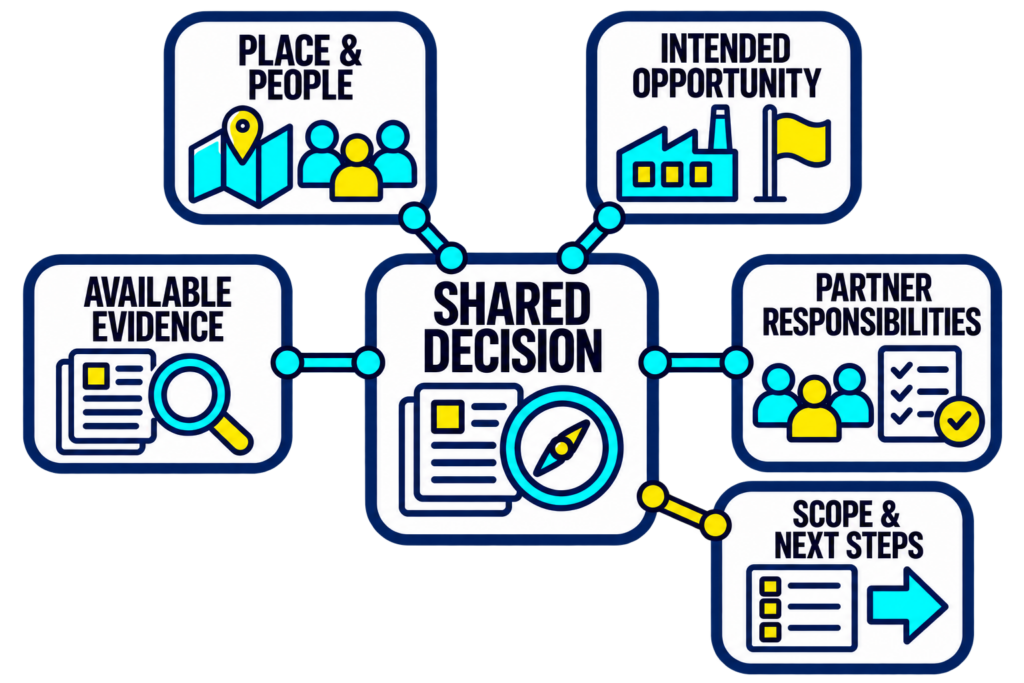
What needs to connect?
Place and population
Selected geography
Relevant travel area
People potentially affected
Access conditions
Important exclusions
Industry and opportunity
Selected industry or initiative
Proposed economic opportunity
Relevant employers
Expected timing
Unconfirmed assumptions
Decision and evidence
Decision to be supported
Available source material
Strength of evidence
Questions needing validation
Criteria for moving forward
Partners and responsibilities
Sponsor and convener
Decision owners
Employer and provider roles
Worker or community perspectives
Missing participants
Scope and follow-through
Workshop boundaries
Priority questions
Selected modules
Validation responsibilities
Next review point
These elements describe the starting foundation. The workshop should distinguish what is known, what is proposed, and what still requires confirmation.
How this module helps
1. Understand the direction problem
Learn why a shared regional ambition can still leave partners working toward different decisions.
2. Examine one initiative
Use a selected opportunity to identify differences in geography, timing, assumptions, evidence, and responsibilities.
3. Define a workable foundation
Draft a decision statement and scope that participants can review, revise, and use to select further work.
4. Prepare the next step
Identify the modules, evidence requests, partner conversations, and configuration questions that follow from the agreed direction.
Begin with one regional opportunity.
Choose an initiative that is specific enough to examine with the people and evidence available.
For example, a regional intermediary may want to understand whether local providers and employers could support an initial preparation route for industrial maintenance work.
The module examines how to frame that initiative before assuming the number of places needed, the population available, or the commitments partners can make.
Questions to review together
Describe the initiative and why it matters. Identify whether it concerns an existing need, proposed expansion, emerging opportunity, or change requiring further investigation.
Clarify the area under consideration and the reasons for choosing it. Note where employer recruitment areas, provider coverage, travel conditions, and administrative boundaries differ.
Identify the people the initiative could serve or affect. Avoid assuming that a regional population count establishes interest, availability, readiness, or access.
Name the choice that follows from the investigation, who owns it, and what they need to know before proceeding.
Review existing information, its source and timing, and the questions it can reasonably answer. Identify missing employer, provider, worker, or community perspectives.
Distinguish the ability to convene, advise, contribute information, authorize decisions, commit resources, and deliver work.
Six dimensions of a useful direction
Geographic clarity
Define the selected area while recognizing relevant movement across its boundaries.
Opportunity clarity
Describe the intended opportunity and distinguish its current status from expectations about what may happen.
Decision clarity
Identify the choice to be supported, its owner, and the evidence needed to make it.
Population clarity
Clarify whom the initiative may serve and which assumptions about participation require validation.
Responsibility clarity
Name the roles partners can fulfill and the decisions or contributions requiring additional authorization.
Scope clarity
Set boundaries around the questions the workshop can address and the work that must follow.
When direction remains unclear
Partners may begin with a broad ambition while carrying different assumptions about:
- Which geography matters.
- Which occupations or activities are priorities.
- Whether demand is projected or confirmed.
- Which people could realistically participate.
- Who can commit capacity or resources.
- What should happen after the workshop.
The result can be substantial effort without a shared basis for deciding what to do next.
When direction becomes usable
A shared foundation makes it easier to:
- State the opportunity being examined.
- Name the decision the work should support.
- Separate evidence from assumptions.
- Identify necessary partner perspectives.
- Select a manageable combination of modules.
- Assign validation and follow-up responsibilities.
Partners can then investigate the same questions while retaining their distinct responsibilities and authority.
What this can look like in practice
A regional economic-development organization wants to support a proposed manufacturing expansion.
The initial request is to “build a talent pipeline,” but the participating organizations interpret that request differently.
Employers are concerned about maintenance capability. A training provider is considering a new cohort. Workforce partners want to understand whether existing participants could benefit.
The proposed recruitment area also extends beyond the boundaries used in the initial planning documents.
During the module, participants define the starting initiative around a selected group of maintenance roles and a practical area for recruitment and preparation.
They clarify that the immediate decision is whether to develop an initial coordinated response and what must be validated before partners commit to it.
Existing employer conversations are recorded as an input. Unconfirmed requirements, hiring timing, provider capacity, and participation conditions remain explicit questions.
The sponsor can convene the work, but employers retain hiring decisions and providers retain responsibility for committing delivery capacity.
The group selects Employer Demand & Hiring Commitment, Critical Roles & Capability Requirements, and Training Capacity & Delivery Bottlenecks as the next areas to examine.
The result is a focused direction brief and a set of assigned questions that can inform a later action plan.
Convening is different from committing.
A partnership may include organizations with different responsibilities, incentives, and decision processes.
The workshop sponsor may be able to organize the discussion without having authority over employer hiring, college delivery, public funding, or participant choices.
Those distinctions belong in the foundation.
Participants should identify where they can provide information, propose action, seek approval, or make a confirmed commitment.
When a necessary decision owner is absent, the output should record the question and the route for obtaining their input.
This helps the partnership develop a realistic plan for decisions and contributions.
A regional population is not a confirmed talent pool.
Information about people living, studying, or working in an area can help frame an investigation.
It does not establish that particular individuals want an opportunity, can access it, meet its requirements, or are available at the proposed time.
The foundation should distinguish potential populations from people whose interest and circumstances have been confirmed.
It should also identify whose perspective is missing from the initial discussion.
Worker, participant, employer, and provider input may reveal conditions that change the scope or sequence of the initiative.
These questions guide further validation without requiring the workshop to collect identifiable personal information.
WORKSHOP MODULE 1 — REQUIRED FOUNDATION
Build a shared foundation for regional workforce action.
Regional Workforce Direction is the required foundation for the Regional Workforce & Industry Alignment Workshop. Through a focused minicourse and a practical exercise, participants learn how to frame one initiative, examine its assumptions, and define the decisions and responsibilities that should guide the remaining work.
What can this module address?
The module establishes the starting direction for one selected initiative. Topics may include:
- The geography and relevant travel area.
- The selected industry, occupation, or economic initiative.
- The intended opportunity and who may benefit.
- The decision the workshop should support.
- The initiative’s current stage and expected timing.
- Available evidence and its source context.
- Assumptions requiring further validation.
- Sponsor, convener, and decision-owner roles.
- Employer, provider, worker, and community perspectives.
- Partner responsibilities and missing participation.
- Workshop boundaries and module selection.
- Follow-up questions and review responsibilities.
What responses might emerge?
The appropriate response depends on what the foundation reveals.
Clarify
Refine an initiative whose geography, opportunity, or intended decision is currently too broad.
Narrow
Select an initial population, role group, location, or phase that can be examined with available evidence.
Validate
Identify the assumptions that need employer, provider, worker, or community input before proceeding.
Convene
Bring in the organizations or perspectives required to understand the decision and its dependencies.
Sequence
Determine which questions need to be resolved before later capacity, participation, or investment decisions.
Reframe
Revise the original request when the available evidence points toward a different starting problem.
The foundation may show that further investigation is the appropriate next step. Its value comes from making that step clear and accountable.
What will we review?
The initiative statement
How the opportunity is currently described and what participants believe the work is intended to achieve.
The selected geography
Relevant boundaries, movement between places, and differences among partner service or recruitment areas.
The decision pathway
Who needs to decide what, when that decision is needed, and what would support it.
The available evidence
Existing plans, employer input, provider information, and other material relevant to the selected question.
The partner arrangement
Who is involved, what they can contribute, and where authority or participation is missing.
The proposed scope
What can be addressed through the workshop and which questions require separate work.
A practical exercise: create a Regional Workforce Direction Brief.
Participants work through one selected initiative and draft a shared foundation for the workshop.
STEP 1
Describe the opportunity
State what the partnership wants to investigate or advance and why it matters.
STEP 2
Define the starting boundaries
Identify the geography, industry or role focus, population, and phase being examined.
STEP 3
Name the decision
Write the immediate decision question, identify its owner, and clarify the evidence they need.
STEP 4
Separate evidence from assumptions
Record what is available, what it supports, and what requires validation.
STEP 5
Map responsibilities and missing voices
Identify the sponsor, convener, contributors, decision owners, and people whose perspectives are needed.
STEP 6
Select the next work
Choose the modules and follow-up questions most relevant to the foundation, with owners and review points.
A draft Regional Workforce Direction Brief that participants can review and use to guide the selected workshop modules.
CONNECT THE WORKSHOP TO A PRACTICAL NEXT STEP
Define the context a future Gobekli configuration would need.
A regional initiative needs an understandable account of its purpose, evidence, relationships, and responsibilities. This module helps define that context before a subsequent Gobekli implementation is scoped.
- The selected initiative and its organizational purpose.
- Relevant industries, roles, activities, and requirements.
- Participating organizations and their relationships.
- Named owners and authorized reviewer roles.
- Evidence sources and the questions they support.
- The status of proposals, assumptions, and commitments.
- Relevant populations described at an appropriate level.
- Information-use and access boundaries.
- Questions requiring partner confirmation.
- Changes that should trigger a review.
Where appropriate, these requirements can inform a TalentSync configuration for organizational context and coordination. Later modules may also identify a role for TalentPass and Passport Pages when individuals choose to contribute or share relevant experience.
The workshop defines the intended use and starting requirements. Product scope, availability, integrations, permissions, and implementation responsibilities are established separately.
SCOPE AND BOUNDARIES
What this module does—and what requires further work
This module establishes direction for a selected regional workforce initiative.
It helps participants identify the questions, evidence, responsibilities, and boundaries needed for focused work.
It does not resolve every question about demand, capacity, access, investment, or delivery. Those questions inform the selection of further modules and partner activity.
Further work may be needed to:
- Validate employer demand and hiring commitments.
- Examine role requirements in detail.
- Assess available talent and interest.
- Confirm training or placement capacity.
- Review participation and access conditions.
- Develop investment or funding proposals.
- Obtain organizational approvals and commitments.
- Scope technology, integrations, and operating arrangements.
A workshop discussion does not establish another organization’s commitment or authority. Proposed contributions remain subject to confirmation by the responsible organization.
Economic growth, employer investment, hiring, and participant outcomes depend on factors beyond the workshop. The outputs support clearer decisions and coordination.
What should participants bring?
Bring the material you already use to describe the selected opportunity and organize the partnership.
A short, incomplete starting brief is useful when its gaps are visible. De-identified or aggregated examples are usually sufficient for establishing direction.
Useful inputs
- An initiative summary or existing regional plan.
- A description of the selected geography.
- Relevant employer conversations or requirement summaries.
- Available provider and program information.
- Existing workforce or industry evidence.
- A list of participating organizations and contacts.
- Known decisions, milestones, or deadlines.
- Current assumptions, unresolved questions, and constraints.
Participants should bring information they are authorized to use. Missing evidence can be recorded as a follow-up question.
What can you leave with?
Regional Workforce Direction Brief
A shared description of the initiative, geography, intended opportunity, decision, and workshop boundaries.
Evidence & Assumption Register
A starting account of available sources, what they support, and the questions needing validation.
Partner Responsibility Map
Named sponsor, convener, contributor, and decision-owner roles, including missing perspectives and confirmation routes.
Module & Next-Step Plan
Recommended workshop modules, assigned follow-up questions, review points, and starting requirements for a possible Gobekli configuration.
These outputs begin with the initiative examined during the module. They provide the foundation for a broader regional workforce action plan developed through the selected workshop modules.
Where might the work lead next?
Employer Demand & Hiring Commitment
Examine the strength and timing of employer needs before building a response around them.
Critical Roles & Capability Requirements
Clarify the work and requirements associated with priority roles so partners can investigate specific preparation needs.
Regional Talent Supply & Hidden Capability
Explore relevant information about available experience and capability, while identifying assumptions about interest and availability.
The appropriate next modules depend on the direction brief. Some initiatives may first need to examine delivery capacity, participation conditions, or partner commitments.
Frequently asked questions
Questions regional partners ask before beginning.
It gives the selected modules a shared geography, initiative, decision, and set of responsibilities. Without that foundation, partners may investigate different problems while using the same broad language.
Include people who understand the initiative, relevant evidence, and partner responsibilities. Depending on the question, this may include economic-development leaders, workforce organizations, employers, providers, intermediaries, and worker or community representatives.
Yes. One organization can define its own decision and starting questions. The output should identify where other organizations need to contribute, validate information, or authorize action.
No. The module distinguishes convening and sponsorship from authority to commit hiring, delivery, funding, or other resources.
Choose an area that fits the decision. This may be a local cluster, commuting area, multi-county region, or selected statewide initiative. Record relevant differences among administrative and operating boundaries.
Yes. It can frame workforce questions associated with a selected expansion, industry initiative, or production opportunity. Detailed demand, capacity, investment, and delivery questions may require additional modules.
The decision can focus on whether and how to investigate it. The foundation should clearly describe its stage and the assumptions that remain unconfirmed.
No. Unconfirmed demand may be the main issue to address next. The module records the evidence available and avoids treating interest or projections as confirmed commitments.
The exercise makes the differences explicit. Participants can narrow the initial decision, document alternatives, or assign further validation before selecting a response.
Record the decisions and questions requiring their input, identify a route for involving them, and keep any assumptions about their contribution provisional.
Usually not for this foundation module. Aggregated or de-identified information can establish the starting questions and scope.
The module produces a focused direction brief. A broader strategy or action plan requires additional investigation, partner decisions, and work appropriate to the initiative.
Workforce Pathway Direction focuses on a selected participant service journey. Regional Workforce Direction focuses on a regional or industry initiative connecting opportunity, employer needs, preparation, talent, and partner action.
This module frames the regional initiative and its operating questions. Infrastructure work examines the systems, exchange arrangements, standards, and governance needed to support information use across organizations.
It can identify starting configuration requirements. Implementation scope, product availability, integrations, and responsibilities are agreed separately.
The direction brief identifies which uncertainties most affect the decision. Those questions guide the selection of a manageable set of modules.
Participants review the brief, confirm responsibilities, gather missing input, and use the foundation to guide the selected workshop modules and next decisions.
START WITH A SHARED REGIONAL DECISION
Give partners a clear place to begin.
A regional opportunity becomes easier to act on when partners understand the decision, the evidence, and their responsibilities.
Begin with Regional Workforce Direction, then build a workshop around the questions your initiative needs to resolve.