Passport Pages are the connective tissue between TalentSync, individual-controlled TalentPass records, partner organizations, source systems, learning resources, evidence, and credentials.
Every important relationship gets a page.
TalentSync uses Passport Pages to separate who the relationship is with, what kind of exchange is allowed, what proof exists, and what still needs review.
People Pages connect organizational context to person-owned records and consented evidence.
Org Pages manage clients, partners, issuers, standards bodies, schools, and member organizations.
Claims, systems, and resource packets keep evidence, data routes, and support actions visible.
Passport Pages make exchange concrete.
The current website page lists what Passport Pages can do. This version turns those ideas into a clearer product story.
See
See people and organizations in context.
Pages show who is connected, why the relationship exists, what role each party plays, and what data can move.
Request
Request data, proof, or participation.
Organizations can ask for Stories, evidence, confirmations, credential context, system records, or profile-ready contributions.
Return
Provide resources, credentials, and value back.
Pages can hold resource packets, templates, learning paths, LERs, endorsements, and system exchange routes.
Passport Page examples
This should be the main accordion section on the website. Each panel explains a kind of Passport Page and pairs it with a real app screenshot.
Org Pages - Manage client, partner, issuer, standards, member, service provider, and unsynced organization relationships.
Client organization pageConnects a customer workspace to delivery evidence, shared resources, profile outputs, and request history.Partner or coalition pageShows who leads the relationship, who joins it, and what permissions or templates apply.Issuer or standards pageMaintains reference context for credentials, LER standards, proof routes, and external anchors.
People Pages - Connect team members, contractors, learners, members, applicants, and external contributors to governed TalentSync context.
Employee or team member pageTracks work context, profile contribution, evidence requests, and role relationship inside TalentSync.Contractor or partner-side contributor pageSeparates project participation from portable person-controlled proof.Learner or member pageSupports program participation, progress proof, resources, and consent-aware reporting.
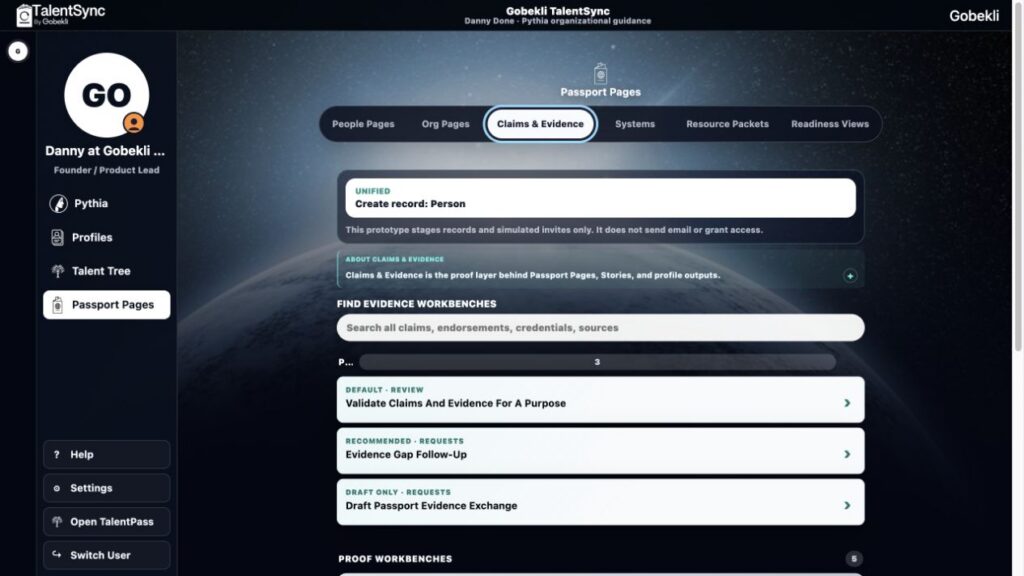
Claims & Evidence - Track the proof behind Stories, profile claims, endorsements, work evidence, and credential-ready records.
Evidence requestAsk a person, manager, organization, or system for proof tied to a specific Story or profile claim.Endorsement recordCapture who confirmed a contribution, what they confirmed, and what visibility applies.Credential-ready proofPrepare evidence for LERs or badges without issuing anything automatically.
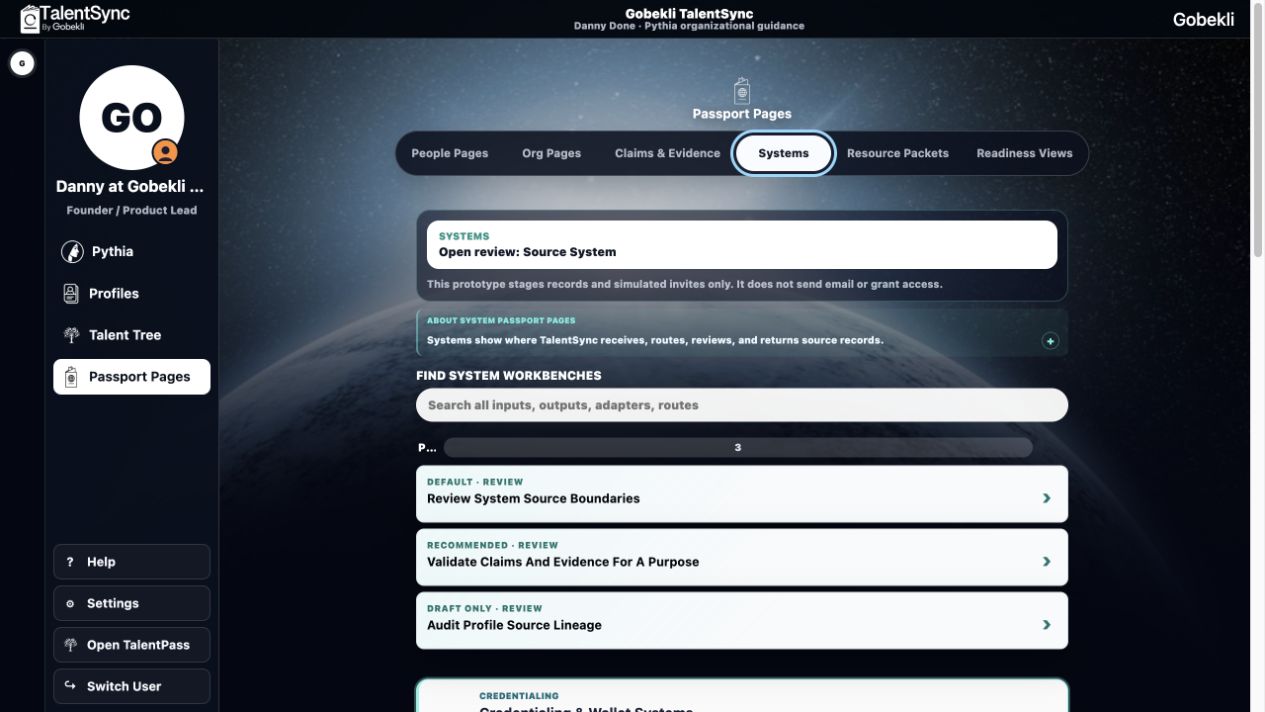
Systems - Connect HRIS, LMS, ATS, CRM, productivity, credentialing, and partner systems through page-scoped routes.
Source system recordShow whether a system contributes roster, activity, learning, credential, applicant, or workflow data.Field and purpose boundaryMake the difference between source data, derived intelligence, and shareable profile output clear.Integration healthGive admins a readiness view of what is synced, stale, missing, or review-blocked.
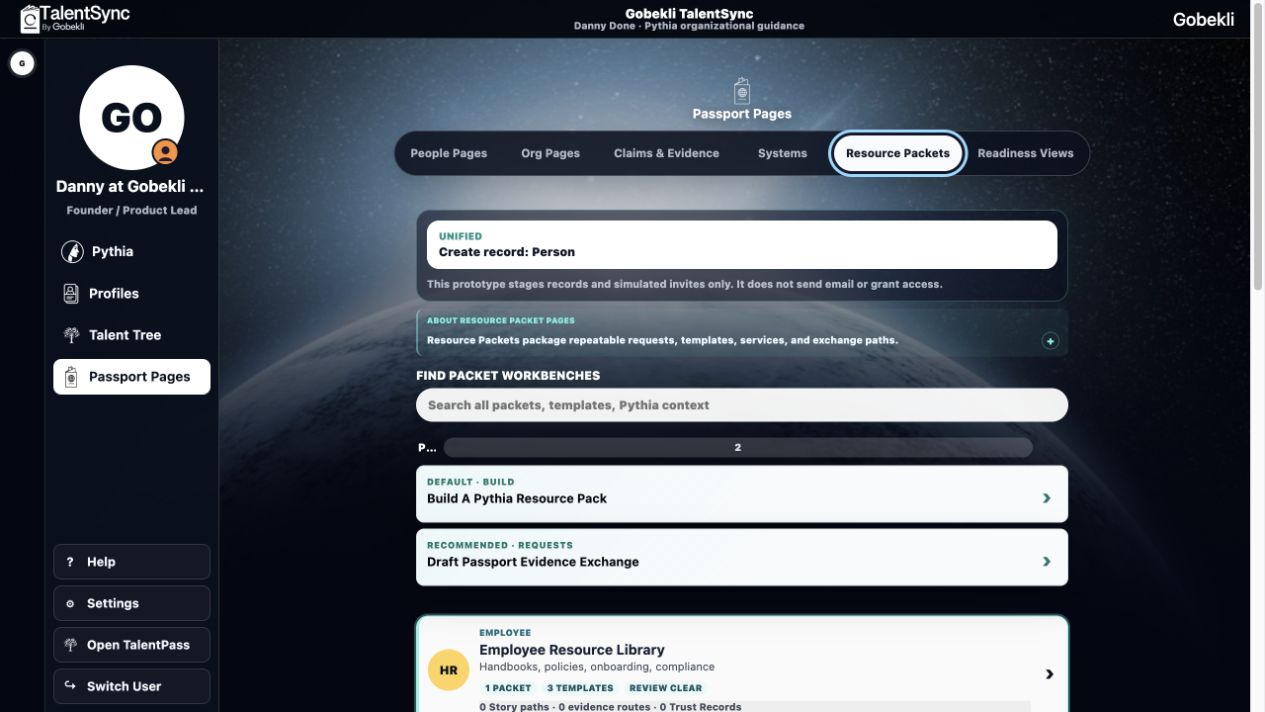
Resource Packets - Resource Packets Attach templates, guidance, learning paths, Pythia prompts, services, and support assets to a relationship.
Pythia resource packAttach reusable conversations and onboarding guidance to a page or program.Evidence exchange packetBundle request templates, proof instructions, owner routing, and review expectations.Employee or learner resource libraryProvide handbooks, policies, learning materials, and support resources through a scoped page.
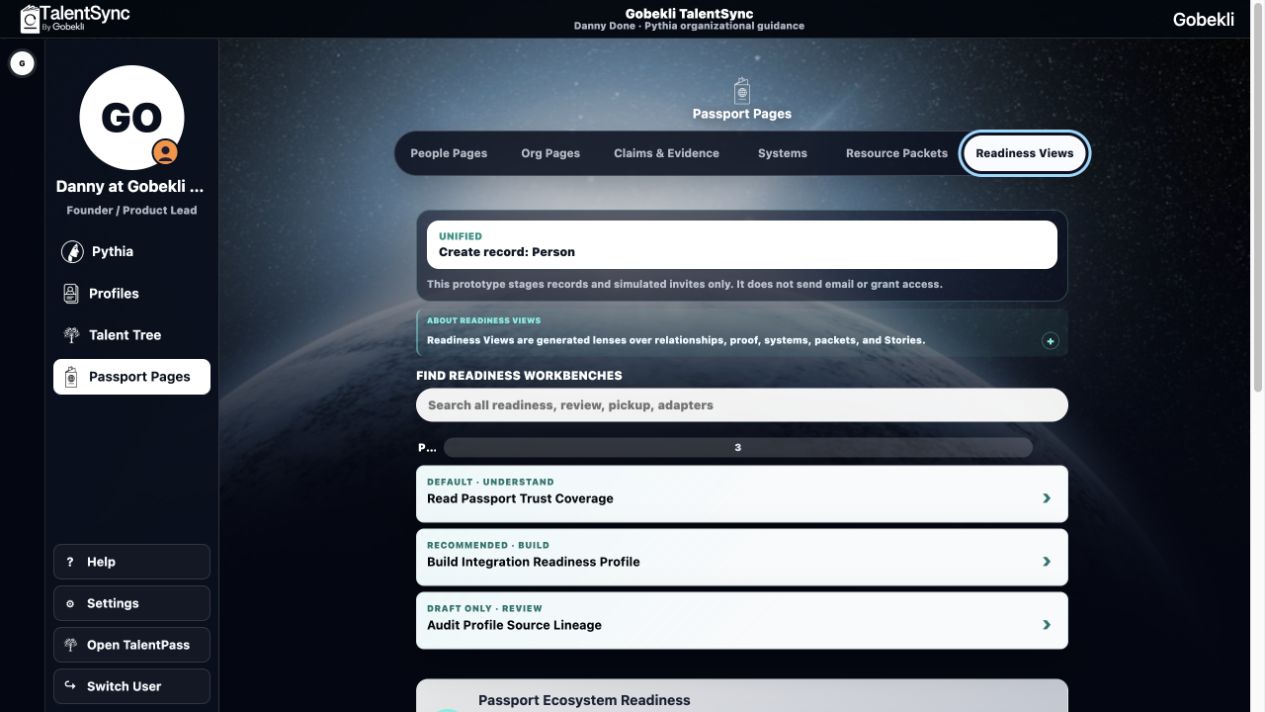
Readiness Views - Turn page-level relationships into aggregate readiness, coverage, trust, and adoption intelligence.
Connection coverageShows how many people, orgs, systems, claims, resources, and credentials are connected.Evidence readinessHighlights proof gaps, disputed claims, unclaimed pages, and review queues.Value and adoption signalSummarizes engagement, pickup, resource use, and profile coverage for leaders.
How Passport Pages work
Pages are not just records. They define exchange rules between TalentSync, people, organizations, resources, and systems.
Identity
Each page names the relationship.
A page can represent a person, organization, team, project, class, system, issuer, resource, or claim. It explains why that entity matters in the TalentSync workspace.
Exchange
Each page controls what can move.
Requests, evidence, resources, credentials, profile contributions, and system records move through page-scoped routes instead of unmanaged inboxes or disconnected spreadsheets.
Lineage
Each page preserves source and review context.
TalentSync can show what came from a person, an organization, a source system, a manager, Pythia, or a reviewed credential route.
1
Create Page
Start with a person, org, group, system, claim, or packet.
2
Set Purpose
Name the relationship and what exchange is allowed.
3
Request Proof
Ask for Stories, evidence, confirmations, or source records.
4
Return Value
Provide resources, guidance, templates, credentials, or profile outputs.
5
Review
Keep outputs scoped, consented, source-backed, and auditable.
The trust boundary is the product.
Passport Pages should make TalentSync feel powerful without making it feel like surveillance. The page needs to be explicit about what is organizational, what is person-controlled, and what requires consent.
Organization Side
TalentSync can manage work relationships.
Teams, roles, workflows, system records, resources, client relationships, and reviewed profile outputs live in the organizational workspace.
Person Side
People keep control of portable context.
Private reflections, TalentPass records, selected evidence, profile excerpts, and personal proof are shared only through consented routes.
Exchange Side
Requests and returns stay auditable.
Every request, resource, credential, endorsement, system sync, and profile contribution can be traced to its page and purpose.
Passport Pages create trusted, permissioned connections between people, organizations, services, and systems—without creating another isolated data silo.