
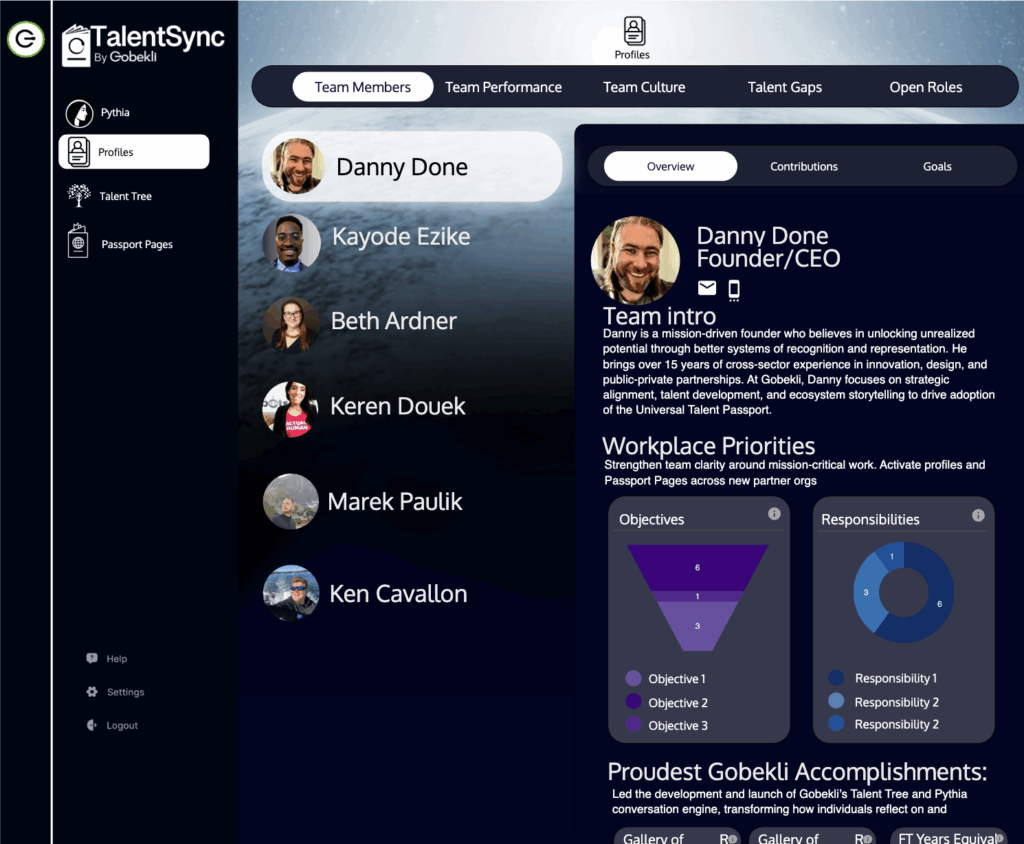
Build Profiles for Every Team and Leadership Question
TalentSync Profiles turn the same connected Talent Tree into purpose-built views for different teams, stakeholders, and decisions. Combine Gallery Stories, individual Stories, evidence, credentials, artifacts, and cross-node data to tell the story that matters—from executive alignment and team performance to capability, culture, succession, innovation, and growth. Each Profile draws from the same living source of talent data, but selects and organizes it around the questions leaders actually need to answer.
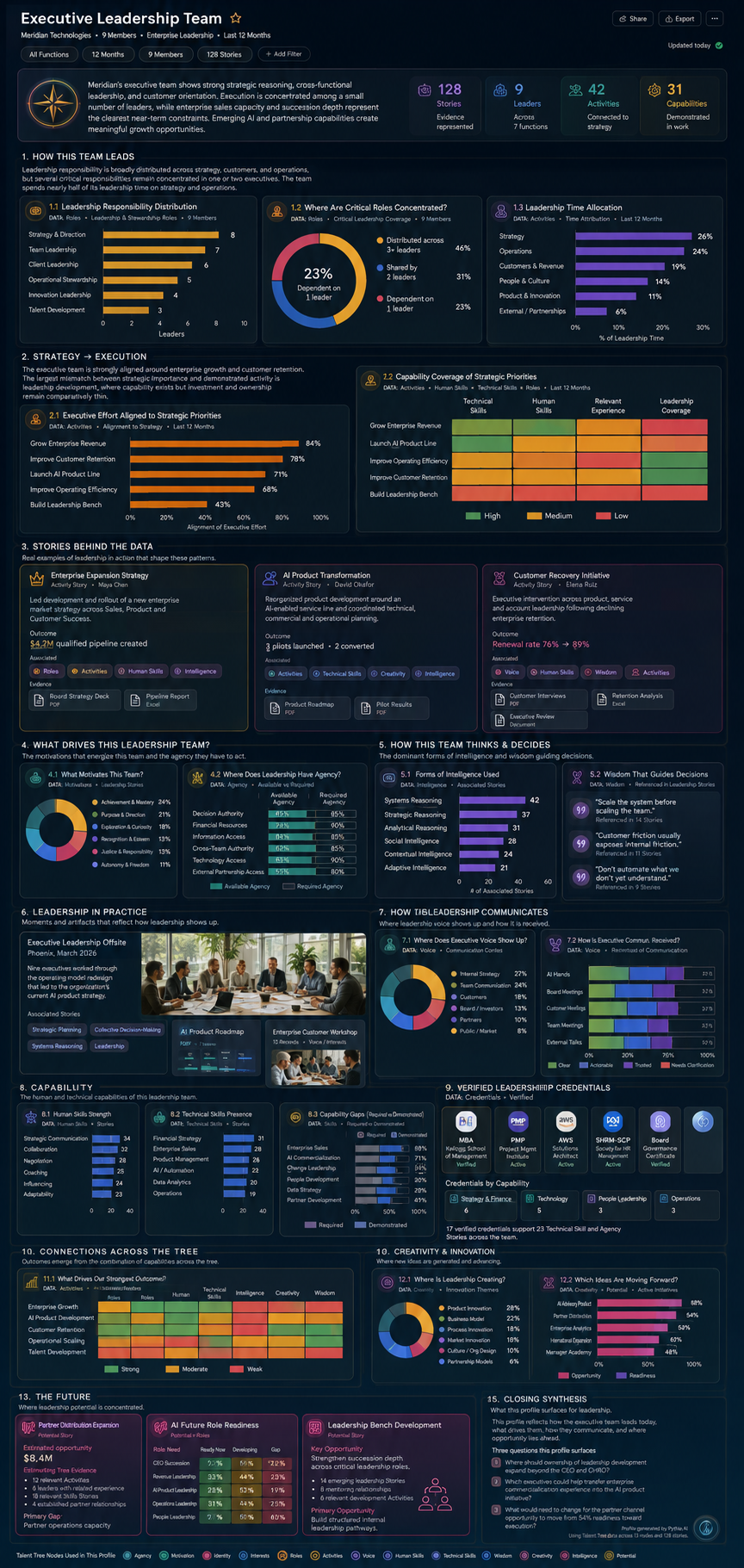 | Explore Your Executive Leadership TeamTalentSync Profiles turn connected Talent Tree data into a focused narrative for a particular audience, question, or decision. See How Leadership Is Really DistributedExplore the Roles leaders are actually playing, where critical responsibilities are concentrated, and how executive time is distributed across strategy, operations, customers, people, innovation, and partnerships. Connect Strategy to ExecutionSee whether executive Activities, capabilities, and leadership coverage align with organizational priorities. Combined Gallery Stories can select data from multiple Nodes to reveal where strategy is well supported—and where Skills, experience, ownership, or attention may be missing. Move From Patterns to ProofProfiles don’t stop at aggregate charts. Individual Stories can reveal the experiences behind important patterns, supported by documents, photographs, project artifacts, credentials, attestations, and measurable outcomes. Pattern → Story → Evidence Understand How the Team OperatesMotivation, Agency, Voice, Intelligence, Wisdom, Human Skills, and Technical Skills add context conventional workforce systems rarely capture—helping leaders understand what drives the team, what enables action, how people communicate and make decisions, and what capabilities are actually demonstrated through work. See Connections Across the Talent TreeSome of the most valuable Gallery Stories combine datasets from several Nodes. This makes it possible to understand not simply what capabilities exist, but how combinations of Roles, Activities, Skills, Intelligence, Creativity, Wisdom, and other talent data contribute to real organizational outcomes. Look Toward What’s NextPotential provides the forward-looking view—surfacing leadership bench strength, emerging capabilities, succession needs, innovation opportunities, market opportunities, and strategic initiatives alongside the existing evidence and gaps that could determine what becomes possible next. One Profile. One Purpose. The Whole Tree Behind It.The same connected Talent Tree can generate Profiles for executives, teams, projects, operations, culture, investors, clients, sales, recruiting, or individual team members—each selecting the Gallery Stories, individual Stories, Evidence, and relationships most useful to that audience. The data stays connected. The Profile changes with the question. |
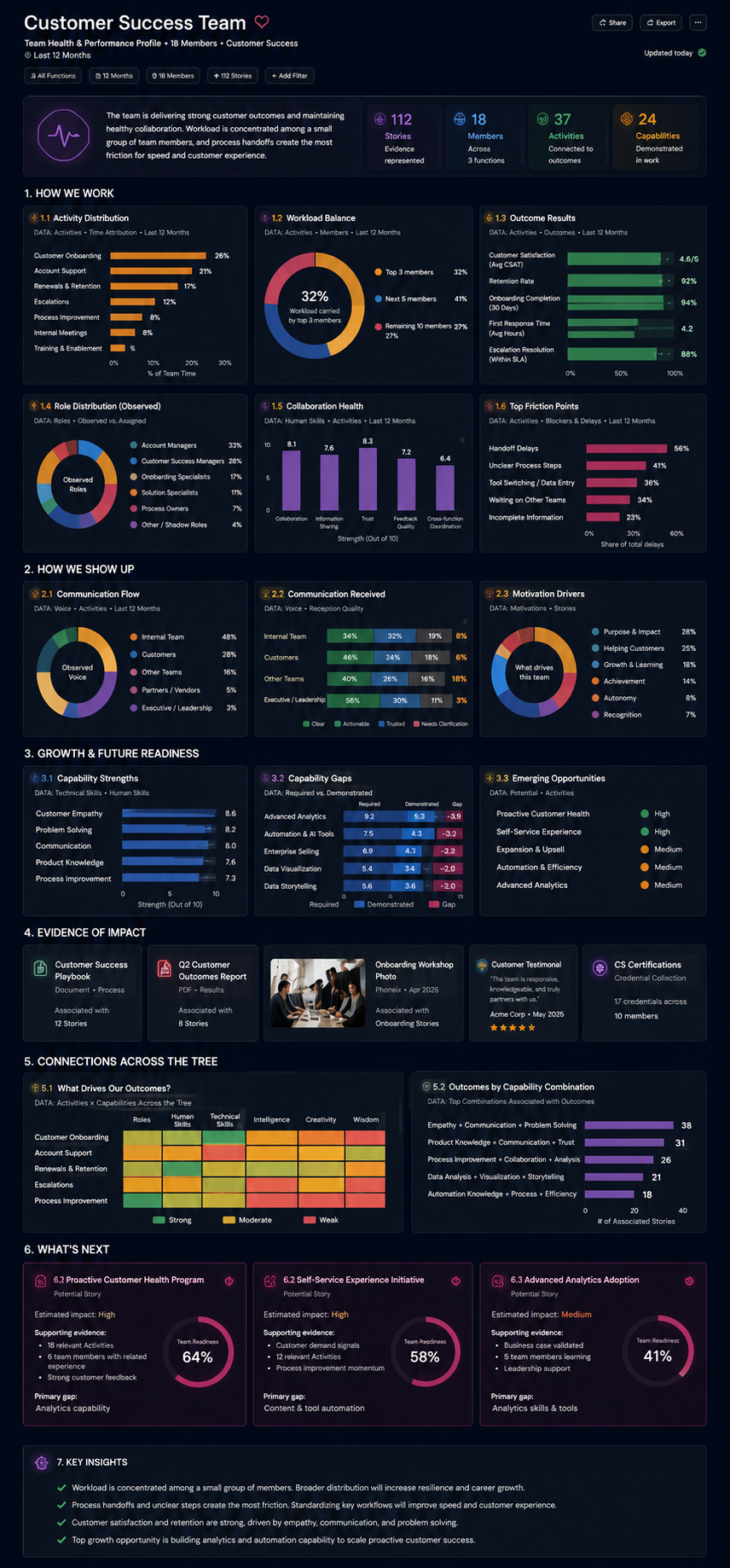
See how work actually happens across a team—not just how it looks on an org chart. A Team Health & Performance Profile brings together Activities, Roles, Voice, Motivations, Human and Technical Skills, Potential, outcomes, and supporting evidence to create a living picture of how a team operates and where it can improve.
| Explore Your Team Health & PerformanceSee how work actually happens across a team—not just how it looks on an org chart. Understand How Work Gets DoneSee where time and effort are concentrated, how responsibilities are distributed, what outcomes the team is producing, and where workload or process friction may be slowing people down. See How the Team Shows Up TogetherConnect Roles, Activities, Voice, Human Skills, and Motivations to understand how people collaborate, communicate, share responsibility, and contribute beyond their formal job descriptions. Identify Strengths, Gaps & OpportunitiesSee the capabilities demonstrated through actual work, compare them with what the team needs, and identify emerging opportunities where existing talent could be developed or applied differently. Ground Insights in Real EvidenceMove from aggregate Gallery Stories into the evidence behind them—including individual Stories, project artifacts, reports, photographs, credentials, customer feedback, and measurable outcomes. Connect the Whole Talent TreeCombined Gallery Stories can select multiple Talent Tree datasets to answer more complex questions—for example, connecting Activities, Roles, Human Skills, Technical Skills, Intelligence, and Wisdom to reveal which combinations of talent are associated with stronger outcomes. Look Toward What’s NextPotential Stories turn what the team already knows about itself into a forward-looking view—surfacing new initiatives, development opportunities, capability needs, and the existing evidence that suggests what the team may be ready to take on next. The result is more than a performance dashboard. It is an evidence-backed narrative of how a team works, what makes it successful, where friction exists, and how it can continue growing together. |
|
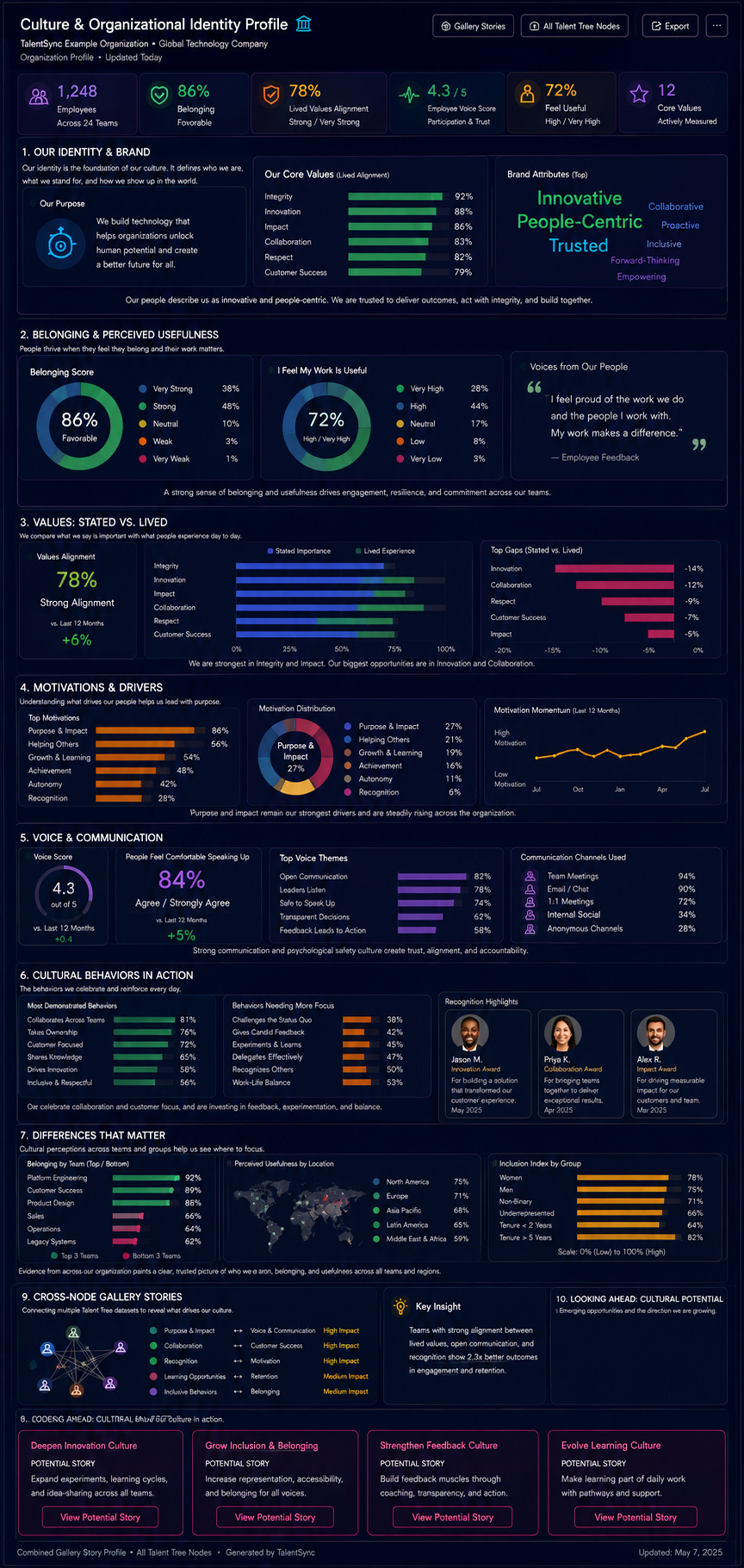
Explore Your Organizational CultureSee the culture people actually experience—not just the values written on the wall. A Culture & Organizational Identity Profile brings together Identity, Voice, Motivations, Roles, Activities, Human Skills, Wisdom, Evidence, and cross-node patterns to create a living picture of who the organization is, how people experience belonging and contribution, and how that shared identity is changing over time. See Who the Organization Really IsExplore the values, attributes, shared language, behaviors, and Stories that define how the organization sees itself—and compare that identity with how people actually experience it through their work. Understand Belonging & UsefulnessSee where people feel connected to the organization, where they believe their work matters, and how experiences of belonging, recognition, contribution, and purpose differ across teams and groups. Compare Stated Values With Lived CultureConnect organizational values with Activities, Roles, Voice, Motivations, recognition, and outcomes to see where what the organization says matters is strongly reflected in everyday behavior—and where meaningful gaps may be emerging. See What Drives How People Show UpMotivation and Voice Stories help reveal why people engage, how comfortably they speak up, what themes appear repeatedly in communication, and whether leadership messages translate into trust, action, and shared understanding. Make Culture Visible Through Real BehaviorMove beyond abstract culture statements by seeing the behaviors people repeatedly demonstrate through real work—collaboration, ownership, innovation, customer focus, knowledge sharing, feedback, recognition, and other patterns that reinforce the culture every day. Ground the Story in EvidenceGallery Stories can lead directly into individual Stories, employee feedback, internal communications, photographs, documents, recognition, credentials, customer responses, and other Evidence that helps explain why a cultural pattern exists. Connect Patterns Across the Talent TreeCombined Gallery Stories can select data from several Nodes at once—connecting Identity, Motivations, Voice, Roles, Activities, Human Skills, Wisdom, and outcomes to explore what is actually shaping the organization’s culture. See Where Culture Is HeadedPotential Stories provide a forward-looking view of the culture—surfacing opportunities to strengthen innovation, inclusion, feedback, learning, leadership, or other cultural capabilities and connecting those opportunities to the Evidence already present across the organization. The result is more than a culture survey. It is an evidence-backed narrative of who the organization believes it is, how people actually experience it, what behaviors sustain it, and who the organization is becoming. |
|
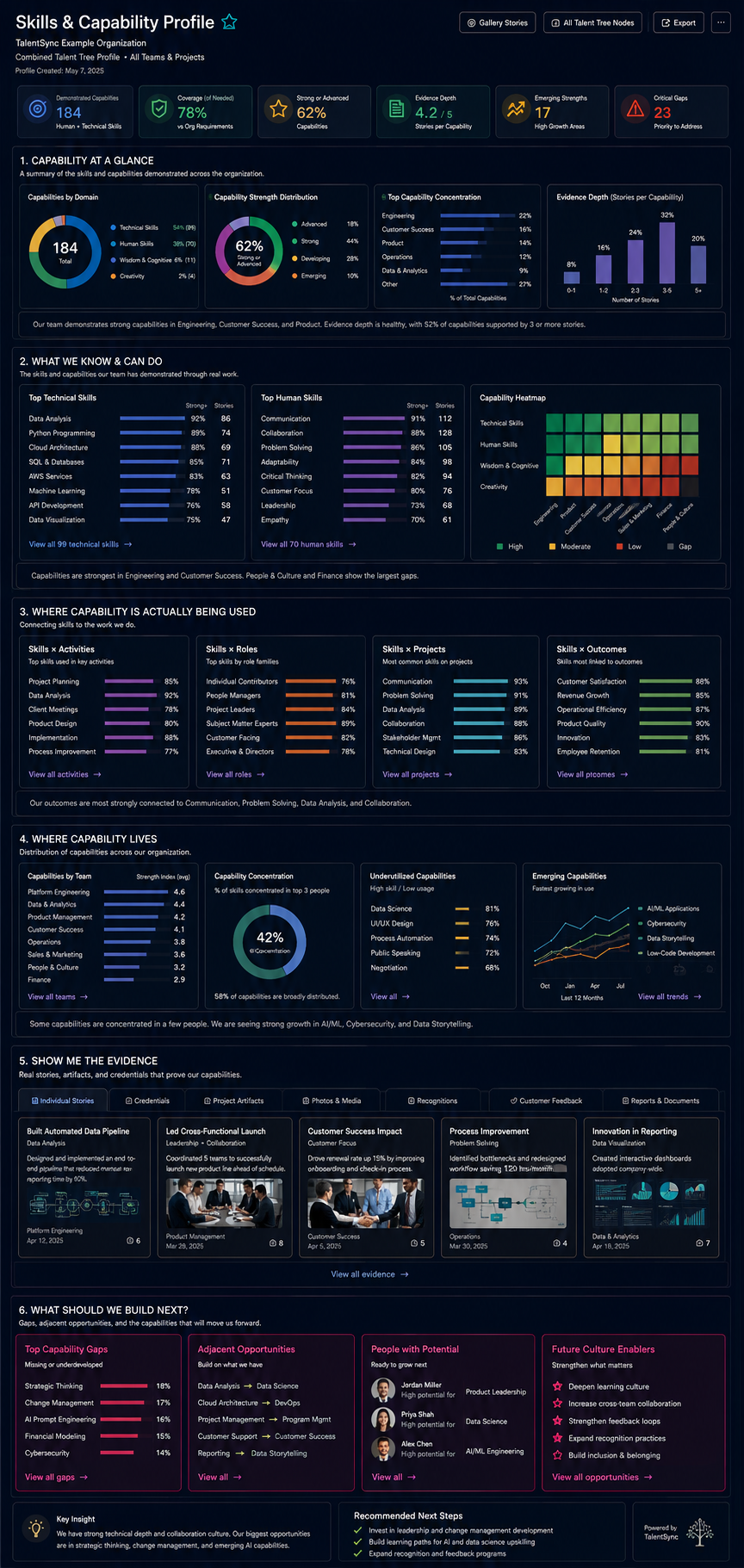
See What Your Team Can Actually DoMove beyond skill lists and see capability through the work that proves it. A Skills & Capability Profile combines Human Skills, Technical Skills, Roles, Activities, projects, outcomes, credentials, and supporting Evidence to show what capabilities exist across a team, where they are being used, and where new capacity may be ready to grow. See What Your Team Knows & Can DoExplore Human and Technical Skills at multiple levels of detail—from broad capability domains to specific branches and sub-branches—so leaders can understand the real mix of knowledge, expertise, and interpersonal capability across the organization. Connect Skills to Real WorkCombined Gallery Stories can connect Skills with Activities, Roles, projects, and outcomes to show where capabilities are actually being applied. This helps distinguish skills that simply appear on a profile from capabilities demonstrated through meaningful work. See Where Capability LivesUnderstand how expertise is distributed across teams, Roles, people, projects, or functions. See where critical capabilities are broadly shared, where they are concentrated in only a few people, and where valuable skills may be present but underused. Move From Capability to EvidenceProfiles can move directly from aggregate capability patterns into the Stories and Evidence behind them—including project artifacts, credentials, reports, photographs, work samples, customer feedback, recognition, and measurable outcomes. Capability → Work → Story → Evidence Find Hidden & Emerging StrengthsIdentify capabilities that are growing quickly, expertise that may be overlooked because it sits outside formal job descriptions, and adjacent skills that could be activated in new Roles, projects, or strategic priorities. Understand Capability GapsCompare the capabilities demonstrated across the organization with what current or future work requires. Gaps can be explored by Skill, Role, Activity, strategic priority, project, or team—without reducing people to a single assessment score. See What You Could Build NextPotential Stories connect capability gaps with adjacent expertise, emerging strengths, people who may be ready to grow, and the learning or experience needed to build future capacity. This turns the Profile from a static skills inventory into a forward-looking capability map. The result is more than a skills dashboard. It is an evidence-backed view of what your people can do, where that capability is producing value, what may be hidden or underused, and what the organization could become capable of next. |
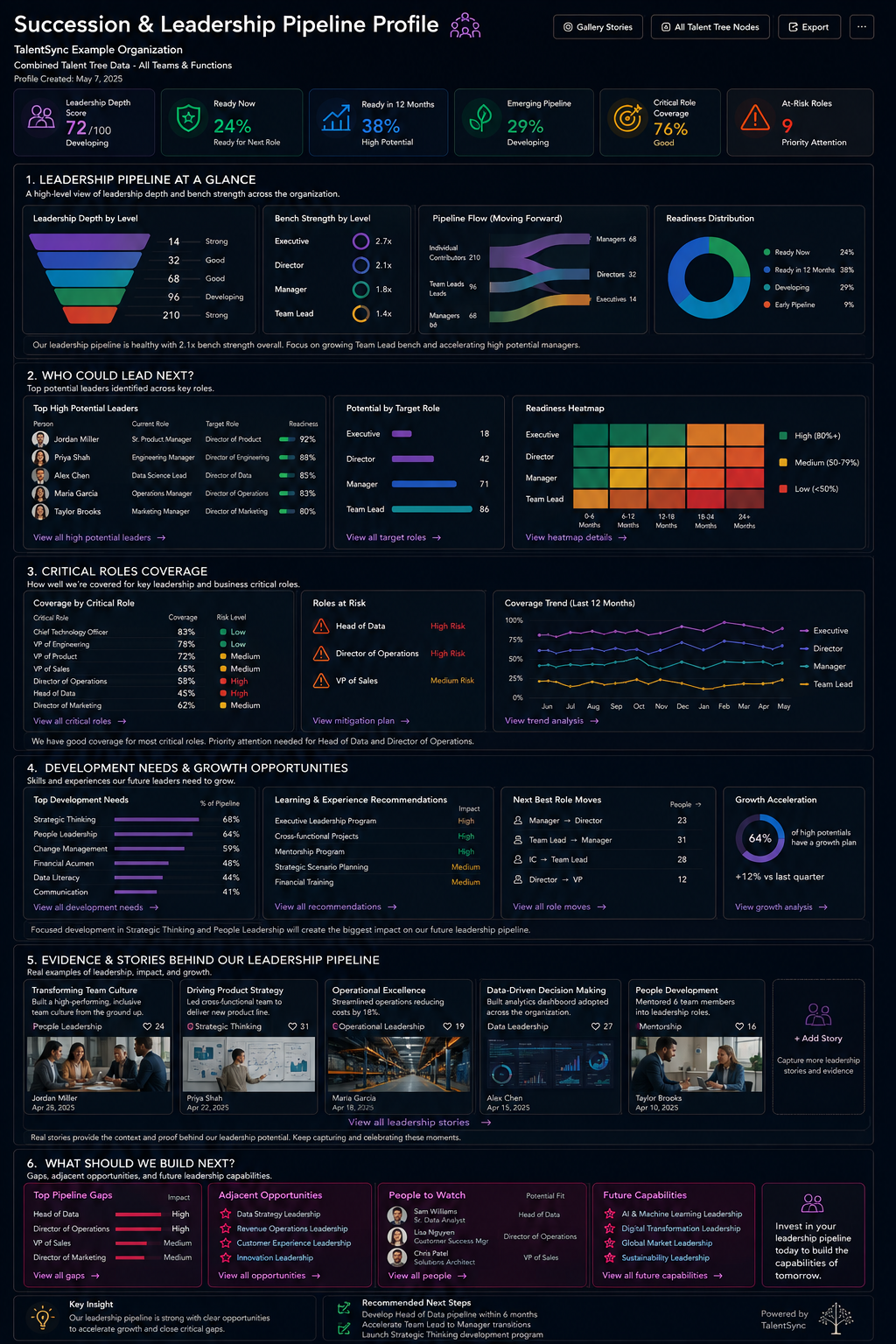 |
See Who Could Lead NextSee how leadership capacity is distributed across the organization—and where the next generation of leaders may already be emerging. A Succession & Leadership Pipeline Profile brings together Roles, Activities, Human Skills, Technical Skills, Intelligence, Wisdom, Agency, Potential, and supporting Evidence to show where leadership is strong, where critical responsibilities are concentrated, and where future leaders may need more experience, support, or opportunity. See the Leadership Pipeline at a GlanceUnderstand leadership depth across levels, readiness for future roles, and whether the organization has enough coverage for key positions. Instead of relying only on titles or performance reviews, the Profile connects leadership patterns to demonstrated work, responsibilities, skills, and evidence. Identify Who Could Lead NextExplore people whose Stories show strong alignment with future leadership Roles, based on the capabilities, experiences, judgment, and responsibilities they have already demonstrated. This is not a prediction of who should be promoted—it is a way to surface evidence-backed readiness for further consideration. Understand Critical Role CoverageSee where important Roles have strong bench strength and where the organization may be overly dependent on one person. Combined Gallery Stories can connect Roles, Activities, Skills, Agency, and Potential to reveal whether future leaders have actually experienced the work required for the next level. See What Development Would Matter MostIdentify the experiences and capabilities most likely to strengthen the leadership pipeline. This may include strategic thinking, people leadership, financial acumen, change management, cross-functional work, mentoring, or exposure to different kinds of responsibility. Ground Readiness in Real EvidenceMove from succession patterns into the individual Stories behind them—including projects led, decisions made, teams supported, credentials earned, mentoring experiences, measurable outcomes, and other evidence that demonstrates how leadership capacity has developed over time. Role Readiness → Stories → Evidence → Future Opportunity See More Than a Replacement ChartSuccession is not only about finding a person to replace another person. TalentSync can reveal adjacent future Roles, transferable capabilities, shadow leadership, informal stewardship, and people who may be ready for opportunities that do not yet exist in the formal organization chart. Build the Next Generation of CapabilityPotential Stories provide a forward-looking view of where leadership capacity could grow next—highlighting critical gaps, people with relevant adjacent experience, emerging leadership capabilities, and the development experiences that could strengthen future readiness. The result is more than a succession plan. It is an evidence-backed view of how leadership is distributed today, where future capability is emerging, and what the organization can do to build a deeper and more resilient leadership pipeline. |
|
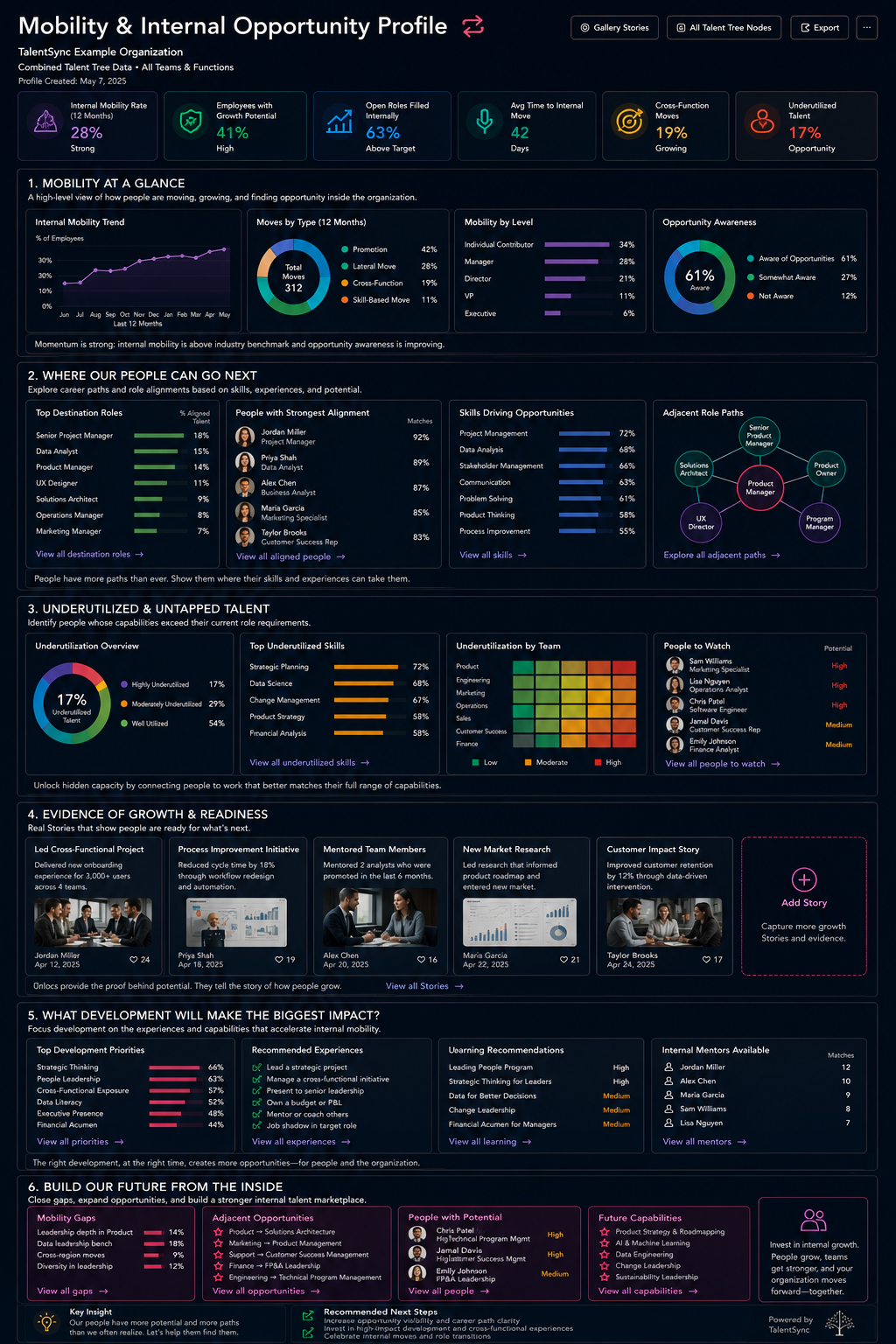
See Where Your People Can Go NextSee the opportunities already hiding inside your organization. A Mobility & Internal Opportunity Profile brings together Roles, Activities, Human and Technical Skills, Interests, Agency, Potential, development experiences, and supporting Evidence to show where people could move, grow, or contribute in new ways. Understand How People Are MovingSee internal mobility trends across promotions, lateral moves, cross-functional transitions, and skill-based moves. Explore where movement is happening, which levels are most active, and whether people can actually see the opportunities available to them. See Where People Could Go NextConnect current Roles, Skills, Activities, Interests, and demonstrated experience with possible destination Roles. Combined Gallery Stories can reveal adjacent career paths and people whose existing evidence already aligns with opportunities elsewhere in the organization. Find Underused TalentIdentify capabilities that people possess but rarely use in their current work. This can reveal hidden strengths, mismatches between people and Roles, and valuable talent that may be overlooked because it sits outside formal job descriptions. Ground Mobility in Real EvidenceMove from possible career paths into the Stories that demonstrate readiness—including cross-functional projects, process improvements, mentoring, new-market work, customer outcomes, credentials, and other Evidence of growth. Capability → Adjacent Role → Evidence → Opportunity See What Development Could UnlockIdentify the experiences and capabilities that could help people move toward new Roles. Development may come through strategic projects, cross-functional exposure, mentoring, formal learning, job shadowing, or other experiences that create new evidence. Build Opportunity From WithinPotential Stories connect mobility gaps with adjacent opportunities, people who may be ready to grow, and capabilities the organization will need next. This helps leaders look internally before assuming the answer must always be another external hire. The result is more than an internal job board. It is an evidence-backed view of where people could contribute next, what might help them get there, and how the organization can create more opportunity from the talent it already has. |
|
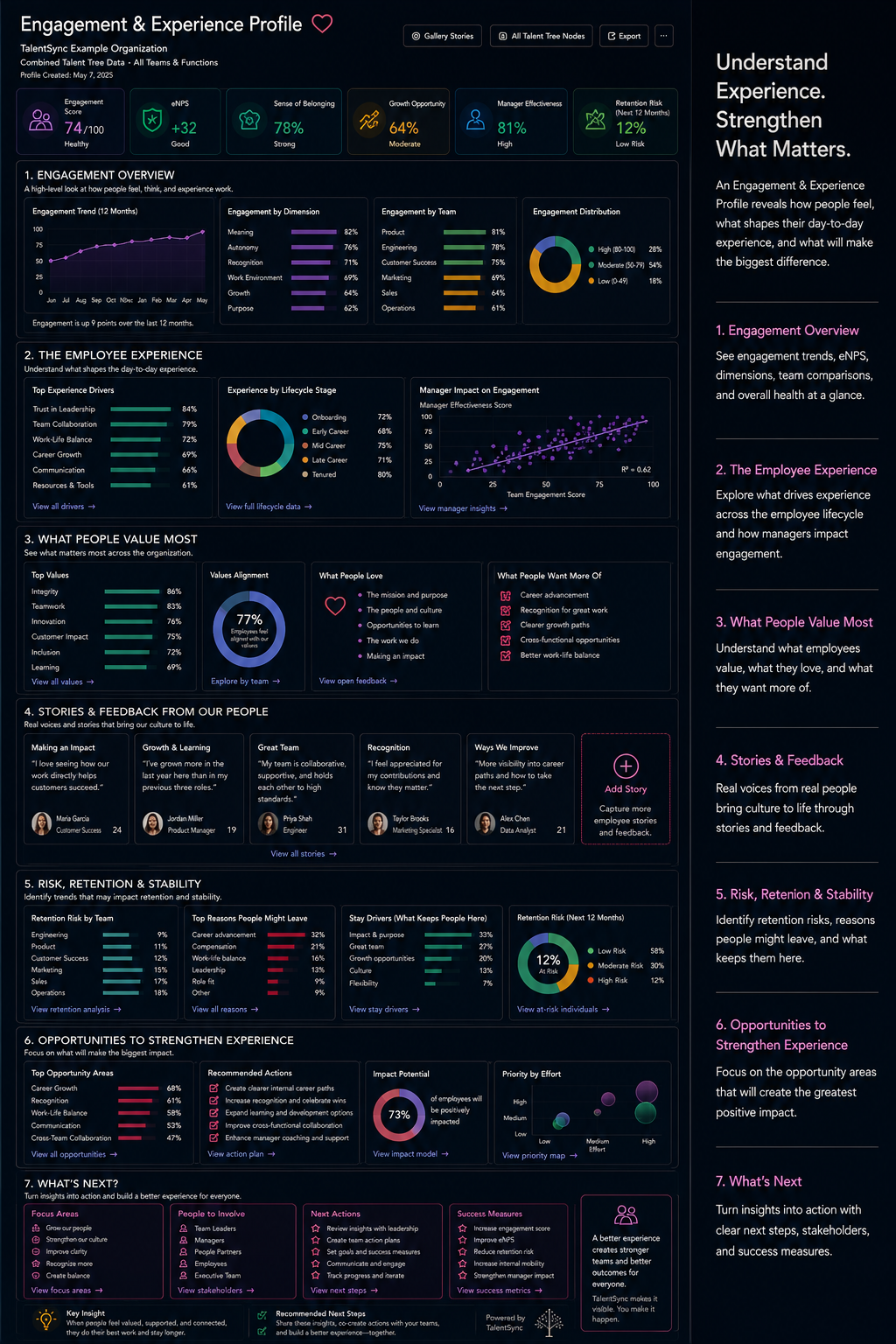
Understand What Helps Your People ThriveSee employee experience through more than a periodic survey. An Engagement & Experience Profile brings together Voice, Motivations, Identity, Agency, Roles, Activities, Human Skills, Stories, Evidence, and outcomes to create a living picture of how people experience the organization and what may help them do their best work. See Engagement in ContextExplore how engagement changes over time and across teams, Roles, projects, or other groups. Instead of stopping at a single engagement number, see the different experiences and organizational conditions associated with those patterns. Understand the Everyday ExperienceSee what appears to strengthen or constrain people’s experience—from trust, collaboration, communication, and resources to recognition, autonomy, growth opportunities, belonging, and the way leadership shows up in everyday work. See What People ValueMotivation, Identity, Voice, and other Talent Tree Stories can reveal what people value about their work and organization, what keeps them connected, and what they want more of—without assuming everyone is motivated by the same things. Hear the Stories Behind the PatternsAggregate Gallery Stories can lead into individual Stories, feedback, recognition, project experiences, photographs, artifacts, and other Evidence that helps explain why a pattern exists and how people are actually experiencing their work. Pattern → Experience → Story → Evidence Understand Retention & StabilityConnect experience patterns with organizational stability to explore where friction may be growing and what people consistently describe as reasons to stay. The goal is not to predict individual behavior, but to give leaders better visibility into the conditions they can actually improve. Find Opportunities to Strengthen ExperienceCombined Gallery Stories can connect employee experience with Agency, Activities, Roles, Voice, Motivations, Human Skills, and other datasets to reveal where changes to growth, recognition, communication, workload, collaboration, or leadership may have the greatest impact. Turn Insight Into ActionThe Profile can finish by connecting opportunities with the people who can help, specific actions the organization can take, and the outcomes that can be watched over time—turning employee experience into a continuous learning and improvement loop. The result is more than an engagement survey. It is an evidence-backed narrative of how people experience the organization, what matters to them, where friction exists, and what leaders can do to create an environment where more people can thrive. |
| See Where Work Is Really LandingUnderstand how work actually moves through your organization—not just how the org chart says it should. See How Work Is DistributedExplore the actual mix of Activities consuming people’s time—from strategic and operational work to projects, meetings, communication, administration, and development—and compare those patterns across teams or functions. Find the Work the Org Chart Doesn’t ShowConnect Activities with formal and informal Roles to reveal shadow responsibilities, invisible work, uneven ownership, and critical work that has quietly become dependent on a small number of people. Understand Where Capacity Is Being LostSee where overload, context switching, duplicated effort, unclear ownership, approvals, coordination, or other Agency constraints are consuming capacity that could otherwise be directed toward higher-value work. Activities → Roles → Capacity → Evidence → Opportunity See Capability That’s Being WastedCompare the Skills people possess with the Activities consuming their time. TalentSync can reveal expertise that is barely being used, people consistently operating beyond their formal Roles, and work that may not require the capability currently assigned to it. Move From Patterns to ProofMove directly from aggregate Gallery Stories into the individual Activities, project Stories, artifacts, outcomes, and other Evidence behind them—so leaders can understand why a workload pattern exists before deciding what to change. Discover Where Capacity Could Be CreatedPotential Stories can model opportunities to redistribute Activities, clarify Roles, remove constraints, reduce coordination burden, activate underused capability, or automate appropriate work—turning workload visibility into practical organizational design. The result is more than a utilization dashboard. It is an evidence-backed picture of how your organization is actually carrying its work—and where you can create the capacity to do what matters next. |

|
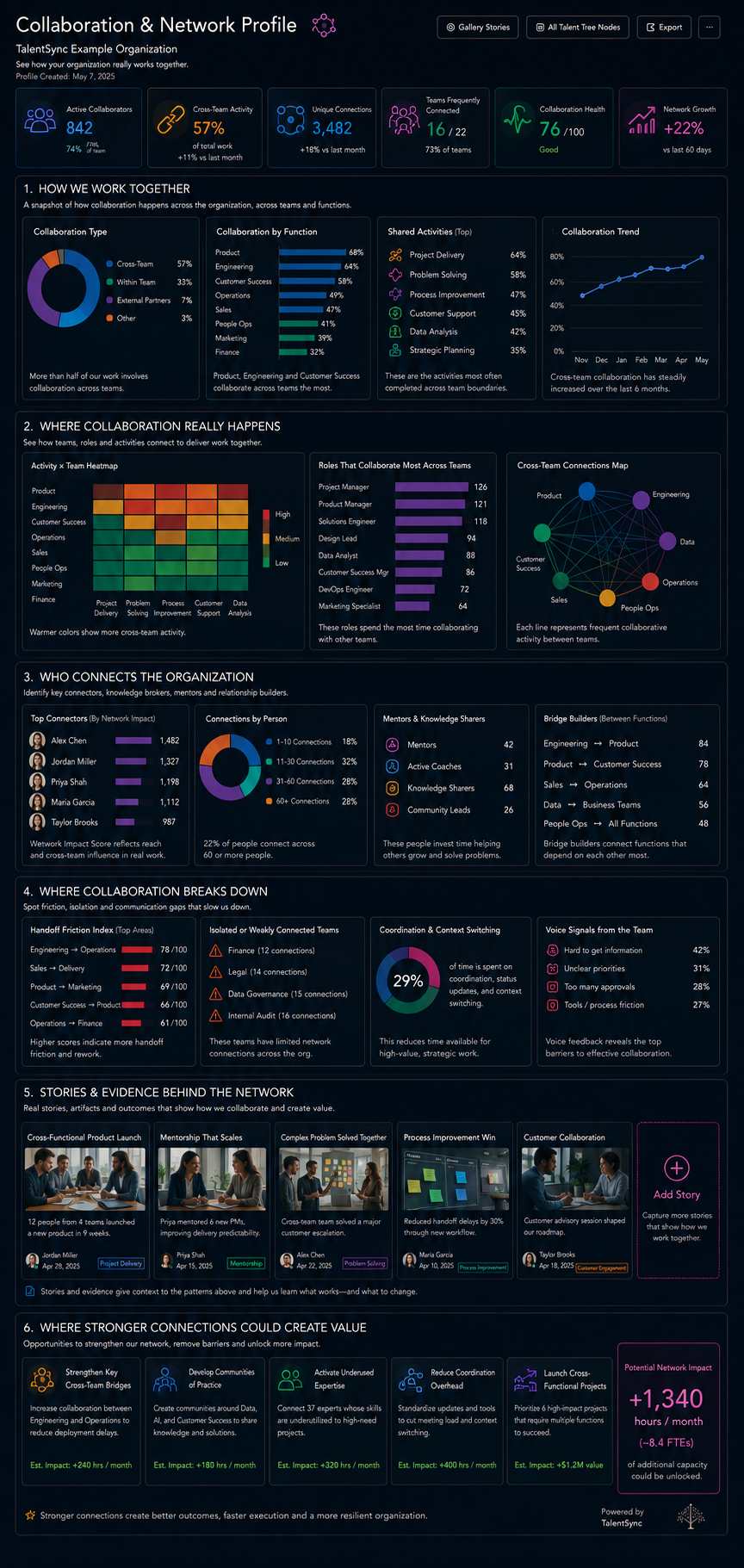
See How Your Organization Really Works TogetherSee the network behind the org chart. A Collaboration & Network Profile connects Activities, Roles, Voice, Human Skills, Stories, Evidence, and outcomes to reveal how people actually work together, where knowledge travels, and which relationships help the organization get things done. See Where Collaboration Really HappensExplore shared Activities and cross-team work to understand which functions collaborate most often, which Roles regularly cross organizational boundaries, and where the real operating network differs from the formal structure. Find the People Who Connect the OrganizationSurface bridge builders, mentors, knowledge sharers, facilitators, and other people whose work repeatedly connects teams. Instead of assigning an abstract influence score, TalentSync can show what they connect, how they contribute, and the Stories behind that value. See Where Connections Break DownIdentify difficult handoffs, isolated groups, excessive coordination, information barriers, unclear priorities, and other friction that can slow work even when the right people and capabilities are already present. People → Activities → Connections → Evidence → Outcomes Understand How Knowledge TravelsSee where expertise is being shared through mentoring, problem solving, collaboration, and repeated work—and where important knowledge may be concentrated or disconnected from the teams that could benefit from it. Move From Network Patterns to Real StoriesMove from organization-wide patterns into the projects, mentoring relationships, customer collaborations, shared artifacts, outcomes, and individual Stories that explain how people actually create value together. Discover Connections That Could Create More ValuePotential Stories can reveal teams that should work together more often, missing organizational bridges, mentorship opportunities, communities of practice, underused expertise, and cross-functional projects that could unlock new capability. The result is more than a network diagram. It is an evidence-backed picture of how your organization creates value together, where collaboration is breaking down, and which connections could make the entire system stronger. |
|
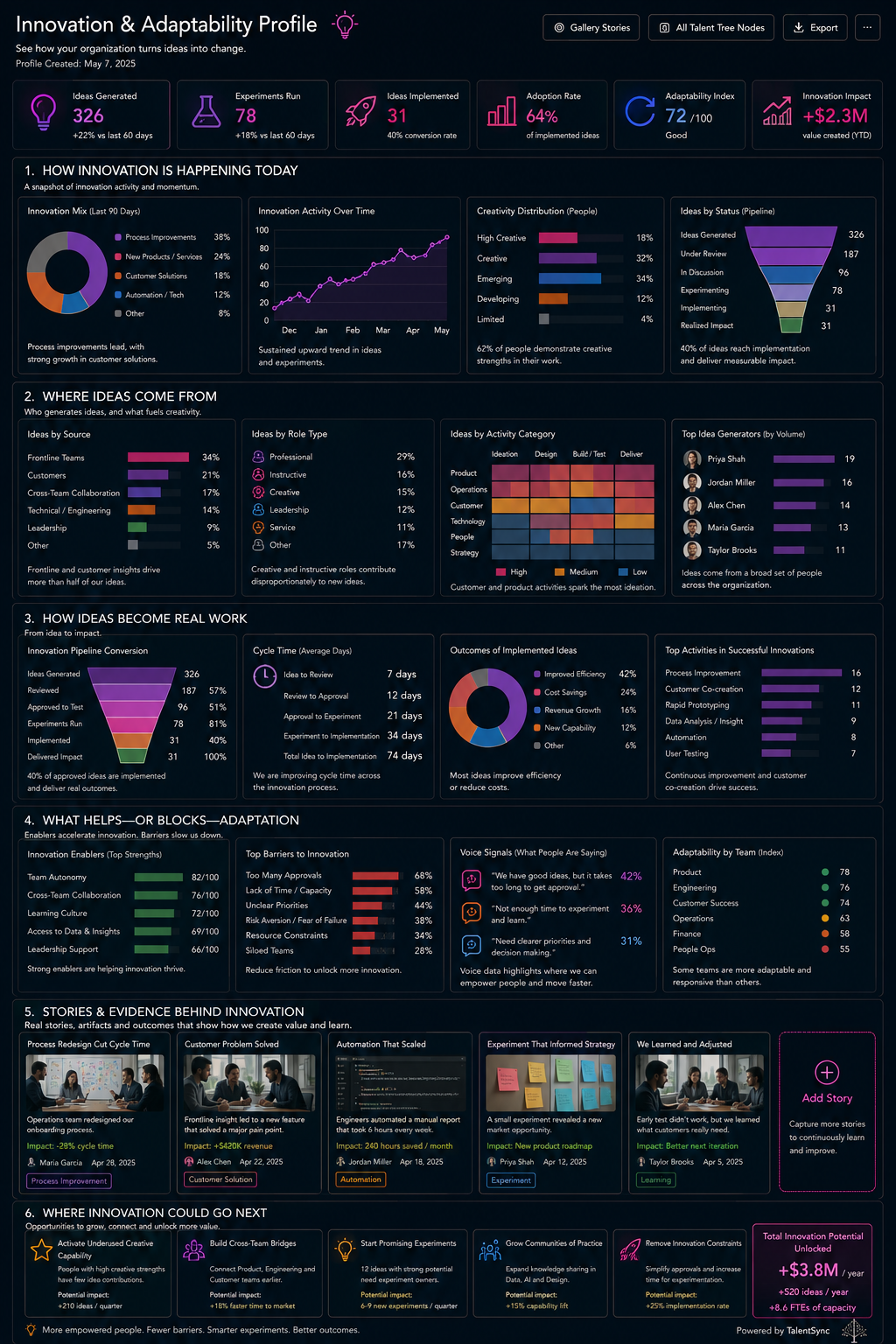
See How Your Organization Turns Ideas Into ChangeInnovation is more than having good ideas. It is the organization’s ability to turn insight into experiments, learning, change, and measurable outcomes. An Innovation & Adaptability Profile connects Creativity with the people, Activities, Roles, capabilities, conditions, and Evidence that determine whether new ideas actually go somewhere. See Where Ideas Come FromExplore which teams, Roles, Activities, customers, and people are generating ideas—and whether creative contribution is broadly distributed or concentrated among a small part of the organization. Follow Ideas Into Real WorkFollow the path from idea to discussion, experiment, implementation, and outcome. See which kinds of ideas move forward, how quickly they are tested, and which Activities repeatedly turn creative thinking into measurable value. Understand What Helps—or Blocks—ChangeConnect Agency, Voice, Human Skills, Intelligence, Roles, and Activities to see where autonomy, collaboration, learning, and leadership accelerate adaptation—and where approvals, unclear priorities, resource constraints, or organizational friction slow it down. Idea → Activity → Experiment → Evidence → Outcome → Learning See Who Is Helping the Organization AdaptSurface the people and teams demonstrating creative problem solving, experimentation, learning, customer insight, systems thinking, and adaptability through their actual work—not simply through an innovation label or assessment. Ground Innovation in Stories & EvidenceMove from organization-wide patterns into individual Stories, prototypes, process improvements, customer discoveries, experiments, artifacts, outcomes, and even useful failures that show how innovation and learning actually happen. Discover What Could Be Created NextPotential Stories can surface underused creative capability, promising ideas waiting for experiments, emerging technologies, missing cross-team connections, and organizational constraints that could be removed to help more ideas become real outcomes. The result is more than an innovation score. It is an evidence-backed picture of how your organization generates ideas, learns through experimentation, adapts to change, and creates what comes next. |
|
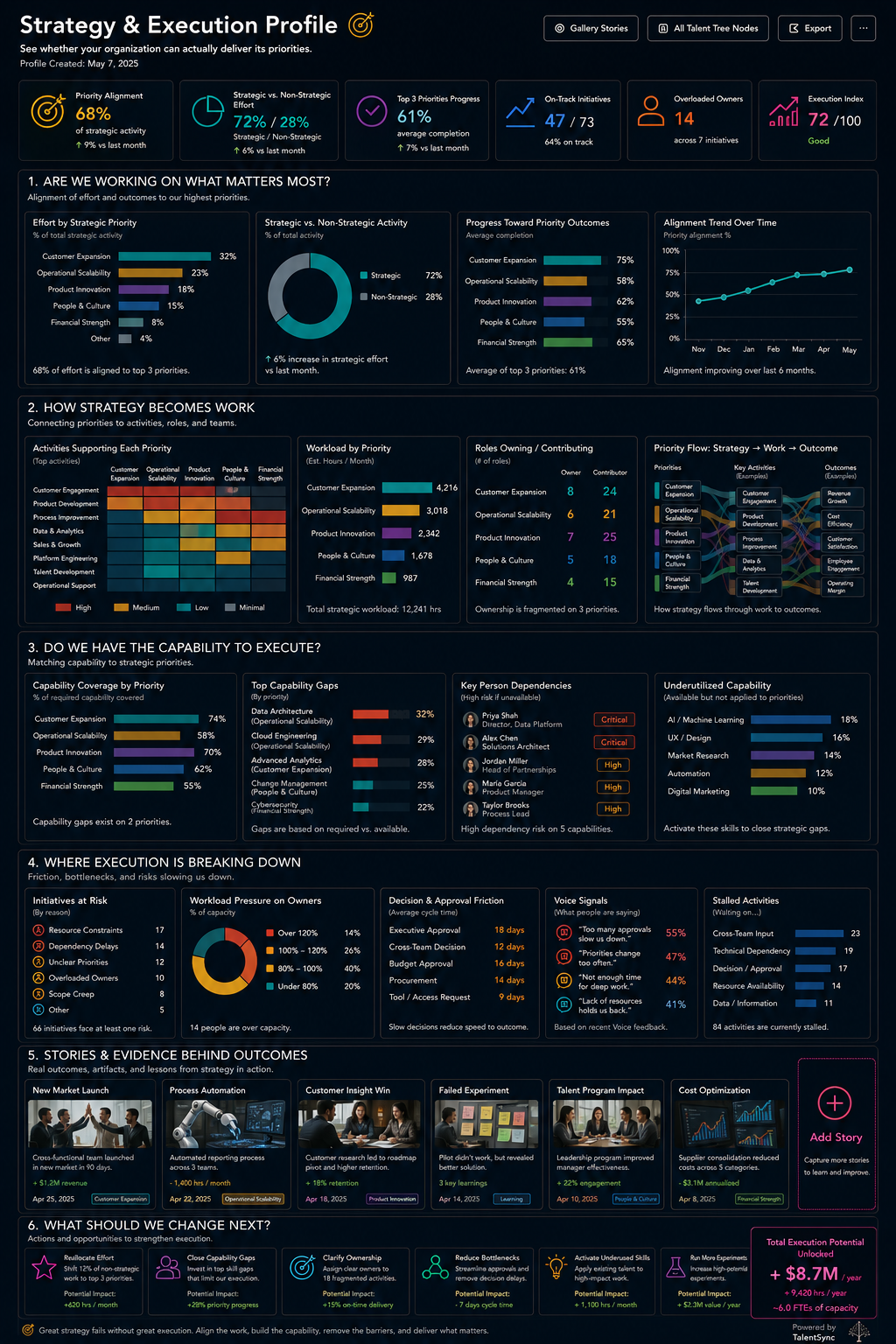
See Whether Your Organization Can Actually Deliver Its PrioritiesConnect strategy to the work actually happening across your organization. A Strategy & Execution Profile brings together priorities, Roles, Activities, capabilities, organizational conditions, Stories, Evidence, and outcomes to show whether the organization is truly aligned around what matters most. See Where Organizational Effort Is GoingCompare stated priorities with the Activities consuming people’s time. See which priorities are receiving meaningful organizational effort, which are progressing toward outcomes, and where everyday work may be drifting away from strategic intent. Follow Strategy Into Real WorkConnect each priority with the Activities, Roles, teams, and people responsible for delivering it. See where ownership is clear, where responsibilities overlap, and where important strategic work lacks sufficient attention or accountability. Understand Whether the Capability ExistsCompare the Human Skills, Technical Skills, Intelligence, Wisdom, and other capabilities required by strategic priorities with the capabilities already demonstrated across the organization—revealing gaps, dependencies, and expertise that may be available but underused. Priority → Role → Activity → Capability → Evidence → Outcome See Why Execution Is Slowing DownSurface overloaded owners, stalled Activities, unresolved dependencies, slow decisions, unclear priorities, resource constraints, and Voice signals that help explain why important work may not be moving as quickly as expected. Ground Strategy in Outcomes & EvidenceMove from strategic dashboards into the Stories behind the results—including launches, customer wins, process improvements, cost reductions, learning, failed experiments, artifacts, and measurable outcomes that show what execution actually produced. See What Should Change NextPotential Stories can reveal where effort should be reallocated, capabilities strengthened, ownership clarified, bottlenecks removed, underused talent activated, or new experiments launched to improve the organization’s ability to deliver. The result is more than a strategy dashboard. It is an evidence-backed view of whether priorities, people, work, capability, and outcomes are actually aligned—and what the organization can change to execute better. |
|
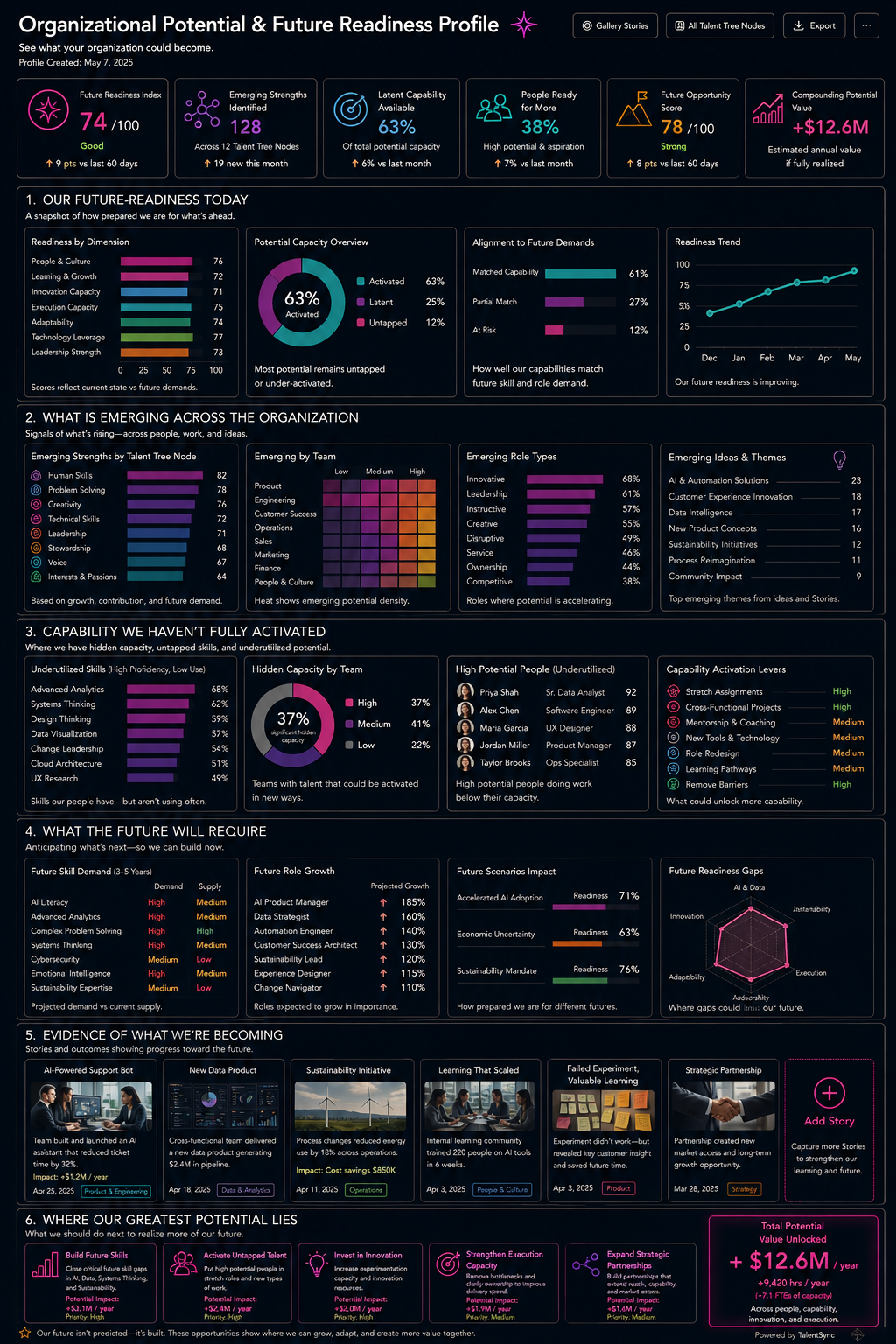
See What Your Organization Could BecomeLook beyond today’s organization and see the capabilities, people, ideas, and opportunities already pointing toward what could come next. An Organizational Potential & Future Readiness Profile brings together signals from across the Talent Tree to show where new capacity is emerging, what remains underused, and how prepared the organization may be for future demands. See How Ready You Are for What’s NextExplore readiness across people, capability, leadership, execution, adaptability, innovation, and technology—and compare what the organization can demonstrate today with the demands it expects to face tomorrow. See What Is Already EmergingSurface Skills, Roles, ideas, leadership patterns, Interests, Activities, and other capabilities that are growing across teams—even when they have not yet become formal parts of the organization’s structure. Find Capability You Haven’t Fully ActivatedIdentify expertise people possess but rarely use, high-potential people operating below their available capacity, and capabilities that could be activated through different assignments, new Roles, mentoring, cross-functional work, or better access to opportunity. Signals → Capability → Evidence → Future Demand → Potential Understand What the Future Will RequireCompare projected Skills, Roles, scenarios, and strategic demands with the capability already present across the organization. See where supply and demand are aligned, where gaps are forming, and where emerging strengths may provide an advantage. Ground the Future in EvidenceFuture readiness does not have to be speculative. Move into the Stories, experiments, new products, learning programs, partnerships, capability gains, artifacts, and measurable outcomes that show how the organization is already beginning to change. See Where Your Greatest Potential LiesPotential Stories can connect emerging demand with underused Skills, high-potential people, future Roles, new Activities, creative ideas, strategic partnerships, and organizational changes that could expand what the organization is capable of achieving. The result is more than a future-of-work dashboard. It is an evidence-backed view of what is emerging across your organization, what remains untapped, what the future may require, and where today’s talent could become tomorrow’s advantage. |

See How Work Actually Happens
Most organizations know what they want a workflow to accomplish.
What is much harder to see is what actually happens along the way.
TalentSync Workflow Profiles create a living picture
of the work itself — connecting expected activities and outcomes with
the people, AI agents, tools, skills, decisions, and contributions
that actually produced them.
The workflow timeline uses the Talent Tree to show
which dimensions of talent were exercised as the work unfolded.
Human contributors, AI agents, and automated systems can all appear
within the same workflow, making it possible to see not only
what happened, but how the work got done.
TalentSync can then compare the actual workflow with its goals to
identify where something is out of alignment: a missing human skill,
an overloaded team member, an unnecessary handoff, an underused AI
capability, the wrong tool, unclear communication, weak motivation,
or simply a process that needs to change.
Pythia turns those signals into conversations.
Teams can explore what is working, what is getting in the way, and
where changes to people, tools, responsibilities, or the workflow
itself could produce better results.
The goal isn’t to automate everything. It’s to continuously understand
and improve how people, technology, and organizations work together.

Protect the Work Only You Can Do
Leaders often know where they want their time to go. What is
harder to see is where their attention, judgment, and decision-making
are actually being spent.
TalentSync Workflow Profiles make that operating rhythm
visible. They compare expected leadership activities with completed work,
showing which decisions, relationships, reviews, and follow-ups are
consuming executive capacity — and which Talent Tree dimensions are
actually being exercised along the way.
Human contributors, AI agents, and automated systems can all be mapped
into the same workflow. This makes it possible to see where AI is
genuinely reducing workload, where tools are underused, and where
automation is simply creating more review work for the leader.
The profile can then surface approval bottlenecks, routine work that
should move downstream, missing decision rights, underfunded strategic
work, and areas where executive judgment creates disproportionate value.
From there, TalentSync can model a better workflow — one that protects
high-value human judgment while redistributing, augmenting, or automating
the work around it.
The goal is not to remove the leader from the workflow.
It is to make their involvement more intentional, more valuable, and
better aligned with the work only they can do.
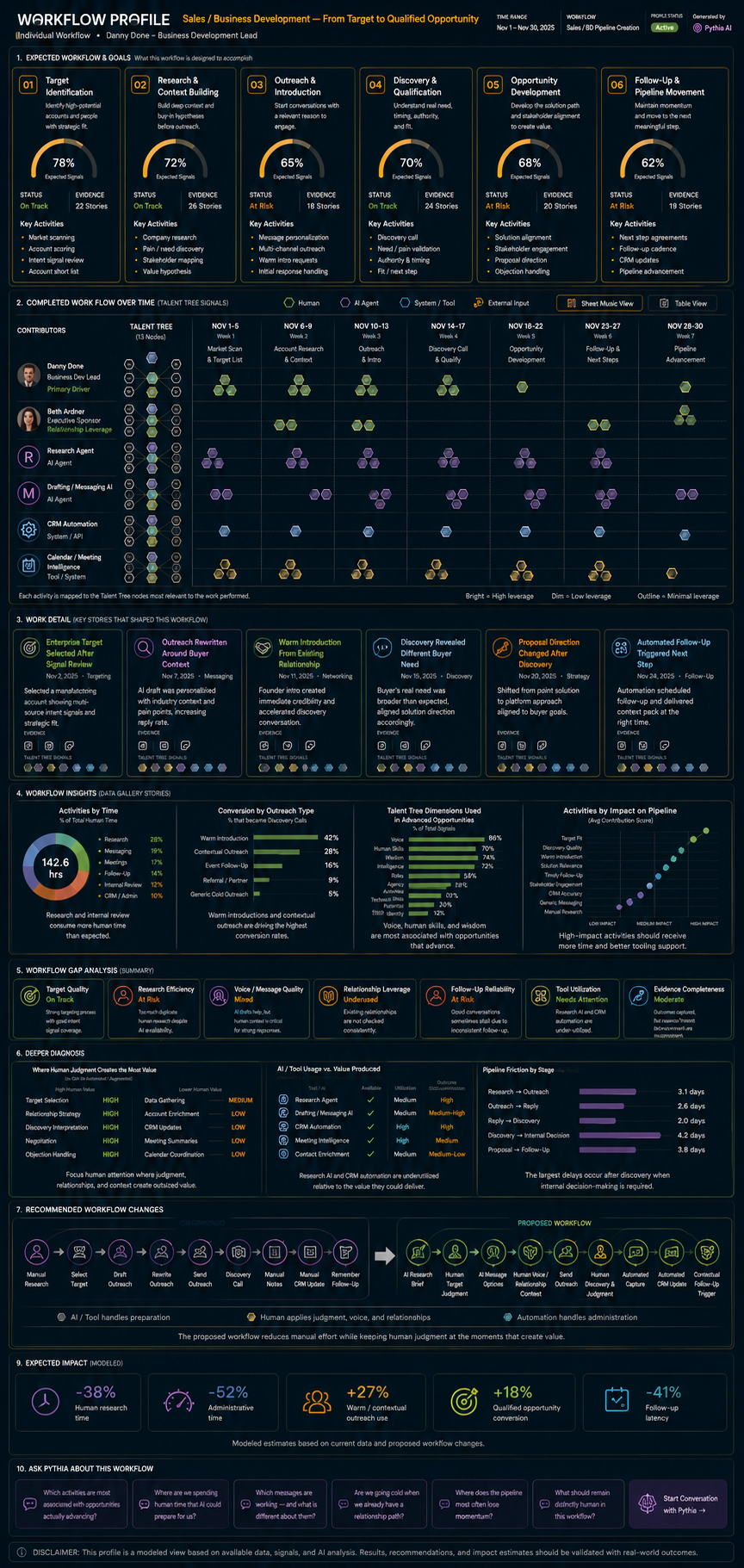
See What Actually Moves Opportunities Forward
A CRM can tell you where an opportunity sits in the pipeline.
It rarely tells you why it moved, what work created momentum,
or whether your people and tools are being used where they create the
most value.
TalentSync Workflow Profiles connect the expected sales
process with the work actually performed — from targeting and research
through outreach, discovery, follow-up, and opportunity development.
Human contributors, AI agents, and automated systems appear within the
same workflow. Their activities can be connected to Talent Tree signals,
evidence, and outcomes, creating a richer picture of how research,
judgment, relationships, communication, tools, and follow-through
contribute to pipeline movement.
That makes it possible to identify where human time is being wasted,
where AI could better prepare the work, where existing relationships are
being overlooked, where automation can remove administration, and where
human Voice, judgment, and trust remain essential.
TalentSync can then turn those patterns into workflow recommendations —
helping teams redesign the process around the combination of people,
AI, tools, and activities that appears most likely to produce better
outcomes.
The goal isn’t simply more activity.
It’s understanding which activities actually create value — and building
the workflow around them.
src=”YOUR-IMAGE-URL-HERE”
alt=”TalentSync Product Development Workflow Profile showing expected product activities, human and AI contributors, Talent Tree signals, workflow intelligence, capability gaps, recommended changes, and modeled impact from customer signal through pr
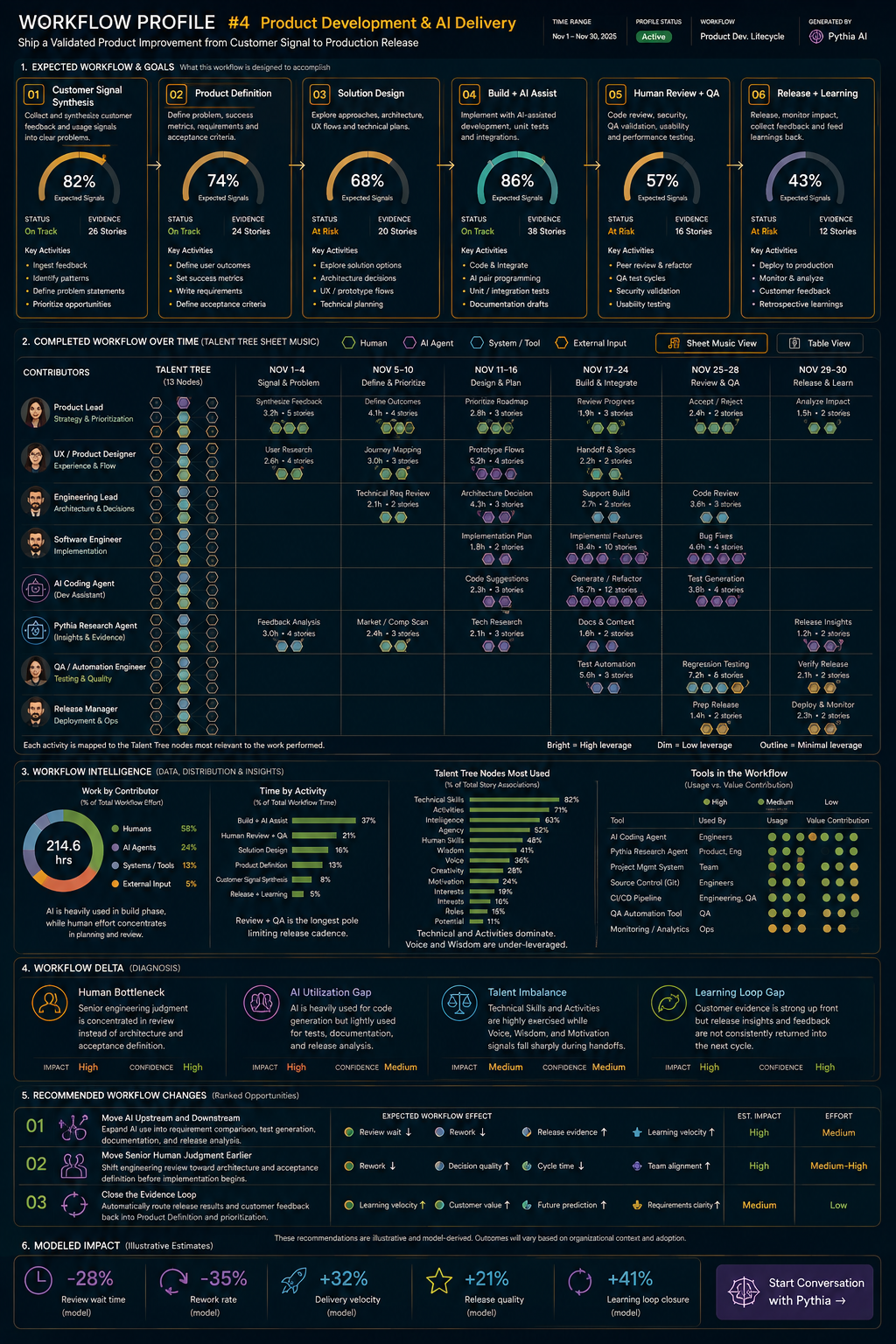
See Where Human Judgment and AI Actually Improve the Work
Adding AI to a workflow does not automatically make the workflow better.
The real question is whether the right combination of people, tools,
capabilities, decisions, and evidence is being used at each stage of
the work.
TalentSync Workflow Profiles make that visible by
comparing the product development process you expect with the work that
actually happens — from customer signal and product definition through
design, development, review, release, and learning.
Human contributors, AI agents, and automated systems can all appear
within the same workflow. Their completed activities can be connected
to Talent Tree signals, evidence, time, tools, and outcomes, creating a
living picture of how the product is actually being built.
That makes it possible to distinguish very different kinds of problems:
senior judgment arriving too late, AI being used heavily without reducing
review work, missing human capabilities during handoffs, overloaded team
members, poorly used tools, or customer evidence that never makes its way
back into the next product cycle.
TalentSync can then surface opportunities to redesign the workflow —
moving AI into the places where it can prepare, accelerate, or automate
work while protecting the moments where human judgment, creativity,
communication, and responsibility create the most value.
The goal is not simply faster development.
It is a workflow that learns — continuously improving how people, AI,
tools, and evidence work together to produce better outcomes.
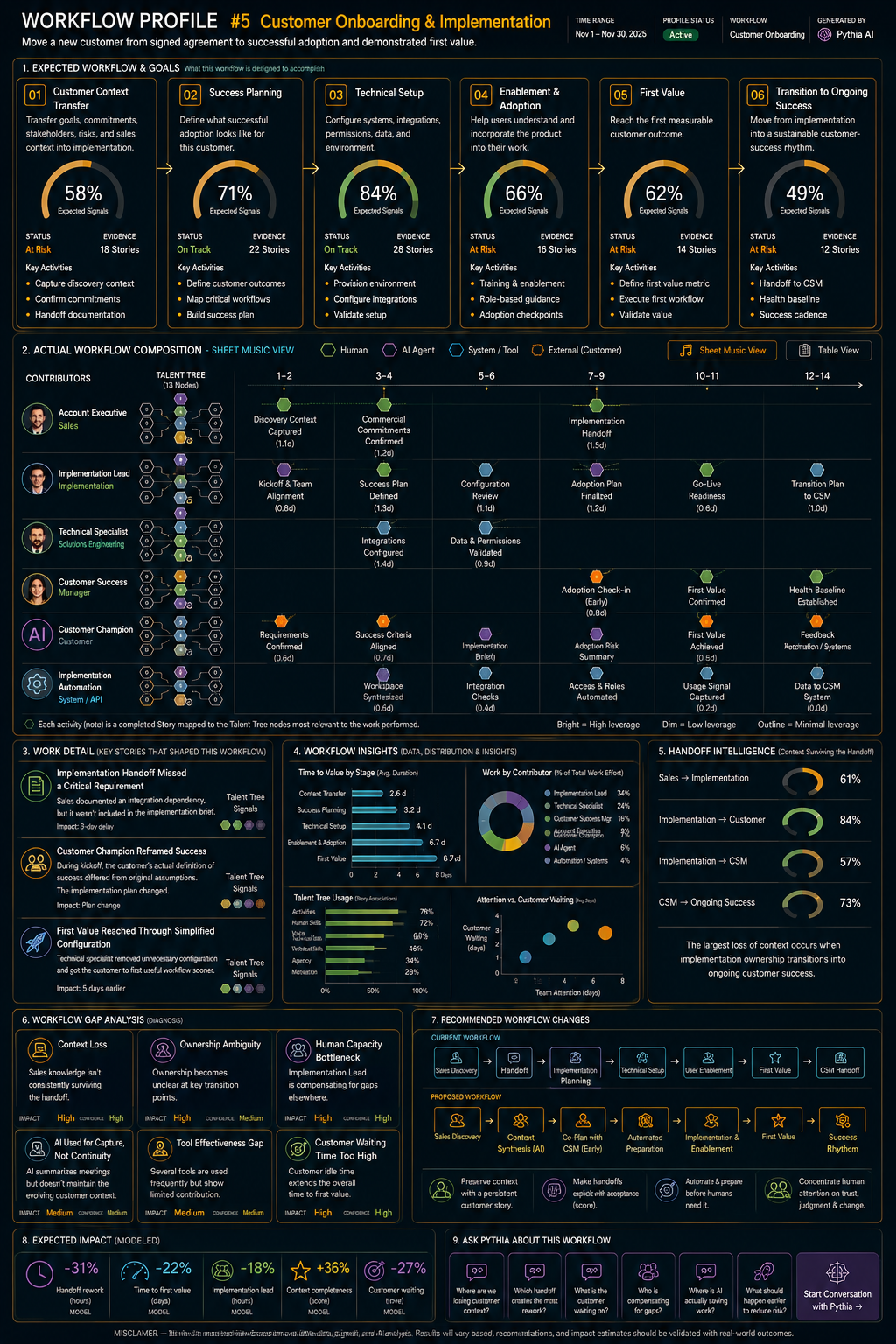
See Where Customer Momentum Gets Lost
Most onboarding processes look straightforward on paper:
transfer the account, configure the product, train the customer,
deliver value, and hand the relationship to customer success.
In practice, the problems often happen between those stages.
TalentSync Workflow Profiles show how onboarding
actually unfolds — connecting expected milestones with the people,
systems, AI tools, customer inputs, activities, and Talent Tree
signals involved in producing the outcome.
That makes it possible to see where customer context is lost,
where ownership becomes unclear, where implementation teams are
compensating for missing information, where customers are waiting,
and where tools are being used without meaningfully improving the
workflow.
TalentSync can also distinguish between different types of
onboarding problems. A delay may come from a technical dependency,
a weak handoff, missing decision authority, overloaded human
capacity, poor communication, or a tool that captures information
without carrying useful context forward.
From there, the workflow can be redesigned around clearer handoffs,
stronger continuity, earlier customer-success involvement, better
use of automation, and more intentional use of human judgment at
the moments where trust and adaptation matter most.
The goal is not simply faster onboarding.
It is creating a workflow where customer context survives every
transition — and where people, AI, and systems work together to
move customers toward value with less friction and rework.

See Why Good Projects Still Get Stuck
A project can have a clear objective, capable people, and a detailed plan
and still lose time to hidden dependencies, unclear ownership, overloaded
contributors, slow decisions, and coordination work that nobody planned for.
TalentSync Workflow Profiles make those dynamics visible
by comparing the project you intended to run with the work that actually
happened across teams, people, AI agents, and systems.
Completed activities can be connected to Talent Tree signals, evidence,
workload, decisions, handoffs, and outcomes. This makes it possible to see
not only whether work was completed, but where progress slowed, who absorbed
unplanned work, which capabilities were relied on, and where the project
depended too heavily on a small number of people.
TalentSync can then distinguish between different sources of friction:
a dependency discovered too late, a decision waiting for authority,
ownership that was never made explicit, weak cross-team context, excessive
coordination, underused tools, or lessons that never make their way into
the next project.
From there, the workflow can be redesigned around clearer decision rights,
earlier dependency detection, better workload distribution, automated
status and coordination support, and more intentional use of human judgment
where it creates the most value.
The goal is not simply better project tracking.
It is understanding how the project actually works well enough to improve
the system behind it — so teams can spend less time coordinating around
the work and more time moving it forward.
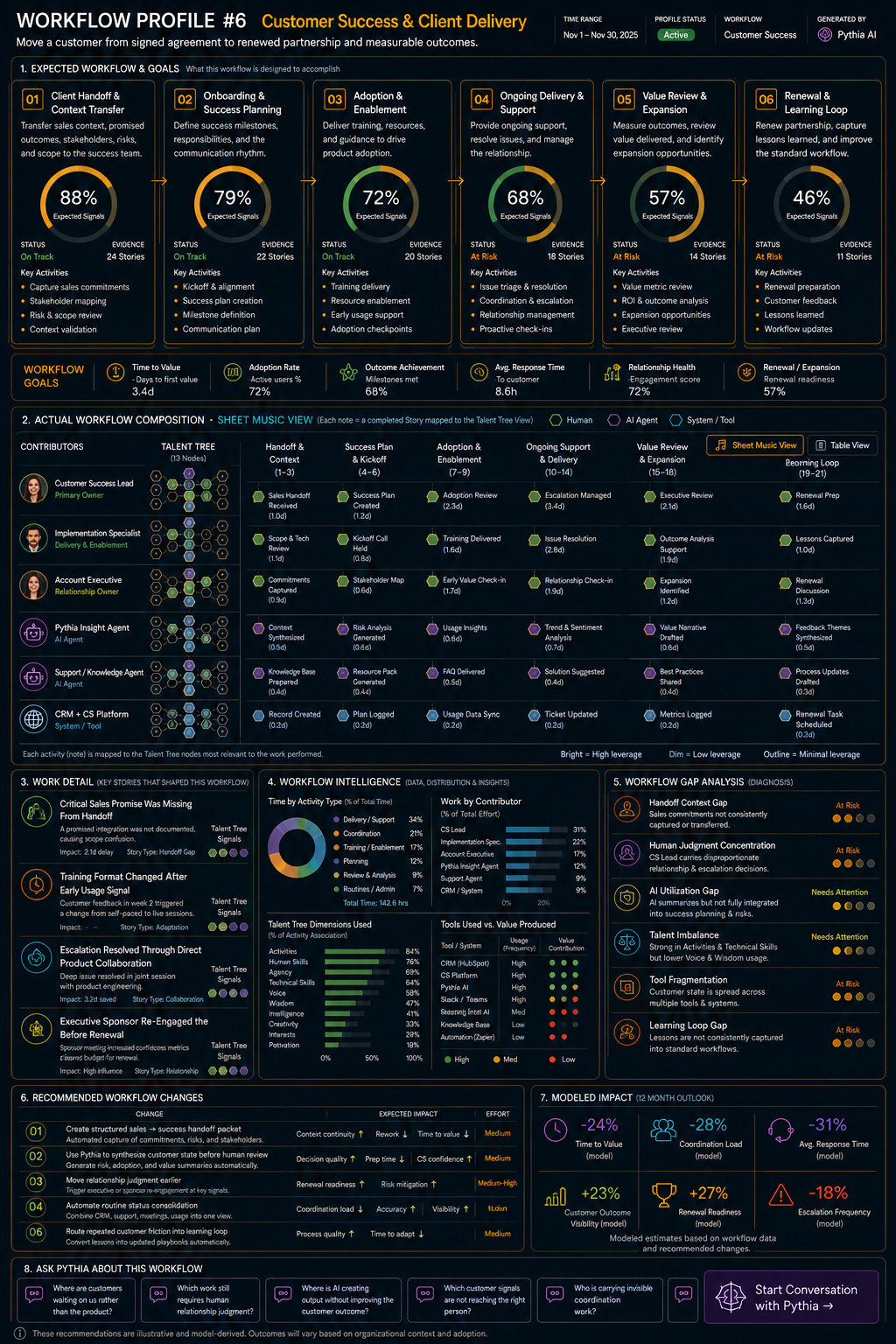
See What Actually Drives Customer Success
Customer success rarely breaks because one task was missed.
More often, value is lost across handoffs, unclear ownership,
fragmented systems, overloaded people, inconsistent follow-through,
or customer signals that never reach the right person.
TalentSync Workflow Profiles make those dynamics
visible by comparing the customer journey you intended to run with
the work that actually happened — from sales handoff and onboarding
through adoption, support, value realization, renewal, and learning.
Human contributors, AI agents, and systems can all be viewed inside
the same workflow. Their activities can be connected to Talent Tree
signals, evidence, time, customer outcomes, and handoffs, creating a
clearer picture of how value is actually being delivered.
That makes it possible to distinguish very different kinds of
problems: missing context from sales, relationship decisions arriving
too late, customer success leaders carrying invisible coordination
work, AI tools creating summaries without improving continuity, or
multiple platforms holding pieces of the customer story without a
shared view of what matters next.
TalentSync can then surface opportunities to redesign the workflow —
automating routine coordination, strengthening handoffs, carrying
context forward, and focusing human attention on the moments where
judgment, trust, communication, and adaptation matter most.
The goal is not simply more customer activity.
It is understanding which people, tools, decisions, and interactions
actually create value — and building the workflow around them.
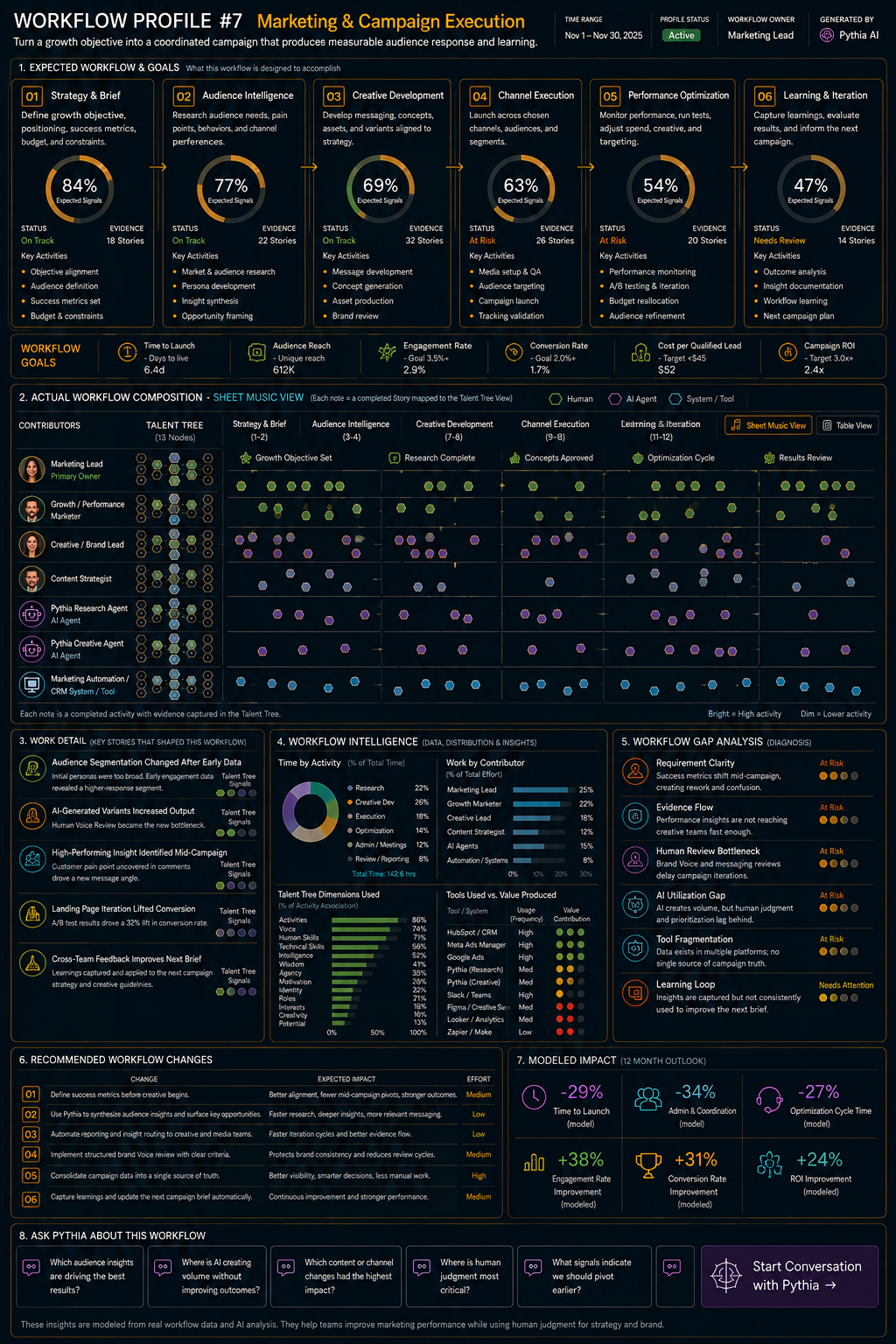
See Whether More Marketing Activity Is Actually Creating More Value
Modern marketing teams can generate more research, content, campaigns,
and variations than ever before. But higher output does not necessarily
mean better performance.
TalentSync Workflow Profiles connect the campaign you
intended to run with the work that actually happened — from strategy
and audience research through creative development, channel execution,
optimization, and learning.
Human contributors, AI agents, and marketing systems can all be viewed
within the same workflow. Their completed activities can be connected
to Talent Tree signals, evidence, time, tools, and outcomes, making it
possible to understand not just how much work was produced, but what
actually contributed to audience response and business results.
That can reveal very different kinds of problems: weak audience evidence,
too many low-value content variations, human review becoming the new
bottleneck, brand Voice being diluted, campaign data trapped across
disconnected tools, or AI producing more output without meaningfully
improving conversion.
TalentSync can then help teams redesign the workflow around the right
division of labor — using AI for research, preparation, generation, and
synthesis; automation for distribution and reporting; and human judgment
for strategy, creative direction, interpretation, relationships, and brand.
The goal is not simply to produce more marketing.
It is to understand which work changes outcomes — and continuously improve
how people, AI, tools, and evidence come together to create it.

See What Is Actually Driving Resource Decisions
Financial planning is often treated as a spreadsheet exercise, but the
real work depends on something much broader: assumptions, evidence,
operating inputs, human judgment, decision rights, and the ability to
learn when reality differs from the plan.
TalentSync Workflow Profiles make that process visible
by connecting the financial plan you intended to run with the work that
actually happened — from strategic assumptions and budget inputs through
modeling, cross-functional review, allocation, performance review, and
reforecasting.
Human contributors, AI agents, and finance systems can all be viewed
within the same workflow. Their completed activities can be connected
to Talent Tree signals, evidence, time, tools, variances, and decisions,
helping leaders understand not only what the numbers say, but how the
organization arrived at them.
That can reveal very different sources of friction: teams submitting
incomplete evidence, finance spending too much time consolidating data,
assumptions being challenged too late, routine decisions waiting for
executive approval, AI accelerating modeling without improving judgment,
or recurring variances that never change the next planning cycle.
TalentSync can then help redesign the workflow around cleaner inputs,
stronger evidence, clearer decision rights, better use of automation,
and more intentional human judgment at the moments where trade-offs,
risk, and strategic priorities matter most.
The goal is not simply a faster budget process.
It is creating a planning system that continuously connects resources
to priorities — and learns from what actually happens.
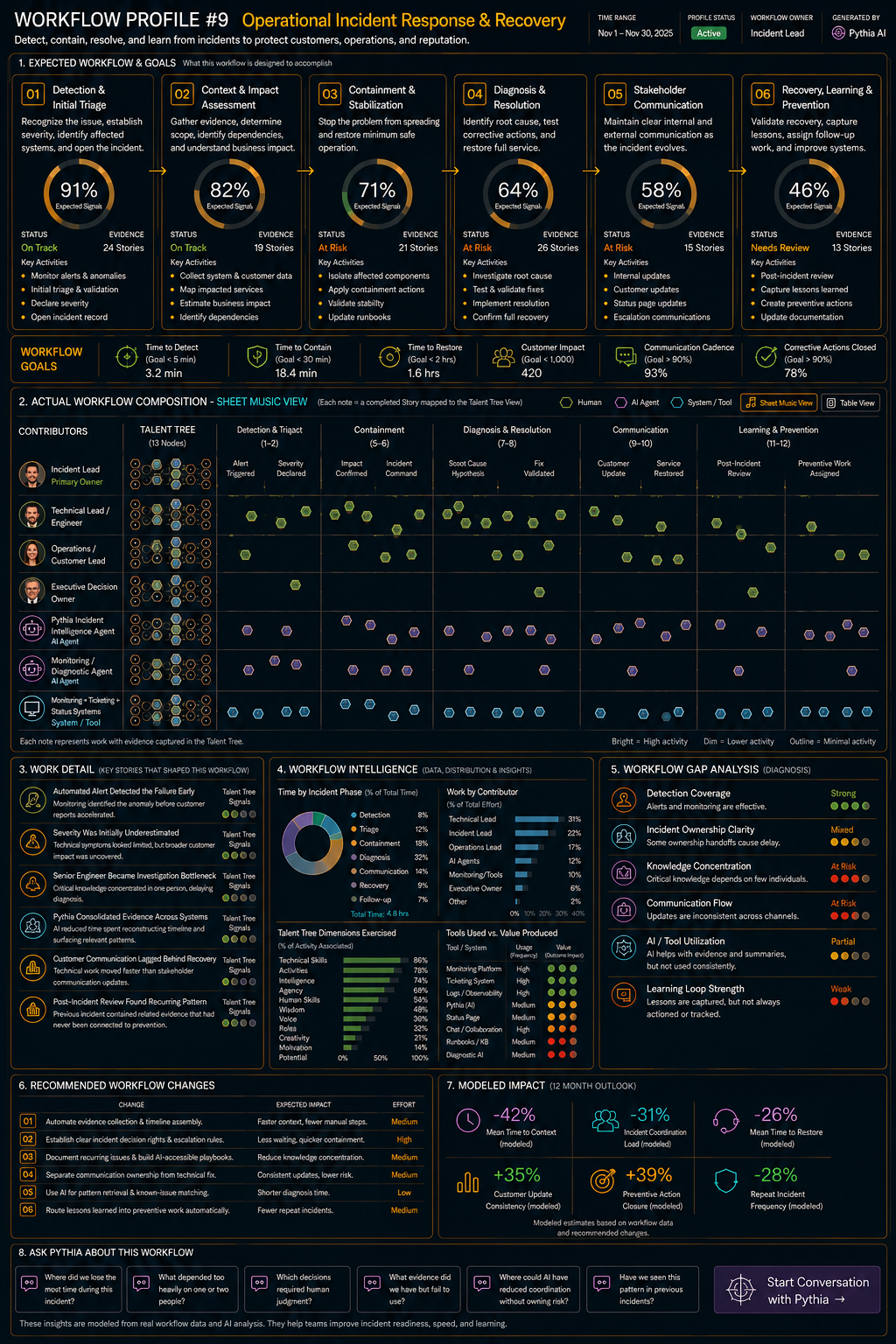
See How Your Organization Responds When the Plan Breaks
Incident response is not just a technical process.
It depends on how quickly people can understand what is happening,
find the right evidence, establish ownership, make decisions,
communicate clearly, and recover without creating new risk.
TalentSync Workflow Profiles make that response visible
by connecting the expected incident process with the work that actually
happened — from detection and triage through containment, diagnosis,
communication, recovery, and prevention.
Human contributors, AI agents, and operational systems can all be viewed
within the same workflow. Their completed activities can be connected to
Talent Tree signals, evidence, time, tools, decisions, and outcomes,
creating a clearer picture of how the organization actually responds
under pressure.
That can reveal very different kinds of resilience problems: critical
knowledge concentrated in one expert, unclear decision rights, teams
spending time reconstructing context, technical recovery outpacing
customer communication, AI tools generating summaries without reducing
coordination, or lessons from previous incidents never becoming
preventive action.
TalentSync can then help redesign the workflow around faster evidence
assembly, clearer ownership, better knowledge distribution, stronger
communication, and more intentional use of AI and automation — while
keeping risk, trade-offs, and recovery decisions in human hands.
The goal is not simply faster incident response.
It is building an organization that can recover, learn, and become more
resilient every time something goes wrong.

Turn Everyday Work Into Visible Growth
Traditional performance systems often separate doing the work from
developing the person. Goals live in one place, feedback happens later,
learning happens somewhere else, and much of the growth created through
real work is never captured at all.
TalentSync Workflow Profiles connect those pieces into
one continuous view — showing how role expectations, completed work,
feedback, reflection, learning, and new opportunities actually relate
to one another over time.
Contributions from the employee, manager, mentors, peers, AI agents,
and work systems can all be viewed within the same workflow. Completed
activities can be connected to Talent Tree signals, evidence, workload,
goals, feedback, and growth patterns, creating a richer picture of both
performance and development.
That makes it possible to see whether someone is simply busy or doing
work that matters; whether their strongest capabilities are actually
being used; whether low-value coordination is consuming their capacity;
whether feedback arrives soon enough to help; and whether their work is
aligned with the motivations and opportunities that will sustain growth.
TalentSync can then surface opportunities to improve the workflow —
automating low-value work, moving feedback closer to the activity,
creating experiences that exercise underused capabilities, and helping
managers connect demonstrated growth to new responsibility, recognition,
and mobility.
The goal is not simply to evaluate performance.
It is to create a continuous development loop where meaningful work
becomes evidence of growth — and growth opens the next opportunity.
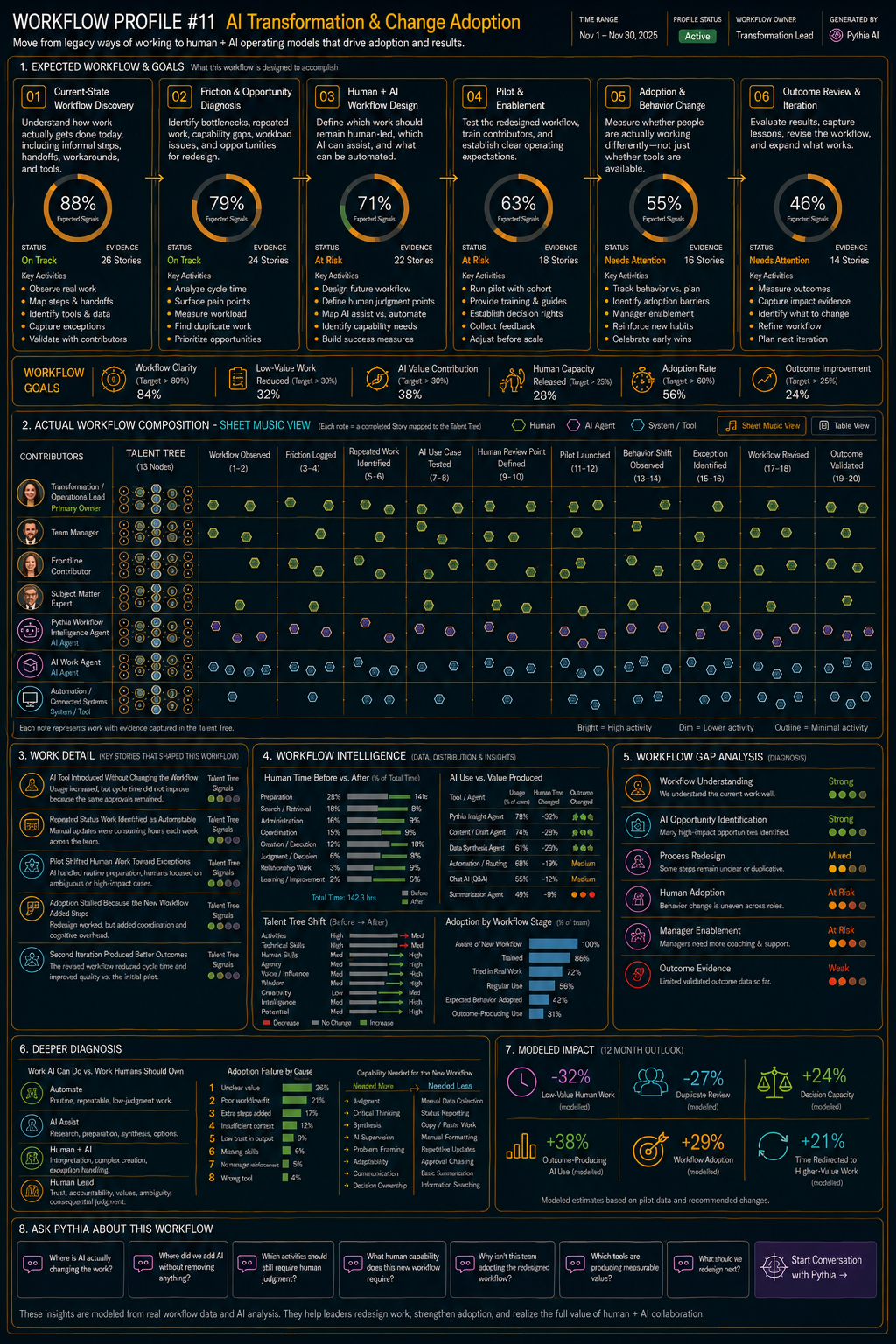
See Whether AI Is Actually Transforming the Work
Adding AI tools does not automatically create a better workflow.
Teams can increase usage, generate more output, and still keep the same
bottlenecks, approvals, duplicated reviews, and coordination burden they
had before.
TalentSync Workflow Profiles make that difference
visible by comparing the workflow as it exists today with the way people,
AI agents, and systems actually contribute after a redesign.
Completed activities can be connected to Talent Tree signals, evidence,
human time, tool usage, adoption behavior, and outcomes. That makes it
possible to see not just whether AI was introduced, but whether the shape
of human work actually changed.
TalentSync can reveal when AI is reducing low-value preparation, when it
is simply creating more work to review, where human judgment remains
essential, which capabilities the redesigned workflow now requires, and
why adoption may be stalling even when the technology itself works.
From there, leaders can redesign the operating model around a clearer
division of labor — using automation for repeatable work, AI for research,
synthesis, preparation, and support, and human talent for judgment,
relationships, accountability, ambiguity, and consequential decisions.
The goal is not AI adoption for its own sake.
It is continuously improving how people, AI, tools, and organizational
goals work together to produce better outcomes.
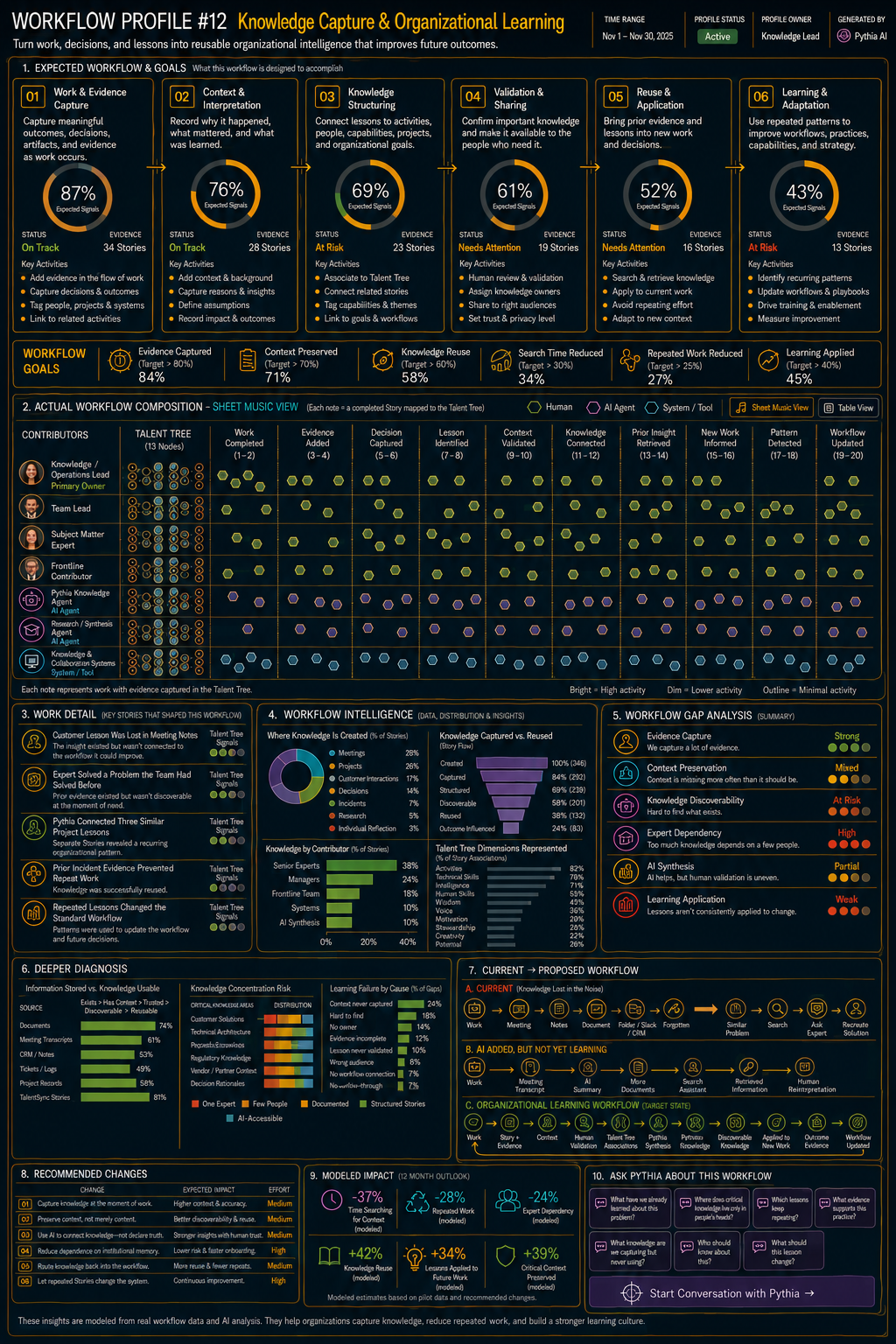
Turn Everyday Work Into Organizational Intelligence
Organizations create enormous amounts of information every day, but much
of what people learn still disappears into meetings, documents, chat
threads, disconnected systems, and individual memory.
TalentSync Workflow Profiles make the learning process
visible by connecting the work that happened with the evidence, decisions,
context, people, capabilities, and lessons it produced.
Human contributors, AI agents, and organizational systems can all appear
within the same workflow. Completed activities can become structured
Stories connected to Talent Tree signals, allowing the organization to
preserve not only what happened, but why it mattered, what evidence
supports it, and where that knowledge can become useful again.
That makes it possible to see where important context is being lost,
which expertise lives primarily in a few people’s heads, what knowledge
is being captured but never reused, where teams are repeatedly solving
the same problems, and whether AI synthesis is actually helping people
retrieve and apply trusted knowledge.
TalentSync can then help strengthen the learning loop — capturing
knowledge closer to the work, preserving its context, connecting related
Stories, reducing dependence on individual memory, and routing lessons
back into the workflows, resources, training, and decisions they can
improve.
The goal is not simply better documentation.
It is creating an organization that remembers what it learns — and uses
that intelligence to make the next piece of work better than the last.
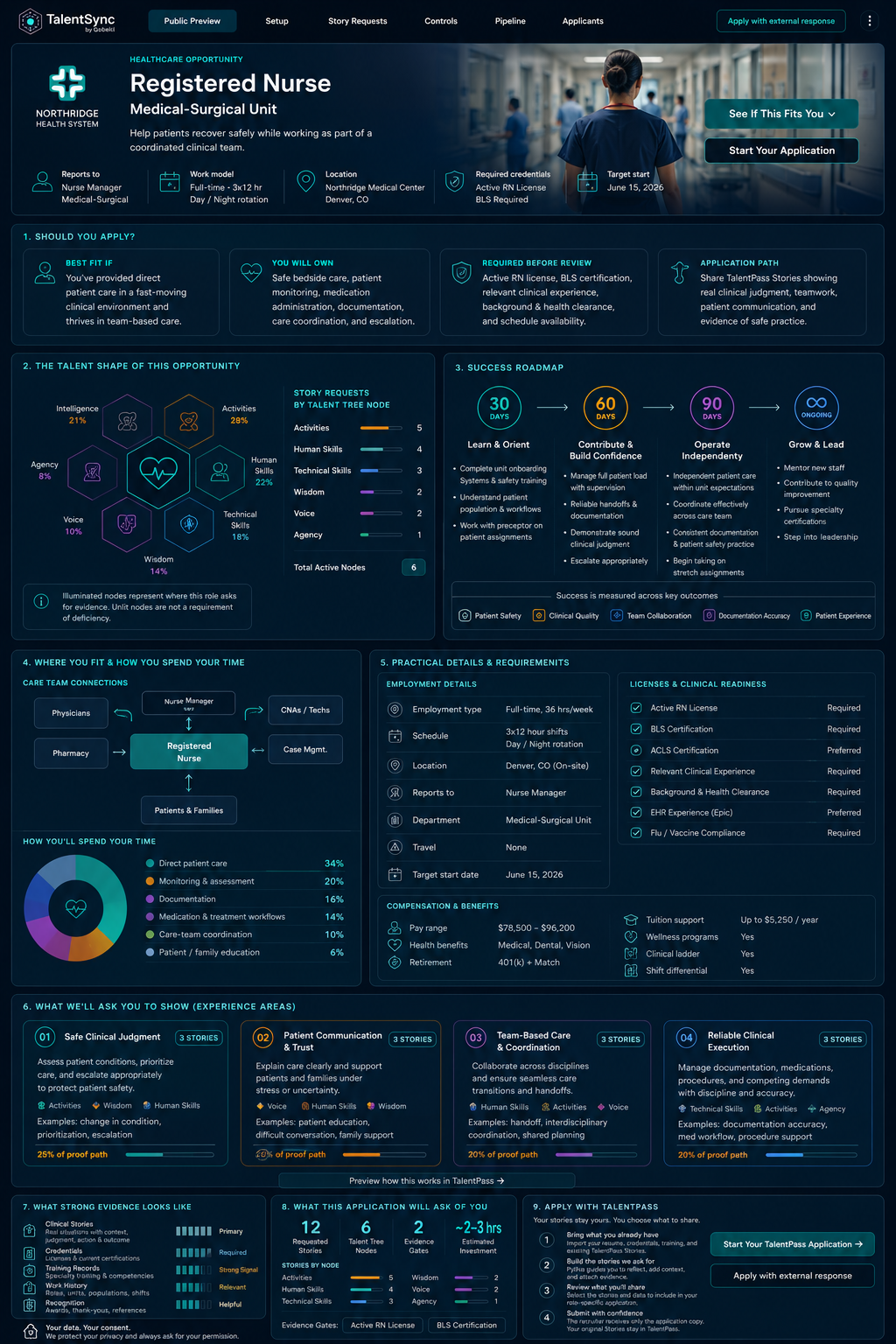
See the Role, the Expectations, and the Evidence Before You Apply
Traditional nursing job listings often combine responsibilities,
certifications, schedules, and culture into one long description.
TalentSync Recruitment Profiles turn that information
into a clearer picture of what the opportunity actually asks from a
candidate.
This Registered Nurse example shows how the same TalentSync structure
can adapt to a licensed, patient-facing profession. The profile makes
practical requirements visible alongside the human and clinical
capabilities that matter in the work itself.
Candidates can see the role’s reporting structure, care-team
relationships, expected time allocation, schedule, compensation,
required credentials, and early success roadmap before deciding whether
the opportunity is worth pursuing.
The Talent Tree then shows where the role is asking for
evidence across areas such as Activities, Human Skills, Technical Skills,
Wisdom, Voice, and Agency. These illuminated areas do not represent a
score or deficiency. They show the parts of the Talent Tree where the
application will ask candidates to share relevant Stories.
Those expectations are translated into clear experience areas such as
safe clinical judgment, patient communication, team-based care, and
reliable clinical execution. Each area can generate specific Story
Requests, helping candidates understand what real examples would make
their experience easier for a hiring team to review.
The profile also separates fit from proof. A candidate
may meet the role requirements, while still needing stronger evidence,
credentials, artifacts, or examples to support a particular claim.
TalentSync makes that distinction visible before the application is
submitted.
TalentPass then gives the applicant a reusable way to respond. Candidates
can bring existing work history, credentials, training, and Stories;
build any missing evidence with Pythia; review what will be shared; and
submit only the opportunity-specific copy they choose to provide.
The goal is not to make healthcare hiring more complicated.
It is to make the opportunity, the expectations, and the evidence clearer
for both the candidate and the hiring team.
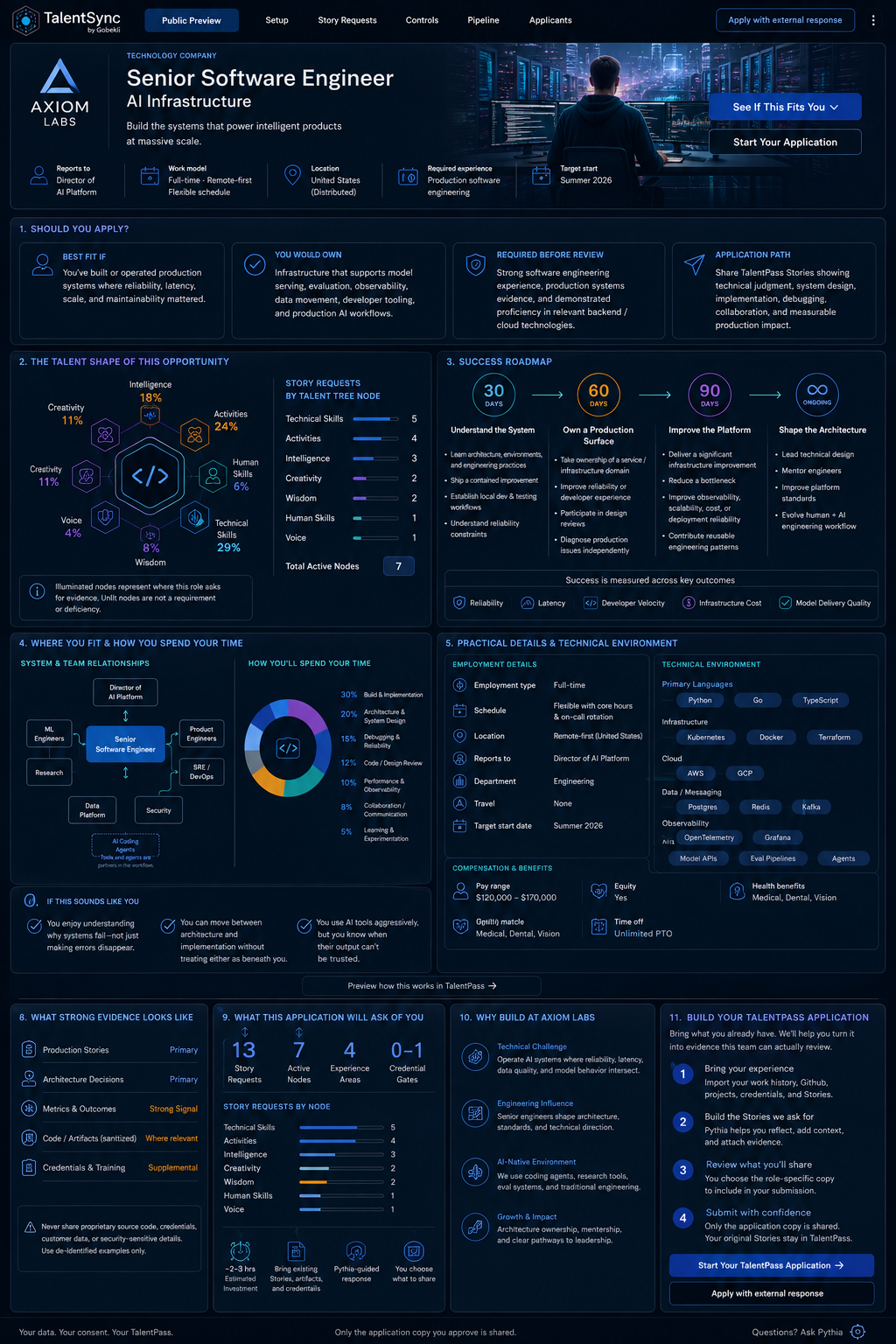
See the Engineering Challenge — Not Just the Tech Stack
Technical job listings often reduce engineering work to a long list of
languages, frameworks, and years of experience. That can make it hard for
candidates to understand what they would actually own — and hard for
employers to distinguish keyword overlap from demonstrated capability.
TalentSync Recruitment Profiles translate the role into
a clearer picture of the work itself: the systems to be built, the
outcomes that matter, the people and tools involved, and the evidence a
strong candidate should be able to show.
In this AI Infrastructure example, the profile makes the technical
environment visible alongside the broader shape of the role. Candidates
can see how time is expected to be distributed across implementation,
architecture, reliability, review, observability, collaboration, and
experimentation.
The Talent Tree shows that the opportunity is asking for
much more than Technical Skills alone. Story Requests also draw from
Activities, Intelligence, Creativity, Wisdom, Human Skills, and Voice —
reflecting the judgment, design thinking, communication, and collaboration
required to operate complex production systems.
Those requirements are translated into clear experience areas such as
production systems engineering, architecture and technical judgment,
AI-native engineering workflow, and engineering collaboration. Each area
can expand into specific Story Requests and examples of the kinds of
evidence that would make a candidate’s experience easier to understand.
The evidence model also recognizes that strong engineering proof can take
many forms. Production Stories, architecture decisions, operating metrics,
sanitized technical artifacts, repositories, technical writing, and
relevant credentials can all provide useful context — without requiring
candidates to expose proprietary code or confidential employer data.
TalentPass then helps the candidate turn what they already have into a
role-specific response. Existing work history, projects, technical
artifacts, credentials, and Stories can be reused; Pythia can help fill
missing context; and the applicant can review and choose exactly what to
share before submission.
The goal is not to replace engineering judgment with a score.
It is to make the role, the work, and the evidence clearer — so both
candidates and hiring teams can spend less time interpreting keywords and
more time understanding real capability.
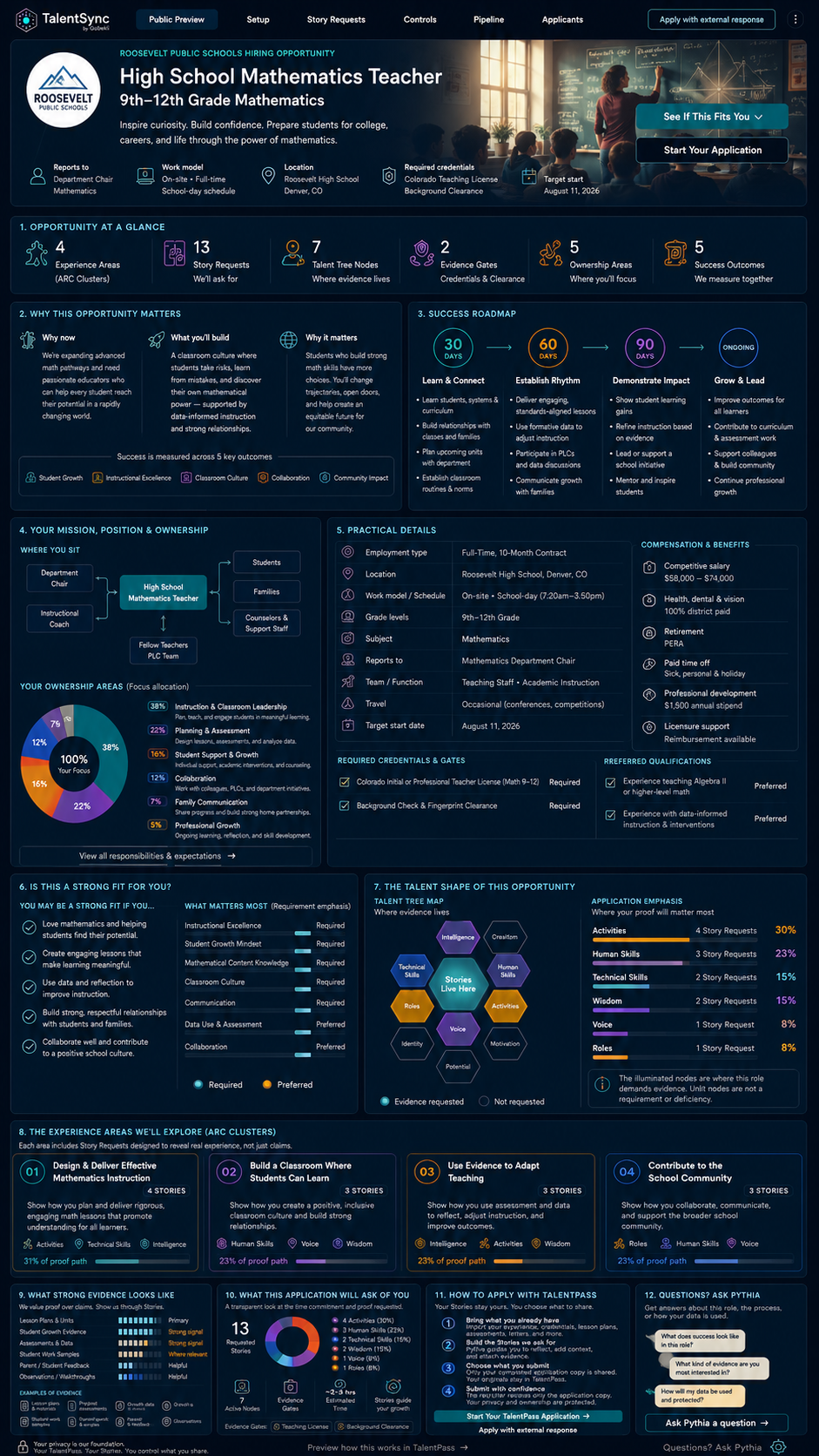
See What Teaching This Role Actually Requires
Teaching opportunities are often described through a mix of certification
requirements, classroom duties, curriculum expectations, and broad qualities
such as communication or classroom management. That can leave candidates
with only a partial picture of what the school is actually looking for.
TalentSync Recruitment Profiles turn those requirements into
a clearer view of the opportunity itself — what the teacher will own, how
success will be measured, where the role fits within the school community,
and what kinds of real experience would help demonstrate readiness.
In this High School Mathematics Teacher example, candidates can see the
opportunity context, practical employment details, reporting relationships,
expected areas of ownership, licensing requirements, and an early success
roadmap before deciding whether the role is a strong match.
The Talent Tree then shows where this opportunity is asking
for evidence. The complete Tree remains visible while the nodes most relevant
to the role are illuminated — including Activities, Human Skills, Technical
Skills, Intelligence, Wisdom, Voice, and Roles.
Those illuminated nodes are not ratings of the applicant. They represent
the parts of the Talent Tree where the opportunity will ask candidates to
share relevant Stories and evidence.
TalentSync groups those requests into clear
Experience Areas, or ARC clusters. In this example, the
school is looking for evidence of effective mathematics instruction,
classroom culture and student relationships, data-informed teaching, and
contribution to the wider school community.
Each Experience Area can generate specific Story Requests that ask candidates
to describe real situations, decisions, actions, and outcomes. Instead of
relying only on statements such as “strong classroom management” or
“data-driven educator,” the application asks candidates to show what those
capabilities have looked like in practice.
The profile also separates requirements from proof.
Credentials such as a teaching license or required background clearance can
be handled as evidence gates, while instructional judgment, communication,
collaboration, and student support are explored through work Stories and
supporting evidence.
Strong evidence may include lesson plans, student-growth examples,
assessment or instructional data, curriculum materials, professional
learning, parent or student feedback, and other appropriate artifacts —
while still allowing the candidate to control what information is shared.
TalentPass then gives the applicant a reusable way to respond. Existing
teaching experience, credentials, artifacts, and Stories can be brought
forward; Pythia can help develop missing context or evidence; and the
candidate can review the opportunity-specific application before submitting
it.
The goal is not to turn teaching into a checklist or score.
It is to help schools explain what they really need — and give educators a
clearer, fairer way to show the experience, judgment, and impact they can
bring to the classroom.
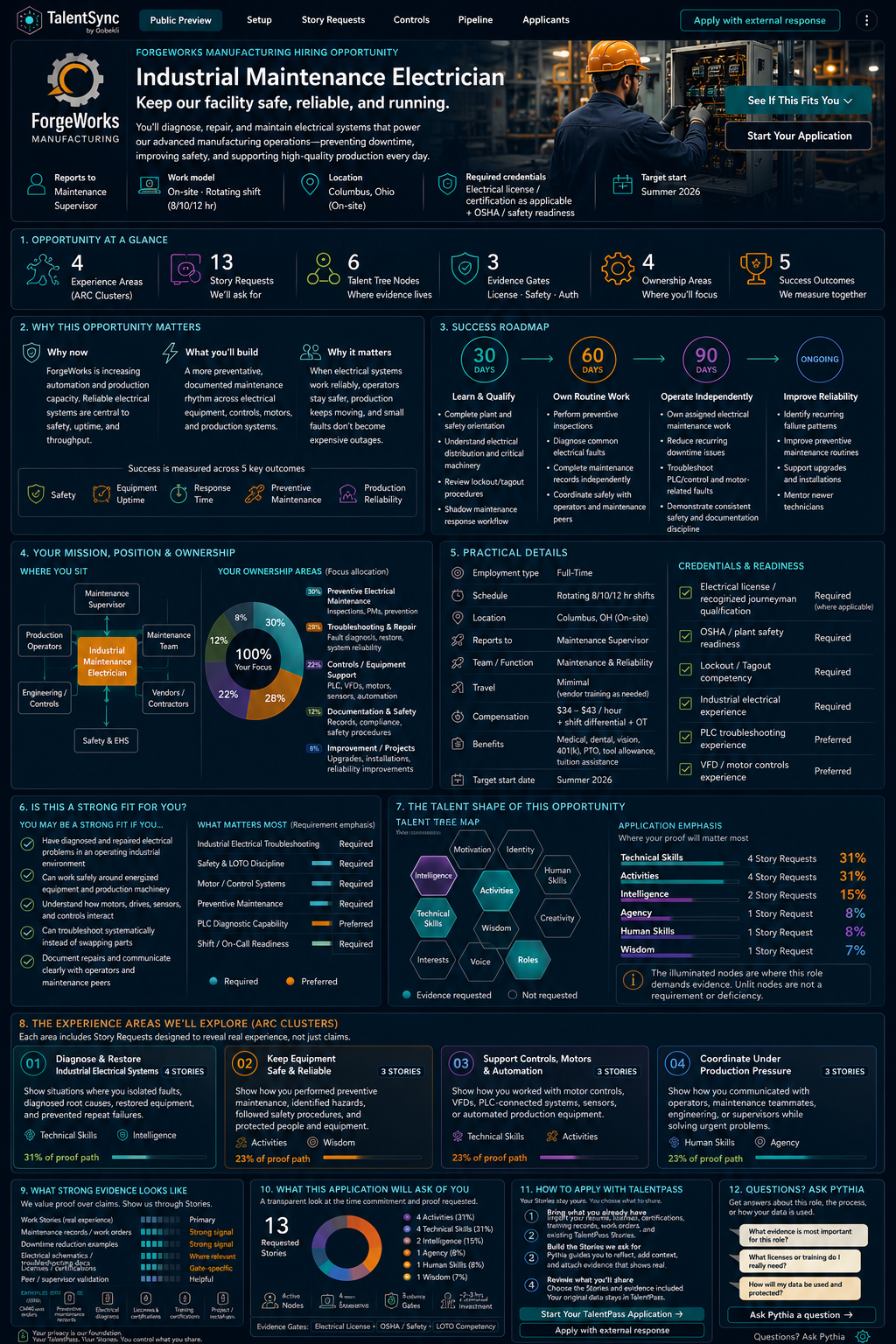
See the Work Behind the Job Title
Skilled-trades job listings often combine licensing requirements,
equipment experience, safety expectations, shift requirements, and a long
list of technical duties. Candidates may be able to tell whether they meet
the basic qualifications, but still have little visibility into what they
would actually own or what proof the employer cares about most.
TalentSync Recruitment Profiles turn those requirements
into a structured view of the opportunity itself — the work to be done,
the outcomes that matter, the operating environment, the evidence gates,
and the real experiences the employer wants candidates to demonstrate.
In this Industrial Maintenance Electrician example, the profile makes the
opportunity tangible before a candidate applies. It shows the reporting
relationship, shift structure, compensation, benefits, safety expectations,
credential requirements, ownership areas, and the success outcomes the
employer expects over the first 30, 60, and 90 days.
The Talent Tree provides a consistent visual language for
the role. The full Tree remains visible while the nodes where this
opportunity is asking for evidence are illuminated — including Technical
Skills, Activities, Intelligence, Agency, Human Skills, and Wisdom.
Those illuminated nodes are not candidate ratings. They show the areas of
the Talent Tree where the application will ask for relevant Stories and
evidence.
TalentSync then organizes the deeper requirements into
Experience Areas, or ARC clusters. In this example, the
employer is looking for evidence of industrial electrical troubleshooting,
preventive maintenance and safety, controls and automation support, and
coordination under production pressure.
Each Experience Area becomes a set of specific Story Requests. Instead of
asking candidates to simply claim that they can troubleshoot machinery or
work safely, the application asks them to describe situations where they
diagnosed a fault, made a decision, completed the work, protected people
and equipment, and produced a measurable or observable outcome.
The profile also separates evidence gates from experience
evidence. Licenses, safety qualifications, and required
certifications can be checked directly, while judgment, troubleshooting,
reliability, teamwork, and applied technical capability are demonstrated
through Stories.
Strong evidence can include maintenance records, work orders, downtime
reductions, preventive-maintenance documentation, electrical diagrams,
relevant certifications, supervisor validation, or other appropriate
artifacts — without requiring candidates to expose confidential plant
information or proprietary documentation.
The application-effort section makes the process transparent before the
candidate starts. Applicants can see how many Story Requests the role
contains, which Talent Tree nodes are involved, which evidence gates must
be satisfied, and approximately how much time the application may take.
TalentPass then allows candidates to reuse what they already have.
Existing work history, credentials, training records, and Stories can be
brought into the application; Pythia can help develop missing context or
evidence; and the candidate reviews exactly what will be shared before
submitting the opportunity-specific profile.
The goal is not to turn skilled work into a checklist.
It is to make the opportunity easier to understand and give experienced
tradespeople a better way to show what they have actually done — safely,
reliably, and in context.
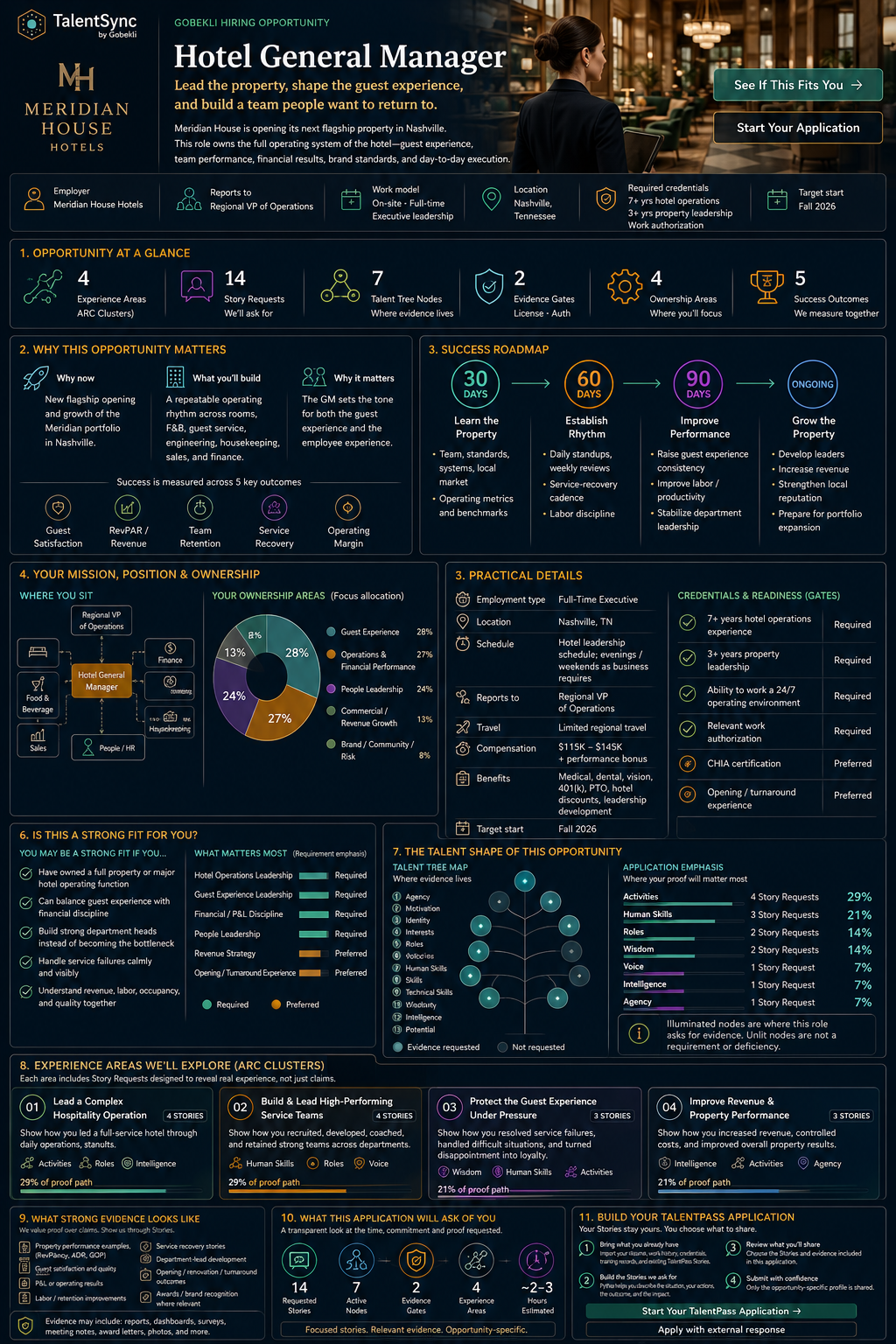
See the Whole Property — Not Just the Job Description
Hotel General Manager roles are often described through a long mix of
operations, guest service, revenue, staffing, brand standards, and
financial responsibilities. That can make it difficult for candidates to
understand what they would actually own — and difficult for employers to
show what great performance really looks like.
TalentSync Recruitment Profiles turn those expectations
into a structured view of the opportunity itself: why the role exists,
what the leader will own, how success will be measured, where the role
fits inside the operating system of the property, and what kinds of real
experience would demonstrate strong fit.
In this Hotel General Manager example, candidates can see the property
context, reporting relationship, compensation, schedule expectations,
leadership scope, ownership areas, and early success roadmap before they
decide whether to apply.
The profile also makes the balance of the role visible. Guest experience,
operating performance, people leadership, commercial growth, and brand or
community responsibilities are shown together so candidates can see how
the job actually distributes attention and accountability.
The Talent Tree then shows where the opportunity is asking
for evidence. The complete Tree remains visible while the nodes most
relevant to the role are illuminated — including Activities, Human Skills,
Roles, Wisdom, Voice, Intelligence, and Agency.
Those illuminated nodes are not ratings of a candidate. They show the
areas of the Talent Tree where this opportunity will ask applicants to
share relevant Stories and evidence.
TalentSync groups those requests into
Experience Areas, or ARC clusters. In this example, the
employer is looking for evidence of leading a complex hospitality
operation, building high-performing service teams, protecting the guest
experience under pressure, and improving revenue and property performance.
Each Experience Area becomes a set of specific Story Requests. Instead of
relying only on claims like “strong leader” or “guest-focused operator,”
the application asks candidates to show situations where they led people,
made decisions, handled service failures, improved operations, and created
measurable outcomes.
Strong evidence may include property performance results, guest
satisfaction metrics, P&L outcomes, labor or retention improvements,
service-recovery examples, department-lead development, opening or
turnaround results, and other appropriate supporting artifacts.
The application-effort section also makes the process transparent.
Candidates can see how many Story Requests the opportunity contains, which
Talent Tree nodes are involved, how many Experience Areas will be explored,
which evidence gates apply, and how much time the response is expected to
take.
TalentPass then gives candidates a reusable way to respond. Existing work
history, achievements, credentials, and Stories can be brought forward;
Pythia can help build missing context or evidence; and the applicant can
review exactly what will be shared before submitting the
opportunity-specific profile.
The goal is not to reduce hospitality leadership to a score.
It is to make the opportunity clearer, make strong experience easier to
recognize, and help both candidates and employers see the real operating
story behind the role.

See What Readiness Really Requires
Emergency management roles are often described through a mix of planning, coordination, incident response, exercises, compliance, and community preparedness. That can make it difficult for candidates to see what the job actually demands — and difficult for public-sector employers to explain what strong readiness looks like before an incident happens.
TalentSync Recruitment Profiles turn those expectations into a structured view of the opportunity itself: why the role exists, what the coordinator will own, how success will be measured, where the role fits across agencies, and what kinds of real experience would demonstrate strong fit.
In this Emergency Management Coordinator example, candidates can see the reporting relationship, work model, location, activation expectations, compensation, benefits, credential requirements, ownership areas, and a 30-60-90-day success roadmap before deciding whether to apply.
The role is also shown as part of a broader operating system. Fire and EMS, police, public works, public health, communications, utilities, city leadership, and community partners all connect to the coordinator, making the interagency nature of the work visible instead of leaving it buried in a job description.
The Talent Tree shows where this opportunity is asking for evidence. The full Tree remains visible while the nodes most relevant to the role are illuminated — including Activities, Human Skills, Roles, Wisdom, Voice, Intelligence, and Agency.
Those illuminated nodes are not candidate ratings. They show the areas of the Talent Tree where the application will ask candidates to share relevant Stories and evidence.
TalentSync then organizes the deeper requirements into Experience Areas, or ARC clusters. In this example, the role asks for evidence of preparing systems before a crisis, coordinating people under pressure, communicating clearly during uncertainty, and turning incidents into stronger systems.
Each Experience Area becomes a set of specific Story Requests. Instead of asking candidates to simply claim that they are calm under pressure or strong collaborators, the application asks them to show situations where they prepared, coordinated, communicated, made decisions, responded to changing conditions, and improved the system afterward.
The profile also separates evidence gates from experience evidence. Required coursework, certifications, licenses, and other readiness conditions can be handled directly, while judgment, communication, coordination, planning, and after-action learning are demonstrated through Stories.
Strong evidence may include emergency plans, exercise materials, after-action reports, improvement plans, incident coordination examples, training records, public communication artifacts, interagency project outcomes, and other appropriate supporting documentation.
The application-effort section makes the process transparent. Candidates can see the number of Story Requests, the active Talent Tree nodes, the number of Experience Areas, the evidence gates, and the approximate time required before they begin.
TalentPass then gives the applicant a reusable way to respond. Existing experience, credentials, training, and Stories can be brought forward; Pythia can help develop missing context or evidence; and the applicant can review exactly what will be shared before submitting the opportunity-specific profile.
The goal is not to turn public service into a checklist. It is to make preparedness, judgment, coordination, and evidence easier to understand — so candidates can show how they have actually helped people, teams, and systems perform when it matters most.

See the Operating Reality Behind the Supervisor Title
Distribution and warehouse leadership roles are often described through a long list of responsibilities: staffing, safety, throughput, quality, inventory, coaching, scheduling, and problem-solving. What is often missing is a clear picture of how those responsibilities fit together and what evidence would actually demonstrate strong performance.
TalentSync Recruitment Profiles turn those requirements into a structured view of the opportunity itself — why the role exists, what the supervisor will own, how success will be measured, where the role fits in the operating system, and what kinds of real experience would help demonstrate readiness.
In this Distribution Center Operations Supervisor example, candidates can see the shift structure, team size, reporting relationship, location, compensation, benefits, readiness requirements, ownership areas, and a 30-60-90-day success roadmap before deciding whether to apply.
The profile also makes the operating balance of the role visible. People leadership, workflow and throughput, safety and quality, problem-solving, and continuous improvement are shown together so candidates can understand how attention and accountability are distributed across the shift.
The Talent Tree then shows where this opportunity is asking for evidence. The full Tree remains visible while the nodes most relevant to the role are illuminated — including Activities, Human Skills, Roles, Intelligence, Wisdom, and Agency.
Those illuminated nodes are not ratings of the applicant. They show the areas of the Talent Tree where the opportunity will ask candidates to share relevant Stories and evidence.
TalentSync organizes those deeper requirements into Experience Areas, or ARC clusters. In this example, the employer is looking for evidence of leading a high-volume shift, protecting safety and quality under pressure, solving operational bottlenecks, and coaching people while building accountability.
Each Experience Area becomes a set of specific Story Requests. Instead of asking candidates to simply claim that they are good leaders or strong problem-solvers, the application asks them to describe situations where they allocated labor, handled changing volume, corrected safety or quality issues, solved workflow problems, coached team members, and produced measurable outcomes.
Strong evidence may include productivity metrics, safety records, quality improvements, shift reports, staffing plans, process-change examples, coaching outcomes, team-retention improvements, recognition, or other appropriate operational artifacts.
The application-effort section also makes the process transparent. Candidates can see how many Story Requests the opportunity contains, which Talent Tree nodes are active, how many Experience Areas will be explored, which evidence gates apply, and approximately how much time the application is expected to take.
TalentPass then gives applicants a reusable way to respond. Existing work history, achievements, credentials, and Stories can be brought forward; Pythia can help develop missing context or evidence; and the applicant can review exactly what will be shared before submitting the opportunity-specific profile.
The goal is not to turn frontline leadership into a score. It is to make the real operating demands of the role easier to understand and give experienced supervisors a better way to show how they have led people, protected safety, solved problems, and delivered reliable results.
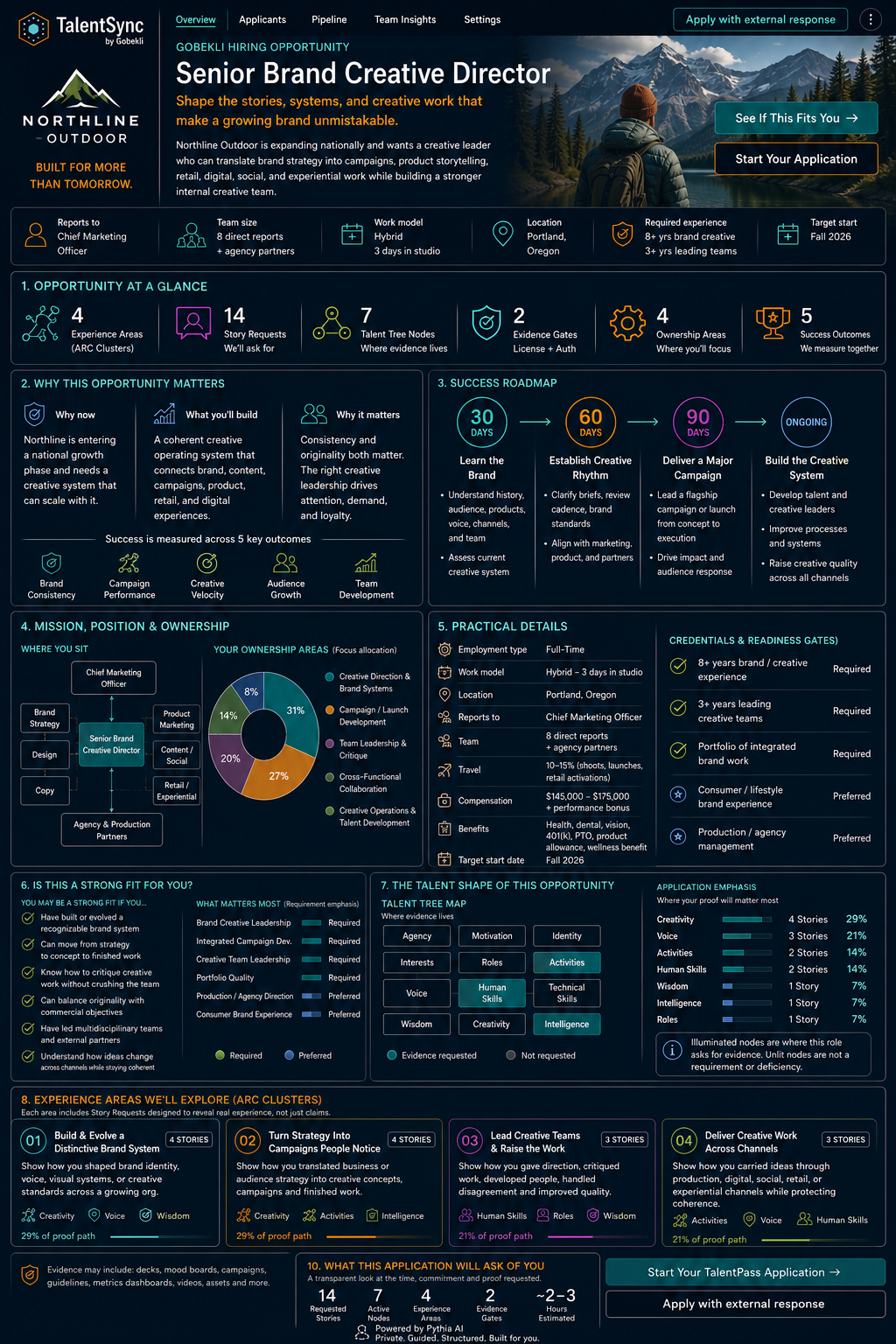
See the Creative System Behind the Title
Senior creative roles are often described through broad phrases like “brand leadership,” “creative vision,” or “strong storytelling.” Those phrases may sound impressive, but they do not always tell candidates what they will actually own, how the work gets made, or what evidence the employer really wants to see.
TalentSync Recruitment Profiles turn those expectations into a structured view of the opportunity itself — why the role exists, what the creative leader will own, how success will be measured, where the role sits within the organization, and what kinds of real work would help demonstrate strong fit.
In this Senior Brand Creative Director example, candidates can see the reporting relationship, team structure, work model, compensation, travel, portfolio requirements, ownership areas, and a 30-60-90-day success roadmap before deciding whether to apply.
The profile also shows how the role balances creative direction, campaign development, team leadership, cross-functional collaboration, and creative operations. That makes the shape of the job visible instead of leaving it hidden inside a long list of responsibilities.
The Talent Tree then shows where this opportunity is asking for evidence. The full Tree remains visible while the nodes most relevant to the role are illuminated — including Creativity, Voice, Activities, Human Skills, Wisdom, Intelligence, and Roles.
Those illuminated nodes are not ratings of the applicant. They show the areas of the Talent Tree where the opportunity will ask candidates to share relevant Stories and evidence.
TalentSync organizes the deeper requirements into Experience Areas, or ARC clusters. In this example, the employer is looking for evidence of building or evolving a distinctive brand system, translating strategy into campaigns, leading creative teams, and carrying creative work across channels.
Each Experience Area becomes a set of specific Story Requests. Instead of simply asking candidates to claim that they are strategic, creative, or strong leaders, the application asks them to show situations where they shaped a brand, developed a campaign, directed a team, made creative decisions, navigated constraints, and produced meaningful outcomes.
Strong evidence may include portfolio case studies, campaign work, brand systems, creative briefs, launch materials, before-and-after brand evolution, audience-growth data, commercial results, team-development outcomes, and other appropriate supporting artifacts.
This profile also demonstrates how TalentSync can support portfolio-driven roles without changing the overall recruitment structure. Portfolio evidence becomes a major signal, while the opportunity still uses the same Story Requests, Talent Tree nodes, Experience Areas, evidence gates, and application framework as other professions.
The application-effort section makes the process transparent before the candidate begins. Applicants can see how many Story Requests the role contains, which Talent Tree nodes are active, how many Experience Areas will be explored, which evidence gates apply, and approximately how much time the response is expected to take.
TalentPass then gives candidates a reusable way to respond. Existing work history, portfolio pieces, case studies, credentials, and Stories can be brought forward; Pythia can help add context, decisions, contribution, and outcomes; and the candidate reviews exactly what will be shared before submitting the opportunity-specific profile.
The goal is not to reduce creativity to a score. It is to make creative expectations clearer and give candidates a stronger way to show the thinking, judgment, leadership, craft, and impact behind the finished work.
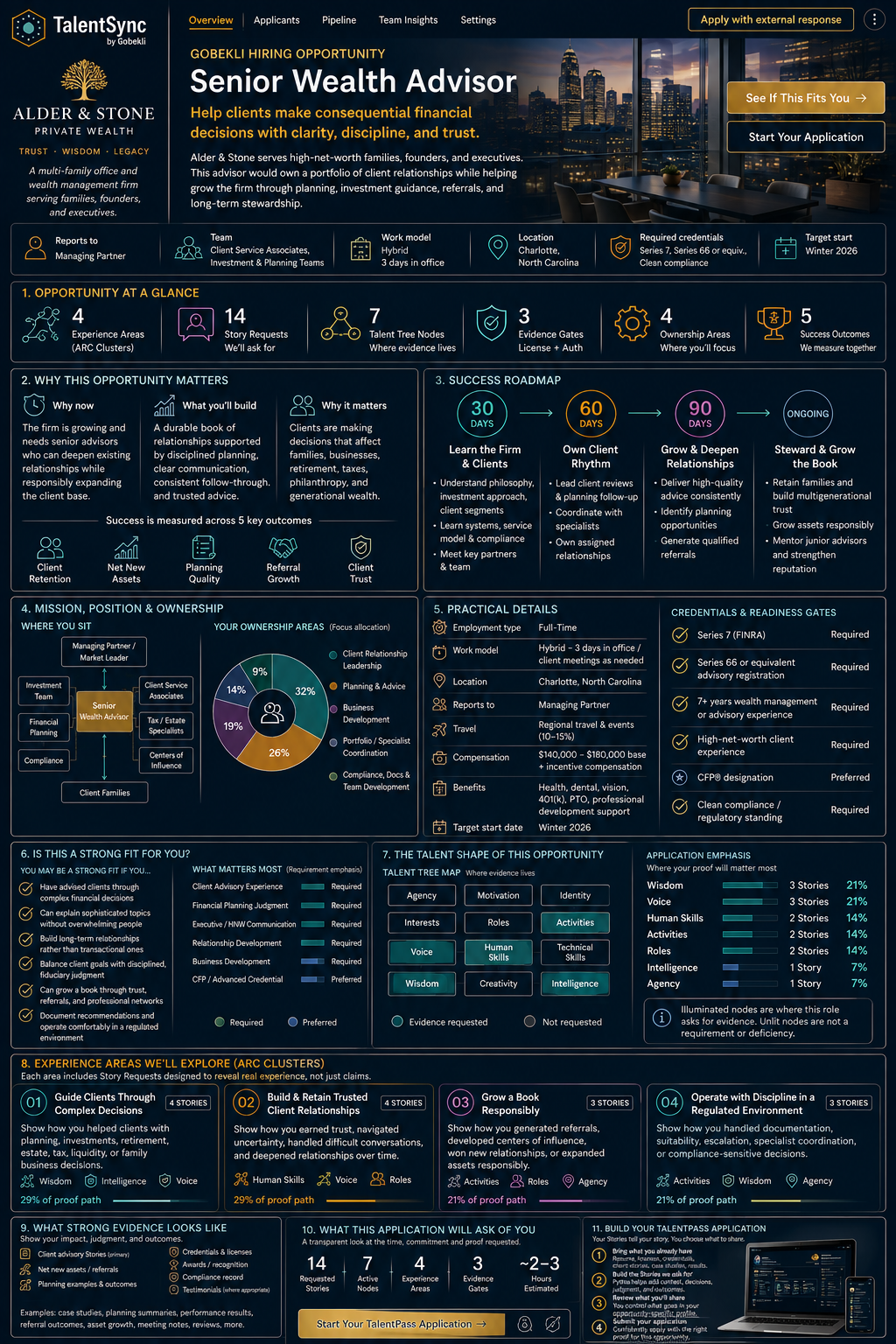
See the Judgment Behind the Advisory Role
Wealth-management opportunities are often described through licenses, production expectations, years of experience, and broad statements about relationship skills. What is harder to see is how much the role depends on judgment, trust, communication, stewardship, and the ability to guide clients through consequential decisions.
TalentSync Recruitment Profiles turn those expectations into a structured view of the opportunity itself — why the role exists, what the advisor will own, how success will be measured, where the role fits within the firm, and what kinds of real experience would demonstrate strong fit.
In this Senior Wealth Advisor example, candidates can see the reporting relationship, client-facing work model, compensation structure, licensing requirements, ownership areas, team relationships, and a 30-60-90-day success roadmap before deciding whether to apply.
The profile also makes the balance of the role visible. Client relationship leadership, planning and advice, business development, specialist coordination, compliance, and team development are shown together so the opportunity is easier to understand than a traditional list of duties.
The Talent Tree then shows where this opportunity is asking for evidence. The full Tree remains visible while the nodes most relevant to the role are illuminated — including Wisdom, Voice, Human Skills, Activities, Roles, Intelligence, and Agency.
Those illuminated nodes are not ratings of the applicant. They show the areas of the Talent Tree where the opportunity will ask candidates to share relevant Stories and evidence.
TalentSync organizes the deeper requirements into Experience Areas, or ARC clusters. In this example, the firm is looking for evidence of guiding clients through complex financial decisions, building and retaining trusted relationships, growing a book responsibly, and operating with discipline in a regulated environment.
Each Experience Area becomes a set of specific Story Requests. Instead of asking candidates to simply claim that they are trusted advisors or strong relationship builders, the application asks them to show situations where they interpreted complex information, exercised judgment, communicated recommendations, navigated uncertainty, grew relationships, and produced meaningful client outcomes.
The profile also separates credential gates from experience evidence. Licenses, advisory registrations, professional designations, and regulatory standing can be handled directly, while judgment, communication, relationship development, and stewardship are demonstrated through Stories.
Strong evidence may include client advisory case studies, planning outcomes, referral or business-development results, asset-growth examples, professional credentials, complex-case summaries, centers-of-influence development, team mentoring, and other appropriate evidence that can be shared without exposing sensitive client information.
The application-effort section makes the process transparent before the candidate begins. Applicants can see how many Story Requests the role contains, which Talent Tree nodes are active, how many Experience Areas will be explored, which evidence gates apply, and approximately how much time the response is expected to take.
TalentPass then gives candidates a reusable way to respond. Existing work history, licenses, credentials, achievements, and Stories can be brought forward; Pythia can help add context, judgment, decisions, and outcomes; and the candidate can review exactly what will be shared before submitting the opportunity-specific profile.
The goal is not to reduce financial advice to a score. It is to make trust, judgment, evidence, and client impact easier to see — while giving candidates a clearer way to demonstrate the quality of the work behind their credentials and production history.
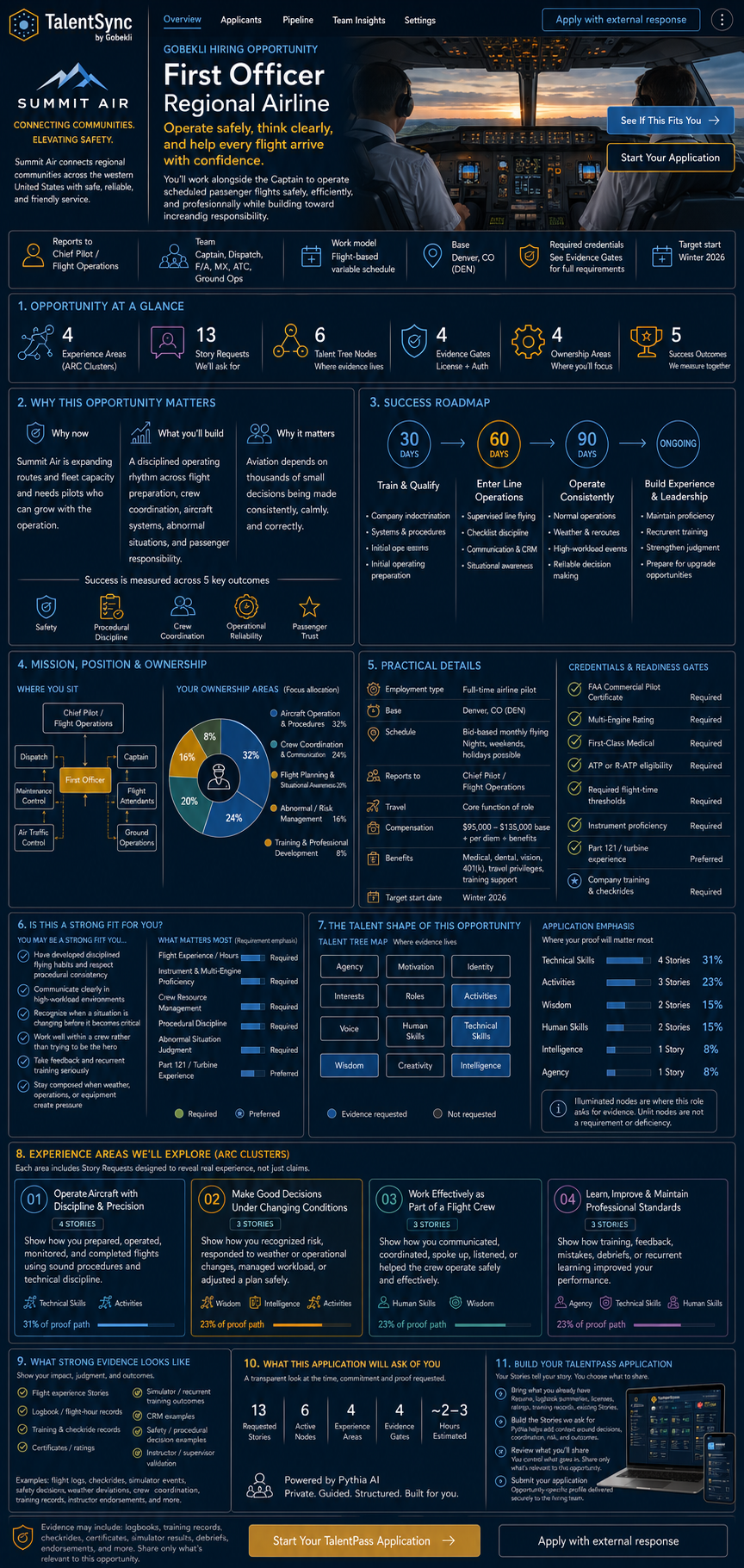
See the Judgment Behind the Flight Hours
Airline pilot opportunities are often defined through certificates, ratings, medical requirements, and flight-hour thresholds. Those are essential gates, but they do not fully show how a pilot actually operates — how they make decisions, work with a crew, respond to changing conditions, or maintain disciplined standards over time.
TalentSync Recruitment Profiles turn those requirements into a structured view of the opportunity itself — why the role exists, what the First Officer will own, how success will be measured, where the role fits within flight operations, and what kinds of real experience would demonstrate readiness.
In this Summit Air First Officer example, candidates can see the base, reporting relationship, schedule model, compensation, benefits, required credentials, ownership areas, and a 30-60-90-day success roadmap before deciding whether to apply.
The profile also makes the operating environment visible. The First Officer works alongside the Captain while coordinating with dispatch, flight attendants, maintenance control, ground operations, and air traffic control. That broader system matters because safe airline operations depend on coordinated decisions across many people and functions.
The Talent Tree then shows where this opportunity is asking for evidence. The full Tree remains visible while the nodes most relevant to the role are illuminated — including Technical Skills, Activities, Wisdom, Human Skills, Intelligence, and Agency.
Those illuminated nodes are not ratings of the applicant. They show the areas of the Talent Tree where the opportunity will ask candidates to share relevant Stories and evidence.
TalentSync organizes the deeper requirements into Experience Areas, or ARC clusters. In this example, the airline is looking for evidence of disciplined aircraft operation, sound decision-making under changing conditions, effective crew coordination, and continuous learning through training, feedback, and recurrent standards.
Each Experience Area becomes a set of specific Story Requests. Instead of relying only on flight-hour totals or broad claims about judgment, the application asks candidates to describe real situations where they prepared, operated, monitored, coordinated, recognized risk, adjusted to changing conditions, communicated with others, and learned from experience.
This profile also makes an important distinction between credential gates and experience evidence. Certificates, ratings, medical status, ATP or R-ATP eligibility, and required flight-time thresholds can be verified directly, while procedural discipline, crew resource management, situational judgment, and professional growth are demonstrated through Stories.
Strong evidence may include flight logs, certificates and ratings, checkride history, training records, simulator or recurrent-training outcomes, CRM examples, safety decisions, instructor endorsements, and other appropriate evidence that helps show how the pilot has actually operated.
The application-effort section makes the process transparent before the candidate begins. Applicants can see how many Story Requests the opportunity contains, which Talent Tree nodes are active, how many Experience Areas will be explored, how many evidence gates apply, and approximately how much time the response is expected to take.
TalentPass then gives applicants a reusable way to respond. Existing work history, logbook summaries, licenses, ratings, training records, and Stories can be brought forward; Pythia can help add context around decisions, coordination, risk, and outcomes; and the candidate can review exactly what will be shared before submitting the opportunity-specific profile.
The goal is not to reduce professional flying to a set of numbers. It is to combine the credentials aviation requires with better visibility into the judgment, discipline, teamwork, and learning that make those credentials meaningful in practice.
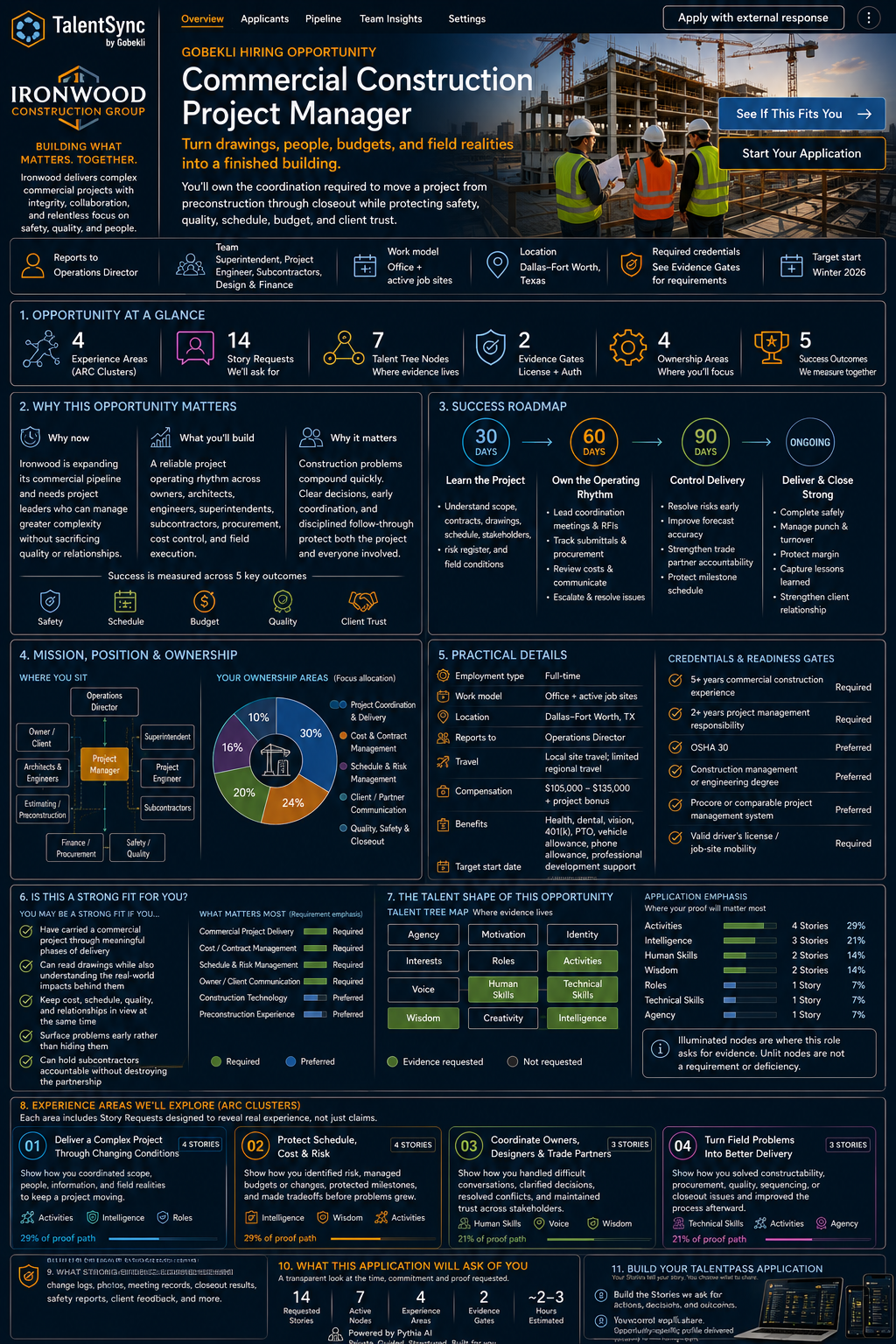
See the Project Behind the Job Title
Construction Project Manager roles are often described through schedules, budgets, RFIs, submittals, subcontractors, safety, and client coordination. What can be harder to see is how all of those responsibilities interact — and what strong project leadership actually looks like when conditions change in the field.
TalentSync Recruitment Profiles turn those expectations into a structured view of the opportunity itself — why the role exists, what the Project Manager will own, how success will be measured, where the role fits across the project team, and what kinds of real experience would demonstrate readiness.
In this Ironwood Construction Group example, candidates can see the reporting relationship, project environment, compensation, benefits, readiness requirements, ownership areas, key stakeholders, and a 30-60-90-day success roadmap before deciding whether to apply.
The profile also makes the operating system of the project visible. The Project Manager sits between owners, architects, engineers, superintendents, project engineers, subcontractors, estimating, procurement, finance, safety, and quality — helping candidates understand the coordination burden behind the title.
The Talent Tree then shows where this opportunity is asking for evidence. The full Tree remains visible while the nodes most relevant to the role are illuminated — including Activities, Intelligence, Human Skills, Wisdom, Roles, Technical Skills, and Agency.
Those illuminated nodes are not ratings of the applicant. They show the areas of the Talent Tree where the opportunity will ask candidates to share relevant Stories and evidence.
TalentSync organizes the deeper requirements into Experience Areas, or ARC clusters. In this example, the employer is looking for evidence of delivering complex projects through changing conditions, protecting schedule and cost, coordinating owners and trade partners, and turning field problems into better project delivery.
Each Experience Area becomes a set of specific Story Requests. Instead of simply asking candidates to claim that they are organized or strong project leaders, the application asks them to show situations where they managed scope, resolved risk, coordinated stakeholders, protected milestones, controlled cost, handled tradeoffs, and produced measurable project outcomes.
Strong evidence may include project schedules, cost reports, change-order examples, RFI or submittal records, project photos, coordination records, closeout results, safety and quality outcomes, client recognition, and other appropriate project artifacts.
The profile also separates readiness gates from experience evidence. Years of commercial construction experience, project responsibility, licenses, required mobility, and relevant training can be handled as qualification gates, while project judgment, coordination, problem-solving, and delivery are demonstrated through Stories.
The application-effort section makes the process transparent before the candidate begins. Applicants can see how many Story Requests the opportunity contains, which Talent Tree nodes are active, how many Experience Areas will be explored, how many evidence gates apply, and approximately how much time the response is expected to take.
TalentPass then gives candidates a reusable way to respond. Existing work history, project lists, credentials, project artifacts, and Stories can be brought forward; Pythia can help add context around constraints, stakeholders, decisions, actions, and outcomes; and the candidate can review exactly what will be shared before submitting the opportunity-specific profile.
The goal is not to reduce project leadership to a checklist. It is to make schedule, cost, judgment, coordination, and delivery easier to see — and give experienced construction professionals a clearer way to show how they have actually moved complex work from drawings to finished outcomes.
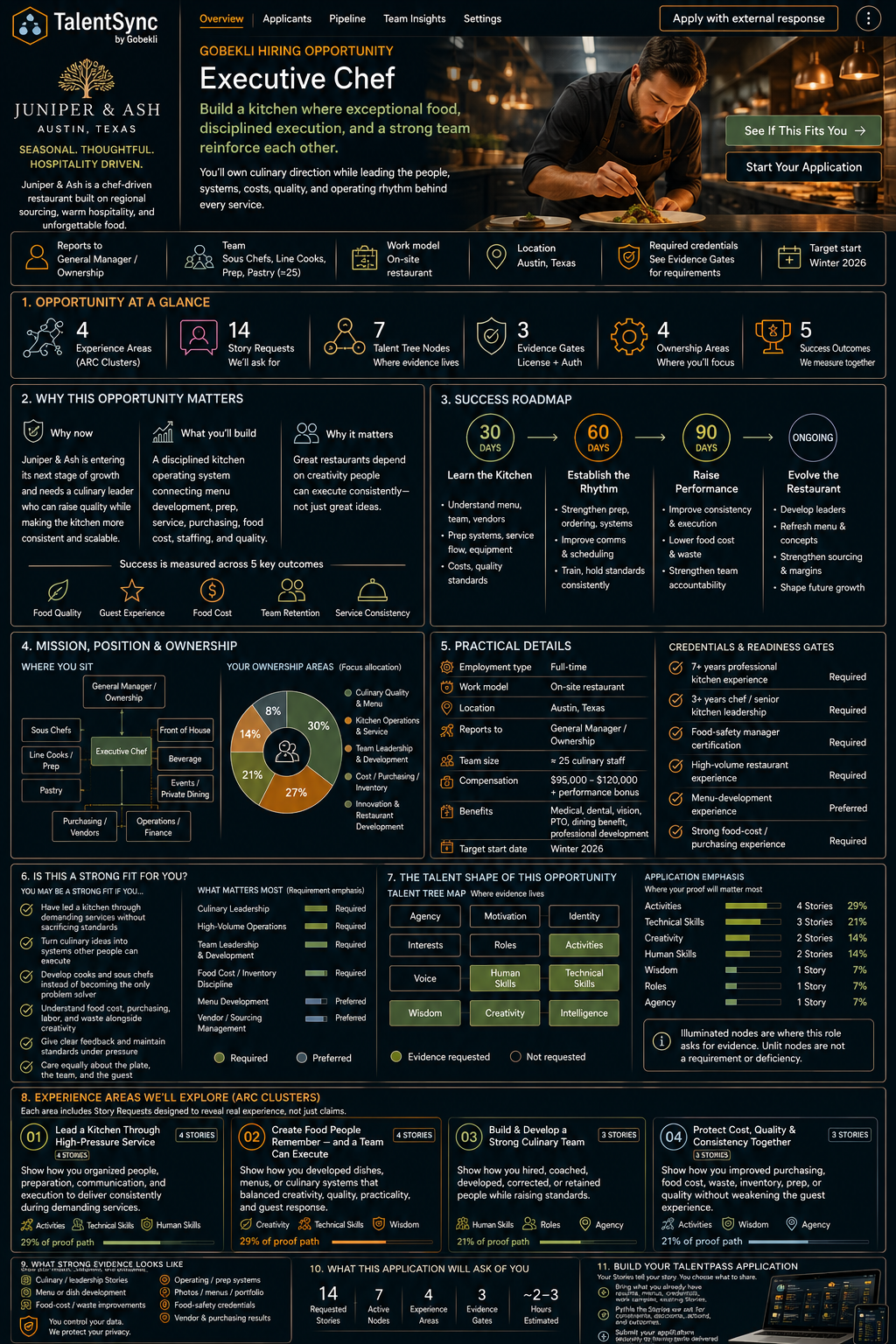
See the Kitchen System Behind the Chef Title
Executive Chef roles are often described through menu development, kitchen leadership, food cost, staffing, quality, and guest experience. What can be harder to see is how those responsibilities work together — and what strong culinary leadership actually looks like during a demanding service.
TalentSync Recruitment Profiles turn those expectations into a structured view of the opportunity itself — why the role exists, what the Executive Chef will own, how success will be measured, where the role fits across the restaurant, and what kinds of real experience would demonstrate readiness.
In this Juniper & Ash example, candidates can see the reporting relationship, team structure, schedule, compensation, benefits, food-safety requirements, ownership areas, and a 30-60-90-day success roadmap before deciding whether to apply.
The profile also makes the operating balance of the role visible. Culinary quality, service execution, team leadership, food cost, purchasing, inventory, and restaurant development are shown together so candidates can understand the real shape of the job instead of reading a disconnected list of duties.
The Talent Tree then shows where this opportunity is asking for evidence. The full Tree remains visible while the nodes most relevant to the role are illuminated — including Activities, Technical Skills, Creativity, Human Skills, Wisdom, Roles, and Agency.
Those illuminated nodes are not ratings of the applicant. They show the areas of the Talent Tree where the opportunity will ask candidates to share relevant Stories and evidence.
TalentSync organizes the deeper requirements into Experience Areas, or ARC clusters. In this example, the restaurant is looking for evidence of leading a kitchen through high-pressure service, developing food a team can execute consistently, building a strong culinary team, and protecting cost, quality, and consistency at the same time.
Each Experience Area becomes a set of specific Story Requests. Instead of simply asking candidates to claim that they are creative, disciplined, or strong leaders, the application asks them to show situations where they organized service, developed menus, coached people, solved operational problems, managed costs, protected standards, and produced meaningful outcomes.
Strong evidence may include menus, dish-development examples, food-cost improvements, purchasing or waste reductions, prep systems, service improvements, training materials, guest-response data, team-development outcomes, food-safety credentials, and other appropriate culinary artifacts.
The profile also separates readiness gates from experience evidence. Food-safety certification, years of kitchen experience, and other baseline requirements can be handled directly, while judgment, leadership, creativity, consistency, and operating discipline are demonstrated through Stories.
The application-effort section makes the process transparent before the candidate begins. Applicants can see how many Story Requests the opportunity contains, which Talent Tree nodes are active, how many Experience Areas will be explored, how many evidence gates apply, and approximately how much time the response is expected to take.
TalentPass then gives candidates a reusable way to respond. Existing work history, menus, certifications, work samples, and Stories can be brought forward; Pythia can help add context around constraints, decisions, leadership, execution, and outcomes; and the candidate can review exactly what will be shared before submitting the opportunity-specific profile.
The goal is not to reduce culinary leadership to a checklist. It is to make craft, judgment, team leadership, consistency, and operating discipline easier to see — and give chefs a clearer way to show the work behind great service.
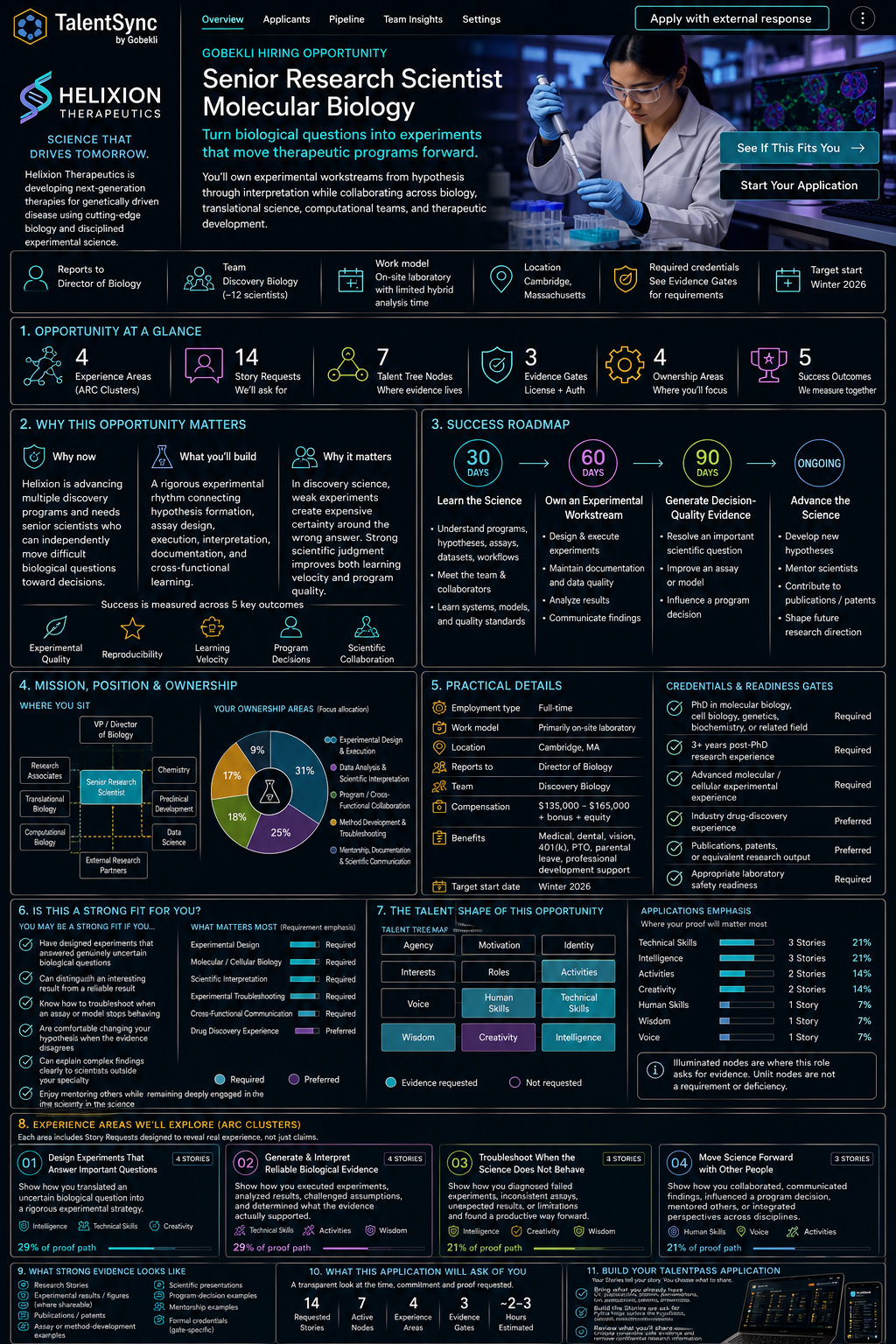
See the Scientific Judgment Behind the Credentials
Senior research roles are often described through degrees, publications, technical methods, and years of laboratory experience. Those signals matter, but they do not fully show whether a scientist can design a rigorous experiment, recognize weak evidence, troubleshoot a failing system, or move an uncertain scientific question toward a useful decision.
TalentSync Recruitment Profiles turn those expectations into a structured view of the opportunity itself — why the role exists, what the scientist will own, how success will be measured, where the role fits across the research organization, and what kinds of real experience would demonstrate readiness.
In this Helixion Therapeutics example, candidates can see the reporting relationship, scientific team, work model, compensation, benefits, research requirements, ownership areas, and a 30-60-90-day success roadmap before deciding whether to apply.
The profile also makes the operating system of the research role visible. The Senior Research Scientist works across discovery biology, translational science, computational biology, chemistry, preclinical development, data science, research associates, and external collaborators — showing how scientific impact depends on both individual depth and cross-functional learning.
The Talent Tree then shows where this opportunity is asking for evidence. The full Tree remains visible while the nodes most relevant to the role are illuminated — including Technical Skills, Intelligence, Activities, Wisdom, Creativity, Human Skills, and Voice.
Those illuminated nodes are not ratings of the applicant. They show the areas of the Talent Tree where the opportunity will ask candidates to share relevant Stories and evidence.
TalentSync organizes the deeper requirements into Experience Areas, or ARC clusters. In this example, the company is looking for evidence of designing experiments that answer important questions, generating and interpreting reliable biological evidence, troubleshooting when the science does not behave as expected, and moving scientific work forward with other people.
Each Experience Area becomes a set of specific Story Requests. Instead of simply asking candidates to claim that they are rigorous, innovative, or collaborative, the application asks them to show situations where they formed hypotheses, designed experiments, interpreted data, challenged assumptions, recovered from failure, influenced decisions, and improved the quality of the science.
The profile also separates credential gates from scientific evidence. A PhD, relevant research experience, laboratory safety readiness, and other baseline requirements can be handled directly, while experimental judgment, troubleshooting, interpretation, creativity, and collaboration are demonstrated through Stories.
Strong evidence may include publications, patents, scientific presentations, de-identified figures, assay-development examples, method-development summaries, program-decision examples, mentorship outcomes, and other candidate-safe scientific artifacts.
For research-intensive roles, the evidence boundary matters. Candidates should be able to demonstrate the quality of their work without exposing proprietary datasets, unpublished company IP, confidential protocols, or sensitive research materials.
The application-effort section makes the process transparent before the candidate begins. Applicants can see how many Story Requests the opportunity contains, which Talent Tree nodes are active, how many Experience Areas will be explored, how many evidence gates apply, and approximately how much time the response is expected to take.
TalentPass then gives candidates a reusable way to respond. Existing CV information, publications, patents, presentations, credentials, and Stories can be brought forward; Pythia can help add context around hypotheses, methods, decisions, interpretation, and outcomes; and the candidate can review exactly what will be shared before submitting the opportunity-specific profile.
The goal is not to reduce scientific capability to credentials or publication counts. It is to make experimental rigor, judgment, creativity, collaboration, and real scientific contribution easier to see — while giving researchers a stronger way to show how they actually move knowledge forward.
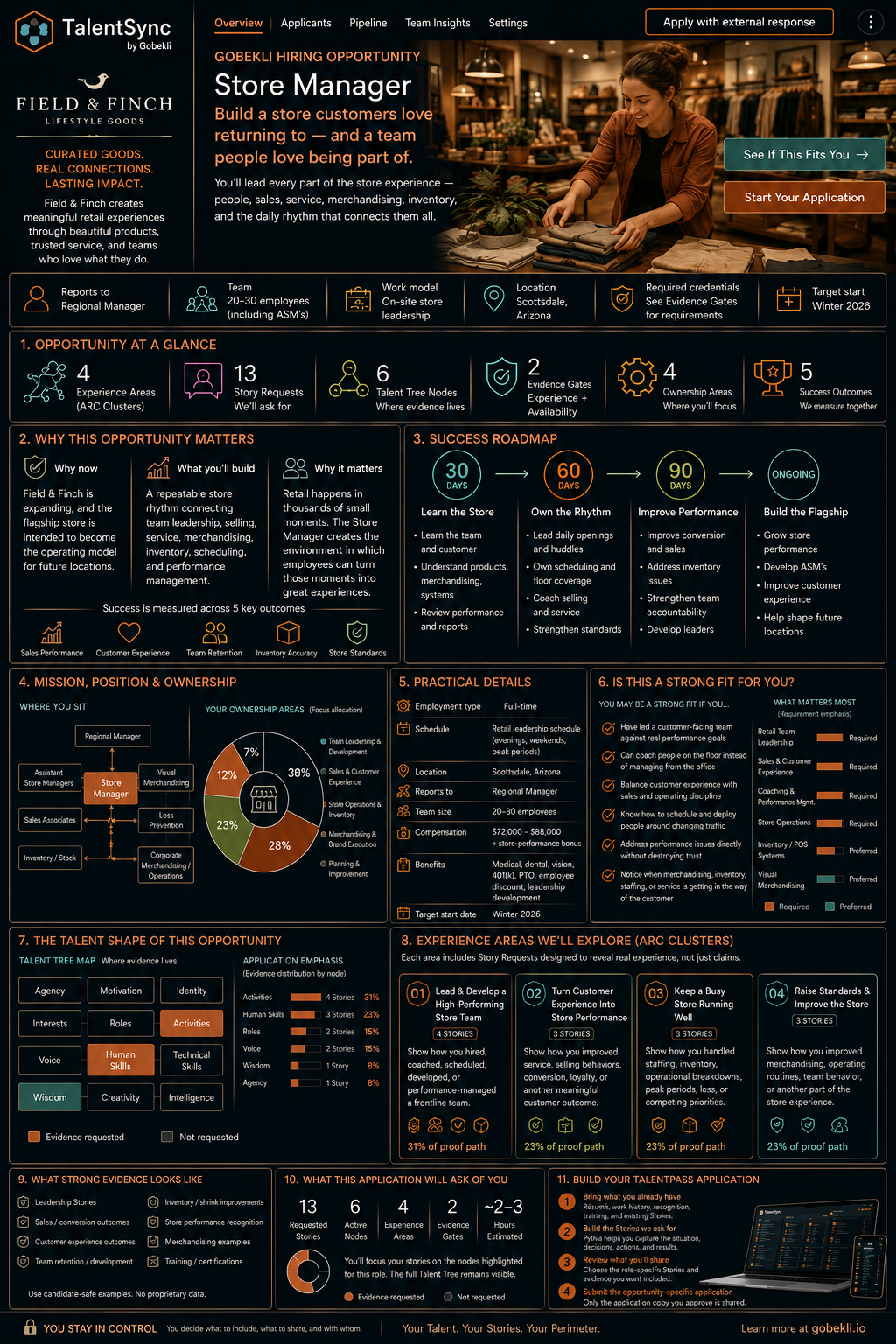
See the Store Leadership Behind the Title
Store Manager roles are often described through sales targets, staffing, customer service, merchandising, inventory, scheduling, and operations. What can be harder to see is how those responsibilities interact — and what strong frontline leadership actually looks like on a busy sales floor.
TalentSync Recruitment Profiles turn those expectations into a structured view of the opportunity itself — why the role exists, what the Store Manager will own, how success will be measured, where the role fits across the store, and what kinds of real experience would demonstrate readiness.
In this Field & Finch example, candidates can see the reporting relationship, team size, schedule expectations, compensation, benefits, readiness requirements, ownership areas, and a 30-60-90-day success roadmap before deciding whether to apply.
The profile also makes the balance of the role visible. Team leadership, sales and customer experience, store operations, inventory, merchandising, and continuous improvement are shown together so candidates can understand the real operating shape of the job instead of reading a disconnected list of duties.
The Talent Tree then shows where this opportunity is asking for evidence. The full Tree remains visible while the nodes most relevant to the role are illuminated — including Activities, Human Skills, Roles, Voice, Wisdom, and Agency.
Those illuminated nodes are not ratings of the applicant. They show the areas of the Talent Tree where the opportunity will ask candidates to share relevant Stories and evidence.
TalentSync organizes the deeper requirements into Experience Areas, or ARC clusters. In this example, the retailer is looking for evidence of leading and developing a frontline team, turning customer experience into store performance, keeping a busy store running well, and raising standards over time.
Each Experience Area becomes a set of specific Story Requests. Instead of simply asking candidates to claim that they are strong retail leaders, the application asks them to show situations where they coached people, improved sales or service, managed staffing, solved operational problems, handled inventory issues, raised standards, and produced measurable outcomes.
Strong evidence may include sales or conversion results, customer experience outcomes, team-development examples, retention improvements, inventory or shrink results, merchandising examples, store recognition, scheduling improvements, and other appropriate retail evidence.
The profile also separates readiness gates from experience evidence. Prior retail experience, management experience, and schedule availability can be handled as baseline requirements, while coaching, judgment, customer leadership, operational discipline, and improvement are demonstrated through Stories.
The application-effort section makes the process transparent before the candidate begins. Applicants can see how many Story Requests the opportunity contains, which Talent Tree nodes are active, how many Experience Areas will be explored, how many evidence gates apply, and approximately how much time the response is expected to take.
TalentPass then gives candidates a reusable way to respond. Existing work history, recognition, training, achievements, and Stories can be brought forward; Pythia can help add context around decisions, leadership, actions, and outcomes; and the candidate can review exactly what will be shared before submitting the opportunity-specific profile.
The goal is not to reduce retail leadership to a score. It is to make frontline judgment, team development, customer experience, and operating performance easier to see — and give experienced retail leaders a clearer way to show how they actually create strong stores.
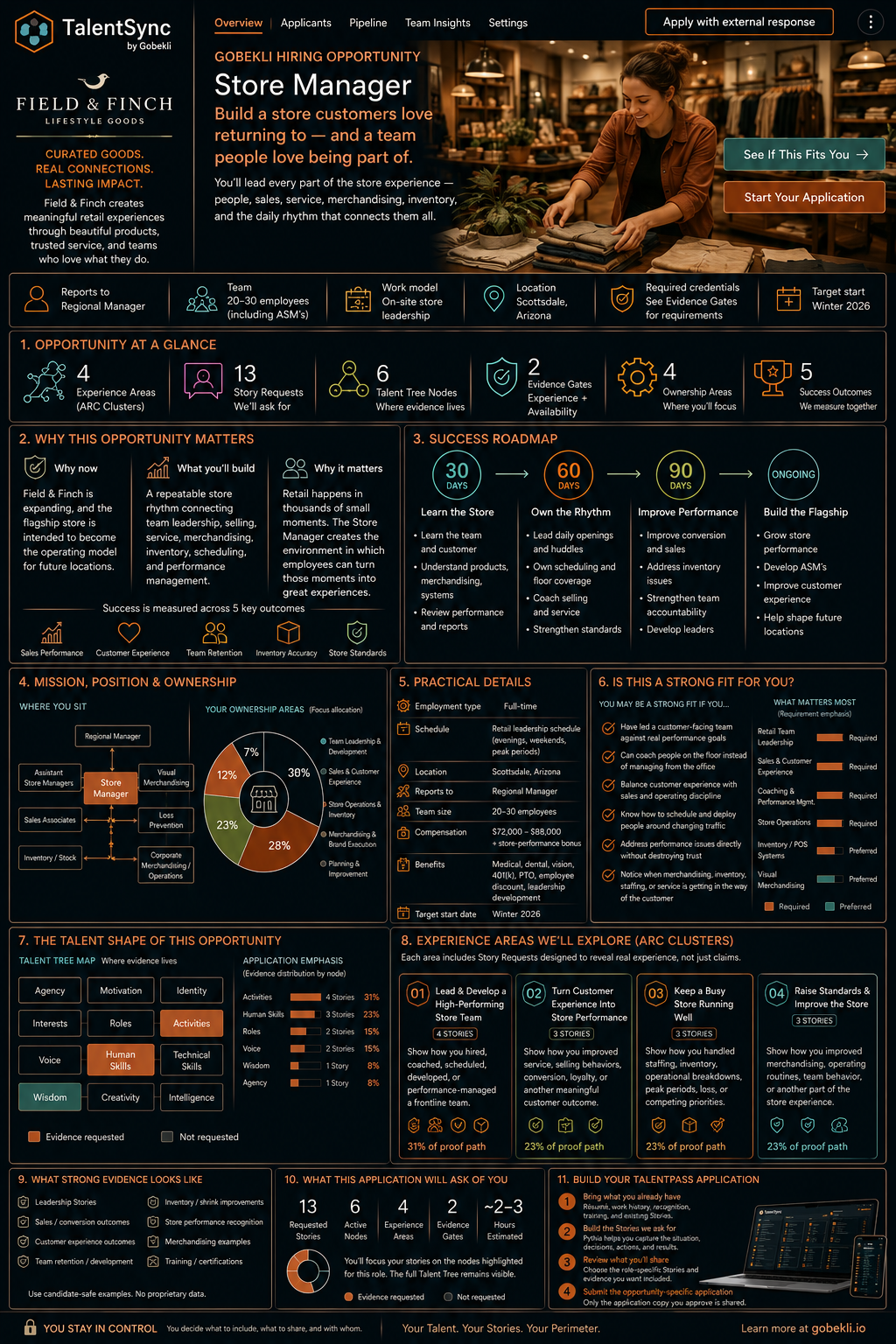
See the Judgment Behind the Legal Title
Senior legal roles are often described through years of practice, bar membership, contract experience, and broad statements about business partnership. Those signals matter, but they do not fully show how an attorney actually evaluates risk, communicates ambiguity, negotiates tradeoffs, or helps the business move forward responsibly.
TalentSync Recruitment Profiles turn those expectations into a structured view of the opportunity itself — why the role exists, what the attorney will own, how success will be measured, where the role fits across the business, and what kinds of real experience would demonstrate strong fit.
In this Meridian Technologies example, candidates can see the reporting relationship, hybrid work model, compensation, benefits, bar and experience requirements, ownership areas, and a 30-60-90-day success roadmap before deciding whether to apply.
The profile also makes the operating system of the legal role visible. Senior Corporate Counsel works across sales, product, security, privacy, finance, people operations, procurement, leadership, and outside counsel — showing how legal impact depends on both independent professional judgment and effective partnership with the business.
The Talent Tree then shows where this opportunity is asking for evidence. The full Tree remains visible while the nodes most relevant to the role are illuminated — including Wisdom, Voice, Intelligence, Activities, Human Skills, Roles, and Agency.
Those illuminated nodes are not ratings of the applicant. They show the areas of the Talent Tree where the opportunity will ask candidates to share relevant Stories and evidence.
TalentSync organizes the deeper requirements into Experience Areas, or ARC clusters. In this example, the company is looking for evidence of navigating complex commercial negotiations, turning legal risk into business decisions, partnering with the business without losing professional judgment, and building legal systems that scale.
Each Experience Area becomes a set of specific Story Requests. Instead of simply asking candidates to claim that they are pragmatic, strategic, or business-minded, the application asks them to show situations where they interpreted ambiguity, negotiated difficult issues, weighed alternatives, advised decision-makers, protected important interests, and improved how legal work gets done.
The profile also separates credential gates from experience evidence. A J.D., active bar membership, professional standing, and required years of experience can be handled directly, while judgment, negotiation, communication, business partnership, and legal-system design are demonstrated through Stories.
Strong evidence may include representative legal work Stories, negotiation outcomes, risk and decision examples, process improvements, executive or stakeholder outcomes, bar credentials, references, and candidate-safe examples of templates or playbooks where appropriate.
Confidentiality matters. Candidates should be able to demonstrate the quality of their work without sharing privileged communications, confidential client information, proprietary agreements, protected personal data, or other restricted materials.
The application-effort section makes the process transparent before the candidate begins. Applicants can see how many Story Requests the opportunity contains, which Talent Tree nodes are active, how many Experience Areas will be explored, how many evidence gates apply, and approximately how much time the response is expected to take.
TalentPass then gives candidates a reusable way to respond. Existing work history, credentials, representative matter descriptions, and Stories can be brought forward; Pythia can help add context around risk, alternatives, judgment, decisions, and outcomes; and the candidate can review exactly what will be shared before submitting the opportunity-specific profile.
The goal is not to reduce legal capability to credentials or deal counts. It is to make judgment, communication, risk management, business partnership, and real legal contribution easier to see — while preserving the confidentiality and professional boundaries the work requires.