
A PROGRAM RELEVANCE WORKSHOP MODULE
Work-to-Capability Translation: Align Programs With Real Work
Turn What People Do at Work Into Capabilities Your Program Can Actually Develop
Employers describe positions through job titles, responsibilities, technologies, qualifications, and skill lists. Educators organize learning through courses, outcomes, activities, and assessments.
The language on each side rarely connects cleanly.
Work-to-capability translation examines the activities people perform, the decisions they make, the conditions they navigate, and the results they must produce—then translates that evidence into capabilities a program can intentionally develop and make visible.
Workshop Module 7 — Work-to-Capability Translation
Does this sound familiar?
Employers ask for broad skills
Terms such as communication, leadership, problem-solving, digital literacy, and adaptability appear repeatedly without explaining what effective performance looks like.
Job titles hide different work
People with the same title may perform substantially different activities depending on the employer, industry, technology, team, customer, or operating environment.
Content is disconnected from action
Learners acquire knowledge but may not have enough opportunities to apply it through authentic decisions, tasks, and constraints.
Learning outcomes are difficult to interpret
Outcomes may use general verbs without identifying the context, quality, independence, or evidence expected.
Curriculum maps stop at skill labels
A program may claim to teach a skill without showing where learners practice it, how deeply they develop it, or what evidence demonstrates it.
Learners struggle to explain capability
Graduates can name courses and credentials but cannot easily translate those experiences into evidence relevant to employers or community partners.
What is work-to-capability translation?
Work-to-capability translation is the process of examining real or foreseeable work and converting it into clear, teachable, observable, and evidence-ready capability statements.
The process begins with the outcomes people support, the activities they perform, the decisions they make, the people and systems they work with, the conditions surrounding performance, and the evidence that would demonstrate effective contribution.
A capability describes what a person must be able to do—not merely what they should know or which job title they might hold. It may combine knowledge, technical skill, human judgment, communication, context, responsibility, and the ability to produce an appropriate result.
The goal is not to turn every job task into a course objective. It is to identify capabilities important, transferable, and developmentally appropriate enough to influence program design.
The problem is not a lack of skill lists. It is the missing translation between work and learning.
Skills frameworks, occupational databases, job postings, advisory-board conversations, and employer surveys can all provide useful signals.
But a list does not explain what people do with a skill, why it matters, where it is used, what it depends on, how much judgment is required, what level is appropriate, how it could be developed, or what evidence would make it visible.
For example, “communication” may involve explaining a technical decision to a client, documenting a safety incident, coordinating a multidisciplinary team, gathering requirements, or presenting evidence to a regulator. Those activities involve different contexts, standards, audiences, and consequences.
Translation makes those distinctions visible so programs can respond to the work rather than merely repeat the language surrounding it.
See the complete translation—not just the skill label.
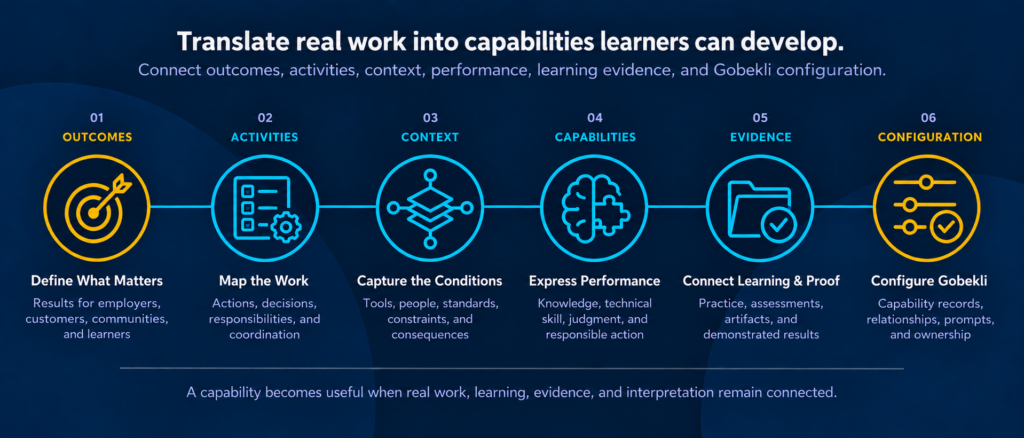
Work Outcomes
- Customer or community results
- Operational performance
- Quality and safety
- Service delivery
- Organizational value
Work Activities
- Analyze and interpret
- Create and produce
- Communicate and coordinate
- Operate and maintain
- Decide and respond
Conditions and Context
- Tools and technology
- People and relationships
- Standards and constraints
- Level of ambiguity
- Consequences of error
Capabilities
- Knowledge in use
- Technical performance
- Human judgment
- Transferable practices
- Responsible action
Learning and Evidence
- Learning outcomes
- Practice experiences
- Assessments
- Demonstrated artifacts
- Gobekli configuration
A useful capability statement connects an action to its purpose, context, expected quality, and observable evidence. That connection allows curriculum, assessment, learner evidence, and product configuration to reinforce one another.
How the translation gap takes hold
STAGE 1
Work is described through shorthand
Job titles, occupational codes, credentials, and broad skill terms are used as proxies for the activities people actually perform.
STAGE 2
Signals are copied into program language
Frequently requested skills are added to outcomes, course descriptions, or marketing without clarifying their meaning.
STAGE 3
Learning remains disconnected
Courses may address relevant content but do not consistently provide practice under the conditions associated with the capability.
STAGE 4
Evidence becomes difficult to interpret
Learners, educators, and employers cannot clearly see what was developed, how it was demonstrated, or whether it transfers.
Translate the work without reducing it to a checklist.
A work activity describes something a person does. A capability describes what enables the person to perform that activity appropriately across relevant conditions.
A useful translation asks several questions.
Clarify why the work matters and what result, decision, service, product, or stakeholder need it influences.
Describe observable actions rather than relying on a title, topic, trait, or abstract skill label.
Identify the concepts, procedures, standards, domain knowledge, and contextual understanding that inform performance.
Examine choices, tradeoffs, interpretation, escalation, prioritization, uncertainty, and consequences.
Consider tools, time pressure, collaboration, customer interaction, regulation, ambiguity, accessibility, and support.
Identify products, decisions, explanations, records, observations, simulations, performances, or results.
A strong capability statement explains more than an action verb.
Action
What the person must be able to do.
Object
What information, material, system, problem, person, or situation the action affects.
Purpose
What result or organizational outcome the activity supports.
Context
The tools, relationships, conditions, constraints, or environments surrounding performance.
Quality
The standards, criteria, accuracy, responsibility, or judgment expected.
Evidence
What could be observed, reviewed, or produced to support a credible conclusion.
Capabilities can be too broad—or too narrow—to guide a program.
Too broad
Labels such as communicate effectively, demonstrate leadership, solve problems, use technology, and think critically identify important domains but do not yet describe meaningful performance.
Too narrow
Statements tied to one employer process, software interface, temporary product feature, local form, or isolated procedure may describe current work while offering little long-term transfer value.
The appropriate level connects authentic work to durable performance while preserving the context needed to make the capability meaningful.
Real work rarely separates technical performance from human judgment.
A person may need to interpret technical information before explaining it, use a digital system while protecting sensitive information, diagnose a problem while coordinating with others, follow a procedure while recognizing when escalation is necessary, or use AI-generated information while checking quality and retaining responsibility.
Technical and human capabilities should be examined together when the work requires them together.
Teach beyond today’s interface without ignoring today’s work.
Programs cannot remain relevant by chasing every new feature, but they cannot prepare learners by treating technology as irrelevant. Translation distinguishes tool-specific procedures, transferable technical practices, durable human capabilities, and emerging needs created by changing technology.
A relevant program teaches likely tools while developing capabilities that help learners adapt when those tools change.
Connect work to learning.
Build programs around capabilities learners can develop, demonstrate, and explain.
THE MATCHING WORKSHOP MODULE
Module 7: Work-to-Capability Translation
This module helps participants convert evidence about real and changing work into capability statements that can guide program design, assessment, learner evidence, and Gobekli configuration.
Participants examine work outcomes, activities, conditions, tools, judgment, responsibilities, and evidence. They distinguish broad labels from meaningful capabilities and determine which translations are strong enough to influence the program.
This module helps your team:
- Break occupational and employer signals into observable work activities
- Connect activities to outcomes, conditions, tools, and responsibilities
- Identify the knowledge, technical performance, and human judgment involved
- Distinguish capabilities from topics, traits, qualifications, and task lists
- Select an appropriate level of capability granularity
- Identify capabilities that transfer across employers and technologies
- Translate capabilities into learning and assessment implications
- Define evidence learners may be able to develop
- Identify claims requiring employer or specialist validation
- Prepare an explicit Gobekli configuration brief
What should happen to each proposed capability?
Not every employer phrase, occupational task, or skill signal should become a program outcome. Each proposed capability should be considered in relation to the work, the program’s purpose, learner needs, available evidence, and the consequences of including or excluding it.
Adopt
Add a clearly supported capability
Clarify
Make a broad or ambiguous capability more specific
Integrate
Connect it across outcomes, instruction, practice, assessment, and evidence
Differentiate
Separate distinct forms of performance hidden inside one label
Defer
Keep it outside the current program boundary
Investigate
Resolve conflicting or incomplete evidence first
These categories organize program decisions. They do not automatically determine curriculum, credit, instructional method, assessment validity, regulatory compliance, or whether an individual learner possesses a capability.
What should a work-to-capability review examine?
The work outcome
What result must the work support, and why is it important?
The activity
What does a person actually do, and which parts require meaningful performance?
The context
Which tools, systems, people, standards, environments, and constraints shape the work?
The judgment
What must the person interpret, decide, prioritize, verify, communicate, or escalate?
The transfer
How widely does the capability apply across employers, technologies, or future conditions?
The evidence
What learner action, artifact, explanation, performance, or result could support interpretation?
Turn validated capabilities into an explicit Gobekli setup.
The workshop should end with more than a capability map. Its findings should identify what needs to be represented, connected, and made visible through Gobekli.
STEP 1
Capability records
Create or refine the capability statements the program intends to develop.
STEP 2
Capability relationships
Connect related capabilities and distinguish expressions that should remain separate.
STEP 3
Program connections
Associate capabilities with relevant programs, courses, modules, projects, or experiences.
STEP 4
Evidence prompts
Define accomplishments, responsibilities, challenges, artifacts, demonstrations, or reflections that may provide evidence.
STEP 5
Context and interpretation
Preserve conditions, tools, standards, audiences, and level of independence.
STEP 6
Review and ownership
Identify who maintains the language, reviews expectations, and validates future changes.
The exact Gobekli configuration depends on the products, features, integrations, and implementation scope selected. Product setup should preserve the distinction between describing a capability, connecting learning to it, and determining whether an individual has demonstrated it.
- Configure validated capability records
- Connect programs and learning experiences
- Define evidence prompts and context
- Preserve human interpretation
- Assign review and maintenance ownership
- Document unresolved implementation questions
LEARNER EVIDENCE CONNECTION
A capability becomes more useful when learners can develop evidence around it.
Evidence may include projects, work products, simulations, applied assessments, field experiences, research, presentations, decisions, documentation, and Accomplishment, Responsibility, and Challenge stories.
A finished artifact may show what was produced but not what the learner personally did, what constraints were present, how much support was provided, or what judgment the work required.
Gobekli configuration can help structure these connections so learner evidence is more understandable without converting it into an automatic or definitive determination of capability.
BOUNDARIES AND RESPONSIBLE INTERPRETATION
Capability language supports decisions. It does not eliminate judgment.
This module should not be presented as:
- Producing one universally correct description of an occupation
- Predicting an individual’s future performance
- Automatically proving that a learner possesses a capability
- Replacing valid assessment design
- Converting every employer request into curriculum
- Treating frequency in job postings as proof of importance
- Assuming every current work practice should be preserved
- Making accreditation, licensing, legal, or regulatory determinations
- Guaranteeing employment or advancement
The module helps participants structure evidence, clarify language, expose assumptions, and make a bounded program decision. Curriculum, assessment, accreditation, licensing, accessibility, employment, privacy, and other specialized questions may require qualified review.
What to bring into the conversation
You do not need a perfect occupational analysis or finalized competency framework. We begin with evidence and language the institution already uses, then distinguish direct evidence of work from generalized claims, inherited terminology, and questions requiring investigation.
Useful inputs may include:
- Program and course outcomes
- Curriculum and assessment maps
- Employer interview notes
- Advisory-board materials
- Job descriptions and postings
- Occupational and industry frameworks
- Work process descriptions
- Licensure, accreditation, or professional standards
- Internship and work-based-learning feedback
- Graduate and alumni observations
- Learner projects and work products
- Employer evaluations
- Faculty expertise
- Tools and technology used in the field
- Existing capability or skill taxonomies
- Current Gobekli configuration
The Program Relevance Direction module establishes the consequential program decision and the boundaries within which the translation should occur.
What this module can help clarify
Which capabilities matter
Identify capabilities connected to relevant work outcomes, activities, responsibilities, and foreseeable change.
What those capabilities mean
Replace broad labels with clearer descriptions of action, context, judgment, quality, and purpose.
Where the program connects
Reveal where capabilities are introduced, practiced, demonstrated, missing, or disconnected from evidence.
How Gobekli should be configured
Translate validated findings into capability records, learning relationships, evidence prompts, context, and ownership.
Final outputs depend on the modules selected and the program decision established through the workshop’s required Program Relevance Direction module.
Where might the work lead next?
Work-to-capability translation often reveals connected questions about changing occupations, curriculum design, learner evidence, assessment, and employer interpretation.
Changing Work & Occupational Futures
Examine how technology, regulation, expectations, and business models may change the activities and capabilities a program should address.
Program Outcomes & Value
Determine which learner, employer, community, and institutional outcomes the translated capabilities should support.
Curriculum-to-Capability Alignment
Map validated capabilities across courses, experiences, assessments, and progression.
Assessment & Evidence Design
Determine what learners should produce or demonstrate and what evidence supports responsible interpretation.
Employer Validation & Partnership
Test proposed capability statements while distinguishing durable needs from local preferences.
Learning Visibility & Talent Evidence
Help learners connect experiences, accomplishments, responsibilities, challenges, and artifacts to capabilities.
Questions institutions ask about translating work into capabilities.
A capability describes what a person is able to do by applying relevant knowledge, skills, judgment, tools, and behaviors within a meaningful context.
A skill names an ability. A capability describes how skills, knowledge, judgment, and behavior are applied to accomplish something under relevant conditions.
Usage varies across fields. The workshop establishes a practical working definition and ensures the resulting statements are consistent and decision-useful.
Job postings are useful but may copy outdated requirements, combine roles, omit routine activities, or reflect one employer’s process. They should be interpreted with other evidence.
No. Some activities are too narrow, temporary, employer-specific, or appropriately learned after entry. Translation determines which capabilities should influence the program.
It should guide learning, practice, evidence, and interpretation while remaining transferable across relevant situations.
Examine how technology changes activities, decisions, responsibilities, information flows, and outcomes. Include tool practice and durable oversight capabilities when relevant.
Tools can identify possible patterns, but outputs may lack local context or reproduce outdated assumptions. People remain responsible for interpretation and program decisions.
It can reveal unclear outcomes, missing practice, unnecessary repetition, weak assessment alignment, or capabilities that should develop progressively.
Not automatically. Interpretation depends on learning activities, assessment design, performance criteria, evidence, and context.
The workshop produces a bounded brief identifying capability language, relationships, learning contexts, evidence prompts, and review ownership.
Program Relevance Direction establishes the decision. This module is selected when the institution must convert evidence about work into capabilities that guide program and product choices.
CONNECT WORK TO LEARNING
Build programs around capabilities learners can develop, demonstrate, and explain.
Translate real work into clear capabilities, connect those capabilities to learning and evidence, and establish an actionable Gobekli configuration brief.
This module is part of Gobekli’s configurable Program Relevance Workshop.