
A PROGRAM RELEVANCE WORKSHOP MODULE
Program Outcomes Assessment: Prove Educational Value
Completion rates can show whether learners reached the end of a program. They cannot, by themselves, explain what learners can now do, what evidence they carry forward, or whether the experience created meaningful value.
Program outcomes assessment connects intended learning, demonstrated capability, learner goals, employment, transfer, advancement, community benefit, and the evidence needed for continuous improvement.
Workshop Module 5 — Program Outcomes & Value
Does this sound familiar?
Completion is treated as the outcome
Graduation, completion, and retention are reported without showing what learners gained or what became possible afterward.
Outcomes are too broad to evaluate
Statements such as “career-ready” or “prepared for success” are not connected to observable capabilities or evidence.
Learning and post-program results are disconnected
Course-level achievement, credentials, transfer, employment, advancement, and community contribution live in separate systems.
Value differs by stakeholder
Learners, employers, faculty, accreditors, funders, and communities may define worthwhile outcomes differently.
Important outcomes remain invisible
Confidence, agency, networks, applied judgment, and capability growth may matter but never enter the evidence picture.
Evidence disappears after the decision
Assessment artifacts are collected for a course, review, or report but are not configured for reuse by learners or programs.
What is learner demand?
Learner demand is the demonstrated or potential willingness of people to invest time, effort, money, and personal risk in an educational experience they believe may help them achieve a meaningful goal.
It can appear through applications, enrollment, inquiries, search behavior, events, advising conversations, waitlists, course-taking patterns, stop-out and reentry behavior, partner requests, interest in adjacent programs, competing choices, and unmet demand among people who never reach the institution.
Learner demand is shaped by more than interest in a subject.
People evaluate whether a program appears relevant to their goals, whether they qualify, whether they belong, whether they trust the provider, whether the schedule works, whether they can afford the complete cost, whether participation fits their responsibilities, and whether the likely value justifies the risk.
A useful learner demand assessment examines desire, goals, choices, access, persistence conditions, and expected benefit together.
Program outcomes describe the meaningful changes a learning experience is intended to support: what learners know, can do, can demonstrate, and may be positioned to pursue.
Program value is the significance of those changes for learners and other stakeholders relative to the time, cost, effort, access conditions, and alternatives involved.
A responsible review does not reduce value to a single metric. It connects intended outcomes, learning experiences, demonstrated capabilities, learner-defined goals, post-program results, and community or institutional purpose.
The problem is not a lack of outcome data. It is the missing connection between claims, evidence, and value.
Measures become decision-useful when leaders can trace what a program promises, where learners develop the capability, how it is demonstrated, which goals it supports, and what evidence can be carried into future decisions.
See the complete value landscape—not just the completion rate.
Learner Goals
- Employment and advancement
- Transfer and further learning
- Career change or exploration
- Confidence, agency, and belonging
Intended Outcomes
- Knowledge and understanding
- Technical and human capabilities
- Applied judgment
- Credentials and milestones
Learning Evidence
- Projects and performances
- Assessments and demonstrations
- Work-based learning
- Learner reflections and stories
Experienced Results
- Completion and persistence
- Employment and earnings
- Transfer and advancement
- Personal and professional growth
Value and Decisions
- Learner value
- Employer and community value
- Program improvement
- Investment and portfolio choices
A program’s value becomes clearer when learner goals, intended outcomes, learning evidence, experienced results, and the decisions they inform can be examined together.
How outcome evidence becomes disconnected
STAGE 1
The institution observes an enrollment signal
Applications rise or fall, a program develops a waitlist, inquiries change, or a particular learner population appears underrepresented.
STAGE 2
The signal becomes a conclusion
Leaders interpret the pattern as evidence that learners want—or no longer want—the program.
STAGE 3
The institution changes the offering or recruitment strategy
Marketing, admissions targets, curriculum, schedules, modality, pricing, or program capacity changes around the initial interpretation.
STAGE 4
The underlying conditions remain unresolved
Learner goals, access barriers, competitive choices, support needs, expected value, or institutional trust continue to shape participation.
Why enrollment does not tell the whole story
Enrollment is a consequential measure. It demonstrates that people moved through enough of the decision and access process to begin the program.
But it cannot independently explain why they enrolled, who wanted the opportunity but could not enter, whether the program fits their goals, or whether they are likely to benefit.
Completion is important, but it answers only whether a learner reached a defined endpoint. A useful outcomes review asks what changed, how that change was demonstrated, whose goals were served, and what the evidence should enable next.
Identify the knowledge, capabilities, judgment, confidence, relationships, and credentials developed.
Connect claims to projects, performances, assessments, work products, and accomplishment evidence.
Examine employment, advancement, transfer, exploration, personal growth, and other learner-defined aims.
Consider persistence, completion, transfer, employment, earnings, advancement, and continued learning.
Understand employer, community, partner, funder, and institutional outcomes without overriding learner value.
Use the evidence to improve outcomes, curriculum, support, delivery, product configuration, or portfolio decisions.
A strong outcome is more than an attractive statement.
Specific
The person can connect the program or learning need to a meaningful goal.
Informed
The learner understands the format, expectations, cost, duration, prerequisites, and likely outcomes.
Feasible
The person can reasonably navigate the time, location, technology, financial, and participation requirements.
Sustained
Interest persists beyond a single survey, event, marketing campaign, funding incentive, or moment of urgency.
Actionable
The institution can identify a realistic program, pathway, access, support, or advising response.
Corroborated
Learner-reported interest is supported by behavior, community evidence, enrollment patterns, partner observations, or unmet participation.
Outputs and outcomes are not the same.
Program outputs
- Courses delivered
- Learners enrolled
- Credentials awarded
- Services provided
- Projects completed
Outputs show what the program produced or delivered.
Program outcomes
- Capabilities developed
- Evidence learners can use
- Goals reached or advanced
- Employment, transfer, or progression
- Community and organizational value
Outcomes show what changed because the program existed.
One program can create multiple forms of value.
Value may include capability development, employment and earnings, advancement, transfer, confidence and agency, professional networks, civic contribution, employer capacity, or regional resilience. The review should make these forms explicit without forcing them into one universal score.
Let learners help define what worthwhile means.
A program may support several legitimate goals. Learner-defined value should therefore be captured alongside institutional measures, with attention to starting conditions, access barriers, tradeoffs, and whether the program helped people move toward what they intended.
Move from learning outcomes to usable evidence.
An outcome becomes more valuable when learners can connect it to a project, performance, credential, work experience, or accomplishment story that remains understandable outside the original course.
That requires an evidence design: what should be demonstrated, where evidence is created, who can verify it, what context travels with it, and how the learner can reuse it with appropriate control.
See the people
behind enrollment.
Connect learner goals to choices, access, participation, and value.
THE MATCHING WORKSHOP MODULE
Module 5: Program Outcomes & Value
This module helps participants connect intended learning outcomes to learner goals, demonstrated capabilities, post-program results, stakeholder value, and continuous improvement.
The workshop distinguishes outputs from outcomes, tests whether claims are supported by evidence, and identifies how the resulting structure should inform both program decisions and product configuration.
This module helps your team:
- Clarify the value the program intends to create
- Connect outcomes to learner goals and stakeholder needs
- Translate broad claims into observable capabilities
- Map where credible evidence is created
- Examine post-program and longer-term results
- Identify gaps between outcomes and measures
- Define a reusable outcome-and-evidence structure
- Configure Program Profiles and evidence pathways
- Establish owners and improvement decisions
- Identify questions requiring further investigation
What should happen to each outcome claim?
Each intended outcome should be reviewed against learner goals, program design, evidence, experienced results, and the decisions it needs to support.
Confirm
Supported by clear evidence
The outcome is relevant, observable, supported by the program, and evidenced well enough to retain.
Clarify
Meaning is too broad or ambiguous
Rewrite the outcome so the capability, result, population, or context can be understood.
Connect
Outcome and evidence are separated
Link the outcome to learning experiences, demonstrations, learner goals, and post-program measures.
Strengthen
Evidence or learning support is insufficient
Improve curriculum, assessment, learner support, work-based learning, or product configuration.
Reconsider
Value or relevance is no longer clear
Examine whether the outcome still warrants emphasis, investment, or inclusion.
Investigate
Important uncertainty remains
Gather additional learner, employer, transfer, community, or longitudinal evidence.
These categories organize evidence and improvement choices. They do not automatically score a program or determine its continuation.
What should a program outcomes review examine?
The learner
Who may want or need the opportunity, and whose experience is missing from existing institutional data?
The goal
What is the learner trying to accomplish, and how consequential is that outcome?
The choice
How do learners discover, compare, understand, trust, and select among available alternatives?
The access conditions
What affects eligibility, affordability, timing, location, technology, participation, and completion?
The expected value
What benefit does the learner expect, and what evidence supports or challenges that expectation?
The demand signal
Is the evidence specific, informed, feasible, sustained, actionable, and corroborated?
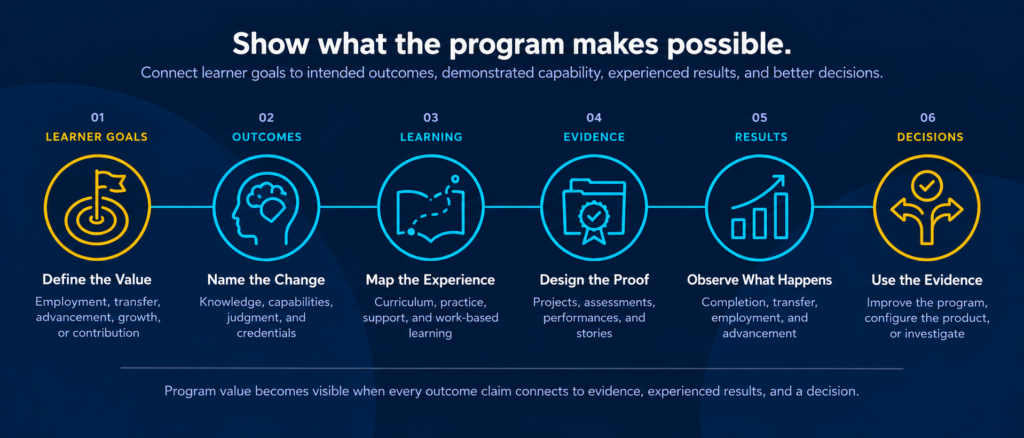
Build an outcome chain that can support action.
The workshop follows the connection from intended value to the configuration, evidence, results, and decisions that make the outcome usable.
STEP 1
Clarify the learner, community, employer, and institutional value the program intends to create.
STEP 2
Translate that value into specific, observable, relevant, and achievable outcomes.
STEP 3
Identify where curriculum, experiences, supports, and environments develop each outcome.
STEP 4
Specify the demonstrations, artifacts, credentials, and context needed to support the claim.
STEP 5
Connect participation and learning evidence to completion, transfer, employment, advancement, and learner-defined results.
STEP 6
Use the evidence to confirm, clarify, connect, strengthen, reconsider, or investigate.
The outcome chain becomes the foundation for both continuous improvement and a practical Gobekli product setup.
- Learner goals and intended value
- Outcome and capability definitions
- Curriculum and experience connections
- Evidence requirements and sources
- Experienced-result measures
- Owners, review points, and decisions
WHOSE VOICE IS MISSING?
Turn program outcomes into a configuration people can actually use.
Program Profile
Configure the program’s purpose, audience, outcomes, capabilities, credentials, experiences, and evidence expectations in TalentSync.
Outcome-to-capability mapping
Connect each intended outcome to the specific capabilities learners develop and the places those capabilities appear in the program.
Learner-controlled evidence
Define how projects, credentials, work experiences, and accomplishment evidence may be carried into TalentPass under the learner’s control.
Connected profiles and pathways
Relate Program Profiles to relevant Opportunity Profiles, learning experiences, credentials, and further pathways without claiming automatic equivalence.
Pythia-guided evidence development
Configure guided conversations that help people add context to capabilities and accomplishments while preserving human review.
Standards-based portability
Structure outcomes and evidence for appropriate exchange and reuse where supported. Configuration depends on current product availability, institutional systems, permissions, and implementation scope.
LEARNER EVIDENCE AND DECISION BOUNDARIES
Structured evidence supports judgment. It does not replace it.
Gobekli should not be presented as automatically proving program quality, assigning a universal value score, guaranteeing employment or transfer, predicting learner success, or making accreditation and funding determinations.
The configuration helps institutions make relationships among outcomes, capabilities, evidence, opportunities, and pathways more visible.
Educators, learners, employers, accreditors, funders, and institutional leaders remain responsible for interpretation and consequential decisions. Privacy, accessibility, data governance, interoperability, employment, and regulatory questions may require qualified specialist review.
Specific features and integrations should be described according to what is currently available and the implementation actually agreed.
What to bring into the conversation
You do not need a complete market-research study or a perfect profile of every potential learner.
We begin with the learner signals, institutional records, community knowledge, and unresolved questions already available. The workshop then helps distinguish what is known from what has been assumed.
You do not need a perfect longitudinal dataset or a single agreed definition of value. We begin with the outcome language, evidence, learner signals, and program information already available.
- Program mission and intended outcomes
- Course and curriculum maps
- Assessment plans and rubrics
- Completion, persistence, and time-to-completion data
- Transfer, employment, earnings, and advancement information
- Learner surveys, interviews, and goal information
- Employer, community, and partner feedback
- Credentials, projects, portfolios, and work-based learning artifacts
- Accreditation and reporting requirements
- Equity and access evidence
- Current TalentSync, TalentPass, LMS, SIS, or data configurations
- Known evidence gaps and improvement priorities
The Program Relevance Direction module establishes the consequential decision and program boundary this module should support.
What this module can help clarify
Who the program may need to serve
Define the learners, populations, circumstances, and goals relevant to the program decision.
What demand exists beyond enrollment
Identify expressed, potential, and unmet demand that current institutional measures may not capture.
Where access or value affects participation
Reveal how information, eligibility, cost, scheduling, location, support, trust, and expected benefit shape learner decisions.
What the program should do next
Organize the evidence into options to confirm, clarify, adapt, support, differentiate, or investigate.
Final outputs depend on the modules selected and the program decision established through the workshop’s required Program Relevance Direction module.
Where might the work lead next?
Program outcomes work frequently reveals connected questions about capabilities, curriculum, applied learning, learner goals, portfolio choices, and ongoing governance.
Work-to-Capability Translation
Translate outcome claims into the capabilities, activities, and evidence they represent.
Curriculum Currency & Coverage
Determine whether current curriculum develops and assesses the outcomes the program promises.
Applied & Work-Based Learning Relevance
Examine where authentic projects, practice, or workplace experiences are needed to create credible evidence.
Learner Demand, Goals & Access
Connect outcome definitions to what learners are trying to accomplish and the conditions shaping participation.
Program Portfolio Decisions
Use outcome and value evidence to support investment, redesign, consolidation, pause, or retirement decisions.
Continuous Relevance Governance
Establish ownership, review cycles, evidence updates, and triggers for continued program improvement.
These questions clarify how program outcomes, value evidence, product configuration, and institutional judgment fit together.
Program outcomes assessment examines whether a program is producing the meaningful learning, capability, progression, and wider results it intends to create. It connects claims to evidence and improvement decisions.
An output records what a program delivered, such as courses, enrollments, or credentials. An outcome describes what changed for learners or other stakeholders because of the program.
Yes. They are essential indicators, but they do not explain by themselves what learners gained, whether goals were met, or what value followed completion.
Value should be defined in relation to learner goals, intended capabilities, experienced results, access conditions, costs, alternatives, institutional purpose, and community or employer needs.
Usually not responsibly. A single metric can hide differences among learner goals, starting conditions, types of outcomes, time horizons, and stakeholder perspectives.
Ask what learners are trying to accomplish and revisit those goals over time. Compare program claims and experienced results with learner-defined aims rather than assuming one universal objective.
Appropriate evidence may include projects, performances, assessments, credentials, work products, observations, reflections, and accomplishment stories with enough context to interpret them.
Employment, earnings, retention, and advancement can be useful measures when connected to program purpose, learner goals, labor-market context, time horizon, and the limits of causal claims.
Examine whether credits, capabilities, evidence, and advising help learners enter and progress through the intended next pathway—not simply whether a transfer record exists.
Important outcomes such as confidence, agency, belonging, judgment, and networks can be examined through mixed evidence. Difficulty of measurement does not make them unimportant, but claims still need clarity and context.
The module can organize outcome definitions, mappings, evidence, and improvement decisions that may support accreditation work. It does not replace an accreditor’s standards or determinations.
TalentSync can structure a Program Profile, connect outcomes to capabilities and opportunities, and help configure evidence expectations and pathways according to current product capabilities and implementation scope.
TalentPass can help individuals develop and control a reusable view of experience, skills, credentials, and accomplishment evidence. It should not be described as automatically verifying every claim or deciding its value.
No. Gobekli helps structure relationships and evidence for human review. Institutions and qualified stakeholders remain responsible for program, financial, accreditation, and policy decisions.
No. The workshop can begin with existing artifacts and systems. It identifies what a useful configuration would require and distinguishes current capabilities from future implementation needs.
Every engagement begins with Program Relevance Direction. Program Outcomes & Value is selected when the institution needs to clarify what the program should make possible, how that value is evidenced, and how it should shape program and product decisions.
SEE THE PEOPLE BEHIND THE ENROLLMENT
Turn learner interest into a clearer understanding of demand, access, and value.
Connect learners’ goals to their choices, circumstances, access conditions, participation, and expected outcomes—then decide what the program should do next.
Learner Demand, Goals & Access is part of Gobekli’s configurable Program Relevance Workshop.