
A PROGRAM RELEVANCE WORKSHOP MODULE
Future of Work Assessment: Prepare Programs for Change
Changing Work & Occupational Futures: Teach for Work That Is Still Evolving
Occupations rarely disappear or emerge all at once. The activities inside them change as technology, AI, regulation, business models, customer expectations, and organizational practices evolve.
Programs built around static job descriptions may remain aligned to a recognizable occupation while falling behind the work learners will actually encounter.
Workshop Module 6 — Changing Work & Occupational Futures
Does this sound familiar?
Programs prepare learners for yesterday’s work
Curriculum reflects how an occupation traditionally operated rather than how its activities, tools, and responsibilities are changing.
AI predictions drive premature decisions
Dramatic forecasts about jobs disappearing or emerging are treated as settled facts without examining the underlying work.
Job titles hide important changes
An occupation keeps the same name while its activities, capabilities, technology, and human judgment shift.
Emerging roles are difficult to define
Employers describe new positions using inconsistent titles, combined responsibilities, or requirements borrowed from older roles.
Short-term demand overshadows resilience
Programs react to immediate hiring signals without preparing learners for continued change and mobility.
Evidence never reaches configuration
Research is collected, but its implications never become updated outcomes, curriculum, evidence requirements, or Program Profiles.
What is a future-of-work assessment?
A future-of-work assessment examines how the activities, responsibilities, tools, capabilities, relationships, and operating conditions within an area of work may change over time.
It may consider AI and automation, new technology, regulation, industry restructuring, new business models, environmental and demographic change, professional standards, and changing customer expectations.
The purpose is not to predict one certain future. It is to identify credible signals, examine several plausible futures, and determine which capabilities remain valuable across them.
The question is not whether a job will exist. It is how the work inside it is changing.
A title may persist while its activities change. One task may be automated, another augmented, and a third made more dependent on human judgment. Program decisions therefore require a view beneath the title.
See the forces changing work—not just the projected job count.
Change Forces
- AI and automation
- Technology adoption
- Regulation and policy
- Industry restructuring
- Demographic and environmental change
Work Activities
- Activities likely to persist
- Activities likely to be augmented
- Activities that may be automated
- Activities moving between roles
- New activities beginning to emerge
Capability Implications
- Durable technical capabilities
- Human judgment and communication
- Data and digital fluency
- Adaptability and learning
- New knowledge or credentials
Learning Implications
- Updated program outcomes
- Revised curriculum
- Applied practice
- Technology-enabled learning
- New forms of evidence
Program and Product Decisions
- What to retain
- What to update
- What to add
- What to monitor
- What to configure in Gobekli
Future-work evidence becomes useful when change signals can be traced through work activities, capability requirements, learning experiences, evidence, and an explicit program response.
How programs fall behind changing work
STAGE 1
The institution observes an enrollment signal
Applications rise or fall, a program develops a waitlist, inquiries change, or a particular learner population appears underrepresented.
STAGE 2
The signal becomes a conclusion
Leaders interpret the pattern as evidence that learners want—or no longer want—the program.
STAGE 3
The institution changes the offering or recruitment strategy
Marketing, admissions targets, curriculum, schedules, modality, pricing, or program capacity changes around the initial interpretation.
STAGE 4
The underlying conditions remain unresolved
Learner goals, access barriers, competitive choices, support needs, expected value, or institutional trust continue to shape participation.
Why occupational forecasts are only a starting point
Employment projections help institutions understand where broad demand may grow or decline. They cannot explain everything a program needs to teach. A program-relevant review looks inside the occupation.
Identify changes in activities, decisions, responsibilities, tools, collaboration, supervision, and operating context.
Distinguish technology adoption from regulation, industry restructuring, demographics, or customer expectations.
Separate widespread practice from early adoption, experimentation, possibility, and unsupported speculation.
Identify technical and human capabilities that support performance across several plausible futures.
Determine how learners may demonstrate applied capability as tools and workflows change.
Establish signals, owners, and review points so the assessment becomes an ongoing relevance process.
Technology does not affect every activity in the same way.
Specific
The person can connect the program or learning need to a meaningful goal.
Informed
The learner understands the format, expectations, cost, duration, prerequisites, and likely outcomes.
Feasible
The person can reasonably navigate the time, location, technology, financial, and participation requirements.
Sustained
Interest persists beyond a single survey, event, marketing campaign, funding incentive, or moment of urgency.
Actionable
The institution can identify a realistic program, pathway, access, support, or advising response.
Corroborated
Learner-reported interest is supported by behavior, community evidence, enrollment patterns, partner observations, or unmet participation.
Job titles can stay stable while the work changes dramatically.
A job-centered view
- Occupational title
- Projected employment count
- Typical degree requirement
- Median wage
- Conventional job description
- Current postings
These signals are useful but may conceal differences among employers, industries, technologies, and operating environments.
A work-centered view
- Outcomes the worker must produce
- Activities required to produce them
- Decisions and judgment involved
- Human and technical capabilities
- Tools, systems, and data used
- How each element may change
The goal is to look inside the occupation closely enough to support a responsible program decision.
Prepare for several plausible futures—not one confident prediction.
A useful scenario describes a coherent way the work could develop based on available evidence. Each scenario should name the change conditions, affected activities, human responsibilities, capability implications, program implications, and signals the institution should monitor.
Scenarios do not eliminate uncertainty. They make uncertainty structured enough to support preparation.
Prepare learners for changing tools without becoming tool-agnostic.
A strong program connects durable foundations—domain knowledge, critical thinking, communication, ethical judgment, data reasoning, and adaptability—to current applied tools, workflows, standards, and role-specific activities.
It also prepares learners to recognize underlying concepts, compare new tools, learn from feedback, adapt workflows, and build evidence over time.
THE MATCHING WORKSHOP MODULE
Module 6: Changing Work & Occupational Futures
This module examines how technology, AI, policy, industry conditions, and occupational boundaries may change the work a program prepares learners to perform.
Participants move beyond job-title forecasts to examine activities, capabilities, tools, evidence, human responsibilities, and several plausible futures. The resulting structure guides program decisions and a concrete Gobekli configuration.
This module helps your team:
- Identify forces changing a selected area of work
- Distinguish evidence from projections and speculation
- Examine how activities may be automated, augmented, transferred, redesigned, or created
- Identify human responsibilities likely to remain important
- Define capabilities valuable across scenarios
- Translate future-work evidence into learning implications
- Clarify what should change now and what should be monitored
- Configure occupational, capability, program, and evidence relationships in Gobekli
- Establish questions requiring further review
- Develop an evidence-backed occupational-futures response
How should the program respond to each future-work signal?
Not every signal requires an immediate curriculum change. The response should reflect the strength of evidence, likely consequences, time required to adapt, and value across several futures.
Retain
A durable capability remains important
Keep knowledge, capability, judgment, or responsibility that supports valuable performance.
Update
Current practice has meaningfully changed
Revise tools, methods, standards, examples, assessments, or applied learning.
Add
A new capability or activity is emerging
Add preparation for work not sufficiently represented in the current program.
Reframe
The occupational model no longer explains the work
Describe activities and responsibilities differently as they move across roles.
Monitor
The signal is credible but not mature
Continue observation without prematurely rebuilding the program around it.
Investigate
Evidence is incomplete or contradictory
Gather additional employer, learner, technology, policy, or specialist evidence.
These categories structure institutional judgment. They do not automatically predict whether an occupation will grow, decline, disappear, or be replaced.
What should an occupational-futures review examine?
The learner
Who may want or need the opportunity, and whose experience is missing from existing institutional data?
The goal
What is the learner trying to accomplish, and how consequential is that outcome?
The choice
How do learners discover, compare, understand, trust, and select among available alternatives?
The access conditions
What affects eligibility, affordability, timing, location, technology, participation, and completion?
The expected value
What benefit does the learner expect, and what evidence supports or challenges that expectation?
The demand signal
Is the evidence specific, informed, feasible, sustained, actionable, and corroborated?
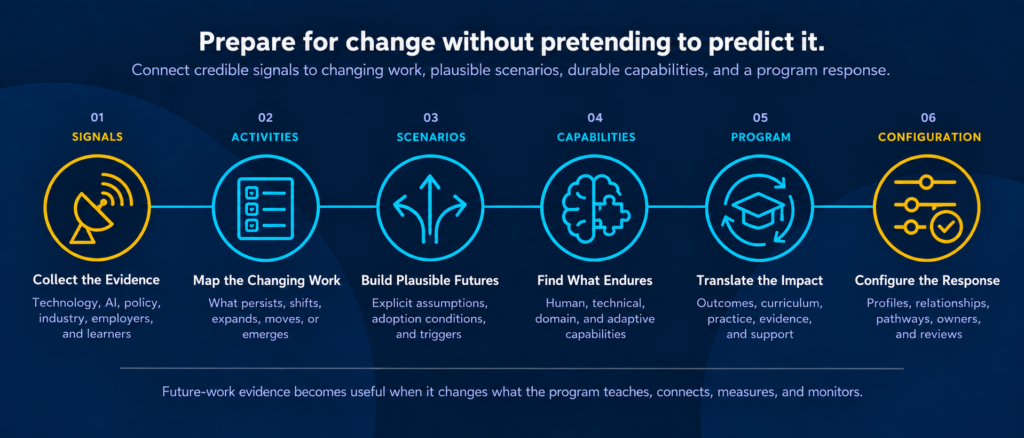
Turn occupational change into a program response.
The workshop connects credible signals to work, scenarios, capabilities, program changes, and product configuration.
Bound the Work
Select the occupational area, program, population, geography, and decision.
Collect the Signals
Combine employer evidence, research, technology, policy, learner observations, and faculty expertise.
Map the Activities
Identify affected outcomes, activities, decisions, tools, relationships, and conditions.
Build the Scenarios
Develop plausible futures with explicit assumptions and monitoring signals.
Translate Capabilities
Determine what remains durable, what changes, and what evidence learners need.
Configure the Response
Translate findings into program changes, Gobekli relationships, ownership, and review points.
The purpose is not to forecast perfectly. It is to shorten the distance between credible change signals and a responsible program response.
- Change forces and evidence quality
- Activities and human responsibilities
- Plausible scenarios and assumptions
- Capability and learning implications
- Program and product responses
- Monitoring signals, owners, and review points
GOBEKLI PRODUCT CONFIGURATION
Configure programs around changing work—not frozen job descriptions.
Occupational and Work Profiles
Represent outcomes, activities, responsibilities, tools, conditions, and context—not only a title.
Activity-to-Capability Relationships
Connect current and emerging activities to the technical, human, domain, and adaptive capabilities they require.
Program Profile Updates
Relate outcomes, curriculum, credentials, experiences, and evidence expectations to the future-work capabilities identified.
Scenario Context
Record whether a relationship reflects current practice, an emerging signal, a plausible scenario, or an unresolved question.
TalentPass Evidence Pathways
Define how learners may build and control evidence related to durable capabilities, projects, work-based learning, credentials, and accomplishments.
Pythia-Guided Review
Configure conversations that help faculty, employers, learners, and leaders add context and identify missing evidence.
Connected Opportunities and Pathways
Relate Program Profiles and learner evidence to opportunities and changing capability requirements without claiming automatic fit.
Monitoring and Governance
Assign owners, evidence sources, review intervals, and change triggers. Final setup depends on current product availability, integrations, permissions, and implementation scope.
PRODUCT AND DECISION BOUNDARIES
Structured futures support judgment. They do not predict it.
Gobekli and this workshop do not predict exactly which jobs will exist, determine whether AI will replace a person, guarantee employment or demand, identify the correct curriculum automatically, or assign a definitive future-readiness score.
The configuration makes relationships among work, activities, capabilities, programs, evidence, and opportunities more visible.
Faculty, learners, employers, and institutional leaders remain responsible for interpretation and consequential decisions. Technology, employment, accessibility, privacy, labor, regulation, accreditation, and other questions may require qualified specialist review.
Specific features and integrations should be described according to current availability and the implementation agreed.
What to bring into the conversation
You do not need a definitive forecast or a complete model of every occupation. We begin with existing signals and distinguish current evidence from assumptions, projections, disagreements, and unanswered questions.
- Occupational and industry outlook reports
- Employer interviews and advisory-board feedback
- Current job descriptions and postings
- Faculty and practitioner observations
- Technology and AI adoption information
- Regulatory and professional standards
- Program outcomes and curriculum maps
- Course and assessment information
- Work-based learning feedback
- Learner and graduate observations
- Alumni career-path information
- Current tools, systems, equipment, and facilities
- Known curriculum-change proposals
- Current TalentSync, TalentPass, or related configurations
The Program Relevance Direction module establishes the consequential decision and occupational boundary this module should examine.
What this module can help clarify
Who the program may need to serve
Define the learners, populations, circumstances, and goals relevant to the program decision.
What demand exists beyond enrollment
Identify expressed, potential, and unmet demand that current institutional measures may not capture.
Where access or value affects participation
Reveal how information, eligibility, cost, scheduling, location, support, trust, and expected benefit shape learner decisions.
What the program should do next
Organize the evidence into options to confirm, clarify, adapt, support, differentiate, or investigate.
Final outputs depend on the modules selected and the program decision established through the required Program Relevance Direction module.
Where might the work lead next?
An occupational-futures review often reveals that employer evidence, capability requirements, curriculum, applied learning, outcomes, or continued governance needs closer examination.
Employer Demand & Hiring Reality
Test whether future-work signals appear in real employer activities, requirements, hiring behavior, and operating conditions.
Work-to-Capability Translation
Translate changing activities and responsibilities into clearer technical, human, domain, and adaptive capabilities.
Curriculum Currency & Coverage
Examine whether courses, experiences, assessments, tools, and credentials cover what future work may require.
Applied & Work-Based Learning Relevance
Identify where learners need authentic practice with changing tools, workflows, environments, and responsibilities.
Program Outcomes & Value
Clarify whether intended outcomes remain meaningful across several plausible occupational futures.
Continuous Relevance Governance
Establish owners, evidence sources, review cycles, and triggers for revisiting assumptions and configuration.
These questions clarify how occupational evidence, scenarios, program decisions, and Gobekli configuration fit together.
It describes how work may change as technology, economics, regulation, demographics, business models, and organizational practices evolve. It is not one predetermined destination.
It examines how activities, responsibilities, tools, capabilities, relationships, and operating conditions within an occupation may change.
Labor-market analysis describes demand, wages, openings, supply, and geography. Occupational-futures analysis looks inside the work to identify implications for learning.
No. Adoption depends on capability, cost, infrastructure, data, regulation, workflow redesign, and human decisions. Activity-level analysis is more responsible.
No. It may reduce one activity while creating review, integration, service, or new production work elsewhere.
They remain useful across different tools, roles, environments, or scenarios while still connecting to current practice and evidence.
No. Learners need current tool fluency, but it should connect to underlying concepts, judgment, and transferable capabilities.
A small number of meaningfully different scenarios with explicit assumptions and signals is usually most useful.
Use both scheduled reviews and event-based triggers such as technology, policy, employer, or evidence changes.
Include learners, graduates, faculty, employers, workers, associations, community groups, policymakers, and relevant specialists.
Examine where context, judgment, communication, relationships, ethics, verification, creativity, and accountability matter in the actual workflow.
Separate current practice from emerging adoption, projections, and speculation; then examine source quality, conditions, scale, and contradictory evidence.
Gobekli can structure relationships among work, activities, capabilities, Program Profiles, learner evidence, opportunities, and pathways. It does not predict the future.
Possible configuration includes Work Profiles, capability relationships, Program Profile updates, evidence pathways, scenario context, owners, and review intervals.
No. It identifies implications for learning. Curriculum Currency & Coverage examines where capabilities are taught, practiced, assessed, duplicated, or missing.
It follows Program Relevance Direction when the institution needs to understand how work may evolve and what that means for capabilities, curriculum, evidence, strategy, and configuration.