
A PROGRAM RELEVANCE WORKSHOP MODULE
Work-Based Learning Gaps: Connect Curriculum to Real Experience
Give Learners the Practice Real Work Requires
Identify where authentic practice, projects, environments, and workplace experience are essential to meaningful learning.
Workshop Module 9 — Applied & Work-Based Learning Relevance
Does this sound familiar?
Learners know but cannot apply
Courses cover important concepts without enough opportunity to use them in realistic situations.
Experience is disconnected from curriculum
Internships, projects, and placements operate beside the program rather than within its capability design.
Access depends on learner networks
Some learners find valuable experiences through personal connections while others receive few realistic opportunities.
Partners lack a clear purpose
Organizations are asked to host learners without knowing what they should practice, demonstrate, or contribute.
Experience quality varies
Learners completing the same requirement encounter different activities, support, feedback, and responsibility.
Evidence disappears afterward
Meaningful work becomes only a résumé line, grade, or record of hours.
What is applied and work-based learning relevance?
Applied learning gives learners opportunities to use knowledge, skills, judgment, and other capabilities through meaningful activity.
Work-based learning places some or all of that activity within, alongside, or in direct relationship with real work and the people, environments, tools, expectations, and consequences that shape it.
Relevant experiences may include internships, apprenticeships, clinical or field experiences, employer-sponsored projects, service learning, laboratories, simulations, research, capstones, community work, and employment connected to learning.
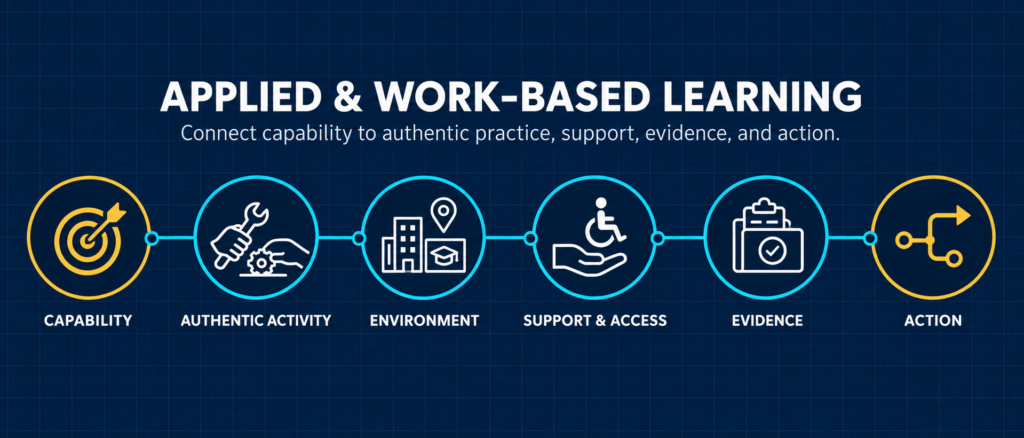
The value of an experience does not come from its label alone. It comes from the connection among capability, activity, support, access, evidence, and the next decision.
The problem is not simply a shortage of placements. It is a missing experience design.
A program may add internships, projects, simulations, or employer engagement without establishing what those experiences are meant to accomplish.
A useful design connects each experience to program outcomes, capabilities, authentic activities, responsibility, environments, support, evidence, access conditions, partner roles, evaluation, and next steps.
Without those relationships, an experience may feel valuable while contributing little to the program’s intended outcomes—or create substantial learning that remains invisible.
See the complete learning experience—not just the placement.
Program Outcomes
- Intended learner value
- Required capabilities
- Professional expectations
- Transfer or career goals
- Community purpose
Authentic Activities
- Projects and problems
- Decisions and responsibilities
- Tools and methods
- Collaboration
- Communication and service
Learning Environments
- Classrooms and laboratories
- Workplaces
- Clinical and field settings
- Community organizations
- Simulated environments
Support and Evidence
- Instruction and supervision
- Feedback and reflection
- Work products
- Demonstrations
- Accomplishment stories
Access and Decisions
- Eligibility and prerequisites
- Compensation and scheduling
- Accessibility and transportation
- Experience ownership
- Recognition and next steps
An experience becomes relevant when the intended outcome, authentic activity, environment, learner support, evidence, and access conditions can be examined together.
How experience becomes disconnected from learning
STAGE 1
Applied learning is treated as an addition
A program adds an internship, project, simulation, or placement after the curriculum is designed.
STAGE 2
The experience is defined by format
Leaders focus on hours, location, or activity type rather than the capabilities learners should develop.
STAGE 3
Quality and access vary
Learners encounter different responsibility, feedback, supervision, costs, schedules, and barriers.
STAGE 4
Completion substitutes for evidence
The institution records that an experience occurred but not what the learner practiced or demonstrated.
Begin with the learning need—not the experience label.
An internship is not automatically more authentic than a classroom project, and a simulation is not automatically less valuable than a workplace placement. The right format depends on the capability, context, consequences, learner readiness, available partners, and evidence required.
Identify the activities, decisions, responsibilities, communication, judgment, and technical work connected to the intended outcome.
Determine whether learners need real customers, equipment, data, team interaction, time pressure, standards, or consequences.
Use projects, laboratories, simulations, cases, or supervised practice to develop readiness where appropriate.
Identify capabilities that depend on workplace relationships, systems, norms, uncertainty, or direct responsibility.
Clarify preparation, supervision, feedback, accessibility, reflection, escalation, and learner well-being.
Define the products, demonstrations, observations, credentials, reflections, or accomplishment evidence learners can carry forward.
Participation alone does not guarantee meaningful learning.
Relevant
Connected to program outcomes, learner goals, and credible next opportunities.
Authentic
Built around meaningful activity under realistic conditions.
Supported
Surrounded by preparation, supervision, feedback, and reflection.
Accessible
Designed with cost, scheduling, transportation, technology, disability access, and other conditions in view.
Evidence-producing
Creates credible information about what the learner did and demonstrated.
Decision-useful
Helps the learner, educator, partner, or institution make an appropriate next decision.
More time in an experience does not automatically create more learning.
Experience volume
- Number of placements
- Participation totals
- Hours completed
- Employers contacted
- Projects assigned
- Partner agreements signed
Experience value
- Connection to outcomes
- Authenticity of activity
- Level of responsibility
- Quality of feedback
- Access conditions
- Evidence created
The goal is not simply to place learners somewhere. It is to create meaningful capability and evidence.
A valuable experience is not relevant if learners cannot participate.
Applied learning can introduce barriers involving compensation, work and caregiving, transportation, scheduling, technology, disability access, language support, eligibility, background checks, safety, placement availability, and supervision capacity.
These conditions should be examined before an experience becomes a universal requirement. The workshop can identify barriers, alternatives, and questions requiring qualified specialist review.
Work-based learning must create a credible exchange of value.
Partners may contribute time, supervision, equipment, expertise, and real organizational problems. Learners may contribute effort, perspective, research, creativity, service, and productive work.
Education providers remain responsible for designing coherent learning rather than transferring the complete burden of instruction or evaluation to a host. A signed agreement is not the same as a functioning learning relationship.
Make experience count.
Connect authentic activity to capability, support, access, evidence, and action.
THE MATCHING WORKSHOP MODULE
Module 9: Applied & Work-Based Learning Relevance
This module evaluates where learners need authentic practice, projects, environments, relationships, or workplace participation to develop and demonstrate important capabilities.
Participants connect program outcomes and curriculum coverage to experience requirements, access conditions, partner responsibilities, learner support, and credible evidence.
This module helps your team:
- Identify capabilities requiring authentic practice
- Distinguish classroom, simulated, community, and workplace needs
- Connect experiences to program outcomes
- Define meaningful learner activities and responsibility
- Examine quality and variation across experiences
- Identify access and participation barriers
- Clarify provider and partner responsibilities
- Define evidence each experience should create
- Establish improvement priorities and ownership
- Identify questions requiring specialist review
- Produce a standalone experience improvement plan
- Define an optional TalentSync EDU configuration
What should happen to each learning experience?
The appropriate response depends on the learning need, authenticity required, access conditions, evidence, available support, and consequences of change.
Keep
Relevant and sufficiently supported
Strengthen
Valuable but inconsistent
Connect
Learning and experience are separated
Expand Access
Opportunity is not equitably reachable
Redesign
The format does not fit the learning need
Investigate
Important uncertainty remains
These categories organize evidence and improvement choices. They do not automatically approve placements, certify experiences, assign academic credit, or determine program quality.
What should an applied learning review examine?
The learning need
Which outcome or capability requires application, observation, feedback, or real-world participation?
The activity
What does the learner actually do, decide, create, communicate, operate, or take responsibility for?
The environment
Which tools, people, information, standards, constraints, and conditions shape the experience?
The support
What preparation, supervision, feedback, reflection, accessibility, and escalation are provided?
The evidence
What demonstrates learner activity, development, judgment, contribution, and accomplishment?
The decision path
Who evaluates the experience, what should happen next, and how will the program respond?
Build a clear path from capability to credible evidence.
The experience design chain creates a practical workshop output that can be used independently or optionally carried into Gobekli.
STEP 1
Name the capability
Identify what learners need to know, do, judge, communicate, create, or take responsibility for.
STEP 2
Define authentic activity
Describe the work, project, problem, decision, performance, or interaction through which it develops.
STEP 3
Choose the environment
Select a classroom, laboratory, simulation, community setting, workplace, or combination.
STEP 4
Design support and access
Establish preparation, supervision, feedback, participation conditions, accommodations, and escalation.
STEP 5
Capture meaningful evidence
Identify products, observations, demonstrations, credentials, reflections, or accomplishment stories.
STEP 6
Use the evidence
Inform learner progression, curriculum improvement, partner development, program decisions, and optional configuration.
The institution can use this chain to improve learning experiences, partner conversations, access, assessment, and program decisions without purchasing TalentSync.
- Capability-to-experience map
- Authentic activity definitions
- Learning-environment decisions
- Support and access requirements
- Evidence expectations
- Owners and improvement priorities
OPTIONAL TALENTSYNC EDU CONFIGURATION
Optionally carry the experience design into TalentSync EDU.
If the institution chooses implementation, workshop findings can provide the foundation for a configuration connecting Program Profiles, capabilities, experiences, opportunities, and learner-controlled evidence.
The configuration may include experience purpose and activities, prerequisites, environments, support, evidence prompts, responsible parties, opportunity connections, and coverage views.
TalentSync is optional. The workshop’s experience map and improvement plan remain useful independently. Any implementation depends on current product capabilities, institutional systems, permissions, learner participation, and implementation scope.
PRODUCT AND DECISION BOUNDARIES
Structured experience evidence supports judgment. It does not replace it.
TalentSync EDU and TalentPass should not be presented as:
- Automatically determining experience quality or learner readiness
- Approving placements or assigning academic credit
- Replacing educator, supervisor, or partner judgment
- Predicting employment success
- Verifying every learner claim automatically
- Guaranteeing equitable access
- Making legal, labor, accessibility, safety, clinical, accreditation, or compliance determinations
- Providing the sole basis for a consequential learner decision
The configuration makes relationships among capabilities, experiences, support, evidence, and decisions more visible. Educators, learners, partners, supervisors, leaders, and qualified specialists retain their appropriate roles.
What to bring into the conversation
You do not need a complete inventory of every project, placement, simulation, or employer relationship. We begin with the experiences, curriculum information, learner observations, and partner evidence already available.
Useful inputs may include:
- Program outcomes and capability maps
- Curriculum maps and course sequences
- Applied assignments and projects
- Internships and cooperative education
- Apprenticeship designs
- Clinical, practicum, and field requirements
- Laboratory, studio, and simulation experiences
- Capstone and portfolio requirements
- Employer- or community-sponsored projects
- Partnership agreements
- Supervisor and educator guidance
- Assessment plans and rubrics
- Learner work products and reflections
- Participation and placement data
- Learner and partner feedback
- Compensation, scheduling, transportation, and access information
- Known quality, safety, capacity, or evidence concerns
- Current systems or product configurations
Program Relevance Direction establishes the consequential decision, affected program, learner population, evidence scope, and review boundary.
What this module can help clarify
Where authentic experience is necessary
Identify capabilities requiring realistic activity, environments, relationships, tools, judgment, or responsibility.
Which experiences create meaningful learning
Examine relevance, authenticity, support, access, evidence, and program connections.
What should improve
Organize experiences into keep, strengthen, connect, expand access, redesign, or investigate responses.
What can optionally be configured
Translate the design into Program Profiles, Experience Profiles, opportunity connections, prompts, and coverage views.
The experience map and improvement plan are complete workshop outputs. TalentSync configuration is an optional implementation pathway.
Where might the work lead next?
Applied learning reviews often reveal connected questions about curriculum, capability definitions, learner access, outcomes, partnerships, and feasibility.
Work-to-Capability Translation
Clarify the activities, responsibilities, tools, and contexts learners need to practice.
Curriculum Currency & Coverage
Determine where courses develop, practice, assess, or miss important capabilities.
Learner Demand, Goals & Access
Examine whether learners can reach and participate in required experiences.
Program Outcomes & Value
Connect experience and evidence to the results the program intends to create.
Employer Partnership Value
Clarify what education providers, partners, and learners contribute and receive.
Program Delivery & Resource Feasibility
Test whether staffing, supervision, scheduling, facilities, and partnerships can sustain the design.
Questions institutions ask about applied and work-based learning.
Education connected to authentic work activities, environments, relationships, expectations, or problems. A useful design explains what learners do, develop, and demonstrate.
Applied learning is broader and includes projects, simulations, laboratories, research, field activity, and other meaningful practice. Work-based learning connects application directly to real work.
No. The program should first determine which capabilities require authentic application and whether an internship is the most appropriate and accessible format.
Examine relevance, meaningful activity, support, feedback, accessibility, evidence, and connection to an appropriate next decision.
Review compensation, scheduling, transportation, disability access, technology, caregiving, eligibility, placement supply, and informal distribution networks.
Sometimes. Simulations support safe, repeatable practice but may not reproduce every relationship, constraint, consequence, norm, or uncertainty found in real work.
Useful evidence may include work products, observations, demonstrations, credentials, reflections, activity descriptions, and accomplishment stories with appropriate context.
Partners can help define authentic activity, provide environments and expertise, supervise, and offer feedback. The education provider should clarify purpose, preparation, responsibility, and evidence.
No. It may organize profiles, prerequisites, capabilities, opportunities, and evidence, but people remain responsible for placement and readiness decisions.
TalentPass can help individuals develop and control a reusable view of experiences, activities, skills, credentials, work products, and accomplishment evidence.
Yes. The capability-to-experience map, quality and access findings, evidence requirements, priorities, and ownership decisions are useful independently.
Program Relevance Direction establishes the decision. This module determines where authentic practice is required and whether current experiences support meaningful learning.
MAKE EXPERIENCE COUNT
Turn applied learning into credible capability and evidence.
Leave with a practical improvement plan. TalentSync EDU can optionally carry the experience design into connected infrastructure.