
A PROGRAM RELEVANCE WORKSHOP MODULE
Program Delivery Feasibility: Can Your Institution Sustain It?
Can You Sustain the Experience You Promise?
A relevant program still fails learners when the institution cannot reliably provide the people, resources, support, and learning environments it requires.
Workshop Module 9 — Program Delivery & Resource Feasibility
Does this sound familiar?
The program depends on unavailable expertise
The curriculum requires faculty knowledge, technical experience, instructional support, or specialized supervision the institution cannot reliably provide.
Required courses are difficult to schedule
Course availability, sequencing, modality, room access, faculty assignments, or prerequisite patterns prevent learners from progressing as intended.
Equipment and technology lag behind
Learners are expected to develop current capabilities using outdated, insufficient, inaccessible, or inconsistently available tools.
Learner support is separated from delivery
Advising, tutoring, accessibility, transportation, technology access, and other support conditions are not incorporated into the operating model.
External experiences depend on fragile partnerships
Internships, clinical placements, apprenticeships, community projects, or employer-supported learning rely on limited capacity or unclear commitments.
The program promise exceeds available resources
The institution approves an intended experience without fully understanding its recurring workload, dependencies, or ability to operate at the expected scale.
What is program delivery and resource feasibility?
Program delivery and resource feasibility is the examination of whether an institution can reliably provide the people, expertise, time, infrastructure, support, partnerships, and funding required to deliver an intended educational experience.
It connects program design to operating reality.
A program may respond to meaningful learner, employer, community, transfer, or occupational needs. Its curriculum may describe appropriate outcomes and capabilities. Yet the experience can still break down when faculty capacity, course availability, learning environments, technology, learner support, placement capacity, coordination, or recurring resources are insufficient.
Feasibility does not mean choosing only what is easiest or least expensive. It means understanding what the intended experience requires and which constraints must be resolved before the program can fulfill its promise.
The question is not whether the program can launch. It is whether the intended experience can be sustained.
Institutions can often assemble enough people and resources to begin a program, add a concentration, introduce a credential, or revise a curriculum.
Initial delivery does not necessarily demonstrate long-term feasibility. A program may rely on temporary funding, uncompensated coordination, one faculty champion, borrowed equipment, manually arranged placements, irregular substitutions, or support services that cannot absorb additional demand.
A useful feasibility review connects the educational promise to the complete delivery system and the evidence supporting it.
See the complete delivery system—not just the curriculum.
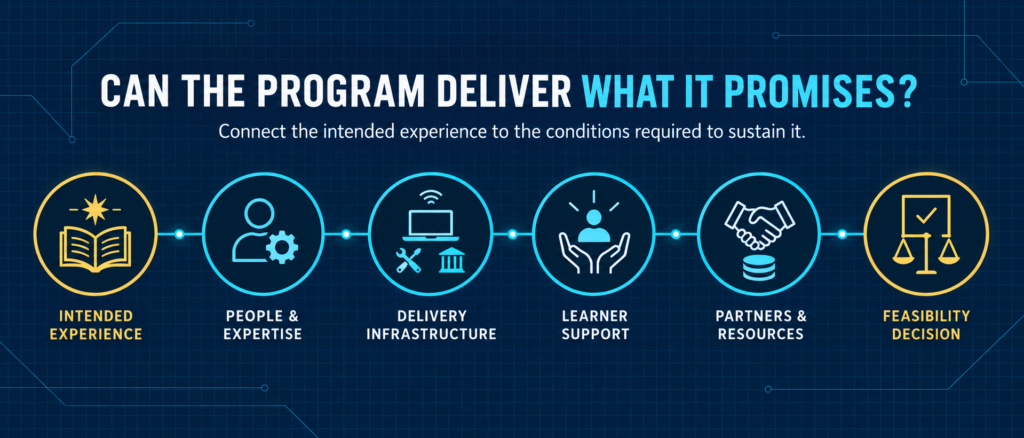
Intended Experience
- Program outcomes
- Capability development
- Course sequence
- Applied learning
- Demonstration and evidence
People and Expertise
- Faculty capacity
- Specialized expertise
- Instructional support
- Supervisors and mentors
- Professional development
Delivery Infrastructure
- Scheduling and modality
- Facilities and learning spaces
- Equipment and materials
- Software and platforms
- Technical support
Learner and Partner Support
- Advising and tutoring
- Accessibility
- Participation support
- Placements and work sites
- Partner coordination
Resources and Decisions
- Recurring resources
- Administrative capacity
- Procurement and approvals
- Dependency ownership
- Feasibility response
Delivery becomes feasible when the intended educational experience, the conditions required to provide it, and the resources available to sustain it can be examined together.
How delivery strain takes hold
STAGE 1
The intended experience expands
New outcomes, courses, technologies, credentials, applied experiences, or delivery formats are added to improve program relevance.
STAGE 2
Resource implications remain implicit
Changes are not fully translated into faculty workload, expertise, scheduling, infrastructure, learner support, partnership, and resource requirements.
STAGE 3
Teams compensate informally
Faculty, staff, and partners use overloads, substitutions, manual coordination, temporary arrangements, and personal relationships to keep the program operating.
STAGE 4
The learner experience becomes inconsistent
Course access, progression, quality, support, and applied learning begin to depend on conditions the institution cannot reliably maintain.
Test the operating model before expanding the program promise.
The purpose of a feasibility review is not to reject every ambitious program design. It is to understand what the intended experience requires before the institution depends on resources or relationships that may not be available.
Identify the courses, activities, assessments, applied experiences, support interactions, and progression conditions required to achieve the intended outcomes.
Clarify faculty disciplines, professional expertise, instructional capacity, technical support, advising, supervision, and coordination responsibilities.
Examine classrooms, laboratories, simulation environments, equipment, software, data, learning platforms, accessibility tools, and technical services.
Consider scheduling, modality, transportation, technology, placement availability, financial conditions, accessibility, and other participation factors.
Identify employers, clinical sites, schools, community organizations, licensing bodies, vendors, or other partners whose capacity affects delivery.
Determine whether alternatives exist when expertise, equipment, a partner, funding, or enrollment differs from expectations.
Available resources do not automatically create usable delivery capacity.
Sufficient
Available in enough quantity for the expected learners and required experiences.
Appropriate
Suitable for the outcomes and capabilities the program intends to develop.
Accessible
Usable by learners and educators when, where, and how the program requires.
Coordinated
Aligned across schedules, responsibilities, systems, approvals, and handoffs.
Resilient
Not dependent on one person, temporary workaround, fragile relationship, or unavailable alternative.
Sustainable
Supportable beyond launch through recurring workload, maintenance, coordination, and resources.
A resource can exist on paper without being available to the program.
Paper capacity
- Total faculty headcount
- Existing rooms and laboratories
- Institution-wide software licenses
- Current support departments
- Signed partnership agreements
- Published course offerings
- Maximum theoretical enrollment
Deliverable capacity
- Faculty time in the required terms
- Expertise connected to specific learning
- Workable course sequencing
- Equipment available during instruction
- Support accessible to relevant learners
- Partner capacity for actual placements
- Alternatives when assumptions change
The goal is not to prove that resources exist. It is to determine whether they can work together reliably enough to deliver the intended experience.
Program capacity is often determined by its narrowest constraint.
A program may appear adequately resourced overall while one required course, faculty specialty, laboratory, clinical site, technology platform, support function, approval, or coordinating role limits delivery.
Making these dependencies visible helps the institution distinguish theoretical program capacity from the number of learners it can responsibly support.
Enrollment growth can weaken a program if delivery capacity does not grow with it.
A program that serves 20 learners may depend on conditions that do not hold at 50, 100, or 300. Growth can alter faculty workload, course availability, laboratory access, placement capacity, learner support, assessment, partner participation, administrative coordination, and consistency across locations or modalities.
A feasibility review should identify the enrollment ranges and resource thresholds at which the operating model must change.
Make the program promise deliverable.
Connect educational intent to the people, resources, support, and partnerships required to sustain it.
THE MATCHING WORKSHOP MODULE
Module 9: Program Delivery & Resource Feasibility
This module examines whether the institution can reliably sustain the people, expertise, scheduling, infrastructure, learner support, partnerships, and resources required by the intended program experience.
Participants connect curriculum and program expectations to actual delivery conditions. They identify critical dependencies, capacity constraints, unsupported assumptions, and the changes required to make the experience feasible.
The purpose is not to produce a complete budget, staffing plan, or operational audit. It is to make the relationships between educational intent and delivery capacity visible enough to support an informed program decision.
This module helps your team:
- Translate the intended experience into delivery requirements
- Examine faculty, staff, and specialized expertise needs
- Test sequencing, scheduling, and modality assumptions
- Identify facility, equipment, software, and technology needs
- Connect learner support to program delivery
- Evaluate placement and partnership capacity
- Distinguish theoretical resources from usable capacity
- Reveal fragile dependencies and informal workarounds
- Examine recurring resource requirements
- Compare feasible delivery scenarios
- Identify questions requiring specialist review
- Develop an evidence-backed feasibility response
What should happen to the delivery model?
The appropriate response depends on the intended experience, available capacity, unresolved dependencies, learner consequences, and evidence supporting the delivery model.
Ready
Proceed with the supported delivery model
Strengthen
Resolve specific capacity gaps
Sequence
Phase delivery around realistic capacity
Partner
Secure appropriate external delivery capacity
Redesign
Change the experience or operating model
Investigate
Resolve material uncertainty first
These categories structure evidence and decisions. They do not replace academic, financial, accreditation, accessibility, legal, procurement, facilities, or other professional review.
What should a delivery feasibility review examine?
The intended experience
What must learners encounter, practice, use, complete, and demonstrate?
The people
Which faculty, staff, supervisors, specialists, and coordinators are required?
The infrastructure
Which spaces, equipment, software, materials, data, and technical services must support delivery?
The learner conditions
Which scheduling, modality, accessibility, financial, geographic, technology, or support conditions affect participation?
The dependencies
Which courses, approvals, vendors, partners, placements, funding sources, or key individuals must remain available?
The operating evidence
What demonstrates capacity, access, reliability, utilization, progression, partner commitment, and sustainability?
Optionally carry the feasibility map into TalentSync EDU.
The workshop creates value independently by mapping the conditions required to deliver the intended program experience. As TalentSync EDU develops, an appropriate configuration may preserve selected relationships in a reusable program view.
STEP 1
Program intent
Connect outcomes and intended capabilities.
STEP 2
Learning experiences
Represent courses, activities, assessments, and applied learning.
STEP 3
People and expertise
Connect faculty, supporting roles, responsibilities, and relevant expertise.
STEP 4
Resources and environments
Represent tools, technology, facilities, services, and learning environments.
STEP 5
Dependencies and evidence
Connect partners, placements, assumptions, evidence, and identified gaps.
STEP 6
Ownership and review
Record responsible owners, decisions, questions, and review conditions.
TalentSync EDU may support relationship mapping, evidence organization, shared visibility, and continued review. It would not calculate budgets, produce schedules, assign workload, guarantee resource availability, or determine whether a program is feasible.
- Connected program delivery view
- People, expertise, and resource relationships
- Dependency and evidence map
- Visible gaps and constraints
- Named owners and review questions
- Optional living program configuration
STANDALONE WORKSHOP VALUE
Leave with a usable feasibility response—with or without TalentSync.
The workshop produces a bounded delivery requirements map, capacity and dependency analysis, delivery-scenario comparison, evidence-gap list, and prioritized feasibility response.
These outputs can support program planning, faculty discussion, institutional approvals, partnership development, resource requests, and implementation using the institution’s existing systems.
TalentSync is not required to complete the workshop or use its findings. It is an optional future pathway for maintaining the relationships as a connected program view.
PRODUCT AND DECISION BOUNDARIES
Shared visibility supports feasibility decisions. It does not replace institutional expertise.
This module and any resulting configuration should not be presented as:
- A complete budget or financial audit
- A faculty workload determination
- A staffing or hiring plan
- A course-scheduling system
- A facilities or engineering assessment
- An accreditation or regulatory review
- A cybersecurity, privacy, or accessibility certification
- A procurement, legal, or contractual determination
- A guarantee of enrollment, funding, placement capacity, or partner participation
- An automated decision about whether a program should proceed
Gobekli helps organize the relationships, evidence, gaps, ownership, and decisions. Academic affairs, faculty governance, finance, student services, information technology, facilities, procurement, accreditation, legal counsel, and other qualified specialists retain their appropriate responsibilities.
What to bring into the conversation
You do not need a perfect resource model or complete cost analysis. We begin with available program plans, operating information, and observations, then distinguish confirmed capacity from assumptions, temporary arrangements, missing evidence, and unresolved dependencies.
Useful inputs may include:
- Program and curriculum maps
- Program outcomes and capabilities
- Enrollment history and projections
- Course schedules and rotations
- Faculty assignments and workload information
- Faculty and staff expertise
- Facilities and learning-space information
- Equipment, software, and technology inventories
- Modality and location plans
- Learner-support information
- Clinical and work-based learning requirements
- Partner agreements and capacity information
- Administrative and approval timelines
- Budget and funding assumptions
- Progression, waitlist, and access data
- Known substitutions, exceptions, or workarounds
Program Relevance Direction establishes the consequential outcome, learner population, program boundary, evidence scope, and decision this feasibility review should support.
What this module can help clarify
What the intended experience requires
Translate program expectations into specific people, infrastructure, support, partnership, and resource needs.
Where delivery is constrained
Identify bottlenecks, unavailable expertise, scheduling conflicts, capacity limits, fragile dependencies, and unsupported assumptions.
Which delivery scenarios are feasible
Compare cohort sizes, schedules, modalities, sequences, partnerships, investments, and implementation approaches.
What must happen before commitment
Clarify what is ready, what must be strengthened, what should be phased or redesigned, and what requires investigation.
The feasibility map and response plan are complete workshop outputs. A TalentSync EDU configuration is an optional future implementation pathway.
Where might the work lead next?
Delivery feasibility frequently reveals connected questions about program purpose, curriculum, applied learning, portfolio choices, and ongoing stewardship.
Program Outcomes & Value
Clarify the outcomes and value the delivery model must support.
Work-to-Capability Translation
Determine which activities, knowledge, tools, and capabilities the program must be equipped to develop.
Curriculum Currency & Coverage
Examine where important capabilities are developed and whether recommended changes can be supported.
Applied & Work-Based Learning Relevance
Evaluate whether applied experiences are relevant, accessible, and realistically supportable.
Program Portfolio Decisions
Bring feasibility evidence into decisions to launch, grow, redesign, combine, pause, retire, or investigate.
Continuous Relevance Governance
Establish who monitors delivery conditions and how feasibility decisions are revisited.
Questions institutions ask about program delivery feasibility.
The institution’s ability to provide and sustain the people, expertise, scheduling, infrastructure, learner support, partnerships, administration, and resources required by an intended educational experience.
Curriculum design establishes what learners should develop. Delivery feasibility examines whether the institution can consistently provide the conditions required to make that design real.
No. Funding matters, but feasibility also depends on expertise, scheduling, infrastructure, learner access, support, partner capacity, coordination, and critical dependencies.
Yes. Faculty, facilities, placements, support, assessment, technology, and coordination may work at one enrollment level and fail at another.
Connect actual courses, experiences, expertise, terms, locations, modalities, assessment demands, advising, and coordination to genuinely available faculty time.
Treat support as part of delivery when advising, accessibility, technology, transportation, scheduling, financial conditions, or navigation affect participation and progression.
Clarify what each partner provides, available capacity, coordination, standards, learner support, commitments, and alternatives if conditions change.
Not necessarily. The response may be to strengthen resources, phase implementation, develop a partnership, redesign delivery, or remove burdens that do not support intended outcomes.
Yes. It can reveal recurring constraints, outdated infrastructure, fragile dependencies, manual workarounds, and differences between the published and actual learner experience.
Yes. It can test assumptions and identify requirements, scenarios, partnerships, thresholds, and conditions that should be resolved before launch.
Gobekli can connect program outcomes, capabilities, experiences, people, expertise, resources, dependencies, evidence, gaps, owners, and decisions without replacing operational systems.
No. A future configuration may organize relationships and evidence, but institutional leaders and qualified specialists remain responsible for interpretation and decisions.
No. The workshop produces a usable feasibility map, analysis, scenario comparison, and response plan independently.
Program Relevance Direction establishes the decision. This module tests whether the intended educational experience can be delivered and sustained under real operating conditions.
MAKE THE PROGRAM PROMISE DELIVERABLE
Turn educational intent into a sustainable delivery model.
Connect the intended experience to faculty, scheduling, infrastructure, learner support, partnerships, resources, and evidence—then determine what must happen next.
