
A PROGRAM RELEVANCE WORKSHOP MODULE
Continuous Program Relevance: Build an Ongoing Review System
Stop Letting Program Relevance Expire Between Reviews
Learner needs, occupations, technologies, community priorities, employer expectations, delivery conditions, and institutional resources can change faster than formal program-review cycles.
Workshop Module 12 — Continuous Relevance Governance
Does this sound familiar?
Program evidence is rebuilt for every review
Teams repeatedly search for the same data, documents, stakeholder input, and explanations because prior evidence is scattered or difficult to reuse.
Formal review cycles move too slowly
Programs may be reviewed every several years even when technologies, occupations, learner expectations, or delivery conditions change much sooner.
Advisory input disappears into meeting notes
Employers, learners, alumni, faculty, community partners, and other stakeholders contribute useful observations without a reliable path into program decisions.
No one owns emerging relevance questions
People may notice changes, but responsibility for investigating, interpreting, escalating, or responding to them remains unclear.
Decisions lose their context
Institutions remember what was approved but not always the evidence, assumptions, tradeoffs, conditions, and uncertainties behind the decision.
Programs react only after performance declines
Falling enrollment, learner dissatisfaction, partner loss, delivery strain, or weak outcomes becomes the trigger because earlier signals were not connected.
What is continuous relevance governance?
Continuous relevance governance is the ongoing system through which an institution monitors changes affecting its educational programs, maintains relevant evidence, assigns responsibility, revisits prior decisions, and determines when further action is required.
It connects institutional direction, community and employer needs, learners, outcomes, changing work, capabilities, curriculum, delivery, applied learning, portfolio relationships, decisions, owners, and review conditions.
Continuous governance does not require every program to be under constant review. It establishes a proportionate way to determine what should be monitored, which changes matter, who evaluates them, what evidence is required, and when a bounded question should return to institutional decision-makers.
The goal is to keep program understanding alive—not to create permanent administrative activity.
The problem is not that institutions never review programs. It is that relevance changes between reviews.
Periodic review remains important, but it captures a moment in time. Technologies, occupations, learner goals, community priorities, transfer agreements, credentials, faculty capacity, partnerships, applied learning, and delivery assumptions may change immediately afterward.
Without a continuous system, these signals remain distributed across meetings, inboxes, reports, systems, relationships, and institutional memory. Continuous relevance governance connects them to the programs, capabilities, experiences, dependencies, decisions, and owners they may affect.
See the complete governance system—not just the review calendar.
Signals and Change
- Learner observations
- Employer and occupational change
- Community and regional developments
- Technology and policy changes
- Delivery and resource conditions
Program Relationships
- Intended outcomes
- Required capabilities
- Curriculum and courses
- Applied learning
- Pathways and portfolio connections
Evidence and Context
- Current evidence
- Stakeholder perspectives
- Assumptions and uncertainty
- Prior decisions
- Supporting rationale
Ownership and Response
- Responsible owners
- Review thresholds
- Investigation pathways
- Escalation routes
- Decision authority
Learning and Renewal
- Actions and commitments
- Implementation evidence
- Change history
- Review conditions
- Next monitoring cycle
A governance system becomes useful when a change signal can be connected to what it may affect, the evidence required to understand it, the people responsible for responding, and the decision pathway that follows.
How program relevance becomes episodic
STAGE 1
A major review is completed
The institution gathers evidence, holds discussions, makes decisions, and documents a plan.
STAGE 2
Evidence disperses again
Reports, stakeholder observations, assumptions, responsibilities, and decisions return to separate systems, files, committees, and individual owners.
STAGE 3
Conditions continue to change
Learner needs, work, technology, community priorities, delivery capacity, partnerships, and portfolio relationships evolve between scheduled reviews.
STAGE 4
The next review starts from an outdated picture
Teams reconstruct the program’s context after relevance concerns have accumulated or institutional memory has been lost.
Do not review everything continuously. Monitor what could change the decision.
Continuous governance should begin with the consequential program decisions the institution needs to keep valid—not an endless stream of meetings, surveys, dashboards, or administrative demands.
Record the important beliefs about learners, needs, outcomes, capabilities, curriculum, feasibility, partners, resources, and portfolio relationships behind the decision.
Identify changes that could alter the program’s value, accessibility, quality, differentiation, feasibility, or institutional response.
Determine which quantitative evidence, qualitative observations, stakeholder perspectives, external developments, or operating conditions deserve attention.
Assign people or groups who can evaluate the evidence in context—not merely collect it.
Establish conditions that justify a closer look, a bounded module review, specialist involvement, or a return to institutional governance.
Preserve what was decided, why it was decided, what remained uncertain, who owns the response, and when it should be revisited.
A dashboard is not the same as a governance system.
Decision-connected
Monitoring is tied to specific program questions, assumptions, commitments, and potential consequences.
Proportionate
The frequency and depth of review reflect the importance, volatility, and uncertainty of the issue.
Evidence-aware
Quantitative evidence, qualitative experience, stakeholder knowledge, and unresolved uncertainty remain distinguishable.
Owned
Every material signal, investigation, response, and future review condition has an appropriate responsible party.
Participatory
Faculty, learners, employers, community partners, administrators, and specialists can contribute where their knowledge is relevant.
Actionable
The system can move from monitoring to validation, investigation, response, escalation, implementation, and renewed review.
More data does not automatically keep programs relevant.
Passive monitoring
- Disconnected indicators
- Dashboards without ownership
- Automatically generated alerts
- Advisory meetings without follow-through
- Metrics selected because they are available
- Issues recorded without escalation
Continuous governance
- The decision that must remain valid
- Assumptions supporting that decision
- Programs and people affected
- Signals that could change the conclusion
- Named owners and thresholds
- Actions and future review conditions
The goal is not to watch every indicator. It is to recognize meaningful change early enough to support a responsible institutional response.
A signal should open a question—not automatically make a decision.
An enrollment decline, employer request, or new technology may be important, but each can have multiple explanations and consequences.
Continuous governance should connect a signal to relevant context, seek additional evidence, involve appropriate people, and determine what question actually needs to be answered. It should not convert incomplete indicators into automatic conclusions.
Keep the reasoning behind program decisions—not only the final decision.
A usable governance record preserves what was decided, the boundary considered, available evidence, stakeholder perspectives, assumptions, alternatives, tradeoffs, unresolved questions, implementation commitments, responsible owners, future review conditions, and later evidence.
This allows future participants to understand a decision without treating it as permanently correct or reopening every settled question from the beginning.
Keep relevance alive between formal reviews.
Connect changing signals to affected programs, evidence, responsible owners, and a proportionate response.
THE MATCHING WORKSHOP MODULE
Module 12: Continuous Relevance Governance
This module helps institutions turn one-time program relevance work into a sustainable system of evidence, ownership, review, escalation, and renewal.
Participants identify which decisions must remain current, what assumptions support them, which signals could materially alter them, who should interpret those signals, and what conditions should trigger investigation or formal review.
The module also establishes how decisions, evidence, responsibilities, and future review conditions should remain visible after the workshop.
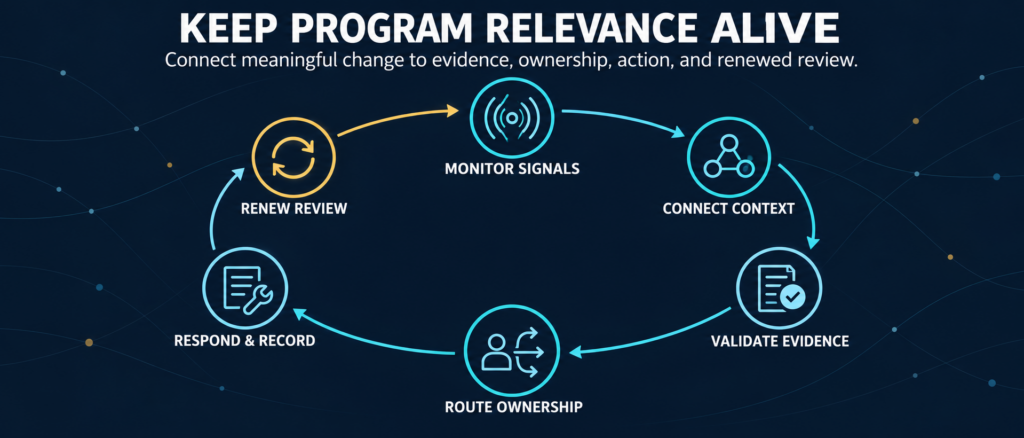
This module helps your team:
- Identify decisions and assumptions requiring continued attention
- Define meaningful internal and external signals
- Connect signals to affected programs and components
- Establish evidence-update responsibilities
- Clarify who interprets different kinds of change
- Set proportionate review rhythms and triggers
- Create investigation and escalation pathways
- Preserve decision rationale and unresolved questions
- Connect commitments to responsible owners
- Distinguish monitoring from formal governance
- Identify questions requiring specialist review
- Develop a sustainable continuous-relevance model
What should happen when a relevance signal appears?
Not every change requires curriculum revision or formal program review. The response should reflect the significance of the signal, the strength of the evidence, the programs affected, and the consequences of delay.
Monitor
Continue observing a relevant condition
Validate
Confirm the signal and its context
Investigate
Examine a bounded relevance question
Respond
Make an appropriate bounded adjustment
Escalate
Move the issue to the appropriate decision body
Renew
Update the decision and future review conditions
These categories structure attention and institutional response. They do not automatically determine whether a program, curriculum, course, partnership, or resource should change.
What should continuous relevance governance examine?
The decision
Which program direction, commitment, assumption, or portfolio response must remain valid?
The signal
What changed, who observed it, which source produced it, and how consequential might it be?
The relationship
Which learners, outcomes, capabilities, courses, experiences, resources, partners, or programs could be affected?
The evidence
What supports the signal, provides context, conflicts with it, or remains unknown?
The ownership
Who monitors, interprets, validates, investigates, responds, escalates, decides, and follows through?
The review condition
What threshold, event, date, dependency, or evidence change should bring the question back into active consideration?
Carry program relevance forward as a connected institutional system.
The workshop establishes a complete governance model without requiring TalentSync. Over time, TalentSync EDU could potentially support a living Program Relevance System that preserves relationships across programs, learners, work, capabilities, curriculum, evidence, stakeholders, resources, decisions, and owners.
The purpose would not be to automate academic governance. It would be to reduce fragmentation, preserve institutional context, and help the right people recognize when connected evidence or conditions have changed.
STEP 1
Maintain the program map
Represent programs, credentials, pathways, learner populations, outcomes, capabilities, courses, applied experiences, and portfolio relationships.
STEP 2
Connect evidence to what it informs
Associate learner, employer, occupational, community, outcome, curriculum, delivery, and portfolio evidence with relevant questions.
STEP 3
Record signals and observations
Allow authorized contributors to document changes, stakeholder observations, emerging concerns, new evidence, and unresolved questions.
STEP 4
Route attention to appropriate owners
Connect signals to the faculty, leaders, administrators, partners, governance groups, or specialists responsible for follow-through.
STEP 5
Preserve decisions and change history
Maintain rationale, assumptions, evidence, owners, actions, dependencies, and developments that confirm or challenge decisions.
STEP 6
Support recurring review
Surface scheduled reviews, defined triggers, evidence gaps, unresolved commitments, changed dependencies, and questions requiring human attention.
TalentSync EDU could potentially function as connective infrastructure around program relevance: maintaining relationships, organizing evidence, preserving decision context, and supporting responsible review. Institutional participants would remain responsible for interpretation, judgment, dialogue, and action.
- Living Program Relevance System
- Connected program and evidence map
- Signals linked to affected relationships
- Owners, triggers, and review pathways
- Decisions, rationale, and change history
- Optional recurring governance configuration
STANDALONE WORKSHOP VALUE
Leave with a continuous relevance system your institution can begin using now.
The workshop produces a bounded governance scope, decision-and-assumption map, relevance-signal framework, evidence responsibilities, stakeholder contribution model, monitoring rhythms, review triggers, validation and investigation pathways, escalation routes, governance roles, decision-record template, implementation structure, change-history approach, and first-year governance calendar.
These outputs can be used through existing committees, program-review processes, shared documents, planning systems, data tools, and communication practices.
TalentSync is not required to complete the workshop or sustain its initial governance model. A TalentSync EDU configuration is a potential long-term pathway for maintaining the relationships, evidence, history, and shared visibility as a living system.
PRODUCT AND DECISION BOUNDARIES
Connected intelligence supports governance. It does not become the governing authority.
TalentSync EDU and any future Program Relevance System should not be presented as:
- Automatically determining whether a signal is important
- Declaring a program relevant or irrelevant
- Automatically changing curriculum
- Ranking programs, courses, faculty, learners, or partners
- Predicting enrollment, employment, or program success
- Replacing faculty expertise or academic governance
- Authorizing program launch, redesign, consolidation, pause, or closure
- Making accreditation, legal, privacy, accessibility, procurement, or cybersecurity determinations
- Replacing institutional research or source systems
- Treating employer demand as the sole purpose of education
- Guaranteeing every meaningful change will be detected
- Providing the sole basis for an institutional decision
The system could help people connect evidence, surface changed conditions, identify affected relationships, preserve context, and coordinate review. Human participants and authorized institutional bodies would remain responsible for interpretation, dialogue, judgment, and action.
What to bring into the conversation
You do not need a complete institutional data architecture or a newly designed governance structure. We begin with the review practices, evidence sources, decision processes, and responsibilities the institution already has.
Useful inputs may include:
- Program-review policies and schedules
- Curriculum-review and approval processes
- Academic governance structures
- Program and portfolio decisions
- Accreditation and regulatory requirements
- Institutional research reports and dashboards
- Learner feedback and outcome evidence
- Employer and advisory-board processes
- Community and regional engagement practices
- Occupational and labor-market information
- Curriculum and capability maps
- Delivery and resource reviews
- Applied-learning partnerships
- Program portfolio analyses
- Prior decision and implementation records
- Known relevance concerns or emerging changes
Program Relevance Direction establishes the institutional outcome, program or portfolio boundary, evidence scope, and consequential decisions the governance system should keep current.
What this module can help clarify
What must remain current
Identify the decisions, evidence, assumptions, relationships, dependencies, and commitments that should not wait for the next comprehensive review.
Which signals deserve attention
Define learner, employer, occupational, community, outcome, curriculum, delivery, portfolio, and institutional changes that could alter a decision.
Who is responsible for what
Clarify contribution, monitoring, interpretation, investigation, escalation, decision, implementation, and follow-up responsibilities.
How the institution should respond
Create proportionate pathways to monitor, validate, investigate, respond, escalate, and renew program decisions.
The governance framework and implementation plan are complete workshop outputs. A future TalentSync EDU Living Relevance System is an optional pathway for operationalizing the connected model over time.
Where might the work lead next?
Continuous governance may reveal that a specific relevance question requires deeper analysis through another module rather than reopening the entire review.
Program Relevance Direction
Revisit the institutional outcome, program boundary, evidence scope, or decision when direction changes.
Employer Demand & Hiring Reality
Investigate changing employer expectations, hiring practices, occupational requirements, and workforce signals.
Learner Demand, Goals & Access
Examine changes in learner interest, goals, participation conditions, access barriers, and populations served.
Curriculum Currency & Coverage
Determine whether important outcomes and capabilities remain current and sufficiently developed.
Program Delivery & Resource Feasibility
Review changing faculty capacity, scheduling, support, infrastructure, partners, and dependencies.
Program Portfolio Decisions
Bring connected evidence and tradeoffs into deliberate portfolio decisions.
Questions institutions ask about continuous relevance governance.
The ongoing process through which an institution monitors changes affecting programs, maintains evidence, assigns responsibility, revisits assumptions, and determines when investigation or action is required.
No. It helps recognize meaningful changes, maintain evidence, follow implementation, and determine when a question should return to a formal process.
No. The institution should monitor consequential decisions and assumptions in proportion to volatility, uncertainty, responsibility, and potential consequences.
Signals may involve learners, employers, occupations, technology, community priorities, outcomes, curriculum, delivery, partnerships, policy, resources, and portfolio relationships.
No. A signal should usually open a question that may require validation, context, comparison, investigation, or escalation.
Begin with consequential decisions, reuse evidence, define thresholds, assign ownership, and route only material questions into deeper governance.
Ownership is distributed across faculty, program leaders, institutional research, learners, partners, specialists, governance bodies, and institutional leaders.
They contribute relevant external observations that should be connected to program questions and considered alongside learner, faculty, outcome, curriculum, and institutional evidence.
Preserve the decision, boundary, evidence, perspectives, assumptions, alternatives, tradeoffs, unresolved questions, owners, commitments, and future review conditions.
It may organize evidence, decisions, and improvement activity, but it does not determine compliance or replace accreditor and specialist requirements.
A connected view of programs, learners, outcomes, capabilities, curriculum, evidence, stakeholders, resources, dependencies, decisions, owners, signals, and review conditions.
No. It may surface changed evidence or defined triggers, but people with appropriate knowledge and authority must interpret evidence and decide what it means.
No. The workshop produces a usable governance framework, signal map, ownership model, triggers, pathways, decision record, and implementation plan independently.
It connects the work of all prior modules to ongoing ownership, monitoring, investigation, escalation, decision history, and renewal.
KEEP RELEVANCE ALIVE
Turn periodic program review into a continuous institutional capability.
Connect signals to programs, evidence to decisions, and decisions to responsible owners—then establish how meaningful change will be recognized and addressed.