
EMPLOYER USE CASE · AN ILLUSTRATED SCENARIO
Plan the Workforce
and Leadership Pipeline
Summit Manufacturing is expanding across locations. Experienced leaders hold knowledge the organization depends on. Its workforce plan lists positions and possible successors—but does not establish whether people are prepared for the work ahead.
Follow Summit and maintenance supervisor Marcus Lee through a workforce and succession planning scenario: identify critical roles, examine readiness, and build pathways before gaps become urgent.
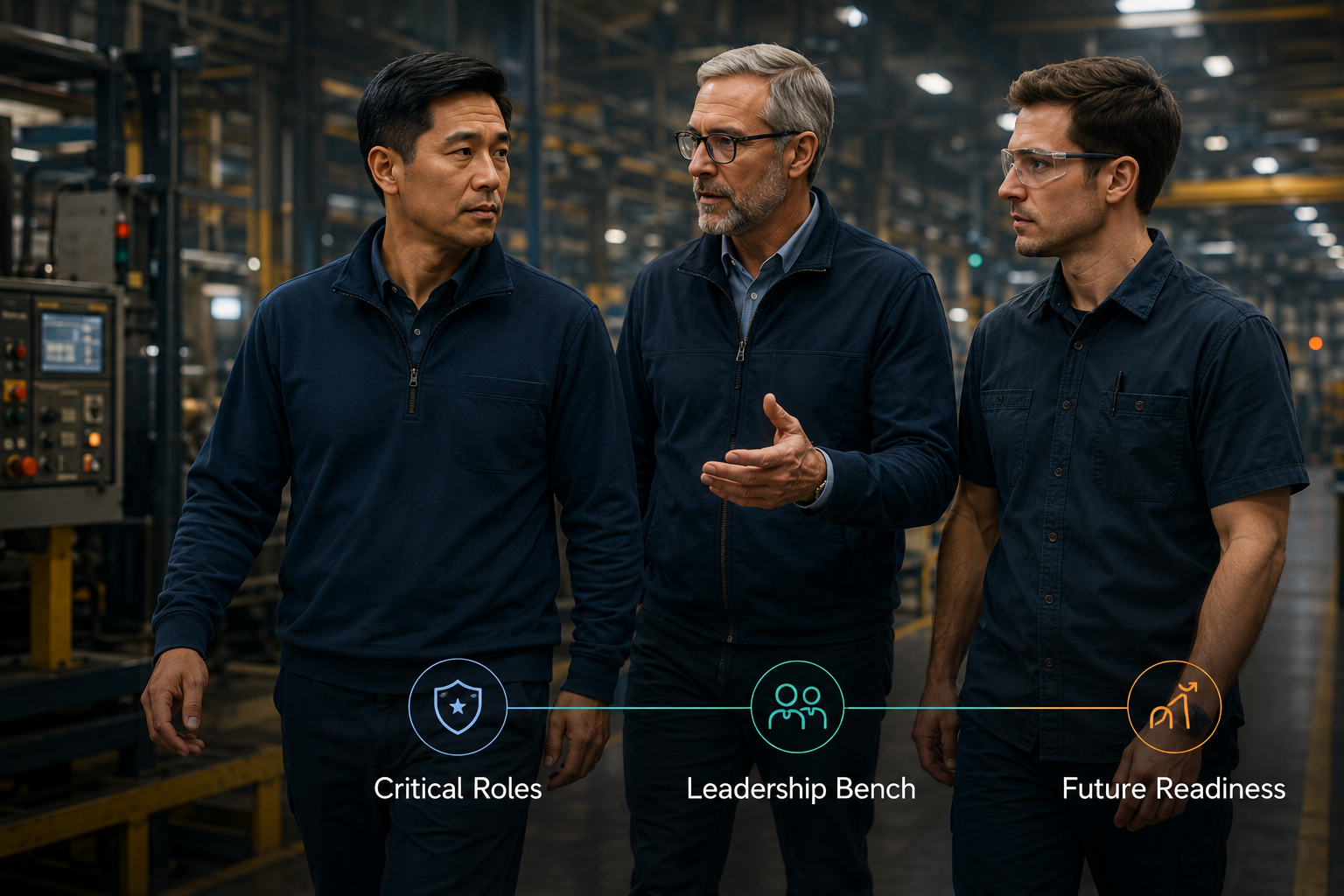
Summit and Marcus are fictional. Illustrations show product concepts and example data, not a deployed customer implementation. See current product availability.
A name on the succession list is only the beginning.
Summit knows its headcount, vacancies, training records, and organizational structure. Its harder questions concern continuity:
Which work would become vulnerable if a key person became unavailable? Who has relevant experience beyond their current role? What would prepare someone for broader responsibility?
Marcus is a trusted maintenance supervisor. That makes him worth considering for future leadership. It does not, by itself, establish readiness to coordinate an entire plant.
“What will our next stage require—and what evidence would show we are preparing people for it?”
01 · IDENTIFY CRITICAL WORK
Start with the work that cannot lose coverage.
Summit begins with the outcomes its expansion depends on: reliable operations, effective supervision, technical problem-solving, and coordination across locations.
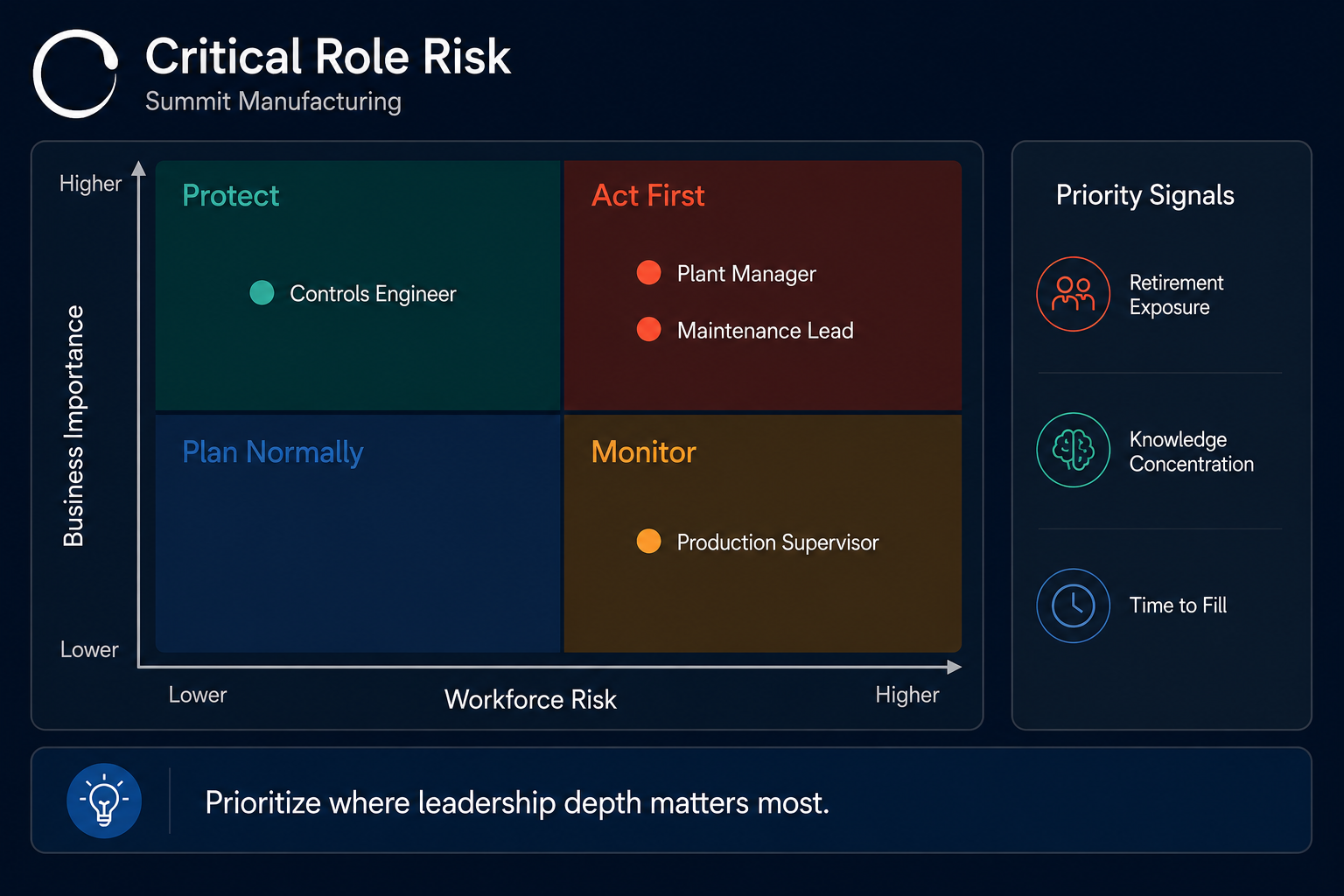
The illustrative matrix connects business importance with workforce exposure to focus further review.
The team examines which responsibilities are difficult to cover, where knowledge is concentrated, and how long replacement capability might take to develop.
A critical-role view could bring those dependencies together. Pythia could help leaders explain why a role matters and distinguish recorded facts from assumptions.
The decision is where to investigate and prepare first—not simply which vacancy to fill next.
02 · EXAMINE LEADERSHIP READINESS
Look for evidence behind the leadership bench.
Next, Summit examines possible successors against the work each role actually requires.

Readiness categories in this concept need supporting evidence, a defined role, and human review. They are not automatic promotion decisions.
For Marcus, the relevant questions extend beyond maintenance expertise:
- What experience demonstrates leadership across functions?
- Which decisions has he owned, and with what support?
- What broader operational exposure would he need?
- Does this direction fit his aspirations and circumstances?
The Talent Tree provides a way to connect responsibilities, activities, capabilities, and supporting evidence. A leadership Profile can organize the relevant context for review.
Readiness should have an explanation: what is demonstrated, what remains uncertain, and what additional experience would matter.
A readiness view supports a conversation. It does not select someone for promotion.
03 · BUILD A SUCCESSOR PATHWAY
Give Marcus a pathway he can help shape.
Suppose Marcus wants to explore broader plant leadership. Summit and Marcus could identify experiences that would help them evaluate that possibility.
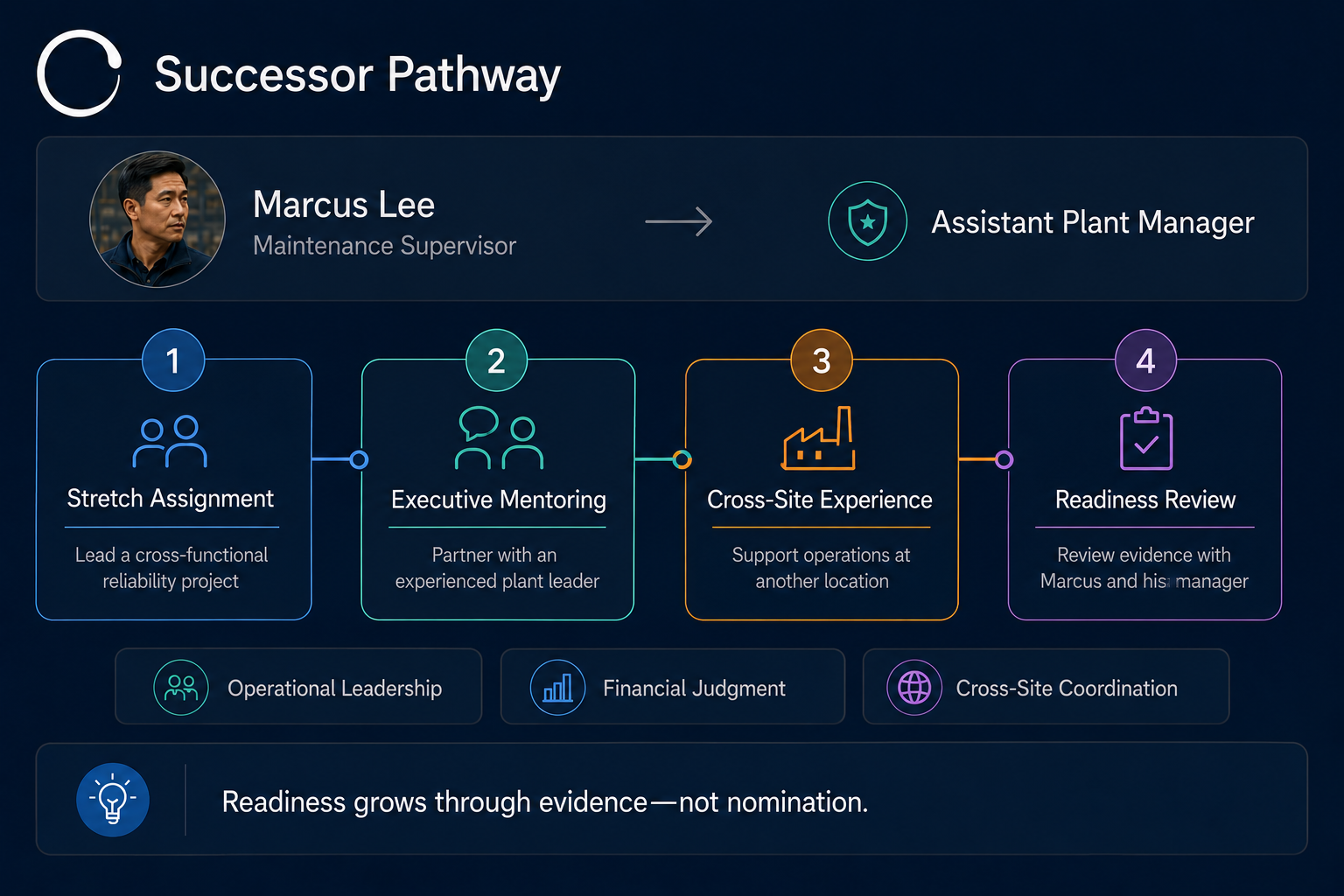
An illustrative development pathway connects real work, mentoring, broader exposure, and review.
Cross-functional assignment
Take responsibility for work that requires coordination beyond maintenance.
Experienced guidance
Discuss decisions, tradeoffs, and unfamiliar responsibilities with a plant leader.
Another location
Understand how operating conditions and working relationships differ.
New evidence
Review contributions, feedback, and remaining needs before deciding what follows.
Pythia could support reflection along the way. Profiles could bring the relevant experience into view for a focused review.
The pathway creates an opportunity to learn and demonstrate capability. It is not a promise of advancement or a fixed prediction of when Marcus will be ready.
04 · COMPARE WORKFORCE SCENARIOS
Test the workforce plan against more than one future.
Summit’s expansion could move faster, take longer, or require different capabilities than expected. A key role could become vacant before its internal pipeline is prepared.
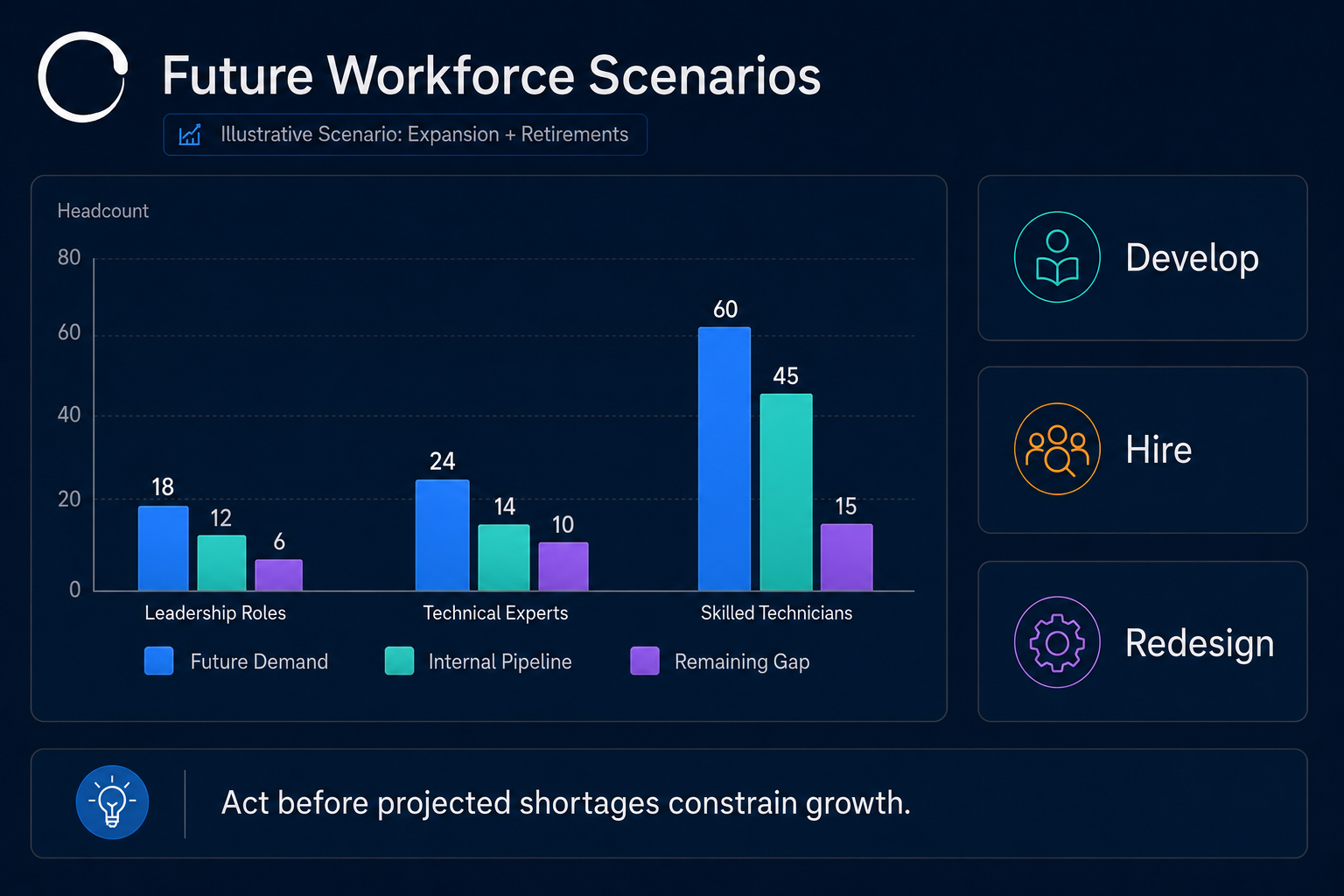
Illustrative demand and pipeline comparisons depend on the assumptions, timeframe, and evidence used.
A workforce scenario compares the work and capacity a defined future would require with the coverage Summit could reasonably expect. That comparison can inform several responses:
- Develop people through relevant experience.
- Transfer knowledge and strengthen backup coverage.
- Redeploy capability across locations.
- Recruit where internal pathways cannot meet the need.
- Redesign responsibilities or consider appropriate technology support.
Each scenario needs visible assumptions, a timeframe, and evidence behind its estimates.
“What should we prepare for, and what would change our decision?”
05 · KEEP THE PIPELINE CURRENT
Keep the evidence—and the conversation—current.
Marcus completes new work. His interests may evolve. Summit’s priorities and role requirements may change. Those developments should inform the next review.
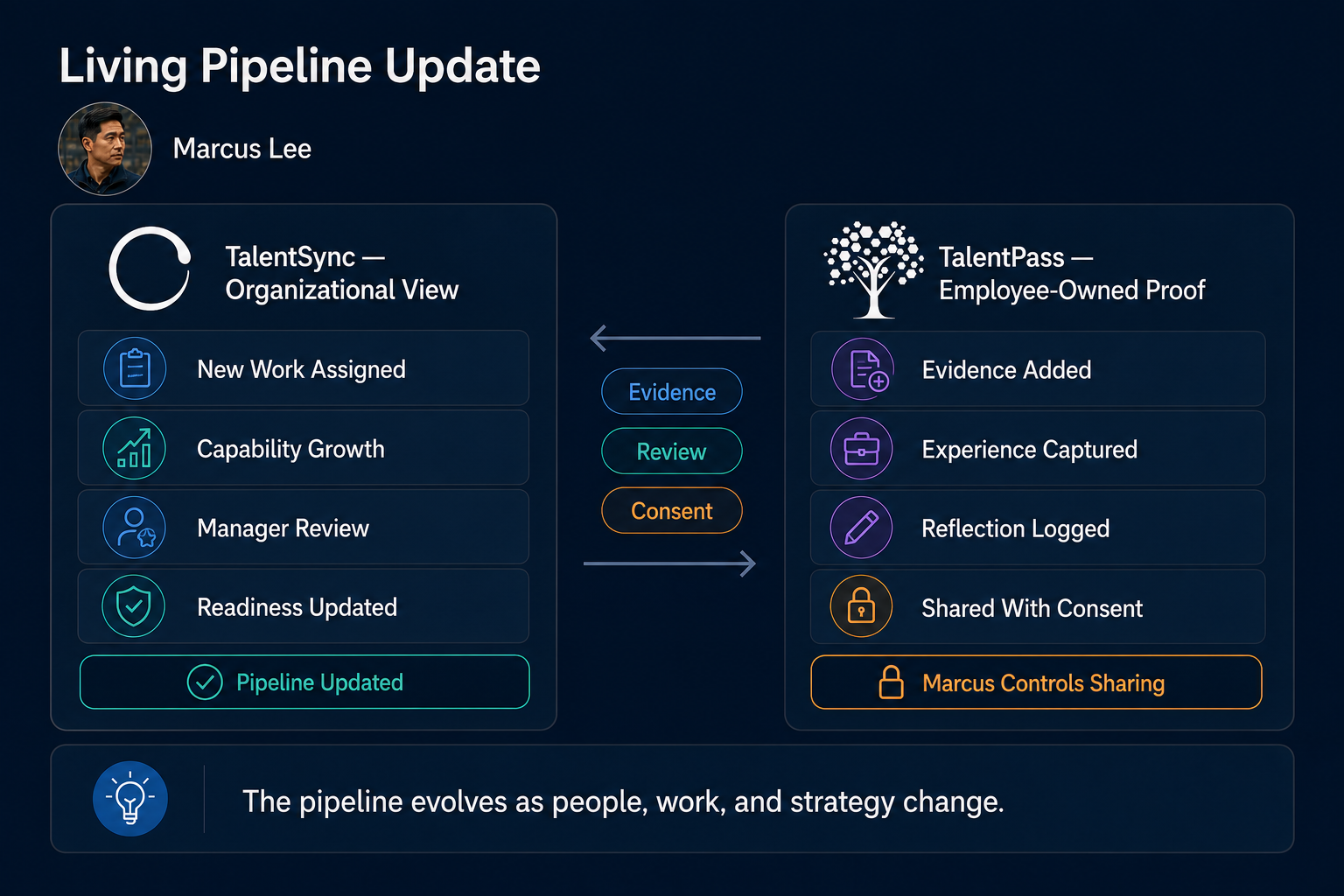
The concept connects employee-owned evidence, sharing choices, manager review, and workforce planning.
Passport Pages provide the intended framework for purposeful exchange between organizational context and person-controlled TalentPass information. Relevant contributions can support planning, while Marcus can receive recognition and useful records of his experience.
Summit needs to know who reviewed an interpretation, what supports it, and when it should be reconsidered. Marcus needs a way to contribute context and understand what is being shared.
A stronger pipeline creates better options.
For Marcus, the possible progression from maintenance supervisor to assistant plant manager becomes a development question with clear expectations and relevant experiences.
For Summit, succession planning becomes a way to build coverage deliberately, rather than wait for a vacancy. The organization would still need to evaluate whether its approach is working:
Critical-role coverage
Are important responsibilities supported beyond a single person?
Development progress
Are people gaining the experiences the future work requires?
Decision quality
Can leaders explain the evidence and uncertainty behind readiness judgments?
Employee participation
Do pathways reflect people’s goals as well as organizational needs?
These are outcomes to work toward and evaluate—not results achieved by a customer in this fictional scenario.
Where is your workforce plan least certain?
Start with the question in Summit’s story that feels most familiar.
“We know our growth target, but not the workforce it requires.”
Connect changing work with capacity, capability, and workforce response options.
“Too much depends on a few experienced people.”
Investigate critical knowledge, backup coverage, and responsibilities that would be difficult to sustain.
“We need another layer of leadership.”
Examine the management responsibilities, authority, capacity, and support the next stage requires.
These are possible starting points. Gobekli helps identify the appropriate workshop foundation and connected modules for one defined decision.
A workshop should produce useful next steps whether or not your organization continues into TalentSync.
Questions about workforce and succession planning
How are workforce planning and succession planning different?
Workforce planning considers the work, capabilities, and capacity an organization will need. Succession planning focuses on continuity and preparation for critical responsibilities and leadership roles. They connect when future workforce needs determine which pathways deserve attention.
What makes a role critical?
Consider the consequences of lost coverage, the concentration of knowledge or decision-making, and the time needed to rebuild capability. Critical responsibilities can sit outside senior management.
Does completing a development pathway establish readiness?
Completion provides evidence to examine. Readiness still depends on the role, demonstrated experience, remaining needs, and accountable human review.
Is this a current self-service TalentSync workflow?
This scenario describes the intended application. Available capabilities and implementation arrangements vary as TalentSync develops. Review current product availability when considering a setup.
Prepare for the responsibility
before it becomes a vacancy.
Begin with one critical role, leadership layer, or workforce decision. Clarify the work ahead, examine the evidence you have, and identify what would create stronger options for your organization and its people.
