- Home
- /
- Workshops
- /
- Learning Alignment Workshop Module
- /
- Alignment Governance & Change Impact
Alignment Governance & Change Impact
LEARNING ALIGNMENT WORKSHOP MODULE
Alignment Governance & Change Impact
When one part of the learning system changes, what else needs attention? Clarify ownership, decision rights, review cycles, and change processes so connected outcomes, activities, assessments, pathways, and requirements stay aligned.
Does this sound familiar?
Everyone contributes, but no one owns the relationship
Different teams maintain outcomes, courses, assessments, and requirements without clear responsibility for keeping their connections accurate.
A local improvement creates an unexpected gap elsewhere
A course or assessment changes without examining the preparation, evidence, or coverage another part of the program depends on.
Approval and implementation are treated as the same event
A change is authorized, but teaching materials, advising guidance, partner arrangements, or system records still reflect the earlier version.
Decisions stall because the roles are unclear
People disagree about who can propose, interpret, approve, implement, or review a change—or discover missing participants late in the process.
Earlier decisions lose their context
Teams can find the revised document but cannot readily explain why the change was made, which evidence informed it, or which conditions applied.
Review happens on a calendar while important changes go unnoticed
Scheduled reviews continue, but a new assessment, partner arrangement, external requirement, or learner issue does not trigger timely reconsideration.
What are alignment governance and change impact?
Alignment governance establishes how people maintain the relationships among learning outcomes, curriculum, activities, assessment, pathways, credentials, and relevant requirements.
It clarifies responsibilities for proposing changes, interpreting their implications, making decisions, implementing them, and reviewing their effects.
Change impact examines what else may need attention when one element of the learning system changes.
A revised outcome may affect activities and assessment. A changed prerequisite may affect several pathways. An updated external expectation may require a new interpretation of an existing crosswalk.
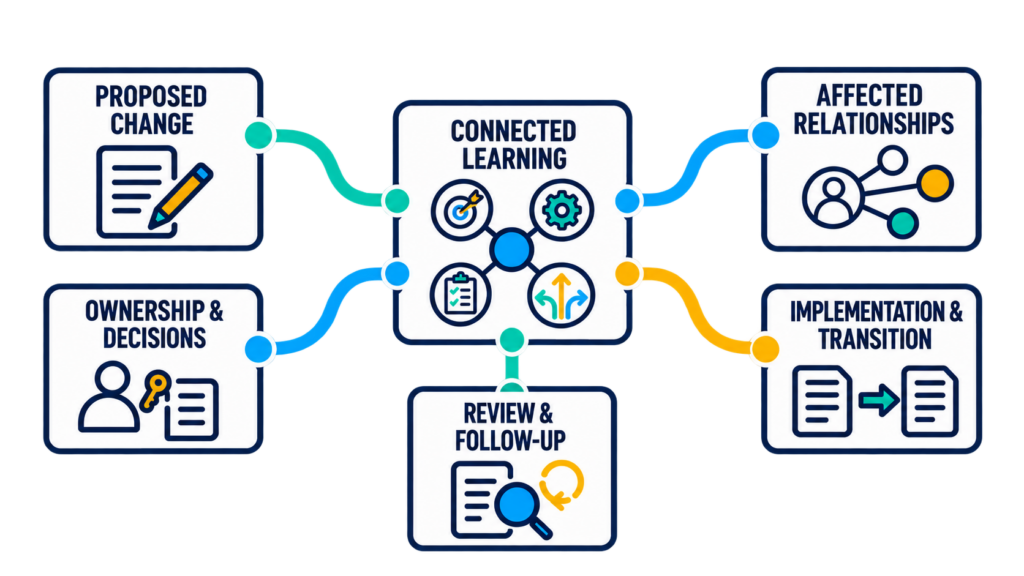
A useful approach connects the proposed change to its purpose, dependencies, decision roles, effective scope, and follow-up.
The aim is to make responsible improvement easier to carry through from the original question to the learning experience.
The change may be local. Its effects may travel.
Learning relationships cross document, department, system, and organizational boundaries.
The person editing a course may not own the program outcome it supports, the later course that depends on it, or the partner agreement that references it.
To understand a proposed change, your team may need to connect:
- The problem or opportunity prompting the change
- The element being modified
- The intended educational improvement
- Outcomes and capabilities connected to it
- Courses, activities, and assessments that depend on it
- Prerequisites, pathways, and progression relationships
- Credential claims and award requirements
- External references and recognition arrangements
- Delivery sites, modalities, and partners affected
- Learner groups and applicable versions
- Proposal, review, approval, and implementation responsibilities
- Communication and transition needs
- Evidence needed to evaluate the change
- Review dates and event-based triggers
These connections help participants identify what must be examined, who needs to contribute, and how the change will be carried into practice.
Connect the proposed change to its consequences and owners.
Change Purpose
Problem or opportunity
Proposed modification
Educational rationale
Intended improvement
Scope and assumptions
Learning Dependencies
Outcomes and capabilities
Courses and activities
Assessment and evidence
Pathways and prerequisites
Credentials and requirements
Decision Responsibilities
Proposal ownership
Relevant consultation
Academic interpretation
Approval authority
Unresolved questions
Implementation and Transition
Effective dates and versions
Materials and system records
Learner communication
Delivery and partner coordination
Transition arrangements
Review and Maintenance
Implementation confirmation
Evidence of effects
Follow-up responsibilities
Scheduled review
Change-triggered review
A change becomes easier to govern when its purpose, connected effects, responsible people, and review conditions remain visible together.
How an approved change leaves the learning system misaligned
STAGE 1 — A useful improvement is proposed
A team identifies a problem and develops a change to an outcome, course, assessment, requirement, or delivery arrangement.
STAGE 2 — The proposal is reviewed within its immediate scope
The discussion focuses on the element being changed while some connected relationships receive limited attention.
STAGE 3 — Implementation reaches different places at different times
Documents, systems, teaching practices, advising information, and partner arrangements do not all move to the new version together.
STAGE 4 — The consequences appear in learner experience
Learners encounter missing preparation, conflicting expectations, unclear requirements, or evidence gaps that were not addressed during the change process.
“The change was approved” leaves implementation and effects to examine.
Approval establishes that an authorized decision was made within a defined scope.
The organization still needs to understand what should change in practice, which relationships are affected, and how the result will be reviewed.
The review should clarify:
State the educational purpose, the available evidence, and the intended improvement. Record assumptions that still need to be tested.
Identify relevant outcomes, activities, assessments, pathways, credentials, external relationships, and delivery arrangements. Distinguish direct dependencies from possible effects requiring investigation.
Clarify proposal ownership, subject expertise, consultation, approval authority, and implementation responsibility. Identify questions that require another team or external party.
Define the applicable programs, cohorts, locations, dates, and delivery arrangements. Examine what happens for learners who began under an earlier version.
Identify materials, records, practices, communications, and partner arrangements that need updating. Assign responsibility for confirming that implementation occurred.
Define what information will be reviewed, when it will be available, who will interpret it, and what findings should prompt further action.
Examine governance across six dimensions.
Ownership
Identify who maintains each important learning element and who maintains its relationships with other elements.
Decision Rights
Clarify who can propose, advise, interpret, approve, implement, and review changes within the relevant scope.
Dependencies
Trace what the changed element supports, relies on, or is used to establish elsewhere.
Version and Scope
Record which arrangements and learners the change applies to and preserve the earlier context where needed.
Implementation
Coordinate the updates, communications, and transition actions needed to put the decision into practice.
Review
Establish how implementation and educational effects will be examined through scheduled and event-based review.
Changes that may fit established local authority
A change may be handled through an existing local process when it:
- Falls within clearly delegated decision rights
- Preserves the approved learning expectations
- Maintains relevant assessment demands
- Does not alter consequential pathway dependencies
- Uses resources already available for the activity
- Remains within agreed delivery or partner arrangements
- Has limited transition implications
- Can be documented and reviewed through the usual process
The appropriate route depends on the institution’s own responsibilities and decision arrangements.
Changes that may need broader coordination
Closer review may be needed when a change:
- Alters an outcome’s scope or expected level
- Removes a learning opportunity another course depends on
- Changes how an essential capability is assessed
- Modifies prerequisites or progression rules
- Affects the meaning or requirements of a credential
- Changes a transfer, partner, or external-reference relationship
- Creates different requirements for learner groups or versions
- Requires action from several teams to implement coherently
The review identifies the relevant consequences before selecting the decision and implementation route.
Removing an assignment can affect more than one course.
Imagine an instructor proposing to replace a written analysis with a shorter presentation to reduce duplication and improve engagement.
The course outcome still appears to be addressed.
A closer review finds that the written analysis also provides evidence for a program outcome, prepares learners for a later research course, and supports an existing requirement crosswalk.
The proposal may still be a good improvement. Participants need to examine whether the new activity preserves those contributions, whether another activity provides them, or whether connected arrangements need revision.
The change brief records the educational rationale, relevant dependencies, people who need to contribute, and how the revised arrangement will be reviewed.
The useful result is a decision that accounts for the connected learning system.
A review cycle needs both dates and triggers.
Scheduled review creates a regular opportunity to examine whether learning relationships remain appropriate.
Some changes deserve attention before the next scheduled review.
A revised assessment, new delivery partner, altered prerequisite, updated external reference, or recurring learner difficulty may call a particular relationship into question.
Participants identify which events should trigger review, who is expected to notice or report them, and what happens next.
The process should be proportionate to the issue. A small clarification may need a recorded local update, while a consequential dependency change may require coordinated interpretation and approval.
Preserve the version learners actually experienced.
A new curriculum version does not describe every learner’s earlier experience.
Record when a change takes effect, which learners and arrangements it applies to, and how continuing learners are supported through the transition.
That context helps people interpret requirements, assessment evidence, recognition decisions, and learning records accurately over time.
THE MATCHING WORKSHOP MODULE
Module 12: Alignment Governance & Change Impact
This practical minicourse helps academic leaders, faculty, curriculum teams, and relevant operational colleagues clarify how learning relationships are maintained as changes occur.
Participants learn a repeatable method and apply it to one proposed or recent change. They trace dependencies, distinguish decision and implementation roles, identify affected learners and versions, and define how the effects will be reviewed.
The exercise also identifies the ownership, dependency, decision, version, and review relationships that a subsequent Gobekli configuration would need to maintain.
This module helps your team:
- Define the purpose and scope of a proposed change
- Identify ownership of learning elements and relationships
- Clarify proposal, consultation, and decision responsibilities
- Trace direct and possible downstream effects
- Examine impacts on pathways, credentials, and requirements
- Identify affected learners and delivery arrangements
- Distinguish approval from implementation
- Plan communication and transition actions
- Preserve rationale, evidence, and version context
- Establish scheduled and event-based review
- Develop a focused change and governance brief
- Outline a connected ownership and change-impact configuration
What should happen when a change reveals a dependency?
Participants examine the significance of the relationship before proposing a response. The appropriate action may preserve the connection, modify the proposal, coordinate another change, or seek further review.
Confirm the Relationship
Document why the proposed change preserves the relevant learning connection and its conditions.
Clarify Ownership
Identify who maintains the affected element, interprets the relationship, and follows up on required action.
Adjust the Proposal
Revise the change where an important learning contribution or dependency would otherwise be lost.
Coordinate Connected Changes
Plan updates to related activities, assessments, pathways, records, or partner arrangements.
Plan the Transition
Clarify effective dates, learner communication, version differences, and implementation responsibilities.
Refer for Review
Bring unresolved consequences or authority questions to the people responsible for determining the next step.
Several responses may apply to the same proposal. Record the decision route, dependencies, responsible people, and conditions that must be addressed before implementation.
What should an alignment governance and change-impact review examine?
The purpose and evidence
Why is the change proposed, and what information supports the intended improvement?
The affected relationships
What learning, assessment, pathway, recognition, or delivery connections may change?
The decision route
Who proposes, contributes expertise, interprets implications, and authorizes the relevant decisions?
The implementation
Which documents, systems, practices, communications, and partner arrangements need action?
The learner and version context
Who is affected, when does the change apply, and what transition arrangements are needed?
The follow-up
How will implementation and educational effects be reviewed, and who responds to the findings?
Learn the method. Trace one change through its connected relationships.
Bring one proposed or recently implemented change to an outcome, course, activity, assessment, pathway, requirement, or delivery arrangement.
STEP 1
Define the change and its purpose
Describe the current arrangement, proposed modification, intended improvement, and evidence prompting the proposal.
STEP 2
Trace the dependencies
Identify what the changed element supports and relies on. Record direct connections and possible effects that require further investigation.
STEP 3
Clarify decision responsibilities
Identify the proposal owner, relevant contributors, authorized decision roles, and people responsible for implementation.
STEP 4
Define scope and transition
Record affected learners, versions, dates, sites, partners, and the actions needed to manage the transition.
STEP 5
Plan implementation and communication
List the materials, records, practices, and guidance that need updating. Assign responsibility for confirming completion.
STEP 6
Establish review and configuration needs
Define the follow-up evidence, review point, event triggers, and relationships a future implementation would need to maintain.
Participants leave with a documented change-impact review, a proposed coordination plan, and a starting configuration brief. The record distinguishes confirmed dependencies from possible effects that still need investigation.
- Begin with a specific change and educational purpose
- Trace relationships beyond the document being edited
- Clarify ownership and decision authority
- Preserve learner, date, and version context
- Separate approval, implementation, and review
- Assign responsibility for acting on the findings
FUTURE PRODUCT CONNECTION
Keep ownership and change decisions connected to the learning system.
The workshop identifies the information and relationships needed to understand what a change may affect and who needs to act.
A potential TalentSync EDU configuration could connect learning profiles and dependencies to responsible roles, proposed changes, decisions, implementation actions, and review records.
The proposed configuration could connect:
- Learning element profiles: the outcomes, courses, activities, assessments, pathways, credentials, or requirements involved
- Dependency relationships: what each element supports, relies on, or helps establish elsewhere
- Ownership relationships: who maintains the element and who maintains its important connections
- Decision roles: who proposes, advises, interprets, approves, implements, and reviews within the relevant scope
- Change records: the proposal, rationale, supporting information, intended improvement, and unresolved questions
- Impact relationships: confirmed and possible effects on connected learning and delivery arrangements
- Version and applicability records: effective dates, affected programs, cohorts, locations, and earlier arrangements
- Implementation actions: updates to materials, systems, practices, guidance, and partner arrangements
- Communication responsibilities: who needs to know about the change, what they need to understand, and who informs them
- Review conditions: follow-up evidence, scheduled dates, event triggers, and responsibility for responding
- Learner connections: relevant experience and requirement context a learner chooses to organize or share through TalentPass
For example, the workshop might identify that a prerequisite change affects two later courses, an advising guide, and a partner pathway. An implementation brief could specify the changed requirement, readiness dependencies, responsible reviewers, affected learner groups, record updates, partner communication, and follow-up review.
Where learner context is relevant, TalentPass could help preserve information about the experiences, requirements, and evidence associated with the learner’s actual route. Institutional changes would need to be interpreted in relation to that history rather than assuming every learner followed the newest arrangement.
The next step is a scoped implementation conversation: select the initial change process and learning scope, confirm available capabilities, identify integration or development needs, and agree on responsibilities and success criteria.
PRODUCT AND DECISION BOUNDARIES
Keep ownership, approval, implementation, and evidence distinct.
A connected configuration should help people understand the decision and carry it into practice with appropriate review.
Its design should preserve the distinction between:
- Maintaining a record and holding decision authority
- Contributing expertise and approving a change
- A possible dependency and a confirmed impact
- Approval of a proposal and completion of implementation
- Updating a document and changing actual practice
- The current curriculum and an earlier learner’s experience
- Observing a result and establishing what caused it
- Access to relevant learner context and permission to share all underlying information
Authorized institutional roles retain responsibility for decisions within their scope. Partners and external authorities retain their respective responsibilities.
The product connection described here includes capabilities envisioned for TalentSync EDU and potential TalentPass connections. Availability, configuration needs, integrations, and required development would be confirmed during scoping.
The workshop produces a useful governance and change-impact brief independently of product adoption.
What to bring into the conversation
Start with one change that crosses responsibilities, has uncertain consequences, or was difficult to implement consistently.
A useful starting question is: “If we change this, what else needs attention, who needs to act, and how will we review the result?”
Useful inputs may include:
- The selected proposal or recent change
- The current and proposed arrangements
- The problem or opportunity prompting it
- Supporting evidence and intended improvement
- Relevant learning outcomes
- Connected courses and activities
- Assessment and evidence relationships
- Prerequisite and progression dependencies
- Credential or award requirements
- Relevant external-reference relationships
- Existing ownership and decision arrangements
- Curriculum review or approval procedures
- Affected delivery and partner arrangements
- Applicable learner groups and versions
- Implementation responsibilities
- Relevant system and document locations
- Communication and transition plans
- Previous decisions or review findings
- Scheduled reviews and possible event triggers
- The decision the review should support
The required Learning Alignment Direction module establishes the scope and decision this work should support. Findings from other selected modules can provide concrete relationships and improvement proposals for this governance exercise.
The depth of the exercise depends on the change selected, available information, participation from the relevant roles, and time allocated within the workshop.
What this module can help your team produce
An ownership and decision brief
A clear account of who maintains the selected relationships and who proposes, advises, approves, implements, and reviews relevant changes.
A documented change-impact map
A structured view of the affected learning elements, confirmed dependencies, possible consequences, and questions requiring further investigation.
A practical implementation and review plan
A proposed sequence of actions covering versions, learner transitions, communication, responsible people, and follow-up evidence.
A starting configuration brief
An outline of the learning profiles, dependencies, ownership roles, change records, version relationships, and review triggers a subsequent Gobekli implementation would need.
These outputs begin with the change reviewed during the module. Final scope depends on the modules selected, available inputs, and the alignment decision established through Learning Alignment Direction.
Where might the work lead next?
A change-impact review may reveal a shift in curriculum coverage, a readiness dependency that needs examination, or an external relationship affected by the proposal.
Curriculum Coverage & Progression
Examine how the change affects where important learning develops and how it progresses across required pathways.
Prerequisites & Course Sequencing
Review the preparation and progression relationships that a course or requirement change may affect.
Framework & Requirement Crosswalks
Reconsider mappings, supporting evidence, and review responsibilities when institutional or external expectations change.
Questions institutions ask before beginning.
Alignment governance clarifies how people maintain the relationships among learning outcomes, curriculum, activities, assessment, pathways, credentials, and relevant requirements. It includes ownership, decisions, implementation, and review.
It examines what else may need attention when an outcome, course, assessment, requirement, or delivery arrangement changes. The review identifies dependencies, affected people, implementation needs, and follow-up questions.
The appropriate route depends on the institution’s decision arrangements and the consequences of the proposal. A useful process distinguishes changes within delegated local authority from changes requiring broader coordination or approval.
An owner may maintain an element or relationship and coordinate its review. Approval authority concerns who is authorized to make a particular decision. These roles may overlap, but they should be made explicit.
The review should identify an accountable role and clarify how the departments contribute. The appropriate arrangement depends on the relationship and the institution’s existing responsibilities.
Begin with direct dependencies and follow consequential connections relevant to the decision. Record possible effects that require investigation without treating every connection as a confirmed impact.
Start with the selected change and the relationships participants can identify from available sources. Record missing information and who can confirm it. The exercise can reveal where better mapping would support future decisions.
Approval is one stage. The organization also needs to coordinate implementation, confirm relevant updates, communicate with affected people, and review the result.
Identify which requirements and versions apply to them, what changes in their route, and what guidance or transition arrangements are needed. Preserve the context of the learning they actually experienced.
Relevant triggers may include changes to outcomes, assessments, prerequisites, delivery partners, external references, or recurring learner issues. The organization should define which events require attention and who responds.
Identify the partner contribution, the connected institutional responsibilities, and the agreement or process governing the relationship. Clarify what needs discussion, approval, communication, and implementation on each side.
Define the intended improvement and the evidence that will help examine it. Review implementation and educational effects separately, and consider other influences before attributing a result to the change.
Software may help surface recorded dependencies and coordinate review. Its usefulness depends on the relationships and context available. Relevant people still need to examine unrecorded dependencies, interpret consequences, and make decisions.
Include the proposal owner, people who understand the affected learning relationships, relevant decision roles, and those responsible for implementation and communication. Partner or learner perspectives may also be important to the selected change.
The reviewed example identifies learning profiles, dependency relationships, ownership, decision roles, change records, applicable versions, and review triggers that need to remain connected. These become the starting point for scoping a potential TalentSync EDU configuration and appropriate TalentPass connections.
No. The review method and governance brief are useful independently. A subsequent implementation can be considered if your organization wants help maintaining dependencies and coordinating change. Product availability and implementation requirements are confirmed during scoping.
KEEP ALIGNMENT WORKING AS LEARNING CHANGES
Make the next change with its connections in view.
Clarify who decides, trace what else needs attention, and plan how the change reaches learners. Leave with a focused governance and change-impact brief and a starting configuration plan.
This module is part of Gobekli’s configurable Learning Alignment Workshop. Begin with Learning Alignment Direction, then select the modules that address your organization’s particular challenges.