How Horizon Financial Services Turns AI Adoption Into Continuous Transformation
Horizon Financial Services is a fictional 5,000-person organization introducing AI across commercial lending, operations, risk, compliance, and customer support.
It can track licenses, tool usage, pilots, and adoption. But those measures cannot tell Horizon whether work is actually improving, where value is emerging, how roles are changing, or where human judgment and new capabilities are becoming more important.
To scale AI responsibly, Horizon needs more than adoption data. It needs a living understanding of how people, work, systems, and AI are changing together.
Gobekli helps Horizon build that Human Intelligence Layer—turning everyday work signals into the shared context leaders, teams, and AI need to continuously improve.
Then retain the comparison section, with slightly revised language:
Horizon can see AI usage.
It cannot yet see transformation.
They can see:
Licenses
Tool usage
Pilot activity
General adoption
They cannot yet see:
Which workflows are actually improving
Where AI is reducing delay, rework, or duplicated effort
How roles, responsibilities, and handoffs are changing
Where customer, compliance, or judgment risk is increasing
Which employees are creating value and developing new capabilities
Which experiments should scale, pause, or remain human-led
Gobekli gives Horizon
the missing transformation layer:
Connect AI to business value - Understand how AI affects revenue, cost, waste, risk, and service quality.
Improve how work flows - See how workflows, responsibilities, handoffs, and management practices are changing.
Engage and reward employees - Turn meaningful contributions into recognition, growth support, and portable proof.
Scale with greater confidence - Separate evidence-backed improvements from assumptions before expanding AI across the organization.
Three Steps to Turn AI Adoption Into Continuous Transformation
Horizon builds its Human Intelligence Layer through a continuous three-part process:
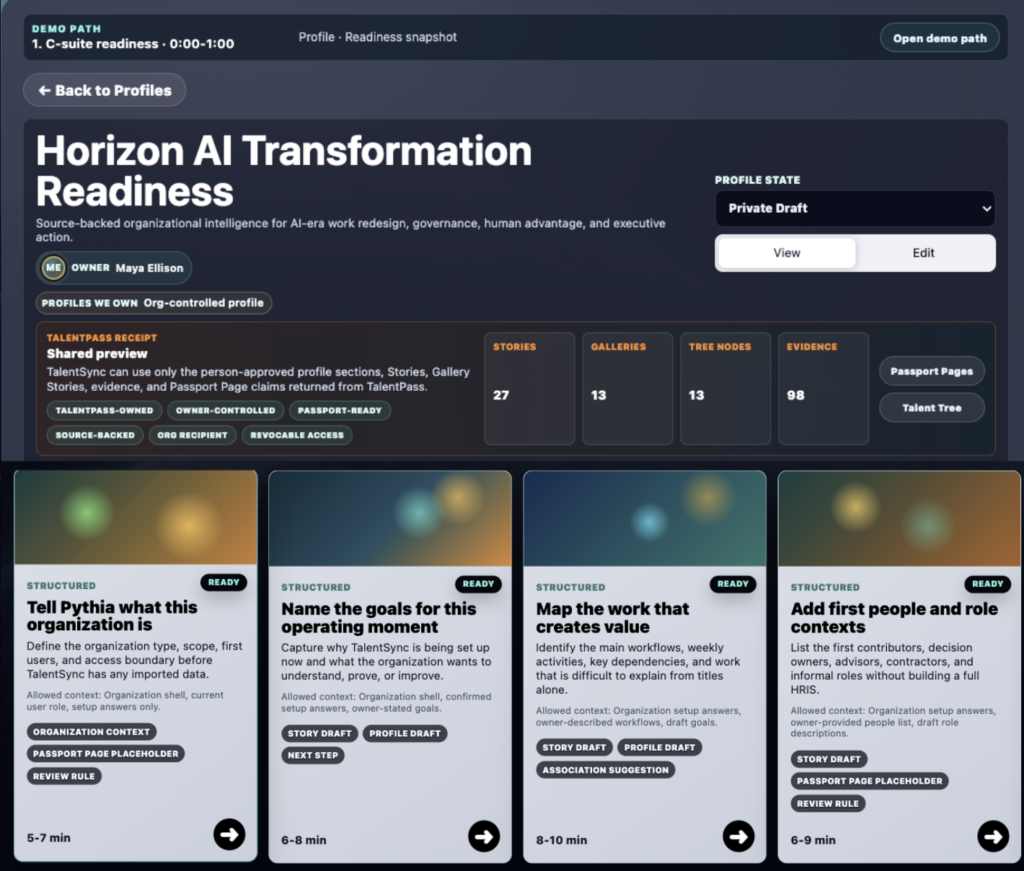
1. Configure TalentSync
Create an initial map of the teams, roles, workflows, systems, priorities, and governance requirements shaping AI transformation.
2. Activate Participation
Invite managers and employees to contribute real work context, validate what is changing, and identify where AI is helping, creating friction, or introducing risk.
3. Improve Continuously
Turn those signals into clearer decisions, stronger teams, better workflows, employee growth, and more useful context for AI.
Each cycle helps Horizon understand what is changing, act on what it learns, and continuously improve how people and AI work together.
1. Configure TalentSync
Horizon creates a shared map of its people, work, systems, and transformation priorities.
AI transformation does not happen in isolation. It unfolds across teams, workflows, technologies, policies, goals, and the people responsible for the work.
Horizon begins by bringing that fragmented context together in TalentSync. This creates the shared foundation managers, employees, leaders, and AI systems will continuously build upon.
1. Map the Organization
Horizon establishes the initial structure for its transformation by connecting:
Strategic priorities and desired business outcomes
Teams, roles, and areas of responsibility
Critical workflows and operational handoffs
AI tools and enterprise systems
Governance, compliance, and risk requirements
Existing documents and operating materials help TalentSync create the starting map. Leaders then invite operational managers to validate it, add missing context, and connect it to how work actually happens.
The result is not a static organizational chart. It is a living map of the people, work, systems, and decisions shaping AI transformation.
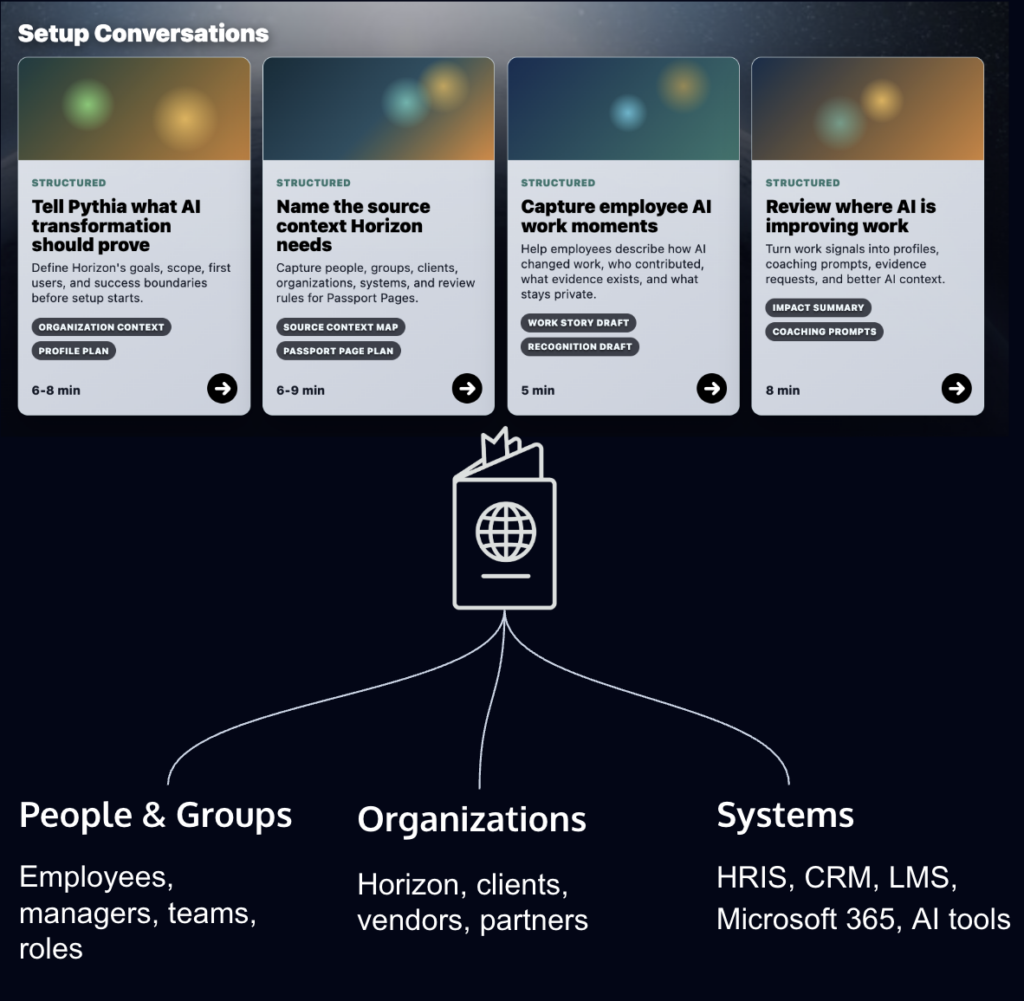
2. Connect Source Context
Horizon connects the people, systems, records, and evidence that help explain how work is actually happening.
Managers use Pythia to identify the sources shaping each team and workflow, including:
Employees and collaborators
Organizational policies and operating procedures
Enterprise systems and AI tools
Project documents and work records
Credentials, qualifications, and relevant evidence
External partners and service providers
Passport Pages establish permissioned connections between those sources. They define what information can be exchanged, where it came from, and how it may be used.
This gives Horizon a more trustworthy foundation for understanding change without pulling every piece of information into another centralized employee record.
Instead of relying on disconnected reports or unverified claims, Horizon can understand each signal in relation to its source, context, and evidence.
3. Structure Intelligence
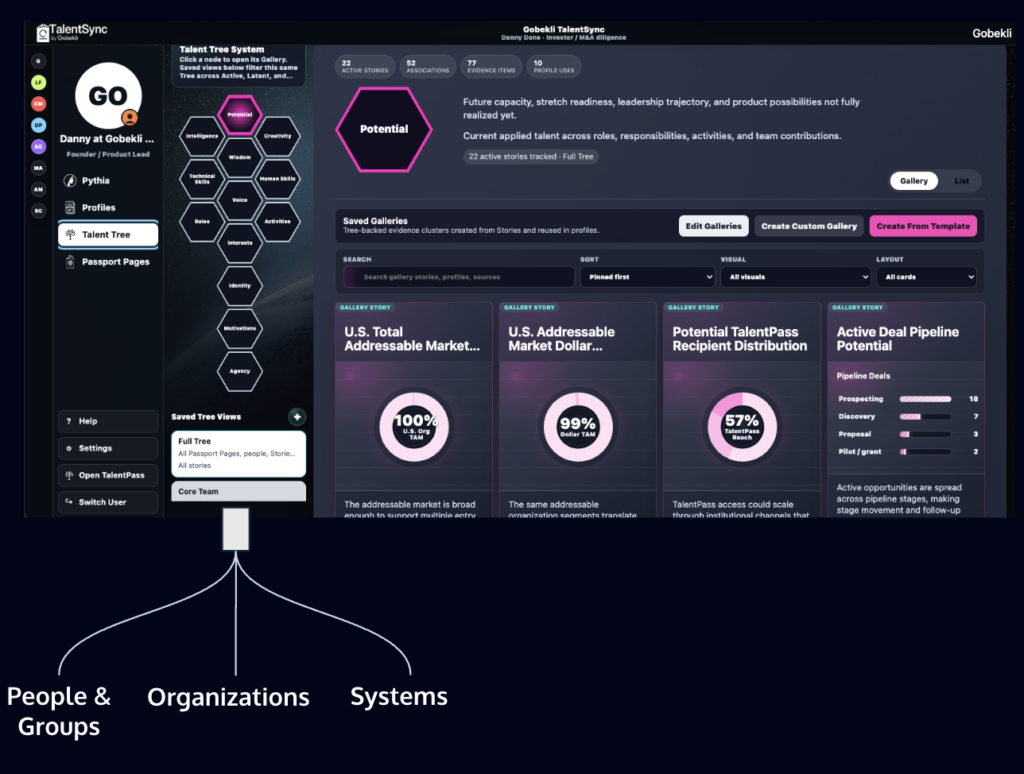
TalentSync organizes Horizon’s people, work, capabilities, goals, evidence, and outcomes through a shared Organizational Talent Tree.
Work signals can become:
Stories that explain meaningful contributions or changes
Evidence requests that help validate important claims
Talent Tree context about capabilities, relationships, and work
Team, workflow, and transformation profiles
Private guidance or follow-up conversations
This structure helps leaders and AI systems understand not only what happened, but who contributed, which work was affected, what capabilities were involved, and why the signal matters.
Horizon gains a living source of organizational intelligence—not another collection of disconnected workforce data.
4. Define Success Views
Horizon creates focused profiles for the teams, workflows, and transformation outcomes it needs to understand.
Rather than forcing every decision into a single dashboard or score, leaders define the context and evidence relevant to each objective.
Team profiles
AI Transformation Readiness
Commercial Lending Team Flow
Risk and Compliance Review
Customer Operations Quality
Workflow profiles
Loan Exception Review
Risk Report Assembly
Customer Response Drafting
Human–AI Collaboration
Each profile brings together the relevant people, responsibilities, work signals, capabilities, evidence, risks, and goals.
Profiles turn Horizon’s shared intelligence into practical views leaders and teams can use to make decisions, guide improvement, and give AI better context.
2. Activate Participation
Managers bring their teams into the transformation process.
AI transformation cannot be understood from system data alone. The people doing the work see where AI saves time, introduces friction, changes responsibilities, improves outcomes, or creates new risks.
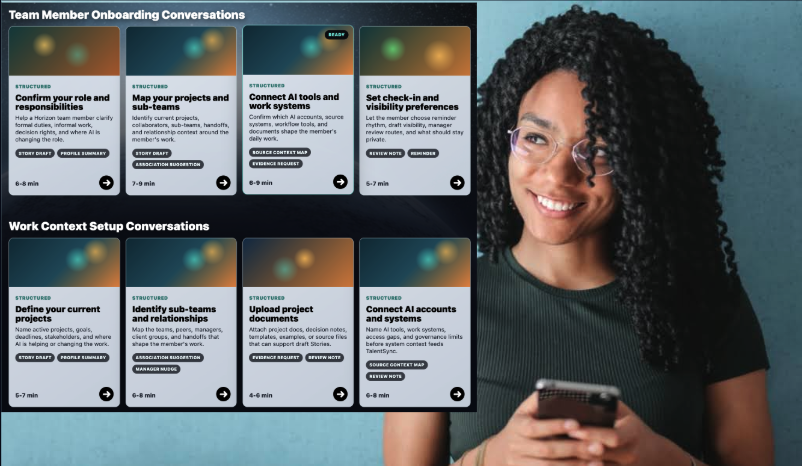
Horizon invites managers and employees to contribute that missing context through focused TalentSync profiles, permissioned Passport Page connections, and guided Pythia conversations.
Participation is designed to create value for both sides: Horizon gains a clearer understanding of how work is changing, while employees gain guidance, recognition, development support, and portable evidence of their contributions.
1. Establish the Team’s Starting Point
Managers begin with a guided TalentSync setup conversation that helps them clarify:
Team goals and current priorities
Roles, responsibilities, and decision ownership
Active projects, workflows, and handoffs
Existing subteams and working relationships
AI tools and enterprise systems being used
Documents and evidence relevant to the work
Current challenges, risks, and improvement opportunities
Preferences for future check-ins and updates
Pythia uses this context to help managers create the initial team and workflow profiles their people will contribute to.
The organization establishes the structure—but managers ground it in the reality of how their teams actually work.
2. Invite Team Members to Build the Shared Picture
Employees join the relevant team, workflow, and transformation profiles through TalentSync.
Each person can review the work they own, the teams they support, and the profiles they have been invited to contribute to. Pythia then helps them add the context only they can provide, including:
Responsibilities and activities they perform
Projects and workflows they contribute to
AI tools they use and how they use them
Changes in workload, handoffs, or decision-making
Friction, risks, and opportunities they observe
Capabilities they are applying or developing
Support, resources, or guidance they need
Profiles remain current through Pythia check-ins, Passport Page connections, relevant system integrations, and reviewed work signals.
Employees do not need to expose their entire professional identity to participate. They contribute relevant context to specific profiles while retaining control over their personal information.
Each contribution adds another piece of the shared picture—helping Horizon understand how transformation is unfolding across real work.
3. Connect TalentPass and Make Participation Valuable
Employees can connect their TalentPass through a permissioned Passport Page.
This creates a two-way connection between Horizon’s organizational intelligence and the individual’s own talent intelligence.
Through that connection, employees can:
Contribute relevant experience, capabilities, goals, and evidence
Receive organizational records, resources, and guidance
Review recognition generated through their work
Add supporting context or evidence
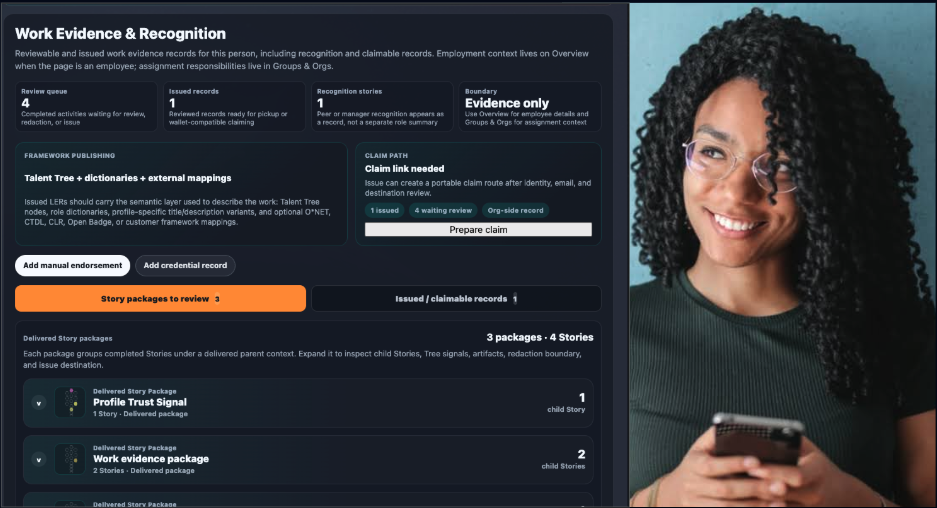
Claim verified contributions in TalentPass
Carry approved recognition and proof into future opportunities
Horizon gains more accurate and continuously improving human context. Employees gain something meaningful in return: greater visibility, better guidance, stronger growth support, and portable recognition they can keep.
Participation becomes a value exchange—not another request for employees to surrender data to the organization.
3. Improve Continuously
Horizon turns everyday work signals into better AI ROI, stronger teams, and safer decisions.
Once people, work, systems, and goals are connected, Horizon can continuously learn from what is happening across the organization.
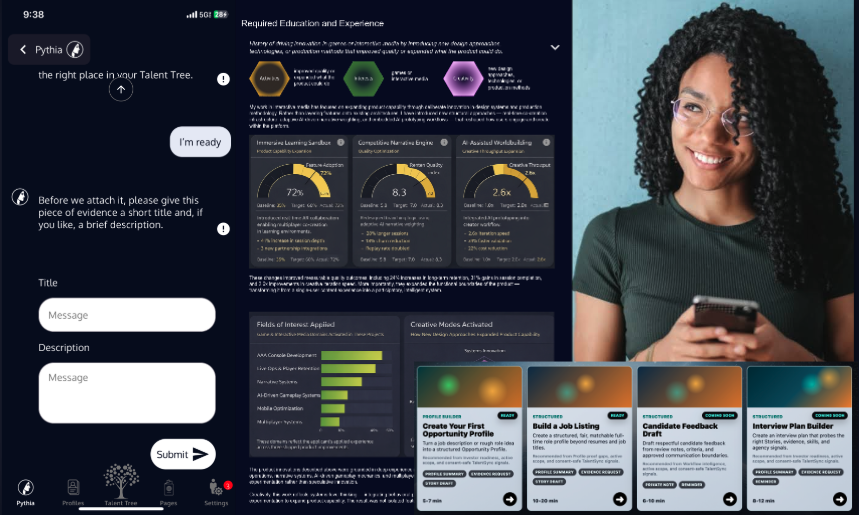
Pythia helps employees and managers capture meaningful work signals, distinguish observations from validated evidence, and turn what they learn into practical improvements.
Instead of waiting for an annual review, transformation report, or failed implementation, Horizon can identify emerging value, friction, capability needs, and risks while there is still time to act.
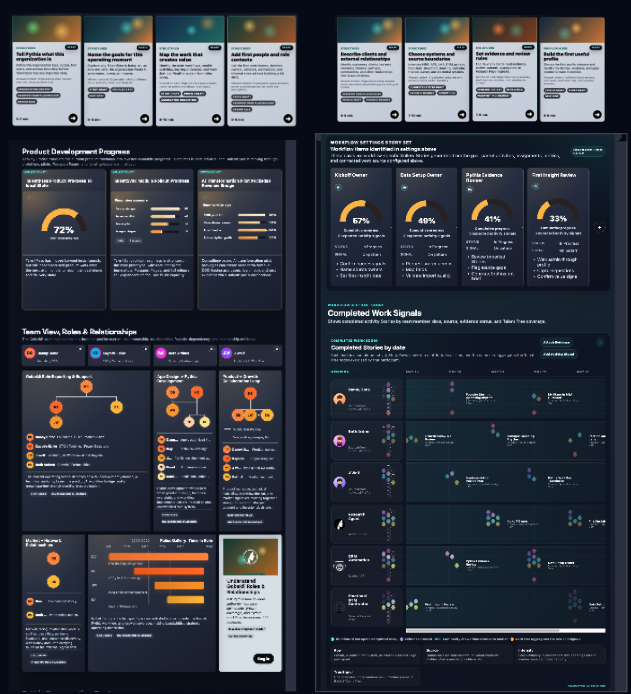
1. Recognize Meaningful Work Signals
Pythia surfaces where AI is changing work, roles, friction, and risk.
Employees and managers use Pythia to capture important moments as work evolves, including:
Where AI saves time or improves quality
Where it creates rework, delay, or confusion
How responsibilities and decisions are changing
Which human capabilities are becoming more important
Where handoffs or workflows are breaking down
What employees are learning through experimentation
Where customer, compliance, or judgment risks are appearing
Which contributions deserve recognition
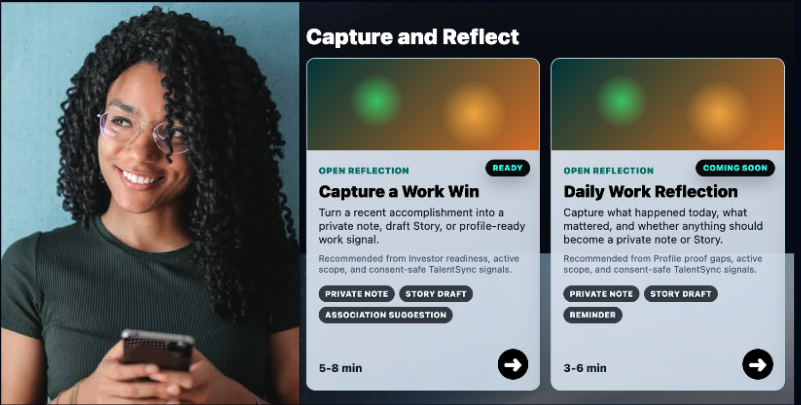
Not every observation immediately becomes an organizational fact. Pythia can help turn a work signal into:
A private reflection
A draft Story
An evidence request
A coaching prompt
A team discussion
A proposed workflow improvement
A reviewed contribution
This allows Horizon to learn quickly without treating every claim, impression, or AI-generated interpretation as verified truth.
Real work becomes a continuous source of intelligence—while evidence, review, and human judgment remain visible.
2. Improve Team Flow and Redesign Work
Managers use reviewed work signals to understand how AI is affecting workflows, responsibilities, handoffs, decisions, and team performance.
With that context, teams can:
Identify where AI can remove friction or repetitive work
Redesign responsibilities as tasks change
Improve handoffs between people, teams, and systems
Clarify where people remain accountable for decisions
Protect human judgment in high-risk or high-context work
Adjust coaching, resources, and development priorities
Recognize emerging capabilities and contribution patterns
Update team and workflow profiles as work evolves
Changes are then reflected in TalentSync, giving everyone a clearer understanding of how the work should operate moving forward.
This creates a continuous improvement loop: teams observe what is happening, evaluate the evidence, make targeted changes, and learn from the results.
Horizon does not simply automate existing work. It helps people intentionally redesign how work gets done.
3. Recognize Contribution and Support Growth
When employees help improve a workflow, apply a valuable capability, reduce risk, support colleagues, or create better outcomes, those contributions should not disappear inside a project update or manager’s memory.
Employees can review what they are being recognized for, add relevant evidence or context, acknowledge collaborators, and decide whether to carry approved recognition into their own TalentPass.
This helps Horizon identify and develop the people creating value throughout transformation—while giving employees a direct and lasting benefit from their participation.
The organization learns from people’s contributions, and people grow through the value they help create.
Horizon Turns AI Adoption Into Business Impact
Grow Revenue
Identify workflow and AI improvements that strengthen customer service, increase capacity, improve sales flow, and create new value.
Reduce Waste and Loss
Find broken handoffs, duplicated effort, underused tools, unnecessary rework, and workflow friction before they spread.
Lower Risk
Keep human judgment, compliance review, evidence boundaries, accountability, and emerging AI risks visible.
Strengthen Culture
Make transformation valuable for employees through participation, recognition, growth support, and greater trust.
TalentSync connects human work signals to the outcomes Horizon already cares about—helping the organization grow revenue, reduce waste, manage risk, and strengthen its culture.
A Continuous Human Intelligence Loop
People Contribute Real Work Context
Employees capture meaningful work moments, evidence, blockers, lessons, changing responsibilities, and AI-assisted activity.
Managers Improve How Work Gets Done
Teams use reviewed signals to redesign workflows, strengthen handoffs, guide coaching, and clarify accountability.
AI Receives Better Human Context
Profiles and Passport Pages give AI systems clearer, more trustworthy context about people, work, capabilities, goals, and evidence.
Employees Gain Recognition and Opportunity
Reviewed contributions can become organizational recognition, personalized growth support, new opportunities, and portable proof.
Each cycle creates better work signals, better decisions, more useful AI, and a stronger partnership between Horizon and its people.
Build workforce and leadership readiness before critical gaps emerge. TalentSync and TalentPass help organizations identify workforce risks, evaluate bench strength, create evidence-based successor pathways, model future scenarios, and keep plans ...
Develop people for the work ahead by connecting changing responsibilities with focused development, real-world practice, manager support, and portable evidence of growth. TalentSync and TalentPass help organizations and employees learn ...
TalentPass and TalentSync help organizations see more of what their people can contribute, connect them with relevant internal opportunities, and support clear pathways for development, recognition, and mobility.
TalentSync gives managers and employees a shared understanding of their team’s responsibilities, capabilities, knowledge, relationships, and needs—helping them improve performance, adapt to AI, recognize contributions, and grow together.
Hiring has entered a new era. AI has made it easier than ever to generate résumés and submit hundreds of applications, making it harder for recruiters to identify real capability. ...