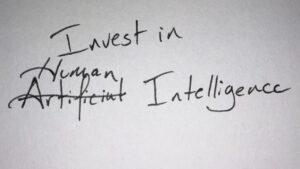
Why AI Transformation Needs a Human Intelligence Layer
Organizations have invested trillions of dollars in advancing artificial intelligence while giving far less attention to the human intelligence that gives it purpose, supplies its context, and must ultimately develop alongside it.
The consequences will not remain abstract. People will experience them through work: which responsibilities change, whose judgment remains valuable, who gains opportunities to grow, who shares in the benefits, and who gets left behind.
These outcomes are not predetermined by AI. They are being shaped by the decisions organizations make today.
In his LinkedIn article, “The Missing Layer of AI Transformation,” Gobekli founder Danny Done asks a more meaningful question than how many copilots an organization has deployed: Do you actually know whether AI is making your organization better?
Organizations can see AI spreading—but not themselves changing
Most AI transformation programs measure adoption, usage, automation, and potential time savings. Those metrics do not reveal whether AI is improving the work.
Is AI helping an organization hire and develop the right people? Are teams collaborating more effectively? Are managers making better decisions? Is performance improving without creating hidden risk, friction, or burnout? Is the organization becoming more adaptable and capable?
Or is it simply completing more activity faster without understanding whether that activity produces better outcomes?
Most organizations cannot answer these questions confidently. They possess enormous amounts of workforce data—titles, employment histories, credentials, training records, performance ratings, and system activity—but little living understanding of how people actually work, how they exercise judgment, what they are capable of, or where they could create value next.
Increasingly intelligent technology is now being placed into the middle of that blindness.
Human context disappears across the enterprise stack
The modern enterprise contains applications, data platforms, analytics, AI models, and autonomous agents. These systems make information more structured and accessible, but they frequently remove the human meaning surrounding it.
A workflow system may know that someone completed a task without understanding the judgment that made it successful. HR may know an employee’s title without seeing the responsibilities they have quietly assumed. A learning platform may record course completion without knowing whether the learner applied that knowledge or helped colleagues adapt.
An AI assistant might have access to every document involved in a decision and still fail to understand why an exception requires experienced human judgment.
AI can reason only from the context it receives. When an organization lacks a trustworthy understanding of its people and work, its AI inherits the same blindness.
Building the Human Intelligence Layer
Organizations have invested heavily in operational intelligence—systems that help them understand customers, transactions, workflows, assets, and performance. They have not built an equivalent foundation for understanding people.
Human Intelligence does not mean IQ, a static skills inventory, or another employee score. It means understanding how individuals, teams, and organizations work, learn, exercise judgment, develop capabilities, form relationships, and advance toward their objectives.
A Human Intelligence Layer connects that understanding to the rest of the enterprise.
Operational systems contribute activity, evidence, and outcomes. People contribute lived experience, reflection, judgment, validation, and meaning. Together, these inputs create a living source of truth for people, work, and AI.
This does not require a universal view of every person or unrestricted access to workforce information. Different people and systems should receive different perspectives based on purpose, permission, and relationship. But those perspectives can originate from the same underlying reality.
That is the difference between accumulating more workforce data and building organizational intelligence.
The exchange must benefit people
Organizations cannot build this layer by simply collecting more employee data.
If people believe a system is intended to monitor them, score them, extract more output, or prepare for their replacement, they will reasonably limit what they contribute. The organization may collect more information without gaining more truth.
Participation becomes sustainable only when the intelligence people help create also benefits them.
Meaningful work should generate evidence-backed recognition, development, and opportunity that individuals can carry forward. The organization gains better context, while each person gains a clearer, more durable understanding of their own experience and growth.
This reciprocity is why Gobekli is a two-sided platform. TalentSync provides organizations with a living perspective across people, teams, workflows, systems, evidence, and change. TalentPass gives individuals a private, portable perspective over their experiences, capabilities, recognition, and development.
Without reciprocity, a Human Intelligence Layer risks becoming another surveillance system. With it, people can participate in creating organizational intelligence while using and benefiting from it themselves.
From AI adoption to continuous transformation
When meaningful experiences remain connected to people, evidence, workflows, and outcomes, everyday work becomes a source of continuous learning.
Managers can see where AI improves a workflow and where employees repeatedly correct it. Leaders can identify practices worth spreading and risks that should shape governance. Emerging capabilities can become visible before job descriptions catch up. AI systems can receive source-backed human context instead of relying on disconnected records.
An isolated correction can become organizational learning. An invisible contribution can become recognition and opportunity. Better context can improve AI, creating new experiences from which people and organizations learn again.
This is organizational self-awareness: the ability to observe how people, work, and intelligent systems are changing together—and use that understanding to guide what happens next.
The organizations that thrive will not necessarily be those that deploy the most AI tools. Those capabilities will become widely available.
The durable advantage will come from knowing where AI creates value, where human judgment remains essential, which capabilities are emerging, how work should be redesigned, and whether transformation is making both the organization and its people more capable.
AI transformation is not ultimately about teaching organizations to use increasingly intelligent tools. It is about building organizations intelligent enough to transform with them.