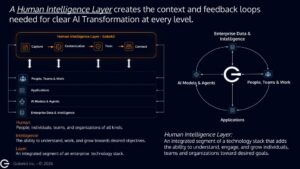
How LER Standards Enable the Human Intelligence Layer
For years, standards bodies, foundations, government agencies, educators, employers, workforce organizations, and technology companies have been building infrastructure to make learning and employment data portable, verifiable, interoperable, and owned by the individual.
We have described this work as digital credentials, skills-based hiring, credential transparency, talent mobility, data wallets, and and Learning and Employment Records.
All of those descriptions remain accurate. But together, these efforts may be building the foundation for something larger: a Human Intelligence Layer for organizations and the economy.
In his LinkedIn article, “The LER Ecosystem Has Been Building the Foundation for the Human Intelligence Layer,” Gobekli founder Danny Done explores why AI makes the broader purpose of the LER ecosystem more urgent and visible.
AI can see the organization—but not its people
Organizations collect detailed data about customers, transactions, finances, workflows, communications, inventory, and software usage. AI can analyze this information, automate processes, and support decision-making across the enterprise.
Yet most organizations still have only a shallow understanding of their people.
They may know someone’s job title, department, salary, manager, credentials, training history, and a list of skills inferred from a resume or entered into an HR system. What they generally lack is a living understanding of what that person can actually do.
Organizations cannot easily see the experiences that shaped someone’s judgment, the activities through which their skills developed, the informal roles they play, the problems they repeatedly solve, or the capabilities they possess beyond their current position. They often cannot see what motivates someone, how they are adapting, or what they could become capable of next.
These are not peripheral details. They are much of what makes an organization work.
That limited visibility was already a problem. In the age of AI, it could become a crisis.
AI adoption creates new human intelligence
AI transformation is usually framed as a technology challenge: select the right tools, connect the right data, find the right use cases, and redesign the appropriate workflows.
But technology represents only half of the transformation.
As people use AI, they also change. They learn where the technology is effective and where it fails. They develop judgment about when to trust it. They create new workflows, combine responsibilities, discover efficiencies, and find new ways to produce value.
AI adoption therefore generates new human intelligence.
Most organizations have almost no infrastructure for capturing it. An employee might reinvent how their work is performed, build new capabilities, and improve an entire team’s performance while remaining unchanged in formal systems—the same title, profile, and outdated list of skills.
Leaders are left measuring AI usage while missing the adaptability that determines whether transformation succeeds. They cannot clearly see where meaningful adoption is occurring, which capabilities are emerging, what practices should spread, where people require support, or how roles need to evolve.
A Human Intelligence Layer creates a feedback loop
A Human Intelligence Layer would provide a living, trusted understanding of what people know, what they have done, how they contribute, what they are learning, and how they are changing.
It cannot be another centralized HR database filled with static employee profiles. It must emerge through a continuing, permissioned exchange between people and organizations.
Individuals could use AI to reflect on their work, connect evidence to their skills and accomplishments, recognize developing capabilities, and understand where they want to grow. Organizations could identify patterns across that shared intelligence, including active talent, latent talent, emerging capabilities, collective strengths, and developing gaps.
That understanding could improve how the organization deploys AI. As work changes again, people would create new experiences, knowledge, and evidence, making both the individual and the organization more intelligent.
The value lies in the loop—but the loop works only when people benefit from participating.
Employees cannot be expected to document what they know, train organizational systems, expose how their work might be automated, and help redesign their roles while all the resulting value flows to the employer or technology provider.
Participation must also help individuals develop a richer, portable, and trusted understanding of themselves. It should provide recognition for their contributions, reveal opportunities to learn and advance, and allow them to carry evidence of their growth forward.
The organization benefits by becoming more self-aware. The individual benefits because their development becomes visible and useful. AI benefits from better human context.
LER standards make trusted exchange possible
A Human Intelligence Layer cannot depend upon one employer’s HR platform, one university’s transcript, one technology company’s proprietary profile, or one institution’s version of a person. Human experience crosses all of those boundaries.
The underlying information must be portable and verifiable. Different systems must be able to understand it. Individuals must be able to decide what they share, with whom, and for what purpose.
This is the foundation the LER ecosystem has been building.
The U.S. Chamber of Commerce Foundation’s T3 Innovation Network has convened employers, educators, public agencies, and technology providers around a more connected talent marketplace. Credential Engine has created open infrastructure for making credentials, competencies, and pathways understandable. Standards developed by 1EdTech, HR Open, W3C, and others make achievements and employment information interoperable and verifiable.
Government and philanthropic initiatives have supported wallets, digital credentials, skills-first hiring, talent marketplaces, and stronger connections between education and employment. Organizations including JFF, Digital Promise, Education Design Lab, and many others have worked to ensure this infrastructure reflects the needs of learners and workers.
Individually, these projects can appear fragmented. Together, they are constructing the shared foundation required for human intelligence to move safely between people, institutions, organizations, and AI systems.
LER standards make trusted exchange possible. The Human Intelligence Layer can make that exchange meaningful.
Human adaptability must keep pace with AI
If organizations deploy AI faster than people can participate in, learn from, and benefit from the transformation, workforce disruption and declining trust should be expected.
The answer is not to stop technological progress. It is to build the human infrastructure required to keep pace with it.
That means making adaptability visible—not only the skills people acquire, but the work through which those skills become real. It means recognizing credentials alongside experience, motivation, judgment, accomplishment, contribution, and potential.
Without a Human Intelligence Layer, AI adoption will remain something organizations do to their workforce.
With it, AI transformation can become something people and organizations do together.