
EMPLOYER USE CASE · AN ILLUSTRATED SCENARIO
Develop People
for What Comes Next
Elena knows how to do her job. Now the job is changing.
As HarborPoint Insurance introduces AI into customer operations, routine processing gives way to more exception handling, customer judgment, and review of AI-generated work.
Follow Elena and her manager through an employee-development scenario: understand changing responsibilities, focus the learning, and build capability through supported practice.

HarborPoint and Elena are fictional. Illustrations show product concepts and example data, not a deployed customer implementation. See current product availability.
The training record is current.
The development question has changed.
Elena Ramirez is an experienced customer-operations specialist. She understands the procedures, recognizes recurring problems, and has completed the required training.
Now HarborPoint is introducing AI to help with routine requests, summaries, and documentation. Elena needs to assess unfamiliar exceptions, question incomplete outputs, and recognize customer situations that require judgment or specialist support.
Her manager can see course completions and tool use. Those records do not explain what Elena needs to practice—or whether the workflow gives her the support to do it.
“What would help Elena grow with the work, and how would we know it is helping?”
01 · UNDERSTAND THE CHANGING WORK
Understand what Elena’s work now requires.
Elena and her manager begin with actual responsibilities: which activities are becoming less frequent, which decisions need more attention, and where she feels confident or uncertain.
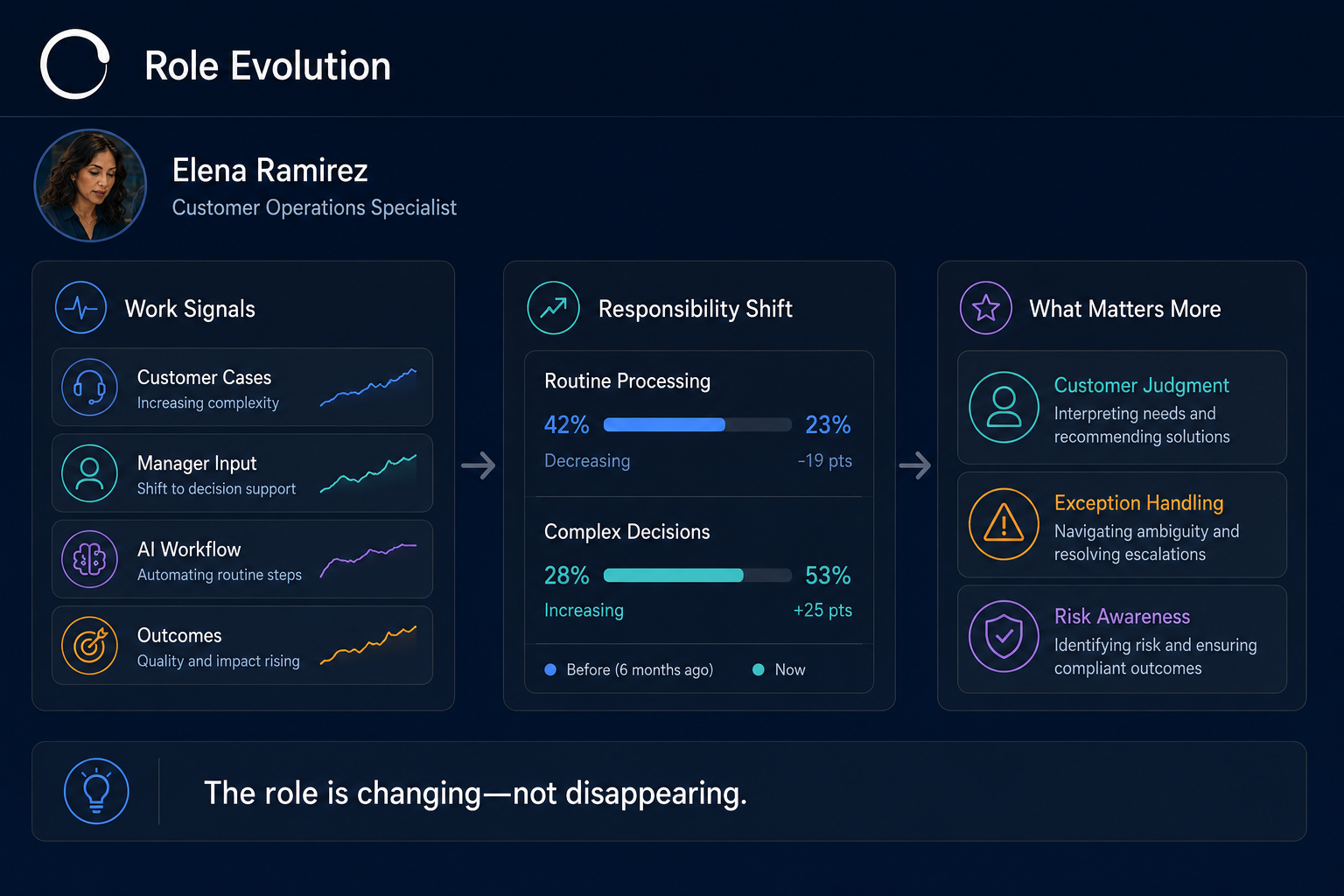
The role-evolution concept brings work records and human context together around Elena’s changing responsibilities.
A Changing Work Profile could combine organizational expectations, relevant work records, and Elena’s account of her experience. Pythia could help them explore questions such as:
- What are you being asked to judge that you previously processed?
- Where does an AI-generated response need additional context?
- Which situations require help from another person?
- What would you like to become better at handling?
The first result is a clearer development question grounded in work Elena and her manager recognize.
02 · FOCUS THE DEVELOPMENT NEED
Separate a learning need from a support problem.
The changing role may call for more exception analysis, customer judgment, and review of AI-generated outputs. Difficulty with the work does not automatically mean Elena lacks capability.
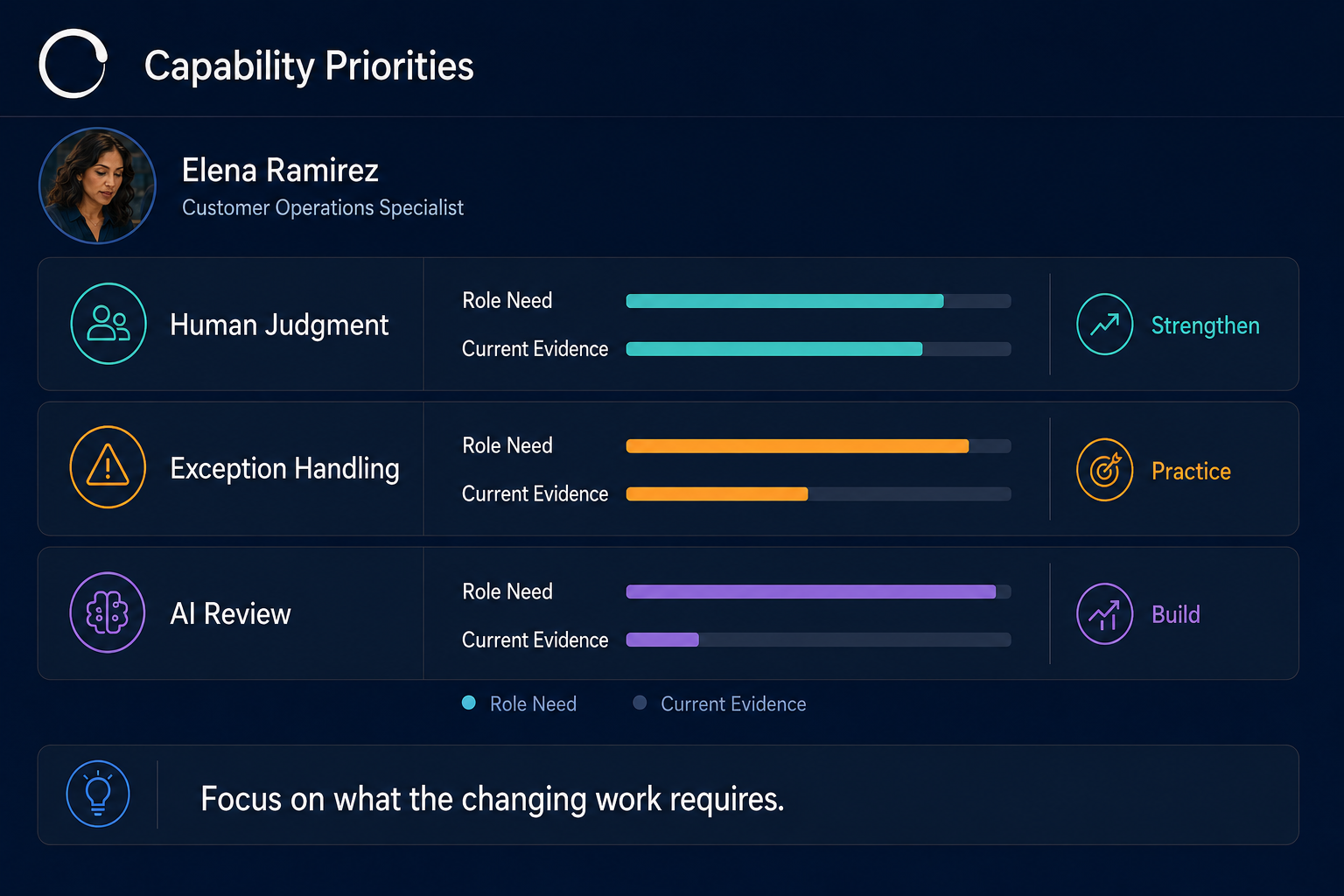
The capability-priorities concept helps compare role requirements with evidence and questions that need further review.
An escalation rule may be unclear. Access to a resource may be missing. Elena may already have relevant experience that her manager has not seen.
The Talent Tree provides a way to connect responsibilities, experience, capabilities, and evidence. That context can help them examine what is established, what remains uncertain, and what needs to change.
“What would help Elena assess complex customer exceptions and recognize when to seek specialist review?”
That focused question guides development without turning every uncertainty into another training assignment.
03 · BUILD A PRACTICAL PATHWAY
Build a pathway Elena can actually practice.
Suppose Elena wants to develop in the evolving role. She and her manager could combine focused learning with supported application.
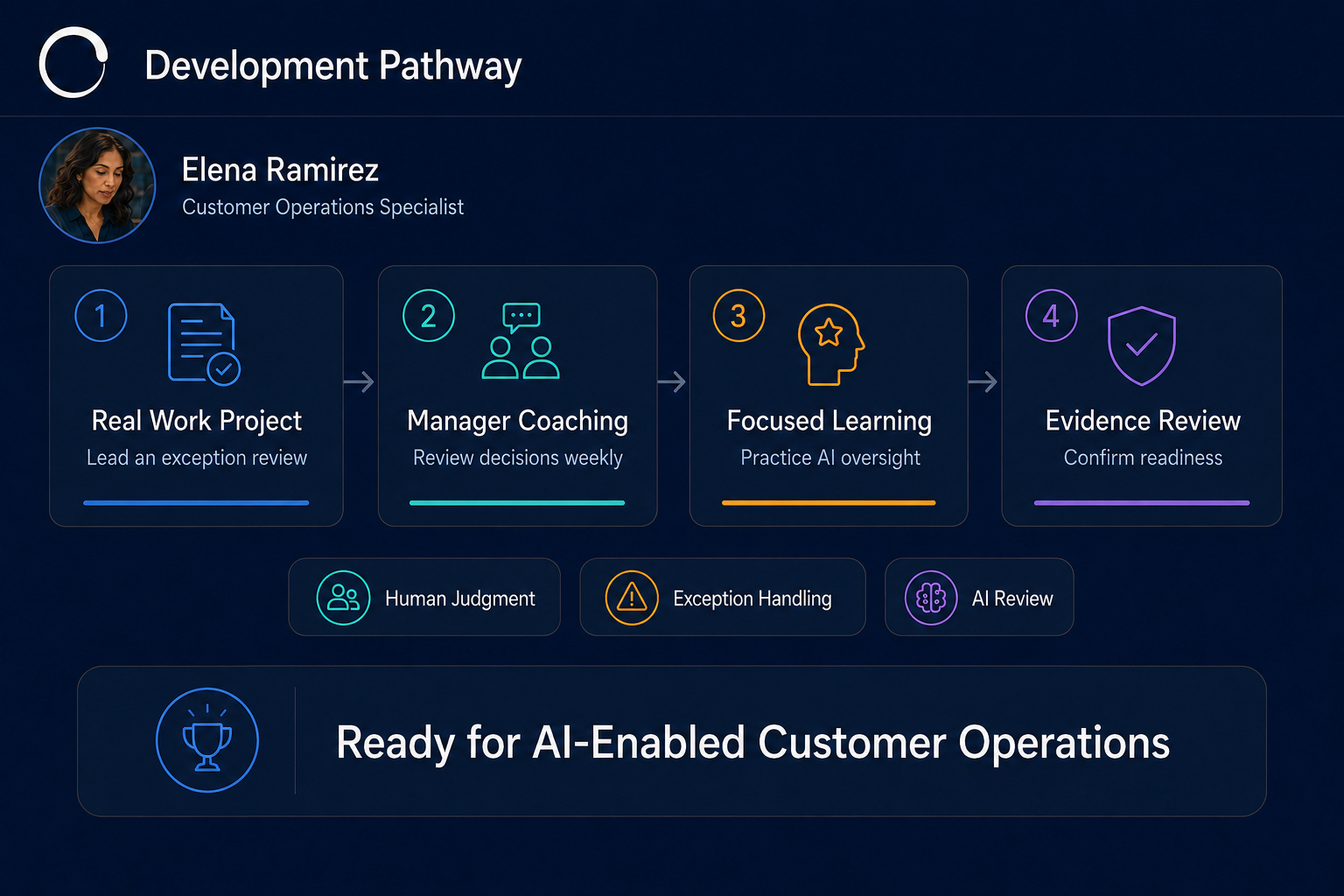
The illustrative pathway connects learning, a real-work project, coaching, and evidence review.
- Review selected examples together. Examine how experienced colleagues interpret context, identify uncertainty, and explain their reasoning.
- Shadow a specialist. Observe how unfamiliar situations are assessed and reviewed.
- Take on a bounded improvement project. Investigate a recurring exception pattern with clear scope and supervision.
- Use focused learning resources. Address questions that arise from the work.
- Review evidence and adjust. Discuss demonstrated capability, remaining needs, and the next useful experience.
The plan needs time, coaching, access, and opportunities to practice. Providing those conditions is part of the organization’s responsibility.
04 · LEARN THROUGH THE WORK
Make room for practice, feedback, and reflection.
Elena reviews a complex AI-assisted case with her manager and a risk specialist. The conversation goes beyond whether she produced an acceptable answer.

Elena, her manager, and a specialist examine a customer exception together in this illustrated scenario.
What did she notice? Which information was missing? Where did AI help? Why did another perspective matter?
Pythia could help Elena reflect on the experience and prepare questions for her next check-in. Her manager could use the context she chooses to share to improve the coaching and adjust the pathway.
Private reflection and organizational evidence serve different purposes. The intended boundaries and sharing arrangements would need to be defined for the implementation.
Experience gives Elena something to learn from. Feedback and reflection help her understand what to carry forward.
05 · RECOGNIZE GROWTH AND CONTRIBUTION
Recognize the contribution—and improve the work.
Suppose Elena’s project identifies a recurring ambiguity in the AI-assisted workflow. Her contribution includes recognizing the pattern, gathering appropriate evidence, involving a specialist, and helping clarify the process.
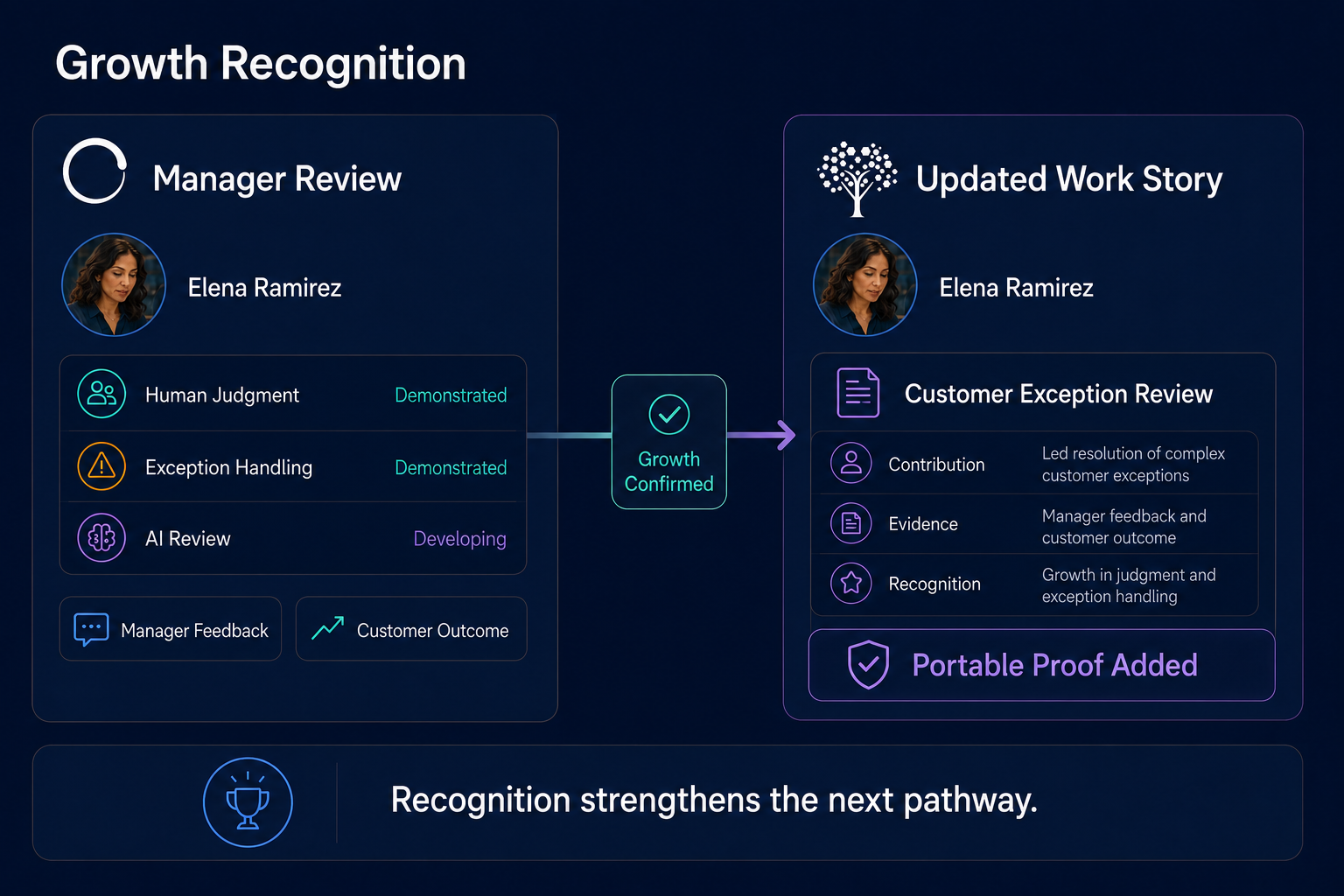
The recognition concept connects reviewed contributions with evidence Elena can carry forward in her TalentPass work story.
A useful review considers the contribution, Elena’s explanation, her collaborators, and the support that made it possible.
Passport Pages are intended to support the exchange of evidence, recognition, and resources. TalentPass gives Elena a way to build a portable account of her experience. A record should describe her contribution without exposing confidential customer information.
The organization learns as well. An unclear instruction, missing resource, or escalation problem could point to a workflow improvement that helps other people.
Elena’s development can reveal what the organization needs to improve, too.
Look for growth in the work,
not just completion of the plan.
The possible change is greater capability in an evolving role. It does not require a promotion or a new job title. Elena and her manager would still need to examine whether the approach is helping.
Application
Can Elena explain and apply what she has learned?
Judgment
Does she recognize uncertainty and know when to seek support?
Contribution
What evidence shows her work helped a customer, colleague, or process?
Conditions
Are time, access, expectations, and coaching supporting her development?
Direction
Does the pathway still fit the changing work and Elena’s own goals?
These are outcomes to evaluate—not customer results achieved in this fictional scenario.
Where is development getting disconnected from the work?
Start with the question in Elena’s story that feels most familiar.
“AI is changing the job, but our development plans have not caught up.”
Explore the activities, decisions, responsibilities, and support that are changing.
“People complete training, but we cannot see whether the work is covered.”
Examine capabilities, knowledge, capacity, and evidence for a defined workflow.
“We need to build more capability with the people we already have.”
Connect workforce needs with development, deployment, and support options for changing demand.
These are possible starting points. Gobekli helps select the appropriate workshop foundation and connected modules around one defined challenge.
A workshop should produce useful next steps whether or not your organization continues into TalentSync.
Questions about employee development
How is employee development different from succession planning?
Employee development builds capability as work evolves. Succession planning focuses on preparation and continuity for future critical responsibilities and leadership roles. Development can support succession, but it can also help someone become more capable in an existing role.
Does TalentSync replace a learning management system?
TalentSync is intended to connect work, evidence, reflection, and support. An existing learning management system can continue to deliver courses and record completion. Specific integrations depend on current availability and implementation scope.
How can we tell whether development is helping?
Define the relevant work and useful evidence before selecting an activity. Review application, reasoning, feedback, and outcomes alongside the conditions for success. Course completion alone does not establish readiness.
Can a manager access an employee’s private reflections?
The intended approach separates private reflection from organizational contributions and relevant, purpose-scoped sharing. It should not mean blanket access to personal information. Confirm permissions and sharing arrangements for the implementation.
Is this a current self-service TalentSync workflow?
This scenario describes an intended application. Capabilities are at different stages of development, so confirm the available scope and implementation arrangements. Review current product availability.
Give people a development path
connected to the work ahead.
Start with one changing role, recurring challenge, or capability need. Understand the required work, create room for practice, and use evidence to decide what comes next.
