Becoming the Source of Truth
People are communicating, applying, pitching, and posting more than ever. Yet fewer people feel heard, understood, or trusted.
Jobs are harder to land. Sales conversations stall before they begin. Institutions appear busy but increasingly hollow. Effort no longer translates reliably into opportunity.
In this new article, Gobekli founder Danny Done argues that these are symptoms of a deeper problem: our systems are losing the ability to recognize human reality.
A crisis of legibility
Employment and sales are among the first markets to suffer when trust declines because both depend on human judgment under uncertainty.
Resumes and pitches are trusted less—not necessarily because people are being dishonest, but because AI has made polished language abundant. A perfectly written application no longer reliably signals effort, care, experience, or competence.
Employers respond with additional interviews, assessments, filters, and screening stages. Sellers increase their outreach volume while buyers become more guarded. Everyone is trying to answer the same underlying question: Is this person real?
The result is more activity but less clarity.
This is not simply a talent shortage or an opportunity shortage. It is a legibility crisis. People possess skills, knowledge, and lived experience, but they lack a trusted way to understand that experience, communicate it coherently, and carry it into new contexts.
AI exposed an existing weakness
AI did not create this crisis. It removed the shortcuts we previously used to approximate understanding.
For decades, titles, degrees, resumes, presentations, and other surface-level signals worked well enough. Now that convincing versions of those signals can be generated almost instantly, surface quality carries less meaning.
Systems respond by retreating into automation and filters. People respond by withdrawing, disengaging, or producing still more noise. Opportunity disappears gradually as trust becomes too expensive to establish.
The deeper issue is that most people were never given the tools to understand and integrate their own lives.
Education fragments learning. Work fragments experience. Platforms fragment identity. People continue moving forward, but the connective tissue between their experiences is repeatedly lost.
When asked to explain who they are or what they can contribute, they reach for the proxies available to them: job titles, credentials, keywords, and templates. That is not deception. It is disorientation.
Trust begins with self-understanding
External verification alone cannot solve this problem. Trust cannot simply be imposed by an institution or extracted through additional screening. It must be offered—and that offering begins with the individual.
Self-understanding does not mean introspection for its own sake. It means being able to integrate lived experience into a coherent, evidence-backed story that can move across institutions and systems.
When people can carry their experience forward with clarity and integrity, employers do not need to over-screen, buyers do not need to begin from an assumption of bad faith, and institutions have a stronger foundation on which to rebuild legitimacy.
People do not need to reject institutions. They need to be able to re-enter them as whole human beings rather than disconnected collections of claims and credentials.
Becoming the source of truth
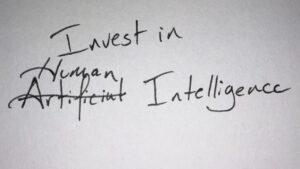
The future is not fundamentally a contest between humans and machines. The meaningful distinction is between humans who possess agency and those whose identities are defined entirely by the systems around them.
AI does not take away our humanity by force. It reveals whether we ever protected human agency by design.
In the age of machines, becoming the source of truth means taking responsibility for understanding your experiences, preserving evidence of them, and communicating them with integrity. It means refusing to be reduced to noise or proxies and choosing to participate actively in shaping the future.
That work cannot be delegated entirely to technology or institutions. It starts with people willing to understand and stand behind their own truth.