Why Enterprises Need Learning and Employment Records—and Why Records Alone Are Not Enough
Originally published September 21, 2023. Updated to reflect the continued development of Learning and Employment Records, enterprise AI adoption, and Gobekli’s Human Intelligence Layer.
Enterprises make consequential decisions about people every day.
Who should be hired? Which employees are prepared for new responsibilities? Where are capabilities emerging? What learning should the organization fund? Which roles will change as AI becomes embedded in the work? Where does institutional knowledge reside? Which teams need support?
Most of these decisions are made using incomplete and disconnected information.
Applicant tracking systems contain résumés and applications. HR systems contain job titles and employment histories. Learning platforms contain course completions. Credential systems contain certifications. Performance systems contain periodic reviews. Project platforms contain evidence of actual work.
Each system sees part of the workforce.
None provides a complete, continuously updated understanding of the people, capabilities, relationships, and work that make the organization function.
Learning and Employment Records, or LERs, can help address this fragmentation by making learning, credentials, skills, and employment information more structured, trusted, and portable.
But enterprises should not mistake better records for complete workforce intelligence.
LERs provide essential infrastructure. Organizations still need a Human Intelligence Layer that connects those records with activities, evidence, goals, relationships, workflows, and continued feedback.
What LERs Bring to the Enterprise
Learning and Employment Records can represent information accumulated across education, training, credentials, and work.
Depending on the record and its source, an LER might include:
- Degrees, certificates, licenses, and microcredentials
- Courses and training
- Skills and competencies
- Assessments and learning outcomes
- Employment history
- Work-related achievements
- Evidence or links to supporting artifacts
- Information about the organization that issued the record
LER standards make it possible for this information to become more machine-readable and portable across systems.
Verifiable credentials can also help an employer confirm who issued a particular record and whether it has been changed.
This creates several advantages over relying exclusively on PDFs, manually entered profiles, or information locked inside an institution’s database.
Greater portability
Employees and candidates can bring trusted records from schools, previous employers, professional organizations, licensing bodies, and training providers.
More reliable sourcing
Organizations can distinguish information issued by a trusted authority from information that is self-reported, inferred, endorsed, or demonstrated through evidence.
Better interoperability
Structured records can move between compatible systems without requiring every piece of information to be re-entered manually.
Greater continuity
Learning and achievement can remain useful after someone changes institutions, platforms, or employers.
More reusable information
The same trusted record can potentially support hiring, onboarding, development, compliance, advancement, and other workflows.
These capabilities make LERs strategically important.
They do not eliminate the need for interpretation, context, governance, or human judgment.
A Record Is Not the Same as Capability
A credential can verify that someone completed a program or met defined requirements.
It may not show how the person applied that learning, how recently they used it, or whether they can transfer it into a different environment.
A skills record can identify capabilities associated with a person.
It may not explain where those capabilities came from, what evidence supports them, or how they appeared in actual work.
An employment record can confirm a role.
It may not reveal the activities, relationships, judgment, or informal leadership that made the person effective.
Enterprises need to distinguish among several different kinds of information:
- What a person claims
- What an organization issued or verified
- What a system inferred
- What an assessment measured
- What an artifact demonstrates
- What another person endorsed
- What happened through real work
- What remains uncertain
Collapsing all of these signals into one profile or score creates false confidence.
The strategic value of LERs comes from connecting trusted records with the context required to use them responsibly.
Enterprise Use Case One: Skills-Based Hiring
LERs can help candidates bring more trusted information into the application process.
Credentials, licenses, training, and other records can supplement the résumé. Structured data can help an employer review relevant information without depending entirely on keyword matching.
But better candidate data solves only half of the problem.
The employer must also define the opportunity clearly:
- What work needs to be performed?
- What outcomes matter?
- Which capabilities are essential?
- Which can be developed after hiring?
- What evidence would demonstrate readiness?
- Which credentials are legally necessary?
- Which requirements are merely inherited preferences?
A skills-based hiring system becomes more trustworthy when structured candidate records are evaluated against employer-confirmed criteria—and when recruiters can review the evidence behind any suggested alignment.
Enterprise Use Case Two: Onboarding and Recognition
Employees often enter an organization with years of learning and experience that never become visible internally.
During onboarding, an LER-enabled process could help employees bring forward relevant:
- Credentials and licenses
- Prior training
- Work experience
- Projects and evidence
- Professional memberships
- Areas of knowledge
- Development goals
This can reduce repeated data entry and help managers begin with a more complete understanding.
It can also surface capabilities that were not required for the employee’s initial role but may become valuable later.
However, employees should not be required to surrender their complete personal records to participate. The process should make clear what information is requested, why it is relevant, how it will be used, and what remains under the individual’s control.
Enterprise Use Case Three: Learning and Development
Most learning systems can report enrollment, participation, assessment results, and completion.
These signals do not necessarily show whether learning changed the work.
LERs can make learning outcomes and credentials more portable, but organizations gain greater value when learning records are connected with:
- The capabilities a role or team needs
- Activities performed during learning
- Evidence created by the learner
- Application in a real workflow
- Feedback from managers or collaborators
- Outcomes following the learning experience
- Continued reflection and growth
This creates a feedback loop between learning and performance.
Employees gain a record they can carry forward. Managers gain better information for coaching. Learning teams gain evidence about which investments contribute to real capability.
Enterprise Use Case Four: Internal Mobility
Organizations frequently search outside for talent they may already possess.
Job titles and org charts hide transferable capabilities. Employees may have previous experience, credentials, interests, or aspirations that are not visible in their current roles.
LERs can contribute trusted information about what employees have learned and accomplished.
A Human Intelligence Layer can connect those records with:
- Current and past activities
- Demonstrated capabilities
- Project experience
- Interests and motivations
- Development goals
- Relationships across the organization
- Evidence of continued growth
- Requirements of emerging opportunities
This can help employees see possible pathways while helping leaders recognize latent capability.
The objective should not be to automatically assign people to roles. It should be to make opportunity and potential more visible so that people and managers can have better conversations.
Enterprise Use Case Five: Workforce Planning
Workforce planning is often built from headcount, job families, compensation bands, and projected openings.
These measures describe organizational structure. They do not always explain how work is actually performed.
LER data can strengthen workforce planning by contributing more consistent information about credentials, learning, and recognized capabilities.
But organizations must also understand:
- Which activities create value
- How roles interact
- Where judgment remains essential
- What knowledge is concentrated in particular people
- Which capabilities are emerging through work
- Which capabilities are becoming less relevant
- Where relationships and trust affect performance
- What people are ready and willing to learn next
This is especially important as AI changes the distribution of work within roles.
Enterprises do not simply need an inventory of existing skills. They need a continuously improving understanding of how people, work, technology, and capabilities are changing together.
Enterprise Use Case Six: AI Transformation
Organizations are deploying AI faster than they can understand its effects on work.
They can measure licenses, usage, generated content, and estimated time savings. They often cannot determine whether AI is improving decisions, strengthening capability, changing responsibilities, or creating new risks.
LERs can help by making learning and recognized capabilities more visible.
However, an AI transformation also depends on human intelligence that is rarely captured in formal records:
- Judgment
- Practical wisdom
- Motivation
- Creativity
- Relationships
- Trust
- Institutional knowledge
- Adaptability
- Leadership
- Stewardship
- Emerging potential
Organizations must understand what AI is automating, what people are learning, where responsibilities are shifting, and which new capabilities are becoming necessary.
That requires a living feedback loop—not a static database.
From LER Infrastructure to a Human Intelligence Layer
LERs create trusted and portable inputs.
A Human Intelligence Layer connects those inputs with the context generated through people and work.
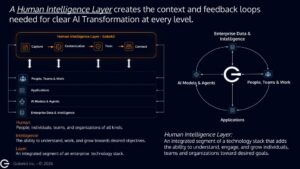
Gobekli defines a Human Intelligence Layer as a sociotechnical architecture that enables people, organizations, and intelligent systems to continuously develop a shared, trusted understanding of human experience, capability, judgment, relationships, goals, evidence, and change.
For an enterprise, this layer can connect information across:
- Candidates and opportunities
- Employees and roles
- Learning and application
- People and teams
- Workflows and outcomes
- Organizational goals and workforce investments
- AI systems and the people affected by them
It does not replace the HRIS, LMS, ATS, project-management platform, credential wallet, or other system of record.
It helps these systems contribute to a more complete and continuously improving understanding.
The Exchange Must Benefit Employees Too
An organization cannot build meaningful human intelligence through extraction alone.
Employees hold context that systems cannot observe automatically. They know what they are learning, where work is breaking down, how relationships affect outcomes, which responsibilities are changing, and what they want to become next.
They will contribute that context only when the relationship is worthy of trust.
A healthy exchange gives people tangible value in return:
- Greater recognition
- Better opportunities
- Useful career guidance
- More relevant learning
- Stronger coaching
- Portable records
- Clearer pathways
- Greater control over how they are represented
If employees contribute rich information and receive only increased monitoring, the system will fail culturally even if it succeeds technically.
The enterprise should not become the permanent owner of every insight a person generates.
Where appropriate, value created through work, learning, feedback, and reflection should also strengthen the individual’s continuing record.
A Practical Enterprise Adoption Strategy
Enterprises do not need to replace their entire technology stack to begin working with LERs.
A responsible approach can begin with one consequential workflow.
1. Choose a specific decision
Begin with a defined problem such as:
- Hiring for a particular role
- Recognizing an existing license or credential
- Supporting internal mobility
- Connecting a learning program with workplace application
- Preparing one workforce segment for an AI-driven change
Avoid beginning with the goal of building a universal skills database.
2. Define the value for both sides
Identify what the organization will gain and what participating employees or candidates will receive.
If the value proposition exists only for the employer, participation and trust will suffer.
3. Inventory existing information
Determine what already exists across HR, learning, credential, project, and workforce systems.
Classify each data source:
- Verified
- Assessed
- Self-reported
- Endorsed
- Observed
- Inferred
This prevents systems from treating every signal as equally authoritative.
4. Define the missing context
Ask what the existing records cannot explain.
The answer may include activities, evidence, goals, relationships, practical application, or the changing nature of the work.
5. Introduce portable employee records
Give people a way to receive, review, organize, and reuse relevant information.
Employees should understand what belongs to the organization, what belongs in their continuing personal record, and what they can choose to share.
6. Integrate with current workflows
Use LERs and richer profiles alongside existing systems before attempting wholesale replacement.
A purpose-specific profile or Passport Page can supplement a conventional application, learning record, or workforce process.
7. Establish governance before scaling
Define:
- What information may be collected
- Which decisions it may influence
- Who can access it
- How AI-generated interpretations are labeled
- How people can correct errors
- How long information is retained
- How outcomes will be evaluated for unintended harm
8. Measure real outcomes
Evaluate whether the implementation improves:
- Decision quality
- Employee or candidate experience
- Time spent reconstructing records
- Recognition of previously hidden capability
- Learning application
- Internal opportunity
- Trust and participation
- Organizational adaptability
Do not assume that more data automatically produces better outcomes.
How TalentPass and TalentSync Support This Model
TalentPass is the individual side of Gobekli’s Human Intelligence Layer.
It helps people build and control a living record of their experiences, capabilities, credentials, evidence, goals, and growth. Pythia helps individuals reflect, create profiles, and prepare for opportunities.
TalentSync is the organizational side.
It helps employers work with structured opportunities, profiles, teams, learning, membership relationships, and workforce intelligence through collaborative implementations.
Together, TalentPass and TalentSync are designed to create a two-way exchange:
- People gain recognition, guidance, opportunity, and portable intelligence.
- Organizations gain richer context for decisions, development, workforce strategy, and AI.
- Both sides learn through continued interaction and feedback.
LERs strengthen this exchange by providing trusted records that can move between institutions and relationships.
The Strategic Imperative Is Adaptability
The original version of this article argued that enterprises should adopt LER technology to gain a competitive advantage.
That remains directionally true, but the deeper imperative is now clearer.
Organizations must continuously adapt as AI changes work, roles, decisions, and the capabilities required to succeed.
They cannot adapt responsibly if they do not understand their people.
LERs provide part of the infrastructure required to make learning and employment information trusted and portable. The Human Intelligence Layer connects those records with the living context of people and work.
The objective is not to collect the largest possible inventory of skills.
It is to create an organization that can see what is changing, develop the people capable of responding, make better decisions with AI, and continuously learn from what happens next.
That is the strategic value of LERs for the enterprise.
Product availability notice: This article describes Gobekli’s broader enterprise vision for LERs and the Human Intelligence Layer. TalentSync is currently delivered through Executive Workshops and Launch Partnerships, with individual modules at different stages of implementation. Visit the Product Availability page for the current status of TalentPass, TalentSync, Pythia, Profiles, Passport Pages, and the Talent Tree.