PDF Resumes Are Collapsing the Job Market in the Age of AI—Help Create What’s Next
Before there were resumes, there was Leonardo da Vinci.
In 1482, Leonardo wanted to leave Florence, so he wrote to Ludovico Sforza describing what he could do, the problems he could solve, and why a future together might make sense. Although the letter is often called the first resume, it was something more meaningful: an act of agency.
Leonardo did not wait to be discovered or reduced to a standardized list of credentials. He understood his value, articulated it clearly, and created an opportunity.
That is what the resume was originally meant to help people do. In this new article, Gobekli founder Danny Done examines how the PDF resume lost that purpose—and how Learning and Employment Records could help restore it.
From agency to artifact
For much of the last century, resumes became the backbone of the talent supply chain. They were static, subjective documents with limited context, no native evidence, and information that had to be manually verified.
They were imperfect, but they worked well enough in an analog economy characterized by fewer transitions, slower movement, institution-held records, and human-mediated trust.
Then AI changed the economics of the system.
AI made polished resume creation effectively free. Language converged, formats became increasingly uniform, and application volume exploded. The production of claims scaled almost infinitely while their verification remained manual.
That imbalance weakened the resume’s value as a signal—not necessarily because applicants were dishonest, but because abundance without evidence erodes trust.
The rational response—and its cost
Employers now receive more applications than ever, many of which are professionally written, correctly formatted, and increasingly difficult to distinguish.
In response, organizations have added assessments, interviews, screening stages, automated filters, and reliance on closed networks. These are rational defenses against overwhelming volume, but they also change what the system rewards.
Hiring begins to select for endurance rather than alignment, access rather than intent, and the ability to survive a process rather than the ability to contribute.
The resume remains, but it increasingly functions as a legacy attachment rather than a trusted source of truth.
A new infrastructure is already emerging
Across education, workforce development, membership organizations, service providers, and credentialing systems, a different foundation is taking shape: Learning and Employment Records.
LERs can provide people with portable, verifiable records of learning, employment, service, skills, and contribution. Every time an individual receives a trusted record they can carry forward, mobility increases and some measure of power returns to the person.
But LERs reach their full potential only when individuals can hold, organize, and share them.
An LER wallet—or what Gobekli calls a Universal Talent Passport—can become a personal source of truth. It gives someone a place to collect records from multiple institutions, decide what to share, present different aspects of themselves in different contexts, and carry their history forward without repeatedly starting over.
This represents a fundamental shift from institution-controlled records toward person-owned agency.
What institutions and employers can do
Schools can issue LERs not only for degrees, but also for projects, learning milestones, and demonstrated growth. Training providers and membership organizations can recognize skills, leadership, service, and participation. Nonprofits and public-service organizations can issue verifiable records of responsibility, contribution, and impact.
Any organization involved in human development may be holding a piece of someone’s future mobility. Issuing a portable record helps preserve that value for the individual.
Employers also have an important role. If organizations are drowning in resumes, the answer is not simply to add more filters. It is to create demand for better upstream signals.
Employers can ask for verifiable records, accept credential wallets as hiring inputs, support LER initiatives, and design selection around evidence rather than polished prose.
The result can be clearer shortlists, fewer redundant interviews, stronger alignment, and better retention. Employers do not necessarily need more applicant data. They need more trusted data that individuals already own and have chosen to share.
Restoring agency at scale
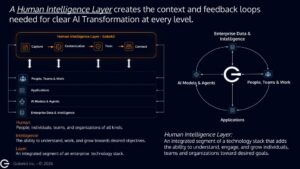
A positive feedback loop becomes possible when institutions issue portable records, individuals gain agency, people find opportunities aligned with their capabilities and motivations, and employers gain contributors who genuinely want to be there.
Trust compounds across the system.
Leonardo was not powerful simply because he possessed unusual ability. He understood himself, could articulate his value, and was able to act when his circumstances no longer fit.
LERs can make that kind of agency possible at scale: the ability to know yourself, grow intentionally, carry trusted evidence, and communicate your value clearly.
The PDF resume will not disappear overnight. But it can no longer serve as the keystone of a digital talent economy.
What replaces it should not be another static document. It should be a new trust layer for human potential—one that gives people the tools to author their futures and gives organizations the clarity to recognize them.