
MEMBERSHIP VALUE WORKSHOP
Make the Value of Membership Clear—and Lasting.
Your organization creates opportunities to learn, connect, contribute, and advance. Members may still struggle to explain what membership makes possible for them.
Clarify the benefits that matter, the outcomes they support, and the evidence members can use when deciding to join, renew, or carry their progress forward.
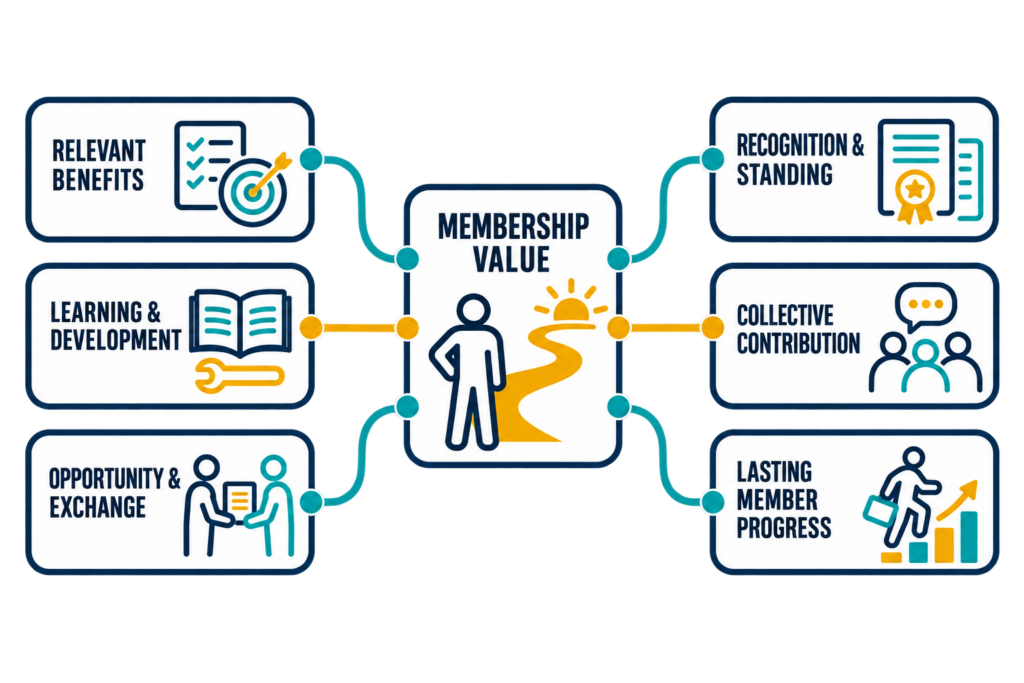
Your organization offers a lot. The value can still be hard to explain.
The promise sounds like every other organization
Education, networking, resources, and advocacy describe the offering without explaining why this membership matters to a particular audience.
The benefit list keeps growing
Programs and services accumulate while outdated offerings, duplication, and unmet needs remain difficult to distinguish.
Activity is easier to report than progress
The organization can count attendance, completions, and introductions but has less visibility into what those experiences helped members accomplish.
Recognition needs more explanation
A badge, certificate, designation, or service award may be meaningful inside the organization while leaving others unsure what it represents.
Useful exchanges remain hard to substantiate
Members share knowledge, make referrals, and collaborate, but the organization struggles to explain the value those exchanges create.
Collective work is difficult to connect to members
Advocacy, standards, and public initiatives serve a wider purpose, while their relevance to individual members remains unclear.
The person paying sees a different picture
An employer or member company funds membership without a clear account of the benefits to its people or organization.
The renewal conversation starts from scratch
Members receive another list of benefits while their learning, contributions, relationships, and progress remain scattered across separate records.
Members need to understand what membership helps them accomplish.
A benefit is an offering. Its value depends on what it enables, for whom, and under which conditions.
A learning program may help someone address a work challenge. A professional designation may communicate reviewed achievement. A referral may open a useful conversation. Collective representation may address a concern no member could readily pursue alone.
Those forms of value require different explanations and different evidence.
Some benefits are immediate. Others accumulate over time or provide access to support when it becomes necessary. Their relevance can change as members develop, businesses evolve, and the profession faces new demands.
To understand that value, your organization may need to examine:
- Whose needs and decisions the membership should serve.
- What the organization promises.
- Which benefits support that promise.
- Where offerings duplicate one another or leave gaps.
- What learning and development enable.
- How career and business opportunities become useful.
- What credentials and recognition actually represent.
- How collective work contributes to shared priorities.
- What individual members and paying organizations gain.
- Whether dues and packages reflect understandable differences.
- What evidence supports a value conversation.
- What members can retain and carry forward.
Membership value is the benefit people and organizations derive from belonging, using what is offered, contributing to the community, and benefiting from its collective work. Making it clearer requires connecting those benefits to purpose, evidence, and an honest account of their limits.
Start with the value question your organization needs to answer.
The Membership Value Workshop is configured around a defined value challenge.
Every engagement begins with the required Membership Value Direction foundation. Your organization then selects the modules that address its most important questions about relevance, outcomes, recognition, packaging, or evidence.
Each selected module combines a short practical lesson with an applied exercise using your organization’s examples. Participants examine what an offering is intended to enable, what the available evidence supports, and which response the organization can carry forward.
Required
1. Establish the Membership Value Direction
Define the member population, value question, organizational decision, intended benefit, available evidence, responsible roles, and boundaries of the engagement.
Choose 2–3
2. Select the Problem Modules
Examine the value proposition, benefit portfolio, development, opportunities, recognition, exchange, collective contribution, organizational membership, packaging, or lasting-value questions that matter most.
Outcome
3. Build a 30–90 Day Membership Value Path
Leave with priorities, responsible owners, practical changes, validation needs, review points, and a starting configuration brief for the value relationships worth maintaining.
A typical engagement combines the required foundation with two or three problem modules. Your organization does not need to complete all 12.
Member conversations, benefit review, employer input, or specialist participation can be scoped where needed. The consultation establishes the appropriate format, preparation, participants, and fee.
Make value easier to understand for members and the people supporting them.
For members
Understand how membership relates to their goals, what different benefits can provide, and which achievements or experiences they can carry forward.
For membership and program teams
Connect offerings to intended benefits, identify gaps, and build explanations supported by appropriate evidence.
For employers and member organizations
Clarify what organizational membership enables for the people using it and the organization funding it.
For leadership and boards
Prioritize the benefit portfolio, examine the membership promise, and make better-grounded decisions about investment, packaging, and renewal conversations.
Explore the 12 Membership Value Workshop Modules
The modules address what membership enables, how those benefits fit different audiences, and how value can be explained and sustained.
Choose the modules that help answer your particular question. Each produces a practical working brief and identifies the benefits, outcomes, evidence, recognition, relationships, and sharing arrangements a future Gobekli configuration would need.
CLARIFY THE PROMISE AND THE BENEFITS
Membership Value Direction
Define whose value question matters, the organizational decision, intended benefit, available evidence, responsibilities, and boundaries the workshop should address. (Required foundation)
Membership Value Proposition & Differentiation
Examine whether the membership promise connects to the intended audience’s needs and explains a meaningful difference from available alternatives.
Benefit Portfolio Relevance & Gaps
Review the benefit portfolio for relevance, duplication, outdated offerings, and missing support so investment can follow the needs membership should serve.
Career & Opportunity Value
Trace how membership-supported preparation, connections, and access relate to meaningful career opportunities, while distinguishing support from outcomes the organization cannot guarantee.
EXAMINE WHAT MEMBERSHIP ENABLES
Professional Learning & Development Value
Examine what professional learning helps members understand, apply, and develop beyond attendance or completion.
Credentials, Recognition & Professional Standing
Clarify what credentials, designations, awards, and other recognition mean, including their criteria, supporting evidence, intended audiences, and limitations.
Member Expertise & Business Exchange Value
Examine how knowledge exchange, referrals, and collaboration create useful value for members, with clear expectations and appropriate evidence of what followed.
Collective Voice, Advocacy & Public Value
Relate collective initiatives to member and public priorities, examining the organization’s contribution, available evidence, and limits on attribution.
MAKE VALUE UNDERSTANDABLE AND LASTING
Employer & Organizational Membership Value
Clarify the benefits to a paying organization and the people using its membership, including how those perspectives inform the value decision.
Dues, Tiers & Benefit Packaging
Examine whether dues, membership tiers, and benefit packages present understandable choices that fit their intended audiences, with assumptions identified for testing.
Member Value Evidence & Renewal Conversations
Bring relevant benefits, experiences, and supported outcomes into a credible value account that helps members and organizations make informed renewal decisions.
Portable Member Progress & Lasting Value
Define how members can retain and appropriately share an understandable account of membership-enabled learning, recognition, contributions, and progress over time.
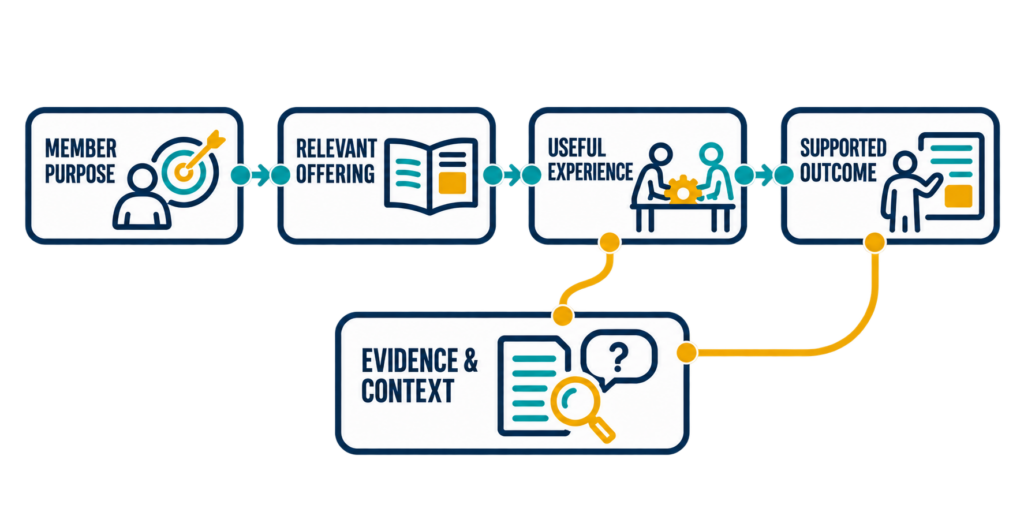
The right response depends on where the value is unclear or incomplete.
Clarify
Explain the intended benefit, audience, conditions, and limits in terms members can understand.
Differentiate
Identify what makes the offering relevant compared with the alternatives available to that audience.
Strengthen
Improve an offering where its design or support falls short of the benefit it is intended to provide.
Rebalance
Address duplication, outdated benefits, or gaps across the portfolio and its priorities.
Substantiate
Connect a value statement to appropriate evidence, source context, and questions that still require validation.
Recognize
Make an achievement or contribution understandable through clear criteria, evidence, and a responsible source.
Package
Organize benefits and membership choices so their purpose, access, and commitments are easier to compare.
Carry Forward
Define what members can retain and share, with its meaning, source, and permissions intact.
These responses organize practical action. Attendance, completion, satisfaction, referrals, and renewal each describe part of the picture. Their meaning depends on the benefit being examined and the evidence available about what it enabled.
How Your Workshop Is Configured:
-
1
Free Discovery Call Identify the value question, the people affected, and the decision your organization needs to make. -
2
Focused Intake & Direction Agree on the selected example, relevant participants, available materials, and modules needed to examine it. -
3
Collaborative Workshop Learn the review method, apply it to your organization’s examples, and develop a practical response. -
4
Membership Value Path Bring the findings into an assigned 30–90 day plan, with validation needs, review points, and a starting configuration brief.
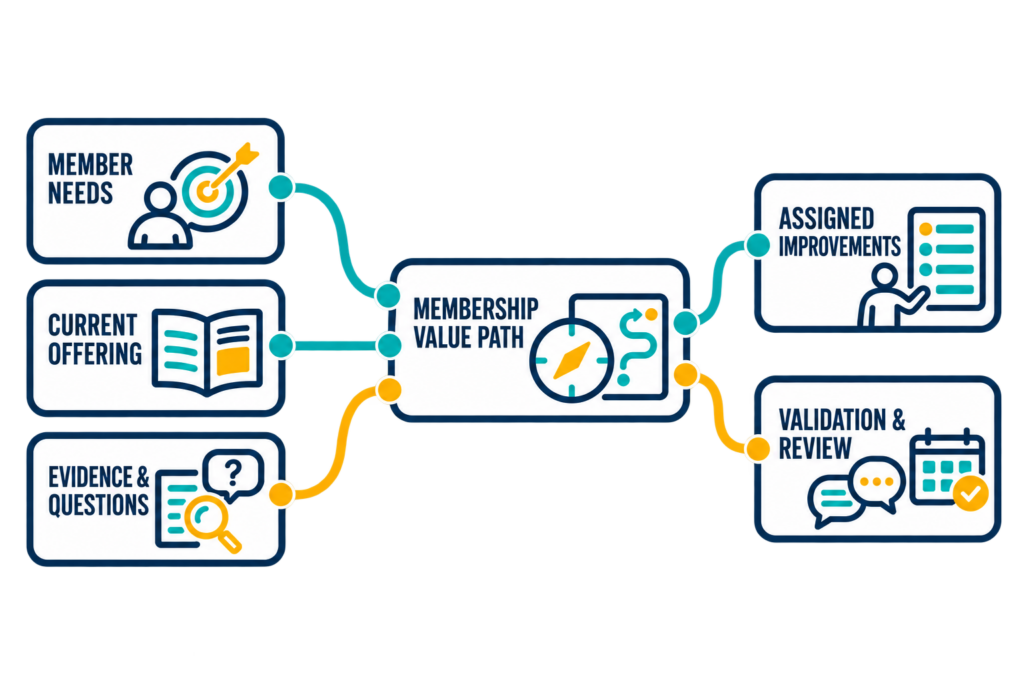
Leave with more than a conversation.
Membership Value Decision Foundation
A shared definition of the value question, audience, intended benefit, organizational decision, boundaries, and criteria for a useful result.
Benefit-to-Outcome Map
A view of how the selected offering is intended to help, which conditions matter, and what progress or outcome it may support.
Value Proposition & Audience Brief
A clear account of the promise, who it serves, relevant alternatives, and the differences worth explaining or testing.
Evidence & Assumption Register
A distinction among recorded activity, member accounts, reviewed evidence, organizational interpretations, and claims requiring further validation.
Benefit Improvement & Value Explanation Plan
Practical changes to the offering, supporting arrangements, recognition, packaging, or explanation of its value.
Ownership & Review Plan
Assigned responsibilities for evidence, benefit information, value statements, member input, and review when circumstances change.
Starting Gobekli Configuration Brief
An outline of the member and organizational profiles, benefits, outcome relationships, evidence, recognition, source connections, and sharing choices worth maintaining.
30–90 Day Membership Value Path
Sequenced actions, responsible owners, dependencies, validation needs, decision points, and review conditions.
Final outputs depend on the selected modules, available information, participants, and question established through Membership Value Direction.
The workshop creates a practical starting point within that scope. Validating assumptions, implementing changes, and reviewing longer-term outcomes continue afterward.
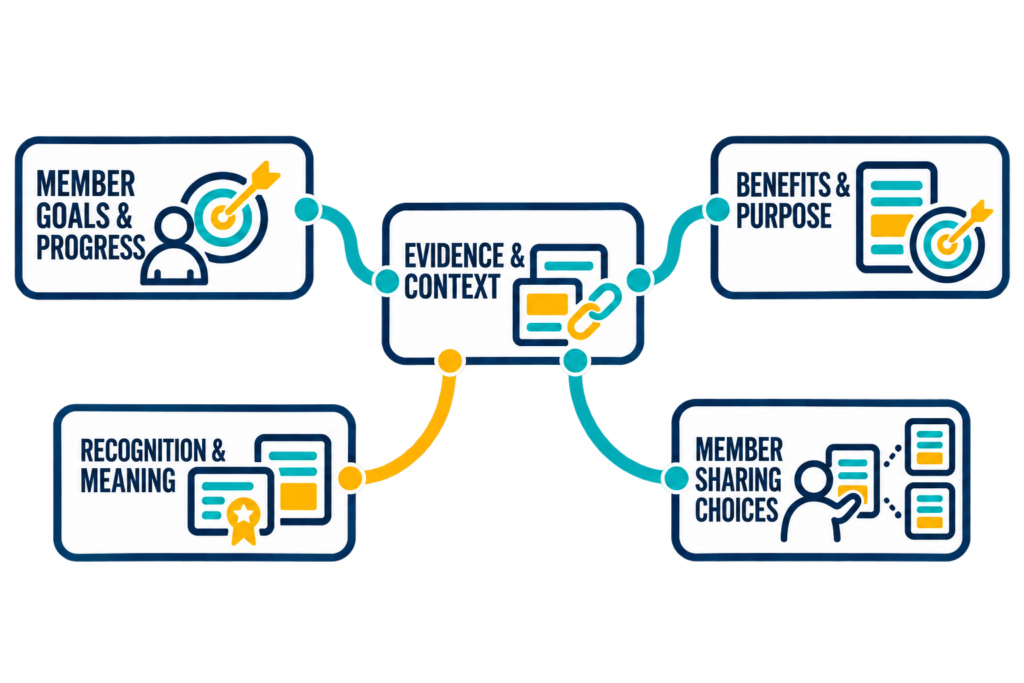
Build the value account around what membership actually helps people do.
We help membership organizations connect their offerings to the purposes, progress, recognition, and collective benefits that make belonging worthwhile.
The work should make it easier for members to understand the value available to them and for organizational teams to explain, improve, and support that value responsibly.
Purpose-connected
Begin with the member or organizational need. Use it to examine the offering, intended benefit, and decision at hand.
Member-grounded
Include relevant member perspectives and recognize that value differs across goals, circumstances, career stages, and membership arrangements.
Evidence-aware
Distinguish what was offered, what happened, what members report, and which conclusions the evidence can reasonably support.
Practical & accountable
Choose changes the organization can operate. Assign responsibility for the benefit, its explanation, and the review of whether it helps.
When the workshop reveals something worth maintaining
Connect membership benefits to an account of progress that can grow.
A workshop may reveal that membership value depends on relationships the organization struggles to maintain across program records, credential systems, member conversations, business exchanges, and renewal materials.
A potential Gobekli configuration could connect organizational benefits and their intended outcomes in TalentSync with appropriate member goals, experience, achievements, and sharing choices through TalentPass.
The starting point is the value question examined during the workshop: who the offering serves, what it is intended to enable, what evidence supports that account, and what the member or paying organization needs to understand.
Workshop Findings
Identify the intended benefit, audience, supporting experience, evidence needs, recognition criteria, and value statements that should remain understandable after the engagement.
Gobekli Setup
Scope relevant member and organizational profiles, benefit and outcome relationships, source connections, reviewed evidence, recognition records, sharing choices, and responsible roles.
Ongoing Review
Maintain the context needed to explain value as benefits change, members develop, new evidence becomes available, and the organization revisits its promise.
Example: showing what professional development helped a member accomplish
An association offers a professional development program and issues a completion certificate.
Members and their employers still ask what the program helped participants do.
The workshop could examine the intended capability, the learning experience, evidence of application, the certificate’s meaning, and what would support a useful account of progress.
A configuration brief could then define program and member profiles, intended outcomes, source records, member-submitted examples, reviewer responsibilities, and an appropriate way to share the resulting account.
TalentPass could help members organize relevant goals, experience, and evidence they choose to provide. TalentSync could help the organization relate the program to its intended benefits and reviewed results. Passport Pages could support appropriate source connections and sharing arrangements. Pythia could help clarify the account using the information and permissions available.
A completion record would remain distinct from evidence of application. An employer’s confirmation or reviewer’s assessment would retain its source and scope.
Specific evidence collection, review workflows, credential connections, and sharing behavior would be confirmed during solution planning.
A Gobekli setup is an optional continuation. The workshop outputs remain useful independently of product adoption.
The configuration described here includes potential capabilities. Current availability, integration needs, configuration work, and any required development would be confirmed during scoping.
Existing membership, learning, credential, and other systems may continue to operate their respective activities. The workshop helps identify which connections would make membership value more understandable and useful.
Frequently asked questions
Questions membership leaders ask before booking.
It is a configurable, facilitated workshop that helps an organization examine a defined question about what membership enables and how that value can be improved or explained.
Every engagement begins with Membership Value Direction and then applies selected problem modules to the organization’s examples. The result is a practical plan grounded in the intended benefit, available evidence, and decision at hand.
It is designed for professional associations, trade associations, chambers, unions, alumni networks, federated organizations, and other member communities.
Participants may include membership leaders, program owners, learning or credential teams, advocacy colleagues, finance or commercial staff, employer representatives, technology teams, and relevant members.
No. Every engagement begins with the required Membership Value Direction foundation.
A typical workshop then includes two or three modules selected around the value question your organization wants to address.
Value depends on what membership helps a person, organization, or community accomplish.
It may include learning, practical support, professional standing, useful exchange, opportunity, collective representation, or access to help when needed. The workshop establishes which form of value matters before deciding how to examine it.
No. Some benefits can be examined financially when suitable evidence exists. Others are better described through capability, access, recognition, support, or collective contribution.
The workshop helps choose an appropriate account rather than assigning a monetary figure to every benefit.
The value proposition is one possible focus. The underlying offering may also need attention.
The workshop can examine portfolio gaps, development outcomes, recognition, exchange, organizational membership, packaging, or the evidence supporting a renewal conversation.
Yes. A learning program, designation, referral service, advocacy initiative, membership tier, or particular audience can provide a useful scope.
A focused example makes it easier to identify evidence needs, assign changes, and review the result.
Yes. It can examine how packages relate to their intended audiences, what differences they provide, and which assumptions need testing.
It does not establish willingness to pay or an optimal price without the additional evidence and analysis those decisions require.
Yes. The workshop can distinguish the perspective of the paying organization from the experiences of the people using the membership.
It can also examine what information each needs, while respecting the member’s choices about sharing personal experience or progress.
Yes. The workshop can connect an initiative to the priorities it serves, the organization’s contribution, and the available evidence.
It also distinguishes that contribution from outcomes influenced by many organizations, events, or external conditions.
Begin with one value question, the audience involved, and examples of the offering or decision.
Useful materials may include benefit descriptions, program objectives, recognition criteria, member feedback, outcome examples, membership packages, dues information, and renewal materials. Complete outcome data is not required to begin.
No. The workshop produces a practical Membership Value Path whether or not your organization adopts Gobekli software.
If the findings reveal relationships or records worth maintaining, an appropriate configuration can be explored afterward.
Member Intelligence examines what the organization understands about its members, their context, capabilities, relationships, and contributions.
Membership Value examines what the organization’s offerings enable and what supports the account of those benefits. Missing member context identified here may become a focused Intelligence follow-up.
Member Engagement examines how members discover opportunities, enter experiences, receive support, and continue participating.
Membership Value examines what those offerings help accomplish, whether the portfolio fits its audience, and what supports the case for joining or renewing. A value review may reveal a participation difficulty that needs an Engagement follow-up.
Your organization leaves with a scoped response and a 30–90 day path.
Next steps may include testing a value proposition, improving a benefit, gathering evidence, clarifying recognition, reviewing a package, or developing a more useful renewal conversation.
Where appropriate, the configuration brief becomes the starting point for a Gobekli implementation conversation.
MAKE MEMBERSHIP VALUE EASIER TO SEE
Help members understand what belonging makes possible.
Clarify the benefits that matter, the evidence that supports them, and the progress members can carry forward.
Begin with Membership Value Direction, then select the modules that address your organization’s particular challenges.